



Hi, it’s Rick Koleta. Welcome to GTM Vault, a breakdown of how high-growth companies design, test, and scale revenue architecture. Read inside OpenAI, Anthropic, Meta, and Google, and by 27,000+ operators across 150+ countries building GTM systems that compound.

Why is AI-native GTM a sequencing problem? Because the layers only work in one order: data first, intelligence second, agents third. Clean the data every agent will reason over, fix qualification before you scale volume, then install agents on top of coherent structure instead of on top of fragmentation. The companies stalling on AI bought the full stack at once and automated their existing chaos at machine speed. The tools are identical across the winners and the losers. The order is not.
The sequencing problem, stated once: an AI agent is only as good as the structure beneath it, and structure has to be built before the agent, not retrofitted after it. Buy the agent first and you do not get intelligence. You get your current fragmentation, running faster.
The sequence at a glance. These seven steps run in order. Skipping to Step 3 is the failure mode this essay documents.
Map the revenue motion before you touch the stack.
Hire the GTM Engineer before you buy the stack.
Choose your system of record first, then build outward.
Design the copilot layer, not the autopilot layer.
Restructure what humans do, not whether to keep them.
Commit to a 12-month timeline, not a 90-day pilot.
Measure outcomes, not activity.
The short version. How should an AI-native B2B company structure its GTM stack? In sequence, not in bulk. Step 1: eliminate the manual data hops, starting with the CRM update, because every agent downstream reasons over that data. Step 2: fix qualification before scaling volume. Step 3: install agents on top of clean structure, not instead of it. The failure mode this essay documents: companies that buy the full AI stack at once and automate their existing fragmentation at higher speed. The tools are not the problem. The order is.
Ramp’s June 2026 study tracked AI spending and workforce outcomes across 21,599 U.S. firms. The companies in the top tier of AI spend grew headcount by 10.2% over two years, with hiring gains extending into sales, administration, and customer success. The companies at the bottom of that distribution, averaging under $3 per employee per month, are mostly running chat seats with nothing to show for it.
Same tool category. Opposite results.
The gap is not technology. It is sequence. The companies compounding on AI made infrastructure decisions before they made procurement decisions. The companies stalling made procurement decisions and then tried to retrofit an infrastructure around them. That sequence does not work, and the data from the first half of 2026 is definitive on the point.
This playbook is the build sequence.
Step 1: Map the Revenue Motion Before You Touch the Stack
Before you evaluate a single tool, map the revenue motion end to end and identify every place where a human is moving information from one system to another.
This step is almost always skipped. Teams go straight from “we need AI” to “let’s evaluate vendors.” The vendor evaluation answers the wrong question. The right question is: where does latency exist in the current system, and what data needs to flow between which systems for an agent to eliminate it?
A typical mid-market GTM motion has six to ten manual handoff points between signal identification and rep action. A signal is identified in one tool. A human researches it in another. A human drafts an outreach in a third. A human logs the activity in the CRM. A manager reviews the CRM and decides on next steps. Each hop introduces latency. Each hop is also a place where context is lost and quality degrades.
Document those hops before you buy anything. The infrastructure you build will exist to collapse them. If you do not know where they are, you will buy tools that solve local problems but do not connect into a system, which is exactly how teams end up with six tools that each do something and none of which compound.
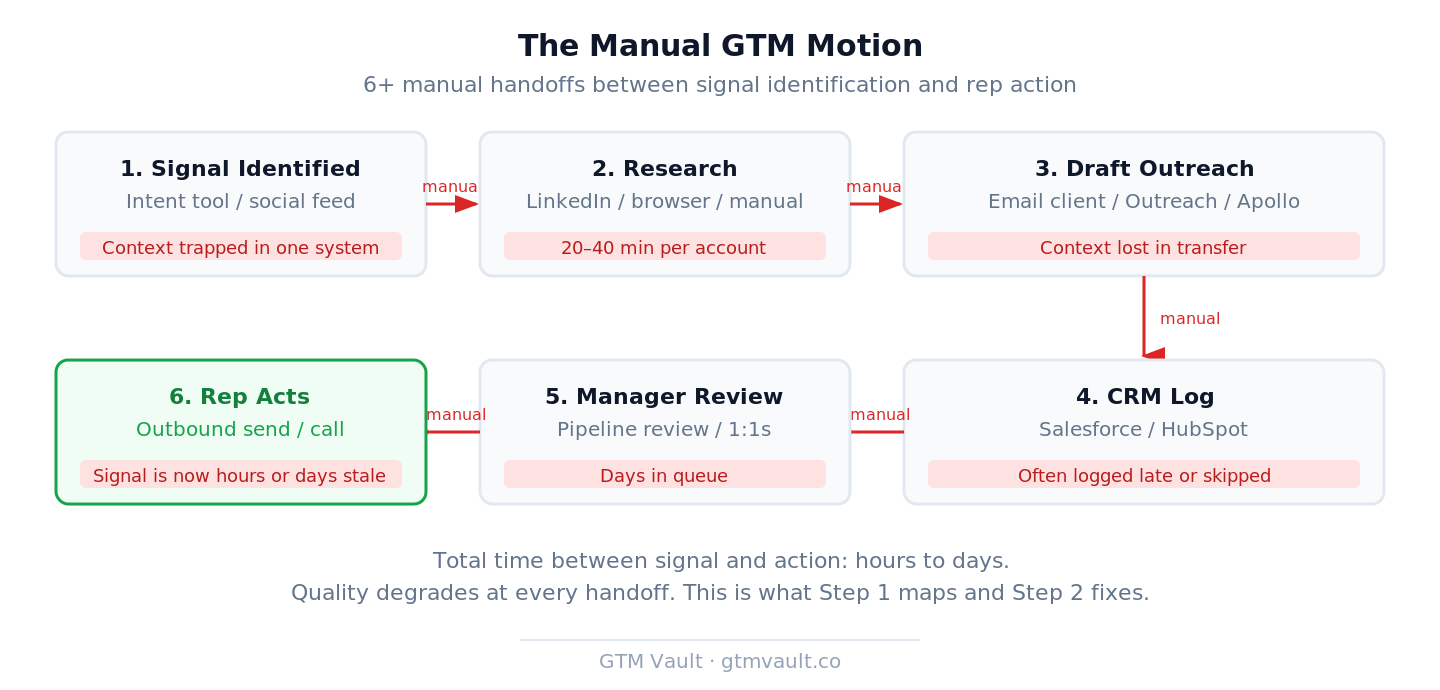
The output of this step is a written map of the revenue motion with every manual hop identified and labeled. That map becomes the specification for the infrastructure you are about to build.
Step 2: Hire the GTM Engineer Before You Buy the Stack
The single most common infrastructure error is buying tools before hiring the person whose job is to architect them into a system.
Fifty-four percent of the fastest-growing private B2B SaaS companies have a GTM Engineer on staff, per GTM Vault’s in-house research, with job postings up more than 200% year over year. The role exists because infrastructure decisions require someone capable of executing them. A RevOps hire optimizes the existing system. A GTM Engineer designs a new one.
The GTM Engineer takes the revenue motion map from Step 1 and specifies the agent architecture that will collapse the manual hops. They decide which systems need to communicate, what data the agents need to reason against, where humans stay in the loop and where they do not, and how the output of each agent feeds into the next step. SQL and Python appear in 38% of job postings for the role, but the core capability is systems thinking applied to revenue motion.
If you are not ready to hire a GTM Engineer, designate someone in the existing org to own the infrastructure decision before the procurement decision. That person needs enough technical fluency to evaluate vendor integrations and enough GTM context to understand what the system is supposed to produce. Running this decision through a committee of tool owners will not work. It needs a single accountable owner.
The GTM Engineer should sit close to the CEO or CRO, not inside RevOps. Infrastructure decisions constrain everything below them. The person making them needs the authority to make them.
Step 3: Choose Your System of Record First, Then Build Outward
The point-solution layer in GTM intelligence collapsed in the first half of 2026 for a specific reason: agents need data to be useful, and the data lives in the CRM.
HubSpot acquired Warmly in June 2026, absorbing person-level buyer intent natively into its customer platform. Zoom announced the acquisition of Common Room two days later, pulling buyer intelligence into its revenue platform. Clari and Salesloft had already merged. Apollo had acquired Pocus. The best-funded standalone GTM intelligence tools in the market were absorbed into systems of record inside twelve months.
The architecture implication is direct. The agent layer you build should live inside or natively connect to your system of record, not beside it. A standalone tool that sits outside the CRM requires a human to carry the insight from the tool to wherever the action happens. That human-in-the-middle step is the latency the agent was supposed to eliminate. When the agent lives outside the data, it does not eliminate the step. It generates output that still needs to be carried somewhere.
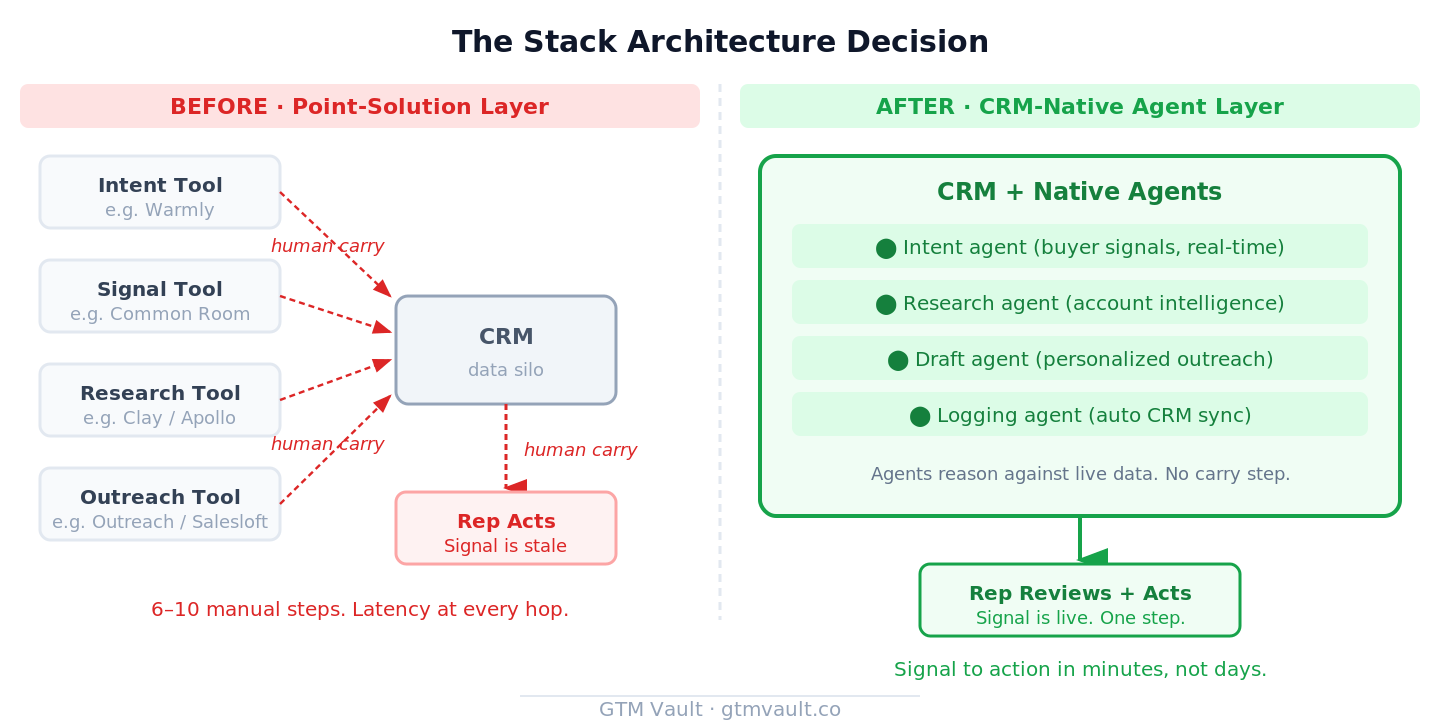
When evaluating your stack, start with the CRM and ask what agent capabilities exist natively or through direct integration. Build outward from there. Tools that require human handoffs to connect their output to the system of record are either transitional or wrong for the architecture.
Step 4: Design the Copilot Layer, Not the Autopilot Layer
The autonomous AI SDR was the most visible infrastructure mistake of the past eighteen months. The failure was architectural, not technological.
Benchmark and a16z deployed $74 million into 11x, the most-funded autonomous AI SDR in the category. By May 2025, 11x had lost roughly 78% of early ARR past the 90-day break clause. Teams that removed the human layer from outbound were reverting to hybrid models across the category. Reply rates on fully autonomous outbound run 1 to 3%. Reply rates on copilot-assisted outbound, where a human reviews, edits, and approves before the send, run 5 to 12%. A hybrid model delivers cost per opportunity of $847 versus $2,214 for AI-only deployment.
The autonomous SDR failed because it placed the human in the wrong part of the workflow. The assumption was: remove the human entirely. The correct architecture is: move the human to the decision point and remove the human from the preparation steps.
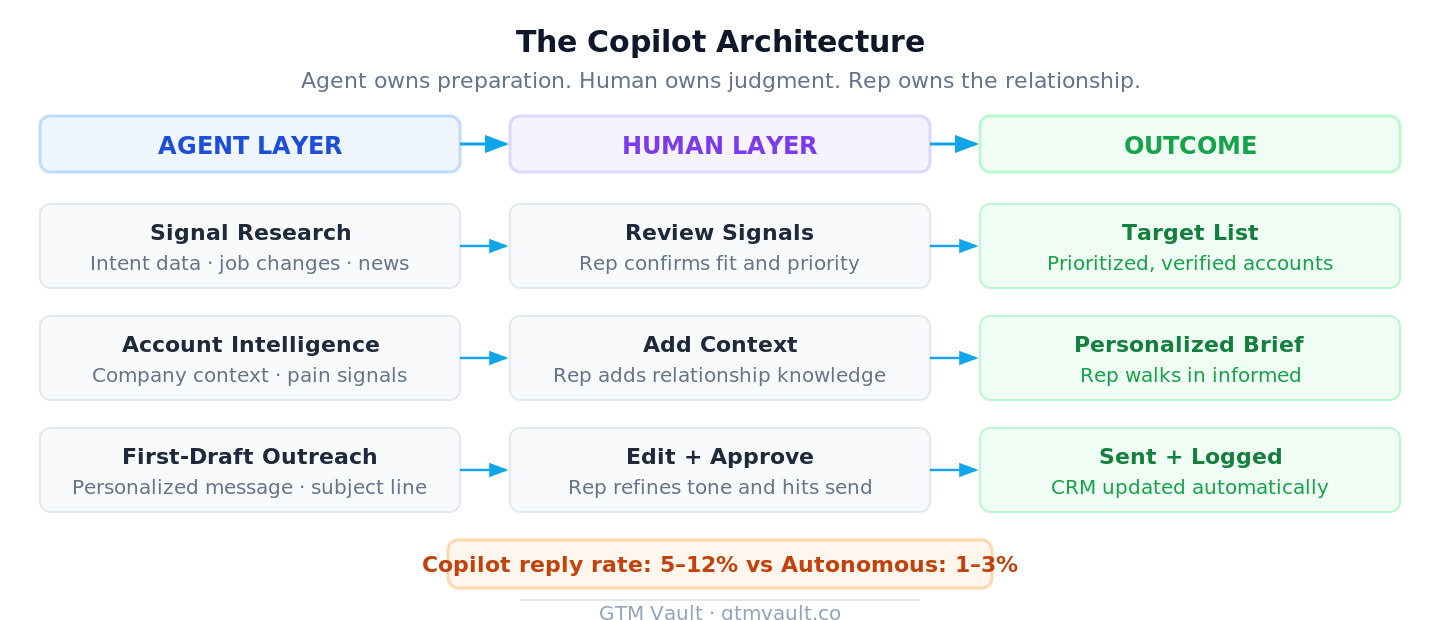
Design the agent layer to own preparation: signal research, account intelligence, first-draft outreach, CRM logging. Design the human layer to own judgment: reviewing agent output, approving or editing, managing the relationship through the sales cycle. The rep’s output per hour increases because preparation time drops. The agent’s output quality improves because a human is catching errors and the feedback loop closes.
Apply this architecture to every agent you deploy, not just outbound. Every agent should have a defined handoff point where a human reviews before the output moves to the next step. When that handoff point does not exist, quality degrades and buyers notice.
Step 5: Restructure What Humans Do, Not Whether to Keep Them
The companies spending the most on AI in the Ramp study grew headcount 10.2% and increased entry-level hiring by 12%, while the share of managers per rep shrank. These numbers are the output of a specific org design decision.
The traditional sales management layer existed because the system was opaque. Managers reviewed pipeline, listened to calls, coached on objections, and made prioritization decisions the system could not make on its own. Pipeline review runs off CRM data now. Call coaching is automated. Signal prioritization is agent-driven. The mechanical oversight functions that justified the management layer are being absorbed into the infrastructure.
What remains is the judgment layer: decisions that require relationship context, organizational knowledge, and the ability to read a situation no data set can read. That is a much smaller function than what most management layers currently contain.
The org design that follows is an AI-fluent junior rep layer operating with leverage that did not exist three years ago, supervised by a thinner management band accountable for outcomes rather than activity. The GTM Engineer and the agent layer absorb the activity monitoring function. The managers who remain manage the result.
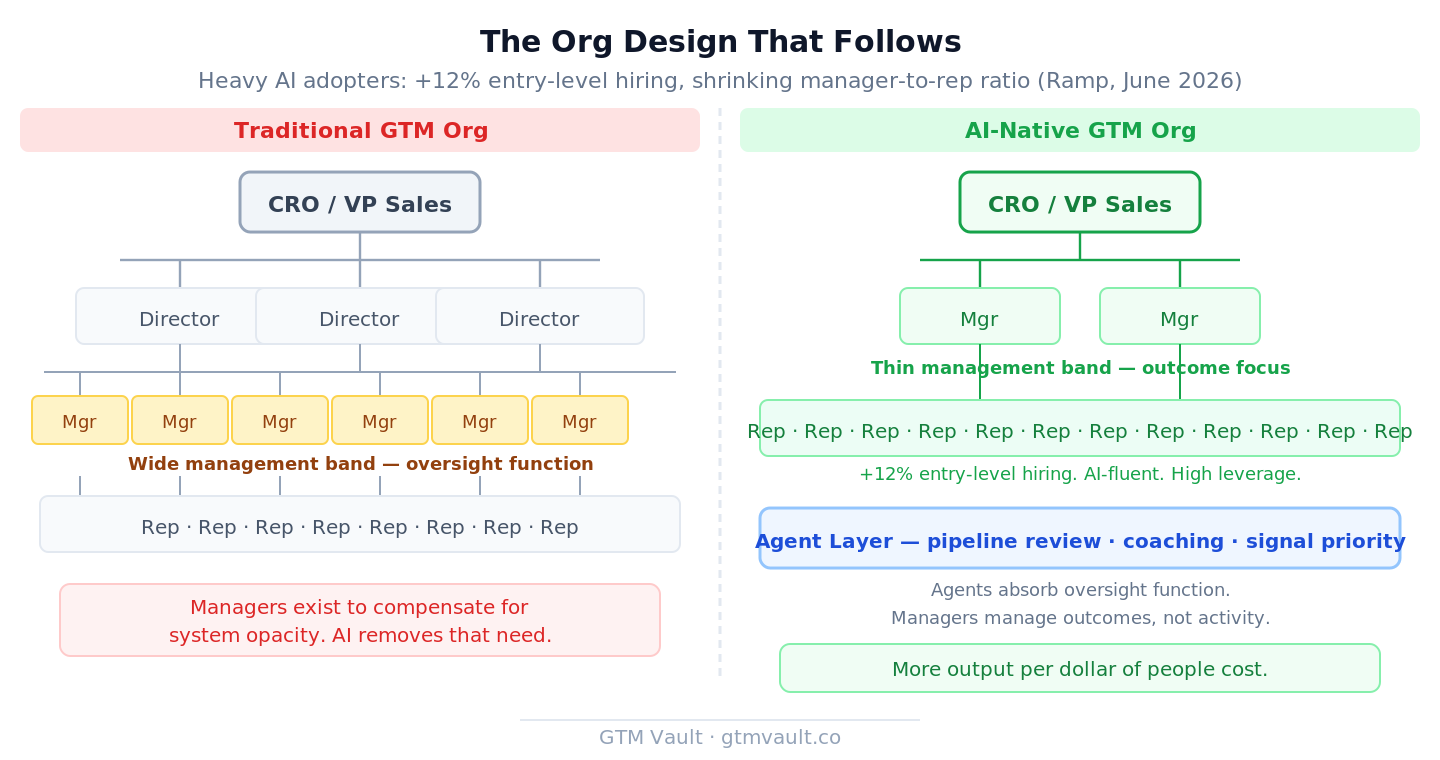
Prioritize AI fluency in entry-level rep hiring above almost every other criterion. An AI-fluent rep inside a well-designed infrastructure runs at leverage a non-fluent rep cannot match regardless of experience. The leverage multiplier is the system. The human needs to be capable of operating it.
Step 6: Commit to a 12-Month Timeline, Not a 90-Day Pilot
Meaningful output gains from AI adoption appear 6 to 12 months after implementation begins. The curve does not bend in the first quarter.
The first 90 days are tooling and integration: getting systems to communicate, getting agents to reason against the right data, getting the stack to function as a system rather than a collection of separate tools. The next 90 days are calibration: adjusting workflows, correcting agent errors, building the habit layer on top of the tooling layer. The compounding begins around month six, once the team has refined the system enough that it runs with less correction and the feedback loop has produced measurable agent improvement.
A one-quarter pilot exits at month three, before the curve turns. The team sees marginal output improvement, concludes the investment is not working, and either abandons it or continues paying without scaling. This is the structural error of the pilot model: it evaluates a six-month investment on a three-month timeline and almost always reaches the wrong conclusion.
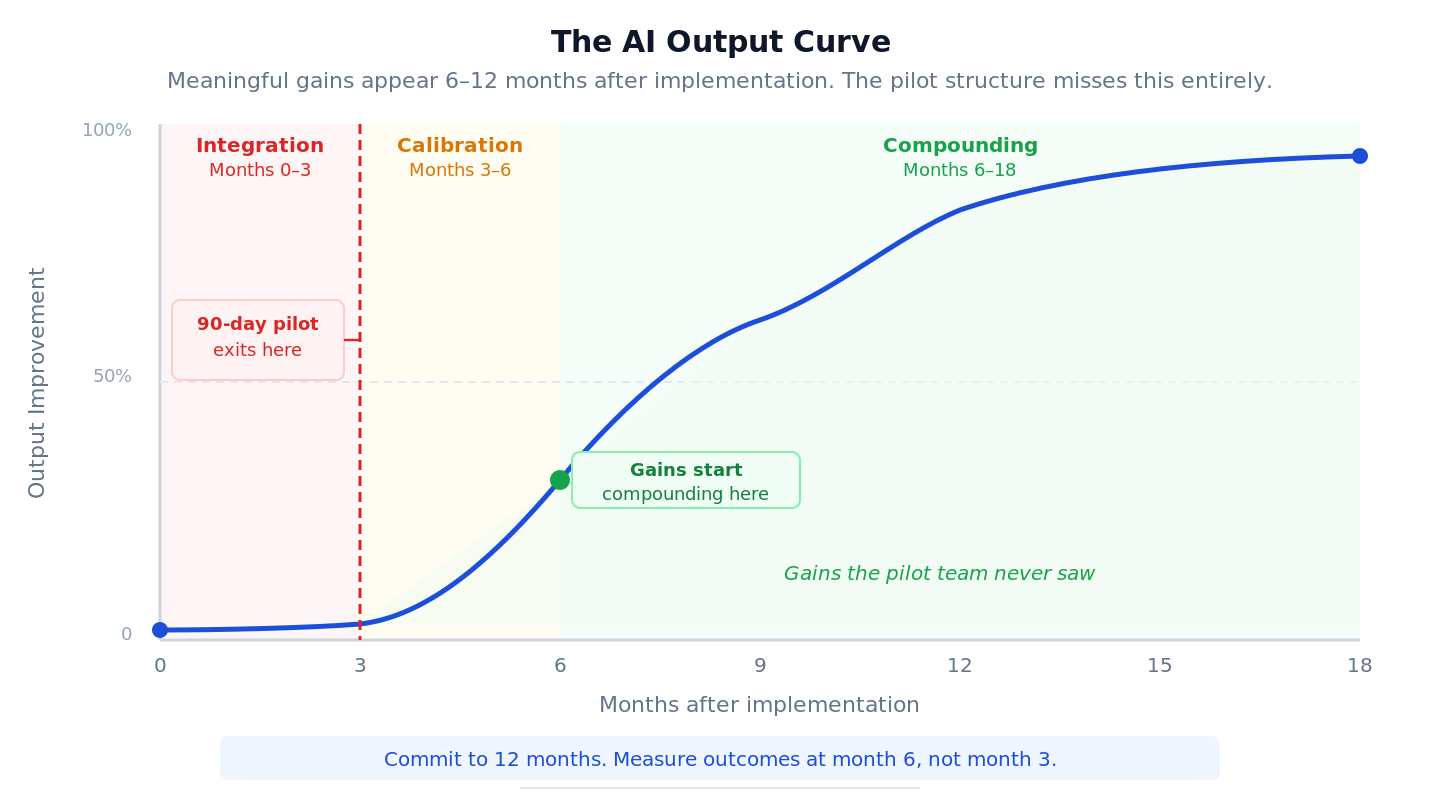
Budget and staff for 12 months from the start. Set internal expectations that output measurement begins at month six, not month three. Define what “working” means in outcome metrics before implementation begins, so the evaluation at month six is against a predetermined standard rather than a feeling. The teams that exit early almost always do so because no one defined success before they started.
Step 7: Measure Outcomes, Not Activity
The most common measurement failure in AI GTM implementations is tracking the wrong layer.
Activity metrics are what procurement decisions produce: prompts sent, emails drafted by AI, percentage of outreach that was AI-assisted, time saved per rep per week. These numbers are measurable and they trend upward quickly, which is why teams report them. None of them connect to revenue. They tell you the tools were used. They do not tell you whether the system produced a commercial return.
Outcome metrics are what infrastructure decisions produce: pipeline generated per seller, conversion rate change at each funnel stage, cost per meeting booked, revenue per head. These connect directly to whether the architecture is working. They are harder to isolate in the short term, which is why teams avoid them. They are the only numbers that answer the CFO’s question about tokenspend.
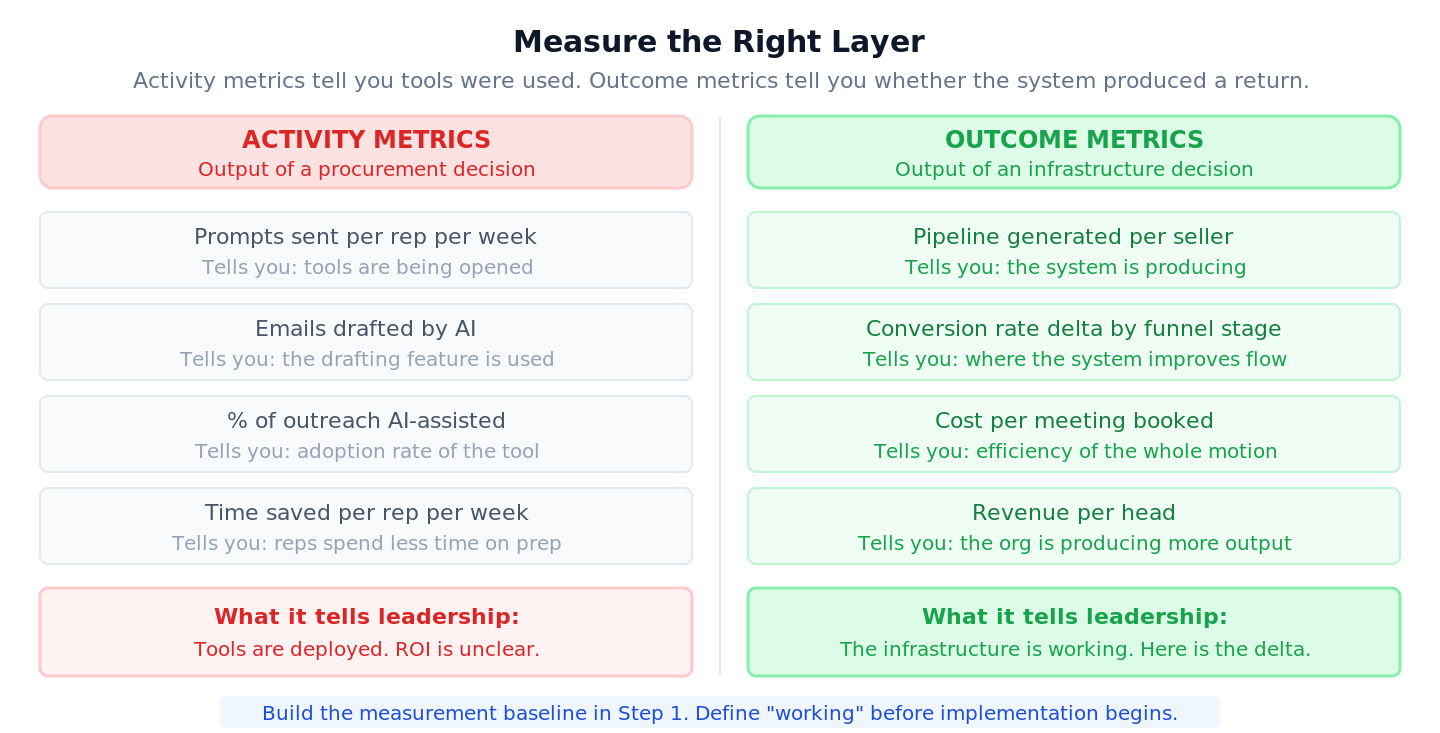
Design the measurement system in Step 1, not after implementation. Define the baseline for each outcome metric before the infrastructure goes live. Measure the same metrics at month six and month twelve. The delta against baseline is the only clean way to attribute the AI investment to a commercial outcome.
Teams that did not build the measurement baseline before implementation have no clean way to isolate the AI’s contribution after the fact. Every gain looks like it might have happened anyway. This is not a data problem. It is a design problem that was created in month one and cannot be fully fixed later.
What This Looks Like at 12 Months
A GTM org that ran this sequence correctly at the start of 2025 looks like this at the midpoint of 2026.
The agent layer handles signal identification, account research, outreach drafts, and CRM logging. Reps review and approve agent output at a defined handoff point before anything goes to a buyer. The management layer is thinner, with pipeline reviews running off CRM data rather than rep self-reporting. The GTM Engineer owns the infrastructure and iterates the agent pipelines based on outcome metrics. AI spending runs at $30 to $40 per employee per month across multiple models and agents, not a single chat seat.
The org is younger and more AI-fluent than it was twelve months ago. It is flatter, with fewer managers per rep, because the oversight function that justified the management layer has been absorbed by the system. Pipeline per seller has improved measurably since month six. The CFO can answer the tokenspend question because the measurement system was built before the infrastructure was deployed.
This is the pattern across the operators running the winning architecture right now. The inputs that produced it are the seven steps above, in that sequence.
The Failure Mode to Avoid
Every team that stalled on AI GTM made the same mistake: they started at Step 3 or Step 4 and never went back to do Steps 1 and 2.
They bought a tool that looked compelling. The tool worked in isolation. It did not connect cleanly to adjacent systems because no one had mapped the revenue motion or specified what the connection needed to do. They bought another tool to fill the gap. The gap did not close because the gap was architectural, not technological. They are now running six tools that each do something and none of which compound.
The fix is not buying better tools. It is stopping the procurement cycle, going back to Step 1, and designing the system the tools are supposed to serve. That requires the GTM Engineer in Step 2 to lead the redesign, which often means the first GTM infrastructure hire is also the person who audits and rationalizes the existing stack before adding anything new.
Infrastructure decisions made late are more expensive than infrastructure decisions made first. But they are less expensive than continuing to stack procurement decisions on top of a system that was never designed.
Frequently Asked Questions
Why is AI-native GTM a sequencing problem?
Because the layers only compound in one order: data, then intelligence, then agents. An agent reasons over whatever structure sits beneath it, so if the data is fragmented and qualification is broken, the agent automates that fragmentation at machine speed. The winners and the losers in the 2026 Ramp data run the same tool categories. What separates them is the order they built in.
What is the correct sequence for building an AI-native GTM stack?
Map the revenue motion and its manual hops first. Hire or designate the GTM Engineer who will architect the system before you buy tools. Choose your system of record and build the agent layer inside it. Deploy agents as a copilot layer with a human at the decision point, not as autopilot. Restructure roles around judgment, commit to a 12-month timeline, and measure outcomes rather than activity.
What happens if you install AI agents before fixing your data?
You do not get intelligence. You get your existing fragmentation, running faster. A scoring or research agent built on incomplete CRM data prioritizes the wrong accounts and drafts confident, wrong outreach, and no amount of workflow automation fixes a broken signal underneath it. This is why teams end up with six tools that each do something and none of which compound.
Why did autonomous AI SDRs fail?
The failure was architectural, not technological. Fully autonomous outbound placed the human in the wrong part of the workflow by removing them entirely, and reply rates on that model run 1 to 3% against 5 to 12% for copilot-assisted outbound where a human reviews and approves before the send. The correct design moves the human to the decision point and removes them from the preparation steps.
Should AI agents live inside the CRM or run as standalone tools?
Inside, or natively connected to, your system of record. A standalone tool that sits outside the CRM requires a human to carry each insight to where the action happens, which reintroduces the exact latency the agent was supposed to remove. The 2026 consolidation wave, HubSpot absorbing Warmly and Zoom acquiring Common Room, was the market pricing in that architecture.
Why do 90-day AI pilots fail?
Meaningful output gains appear 6 to 12 months after implementation, and the curve does not bend in the first quarter. A one-quarter pilot exits at month three, before compounding begins, then concludes the investment is not working. It evaluates a six-month investment on a three-month clock and almost always reaches the wrong answer.
What should you measure to know if AI GTM is working?
Outcome metrics, not activity metrics. Track pipeline generated per seller, stage-by-stage conversion change, cost per meeting booked, and revenue per head against a baseline you defined before the infrastructure went live. Activity metrics like prompts sent or time saved trend up quickly but never answer whether the system produced a commercial return.
GTM Vault publishes the architecture behind what the best operators are building. More at gtmvault.co.