

This is the fourth of eight laws in the GTM Architecture series.
Executive Summary
The most dangerous GTM failure mode does not look like failure.
Marketing is active. Sales is running pipeline. Product is shipping. Customer Success is onboarding. Every function reports progress. Every dashboard shows movement.
But revenue is not compounding the way effort should produce. Win rates are softening without a clear cause. Customer acquisition cost is rising. Net revenue retention is declining. The organization is working measurably harder for incrementally less output.
This is not a talent problem. It is not a demand generation problem, though demand generation will absorb the blame. It is not a sales execution problem, though new training programs will be commissioned in response.
It is a coherence problem. And coherence is an architectural property, not a cultural one.
This law establishes five structural truths:
Functional activity without system coherence produces dilution, not compounding.
Coordination is not coherence. Functions can be synchronized and still misaligned at the system level.
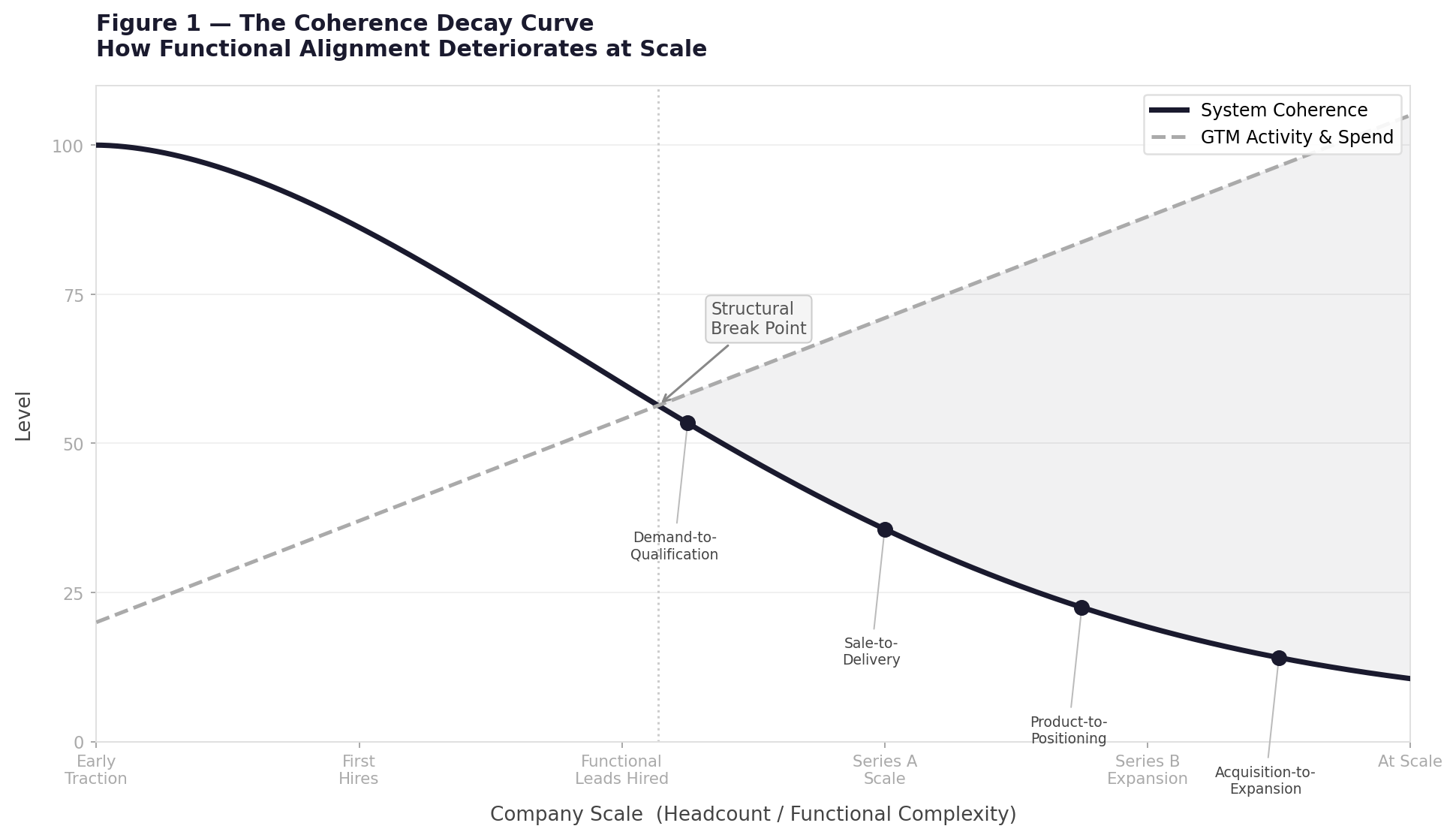
GTM coherence fails predictably at four structural points as organizations scale.
Revenue stalls not because effort declines but because the system no longer matches how buyers evaluate, decide, and purchase.
Coherence cannot be restored through culture programs or communication improvements. It requires architectural intervention.
Organizations that treat coherence as architecture build systems where each function amplifies the others. Organizations that treat coherence as culture watch their functions gradually optimize in isolation until the system produces structural drag faster than any individual function can compensate for.
The Structural Failure Pattern
A recognizable pattern repeats itself at a specific stage of company growth.
The company has passed early traction. Revenue is real. The team has expanded beyond founder-led selling. Functional leaders have been hired to own their domains. Each function now operates with increasing sophistication and, critically, increasing independence.
Marketing optimizes for MQL volume. Sales optimizes for close rate. Product optimizes for the feature requests generating the most noise. Customer Success optimizes for renewal and NPS. Each function performs against its own definition of success. Each leader presents a credible case for strong execution.
And yet the system’s output per dollar of input is declining.
The positioning Marketing uses to generate demand no longer reflects the language Sales uses to qualify and close. The ICP Sales is closing no longer matches the customer profile Product is building for. The value promised at the point of sale no longer reflects the experience Customer Success is delivering. Each function has drifted from a shared architectural center that, upon examination, was never formally established in the first place.
The system is not broken. It is incoherent. The distinction is structural and it determines whether the intervention that follows will be tactical or architectural.