



Hi, it’s Rick Koleta. Welcome to GTM Vault, a breakdown of how high-growth companies design, test, and scale revenue architecture. Join 27,000+ operators building GTM systems that compound.
The short version. GTM engineering is the practice of building go-to-market as a system instead of a headcount plan: workflows, data pipelines, enrichment layers and agents that run the motion, designed and maintained the way software is. GTM Vault’s own motion moved from manual to 21 automated systems in eight days, run by one operator, returning about thirty hours a week. What got replaced was not the roles. It was the coordination between them.
Eight days ago, GTM Vault ran on my hours. Every swap pitch, every guest booking, every sponsor draft, every post went out by hand or it did not go out. Today the entire go-to-market motion runs on twenty-one automated systems, and I run them alone.
I did not build this to save time, though it returns about thirty hours a week. I built it to test a claim I have been making in this publication for months: that revenue problems at working companies are structural, not effort problems, and that the same intelligence applied to a coherent system compounds, while applied to a fragmented one it only produces noise at scale.
The Distinction Most GTM Automation Misses
AI collapsed the cost of execution. That is the whole event. When drafting an email, researching a prospect, or assembling a report costs almost nothing, the scarce skill is no longer doing the work. It is deciding what the work should be, and in what order it runs.
This is what GTM engineering means. GTM engineering is the practice of building go-to-market as a system instead of a headcount plan: workflows, data pipelines, enrichment layers, and AI agents that execute the motion, designed and maintained the way software is. A GTM engineer replaces repetitive execution with orchestrated systems and spends their judgment on what the system should do, not on doing it manually. The discipline emerged when AI collapsed the cost of execution and moved the constraint to design: the scarce skill is no longer doing the work, it is architecting the system that does.
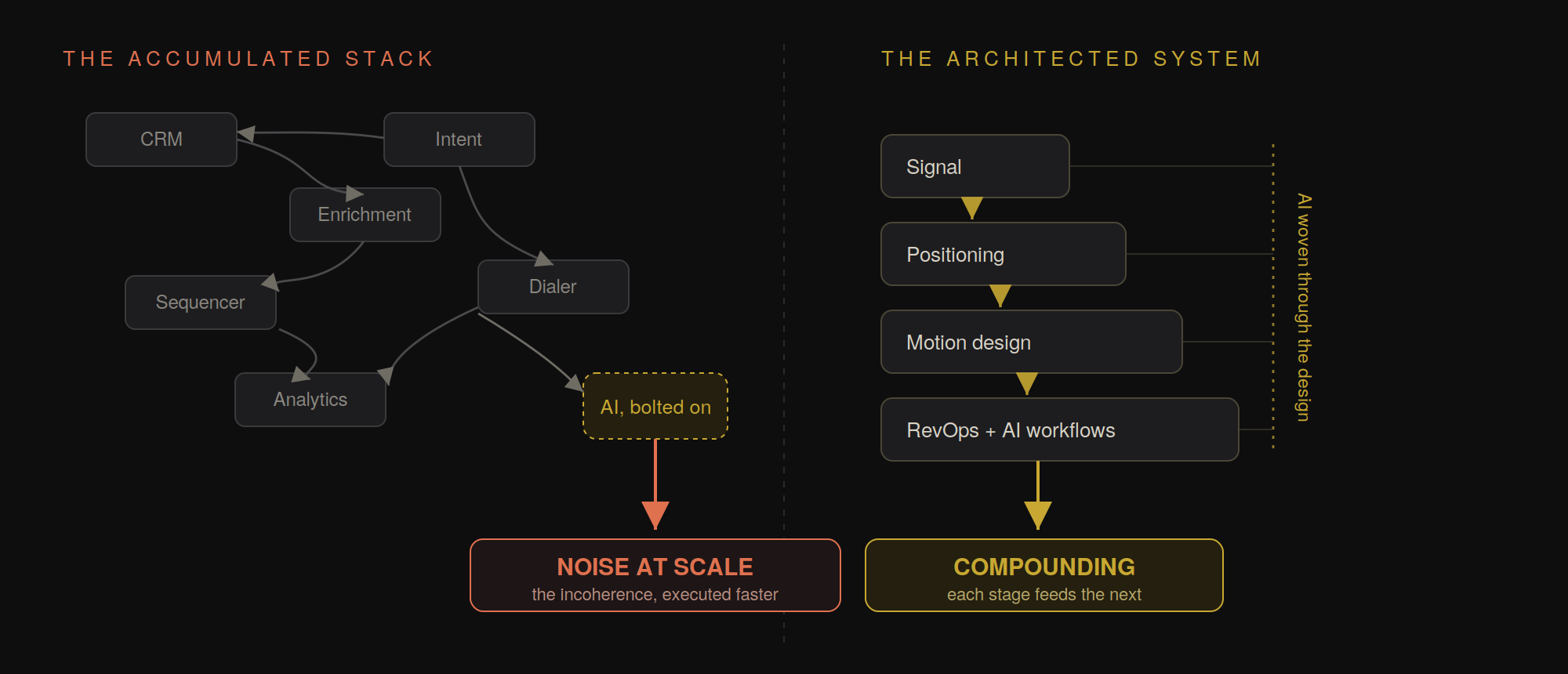
Most teams get the sequence backwards. They bolt agents onto a stack that was accumulated, not designed, six to eight tools stitched together by whoever set them up, and the AI faithfully executes the incoherence faster. The output looks like productivity. It is noise at scale. Automation on a fragmented system does not fix the fragmentation. It industrializes it.
What I Built
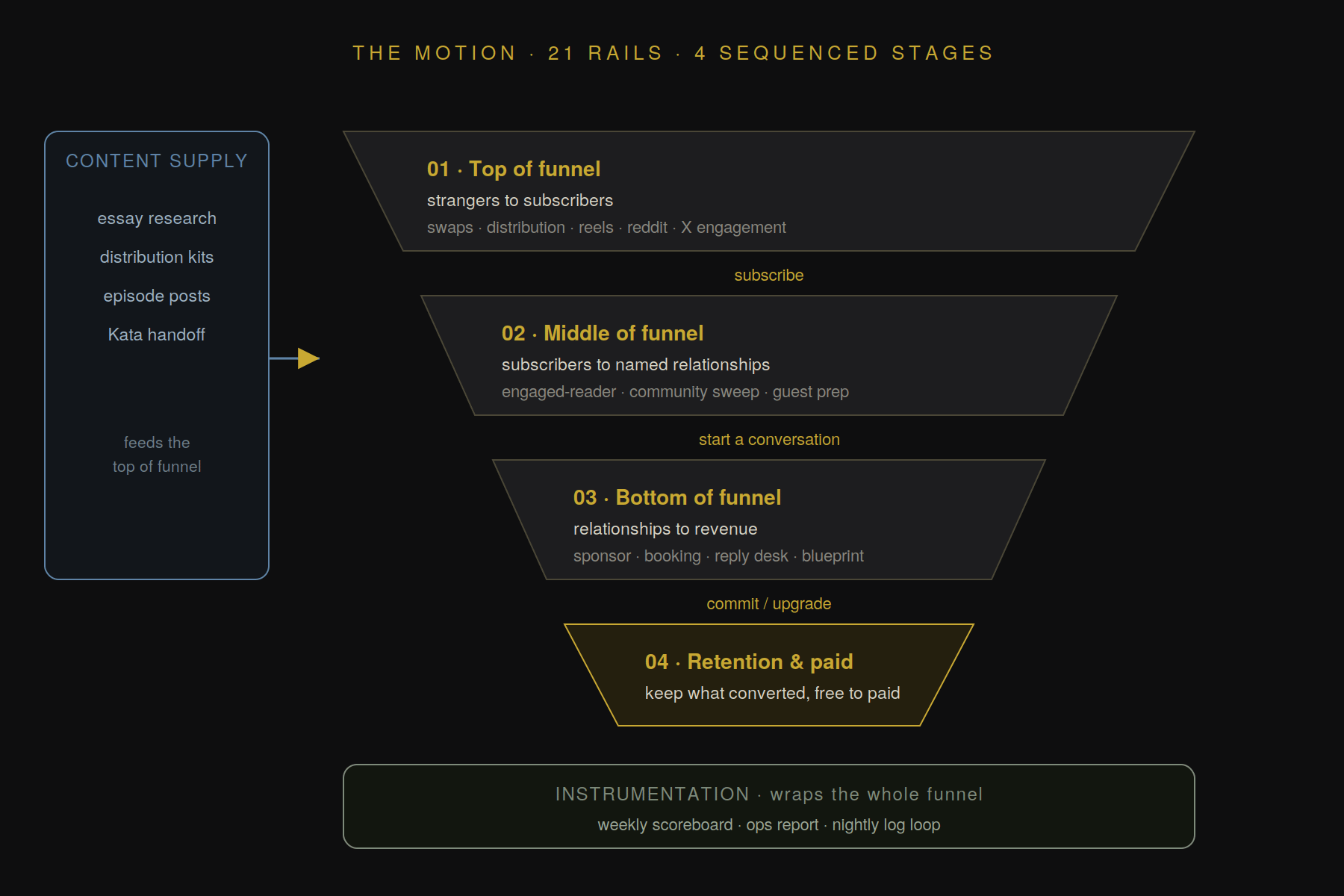
The motion is not a pile of automations. It is a funnel with four stages, each with one job, sequenced so the output of one becomes the input of the next. Top of funnel turns strangers into subscribers. Middle turns anonymous readers into named relationships. Bottom turns relationships into commitments, booked guests and sponsor conversations. Retention holds what converted and measures the one leak that matters, the gap between free readers and paid.
Every rail is capped, deduped, and gated. Caps so the platform accounts survive the volume. A shared record so no asset and no prospect ever gets hit twice. Gates so anything that speaks to a human in my name waits for my judgment before it sends. The machine runs the repeatable work at full capacity whether I slept or not. I spend my hours on the only thing that does not automate: which relationship to close, which sponsor to take, which architecture decision to make next.
The Team Became a System
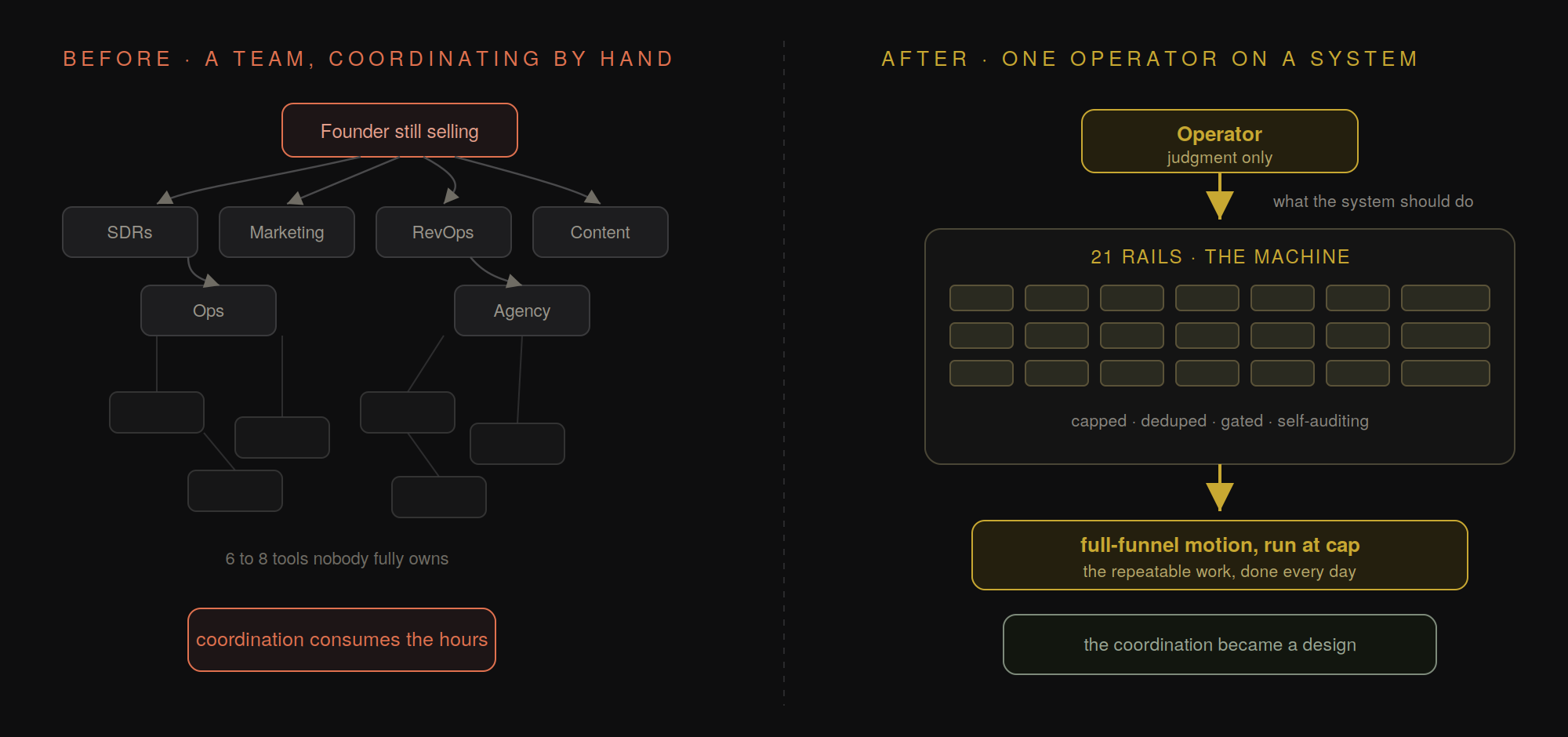
The version of this motion that runs on people looks like an org chart: a founder still closing, an SDR or two, someone on marketing, someone on RevOps, a contractor on content, all coordinating by hand across a stack of tools nobody fully owns. The version that runs on architecture looks like one operator sitting on top of a system that does the repeatable work.
The roles did not get automated away one at a time. What got replaced was the coordination between them, the meetings, the handoffs, the status checks, the coordination that consumed the hours. That is the quiet claim of this whole build. The expensive thing was never the work. It was the coordination, and coordination is a design problem.
What a System Knows That an Automation Does Not
The difference between a pile of automations and a system shows up the first time something tries to go wrong.
On its first live run, the rail that publishes to social came within one action of posting the same essay to the same account twice. It did not, because a shared record of what had already gone out stopped it. That is the line. An automation repeats. A system knows what it has already done, and refuses to do it again.
A day later, the layer that audits the whole operation each night caught something worse. The records claimed outreach had been sent that the mail log could not confirm, and two addresses marked as delivered had in fact bounced into nothing. The dashboard was confidently reporting fiction. This is the part most teams skip when they automate. Instrumentation is not a chart you read on Monday. It is the mechanism that keeps the machine honest about what it actually did, because a system that cannot audit itself will scale its own errors and present them as progress.
And one rule governs every send. The machine publishes freely to my own channels, where a mistake is reversible, and never messages a human in my name without my judgment first, because that is not. Automate the reversible. Gate the irreversible. The sequencing of trust is itself an architecture decision, and getting it backwards is how automated go-to-market turns into a public apology.
The Number That Matters, and the One That Does Not
The thirty hours are real, but they are the byproduct, not the point. The point is that one person now runs a full-funnel revenue motion that used to require a team, and the freed hours convert into judgment instead of execution.
I am not going to show you a growth chart. The system is eight days old, and the honest state is that it runs clean while the outcomes it exists to produce are still compounding. That is the truth, and this audience can handle it. What I can show you is that the architecture holds: the machine executes at cap, catches its own errors, reconciles its own records, and reports against the number that grades it. Results follow structure. They do not precede it.
Everything above is the doctrine I write about, installed on GTM Vault itself. It is not a case study I am describing from the outside. It is the argument, running. For what it is worth on the question of who reads this kind of work, GTM Vault is 27,000+ subscribers with 6,901 highly engaged readers, and it is read inside OpenAI, Anthropic, Meta, and Google. The audience is operators, not spectators.
Automate the reversible. Gate the irreversible.
Why This Installs in a Company That Sells Differently Than Mine
My motion is a publication’s. Yours may be sales-led, enterprise, six-figure deals with a human in every loop. The substrate changes. The principle does not. A sales-led revenue system has the same four stages and the same failure mode: signal, positioning, motion, and RevOps, assembled in whatever order the tools arrived rather than the order the system needs. The enrichment tool bought before the ICP was defined. The sequencer running before the positioning was clear. The AI agent layered on last, executing all of it faster.
The headcount you are about to add to fix a pipeline that will not compound is a bet that the constraint is capacity. In a working company it almost never is. You will scale the fragmentation, and call the higher burn growth.
Common questions
What is GTM engineering?
GTM engineering is building go-to-market as a system rather than a headcount plan: workflows, data pipelines, enrichment and agents that execute the motion, designed and maintained like software. The GTM engineer spends judgment on what the system should do rather than doing the work by hand. It emerged when AI collapsed the cost of execution and moved the constraint to design.
Can one person run a GTM motion with automation?
GTM Vault runs its full motion on 21 automated systems across four sequenced stages (top of funnel, middle, bottom and retention) operated by one person. Every system is capped, deduplicated and gated, so anything that speaks to a human in the operator’s name waits for approval. The operator’s hours go to the decisions that do not automate.
Why does adding AI agents to a GTM stack produce noise?
Because most stacks were accumulated, not designed: six to eight tools stitched together by whoever set them up. Agents on that stack execute the incoherence faster. The same intelligence on a sequenced system compounds, which makes the difference sequencing, not tooling.
What is the difference between GTM automation and a GTM system?
A pile of automations runs tasks. A system shares a record of what has already happened, so it knows not to repeat an action or hit the same prospect twice, and it hands each stage’s output to the next. The difference shows up the first time something tries to go wrong.
The Diagnosis
If your product works and your pipeline does not, the constraint is architecture, not activity. Your team is working. The channels are running. The pipeline still does not compound. No amount of added headcount closes a structural problem, it only makes the incoherence more expensive to run.
I install the same sequencing and coherence on a company’s revenue system that I installed on mine, with a small number of teams each quarter. Not advice layered on top of the existing motion. The system underneath it, rebuilt in the right order. That work runs through GTM Vault Pro. An annual membership is the qualifier, and it opens the Blueprint Intake Form, which arrives by email automatically when you upgrade. It is deliberately not for everyone. It is for teams where CAC is rising, win rates are softening, or headcount is scaling faster than system coherence.
If you are earlier than that, the frameworks behind every rail above live in GTM Vault Pro, and the free publication is one click at gtmvault.co