👋 Hi, it’s Rick Koleta. Welcome to GTM Vault - a breakdown of how high-growth companies design, test, and scale revenue architecture. Join 27,000+ operators building GTM systems that compound.
This episode in the Library: the written playbook, the stack and the full transcript, free and open. Open it at pro.gtmvault.co.
This episode: Garrett Wolfe walks through an account scoring and signal pipeline built in Clay, then shows the custom Intent HQ web app built in Claude Code that sits on top of it. Garrett first built this kind of system at Unify, where the outbound program went from zero to $15M in pipeline inside 12 months. The breakdown below maps the build back to the Revenue Architecture.
The Action Gap That BDRs Live Inside
Most BDR workflows fail at the same place. The account list exists. The signals exist. The intent data exists. But the rep still spends hours every day toggling between the CRM, LinkedIn Sales Navigator, and Apollo, trying to answer two questions: which accounts do I own, and who at those accounts should I call. The prospecting tools surface signals at the company level. The contact tools surface people. The CRM tracks ownership. Nothing connects them.
This is not a data gap. It is an action layer gap. The data is already in the stack. The rep is the integration layer, and the rep burns their highest-leverage hours doing the integration manually.
Garrett Wolfe builds the action layer that closes that gap. He was employee number nine at Unify, where he built their automated outbound program from zero to over $15 million in pipeline inside 12 months, and helped scale ARR from under $1M to over $5M in roughly 13 months using Unify and Clay. He founded 1GTM, a GTM engineering consultancy, and co-authored the first State of GTM Engineering report surveying 225+ practitioners globally. Before that, growth equity at TZP Group, investment banking at Morgan Stanley, CS degree from Duke.
In this episode, Garrett walks through the full build. First, how Clay tables and signal workflows actually get constructed, not the marketing version. Then the production layer: a custom web app built with Claude Code that gives BDRs a single pane of glass replacing the CRM-plus-Sales Nav-plus-Apollo shuffle. The gap between a Clay table and the Intent HQ is the entire argument for why GTM engineering is architecture, not tooling.
The Scoring Foundation: Why Most Teams Start in the Wrong Place
Garrett’s first structural point is that most BDR teams start their day picking accounts by gut feel. Ten favorites for the week. Whoever the rep met at a conference last month. Whoever’s logo is familiar. The scoring layer does not exist, so prioritization defaults to whatever is top of mind.
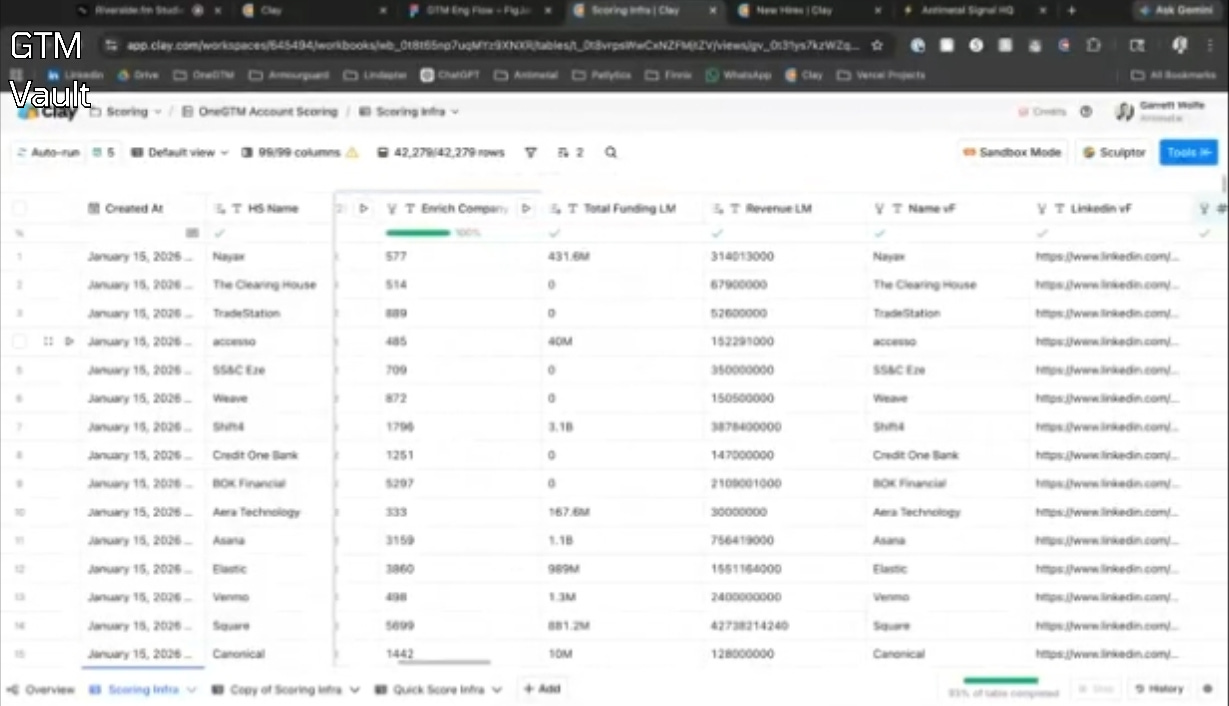
Garrett inverts that. He pulls tens of thousands of companies into Clay and scores every one of them across firmographic and technographic criteria before a rep ever looks at the list. Headcount. Revenue. Leadership composition. Recent news. Engineering count. Infrastructure hires. Each criterion normalized to a zero-to-one score. The composite determines tier.
The data waterfall starts with Lead Magic (Garrett’s first-call enrichment source), then layers in revenue, LinkedIn, and employee data. The waterfall pattern matters: if one vendor misses, the next one fills the gap. A single-source enrichment pipeline has a coverage ceiling. A waterfall does not.
Accounts scoring above roughly 40% qualify for signal monitoring. Everything below that gets deprioritized before signal aggregation even runs. This is the step most teams skip. They jump straight to “find hiring signals at companies” without establishing which companies qualify. The result is a BDR queue full of signals from accounts that were never a fit to begin with.