


Hi, it’s Rick Koleta. Welcome to GTM Vault, a breakdown of how high-growth companies design, test, and scale revenue architecture. Read inside OpenAI, Anthropic, Meta, and Google, and by 27,000+ operators across 150+ countries building GTM systems that compound.
This episode in the Library: the written playbook, the stack and the full transcript, free and open. Open it at pro.gtmvault.co.
Most sales teams still pay six figures for a contact database the reps do not trust. The data is stale, the exports are manual, the CRM update is a separate step, and somewhere between the research, the enrichment, and the send, hours of rep time disappear per account. The fashionable fix is to move the rep into a chat window and call it AI. This episode is a live argument against that: the rep stays in the browser, and the intelligence comes to them.
In episode eight of Show Me Your Stack, Elliot O’Connor runs the argument live. He is the founder and CEO of Frontier (formerly Exportly), which has raised thirteen million dollars from investors including operators at Cursor, EF, Pave, and Reddit, and counts Cursor and an 800-plus-rep Zoom deployment among its customers. In this episode he screen-shares the live product: a Chrome extension that puts Clay’s data and MCP-driven workflows one click away from the rep, on the pages where selling happens.
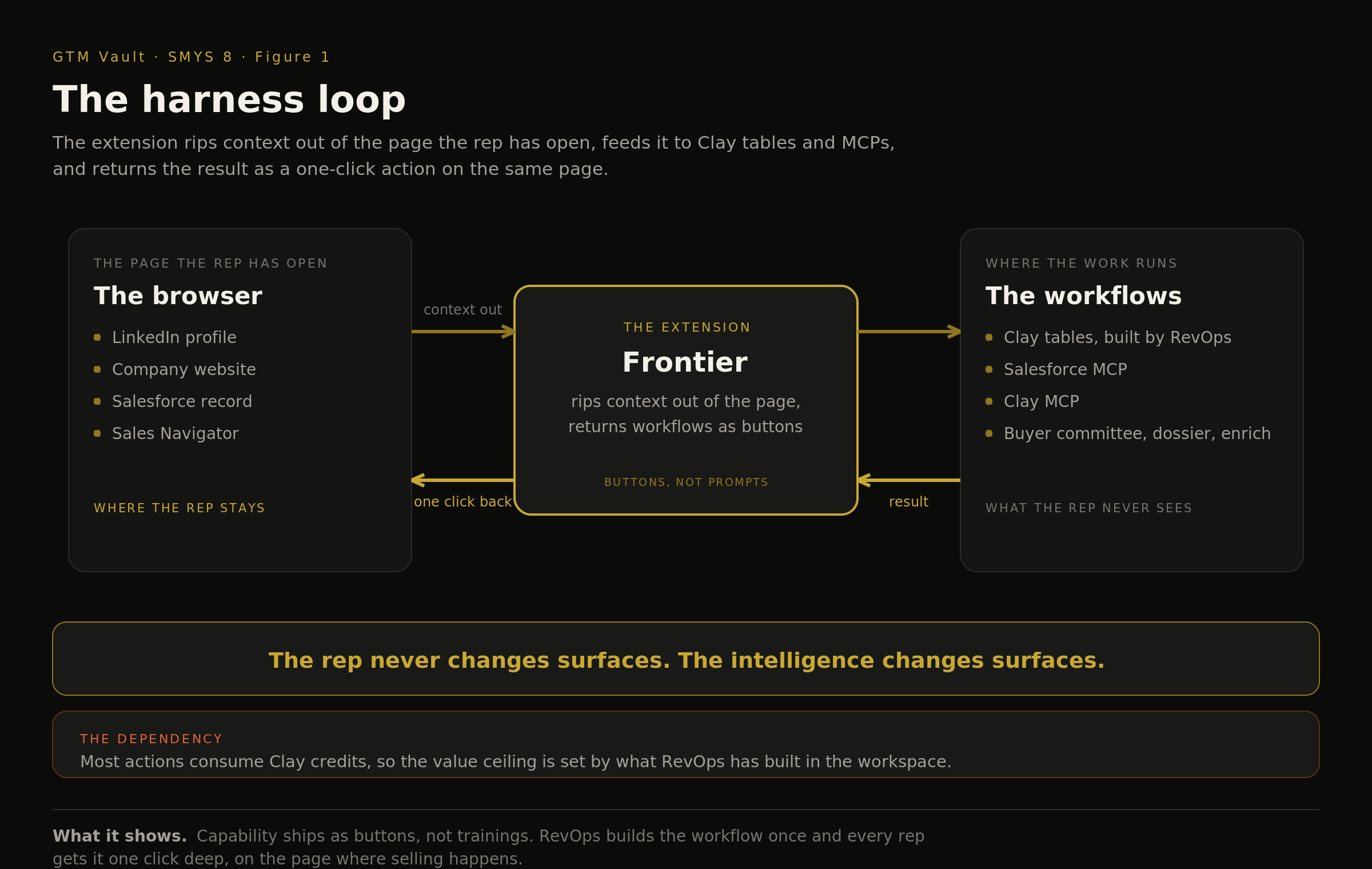
The stack on screen is a Chrome extension, Clay tables, Salesforce MCP, Clay MCP, and Sales Navigator. The tool list is not the story. The story is where the intelligence lives: in the browser, on the page the rep already has open, behind buttons the rep never has to prompt.
Watch now: Elliot O’Connor - Founder & CEO of Frontier
The full episode is on YouTube. Subscribe to the channel for the clips and cuts that never make the write-up.
The Wiring: Clay’s Data Under the Rep’s Surface
The build starts where reps start, on LinkedIn. A year ago Frontier was a deliberately simple extension: move contacts from LinkedIn and company sites, enrich them with contact data, push them into the CRM and the sales engagement platform. The difference was what sat underneath. Every email and phone number came from Clay tables, which meant the rep was pulling from the widest array of data vendors in the market without knowing Clay existed. Clay’s superpowers belonged to RevOps and marketing ops. The extension’s job was to extend them to the average rep, in the interface reps already trust.
The Gate: Why There Is No Install Button
There is no self-serve install, on purpose. A seller with one or two reps does not need the flexibility Frontier sells, and a self-serve user hits a wall the moment value depends on Clay-side build. The buyer is usually RevOps, someone who already owns and loves Clay, at a company where the ops team lives in Clay world while the reps live in a ZoomInfo world. Deployment closes that gap with generated templates, Frontier’s API can create Clay tables inside the customer’s workspace, plus a forward-deployed GTM engineer on every account to tune them. Elliot’s larger claim rides on this: sales used to be about labor, it is increasingly about orchestration and design, and the sales leader and the RevOps leader now set strategy as equals.
The Harness: Chat for Intent, Browser for State
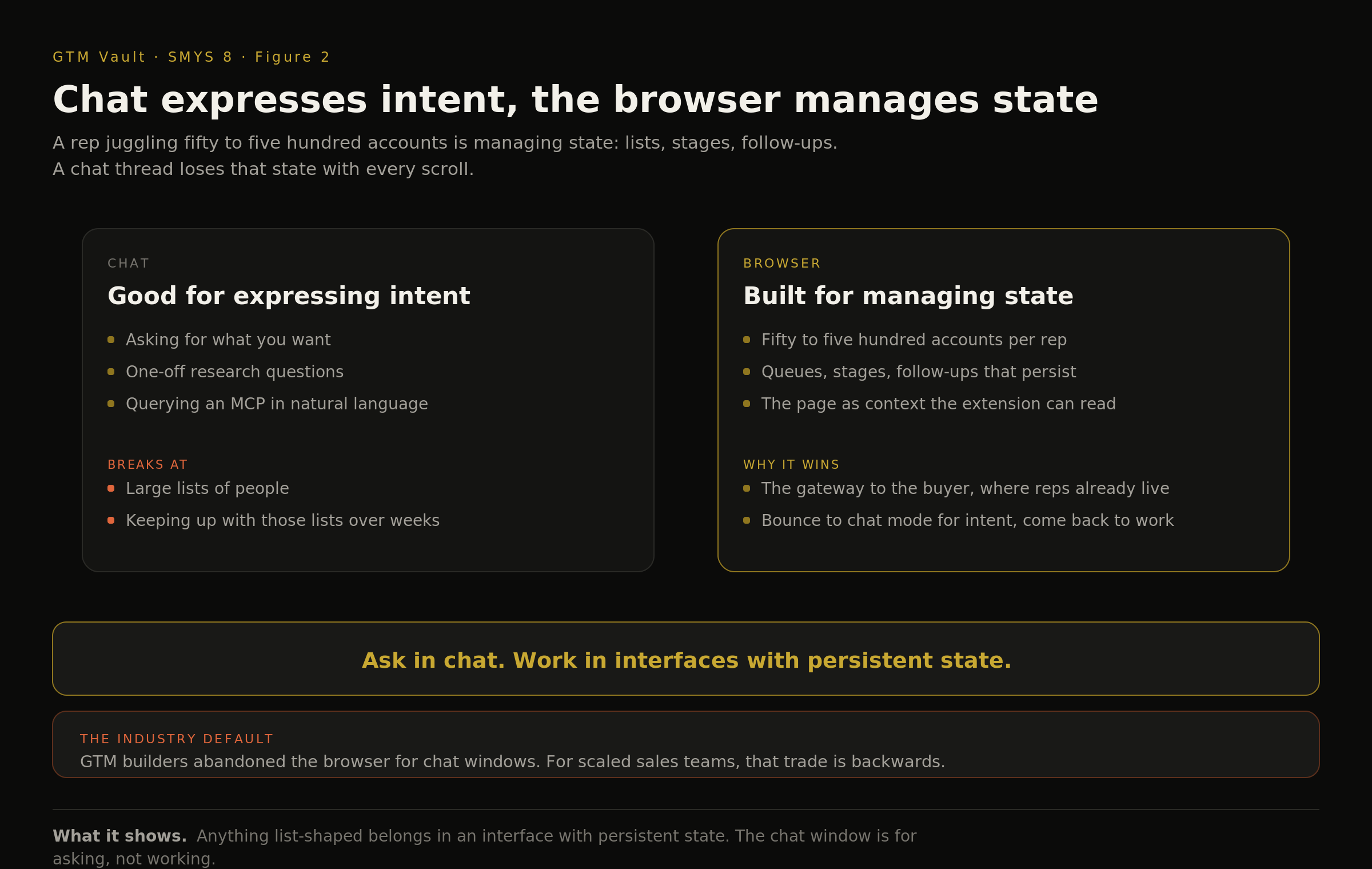
The demo’s sharpest moment is an argument about interfaces. The industry’s default answer is to move selling into a chat window. Elliot’s counter: chat is great for expressing intent, but for managing state, for managing large lists of people, browser interfaces are still far better. A rep juggling fifty to five hundred accounts is managing state, and a chat thread loses it with every scroll. So Frontier built its own AI harness inside the browser: it pulls records from Salesforce through the Salesforce MCP, queries Clay’s MCP for who you sell to, and pushes the rep into Sales Navigator with a generated search no human would have assembled. The rep bounces between chat mode and browser mode without leaving the page.
The Buttons: Prompts the Rep Never Writes
Every workflow in the extension is a button, and every button is a prompt the rep never has to write. Frontier’s position is that prompting is a waste of time and tokens for salespeople. One click returns the buyer committee for the account, tuned to the ICP, with a Clay table running underneath. Another runs a company analysis before a meeting: Clay agents crunch the account and return partnerships, hiring acceleration in go-to-market, and the Chicago office that opened four weeks ago. RevOps builds the workflow once, and every rep at the company gets it as a click, pages of them in a single interface.
The Economics: Seats on Top of Credits
Pricing is old-fashioned SaaS seats, with usage-based AI credits arriving for the MCP features that cost inference. The dependency to see clearly: most actions run on Clay tables that consume the customer’s Clay credits, so the value ceiling is set by what RevOps has built in the workspace. Asked directly whether Frontier is a wrapper on Clay, Elliot takes the question head on: it started as one, and what it became is an AI harness, the same relationship Cursor has to the model providers. Customers and investors can decide how thick the wrapper is. The business he is in is making the best rep surface possible on top of it.
Where This Goes: More Products, Same Surface
Elliot’s forward claim is that the Chrome extension undersells the vision. Frontier’s bet is that reps still want to prospect in the browser, that GTM builders have forgotten and underinvested in it, and that the extension is one product of several they will release to bring AI to the pages where reps work, on Salesforce, on LinkedIn, wherever the buyer is.
The Pattern
Every SMYS episode is one operator showing where the work happens, and this one relocates the question. The industry is racing to move reps into chat windows, and Frontier is betting the opposite: the browser is the gateway to the buyer, and the winning move is bringing intelligence to the rep’s surface rather than moving the rep to the intelligence’s surface.
What it changes is who ships capability. RevOps stops being the team that runs enrichment requests and becomes the team that builds buttons. The gap between what ops can do and what reps can access, the gap ZoomInfo-plus-Clay companies live inside, closes to one click.
The rule: ship capability as buttons, not trainings.
Five Things Worth Stealing
Chat expresses intent, the browser manages state. A rep working hundreds of accounts is managing lists, stages, and follow-ups, and a chat thread forgets all of it. Put asking in chat and working in interfaces with persistent state.
Every button is a prompt the rep never writes. Prompting is overhead for salespeople. RevOps encodes the workflow once, and the whole floor gets it as a click with a Clay table underneath.
The gate is the onboarding, not the demo. No self-serve, because value depends on Clay-side build. Generated templates plus a forward-deployed GTM engineer per account is the distribution model.
RevOps is the buyer now. The extension sells to the team that owns Clay, and rep tooling decisions increasingly run through revenue operations, negotiated as equals with sales leadership.
The wrapper question has a harness answer. Frontier rides on Clay’s credits and data the way Cursor rides on model providers. The moat is the surface and the rep experience, and the market prices how thick that is.
Timestamps
(0:00) The hours that disappear per account
(2:05) Ground zero: the extension on LinkedIn
(3:52) Why there is no self-serve install
(6:30) RevOps as the buyer of rep tooling
(10:52) The AI harness: prospecting through Salesforce MCP
(13:19) Chat for intent, browser for state
(14:30) The buyer committee and company dossier buttons
(19:27) Templates and forward-deployed GTM engineers
(20:56) Seats on top of credits
(22:02) Wrapper or harness, the Cursor analogy
Links
Follow Rick on LinkedIn - https://www.linkedin.com/in/rickkoleta/
Follow Elliot on LinkedIn - https://www.linkedin.com/in/elliotoco/
Try Frontier - https://www.befrontier.com
Previous episodes include
SMYS 6 | From Five Hours in Clay to Forty Minutes in a Terminal: Outbound Run by Claude Code
SMYS 5 | From Account List to Monitoring Universe: Building the Prioritization Layer
If this was useful, hit like and restack at the top of the post.
Show Me Your Stack is a GTM Vault series. Each episode features one operator walking through the system behind their outbound, their prioritization, or their pipeline motion. No slides. Just the stack.
Every tool operators name on GTM Vault is in The Stack Index, placed on the layer of revenue architecture it serves. Build your own stack at pro.gtmvault.co/stack.
Full transcript, searchable to the timestamp: pro.gtmvault.co/episodes/smys-08.