

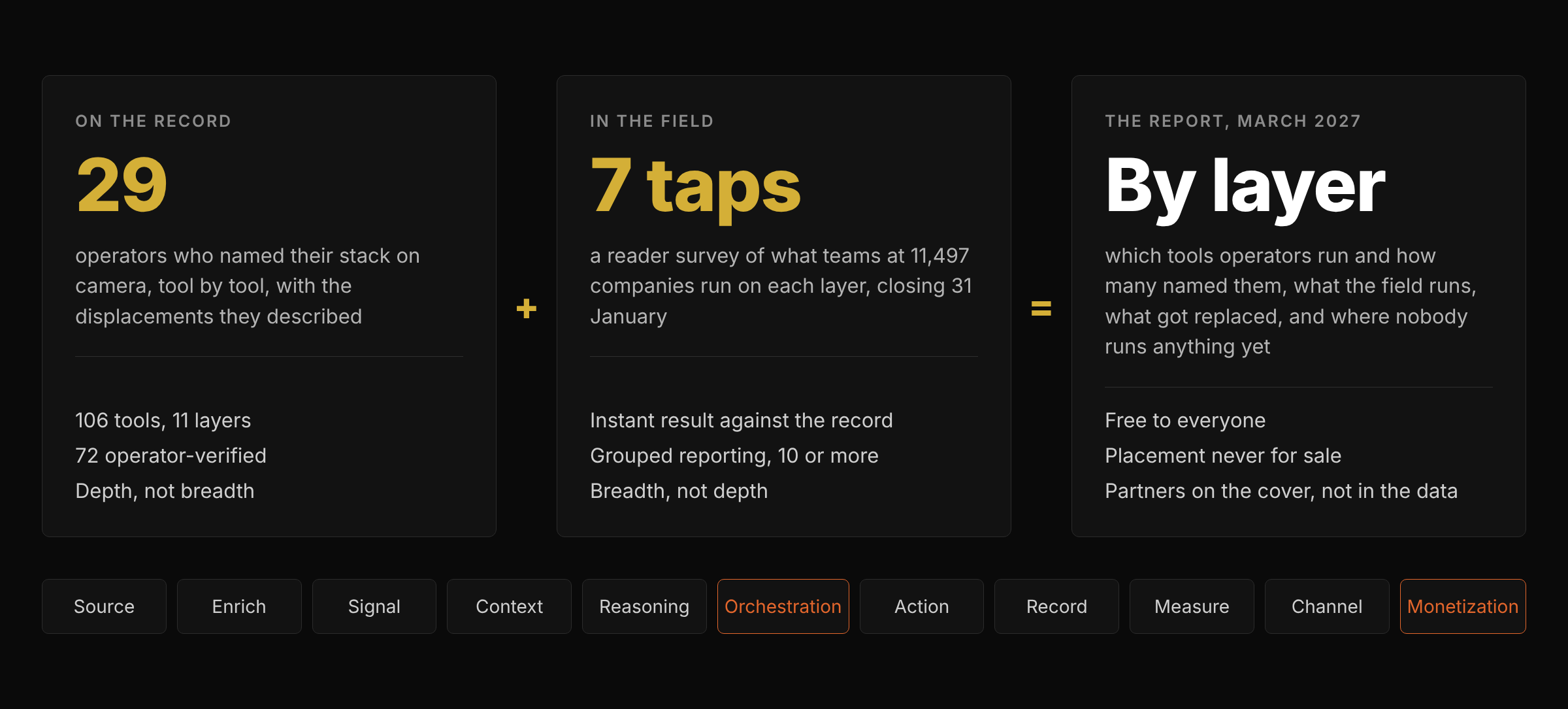
There are 2 ways to find out what GTM teams run. Ask a vendor, and you get a market map with their logo in the middle. Or ask the operators who run the stack, on camera, one layer at a time. GTM Vault has done the second for 32 episodes: 106 tools on the record, named by 29 operators, placed on the layer each one serves. That is The Stack Index.
It has 1 gap. 29 operators is depth, not breadth. The State of the GTM Stack 2027 adds the other half: what teams at the 11,497 companies on this list run on each of the 11 layers, from Source to Monetization, and what changed in the last 12 months.
What you get for 2 minutes
Your stack against the record, instantly. How many layers you run something on, which of your tools an operator has named on the show, and the layers you run nothing on with what operators run there.
The report in March, free, before it is public.
Perks from vendors on the record, unlocked on the result screen as partners confirm.
7 taps, no typing, 2 minutes. Round 2 is optional and covers the other 8 layers. Individual answers are never published and results are reported for groups of 10 or more. Placement in The Stack Index is not affected by any answer or any partner.
Why this matters now
Last year the 2 best GTM surveys ran on 195 and 225 responses. Both were useful. Neither could say which tools operators actually run by layer, because neither had the operators on camera first. This one does, and the survey closes on 31 January so the report can carry both.
On the record
The 29 operators the report is built on, each with their stack on its own page in The Stack Index. If you are reading this and your name is here, your page is in front of 27,500 people today, and it goes out again, 1 a day, on LinkedIn through November.
Alexander Shartsis, Skyp, SMYS 2
Amos Bar-Joseph, Swan AI, GTM 16
Angelo Quiambao, Intellistack, SMYS 7
Ayush Khanna, super{set}, GTM 12
Charles Cormier, TopLeads, GTM 19
Elliot O'Connor, Frontier, SMYS 8
Garrett Wolfe, 1GTM, SMYS 3
Gorish Aggarwal, Sybill, GTM 48
Harsha Gaddipati, Slashy, GTM 30
Jai Toor, DeepLine, SMYS 4
Jason Patel, Open Forge AI, GTM 34
Joseph Lee, Supademo, GTM 44
Mark van Oppen, SecureAuth, GTM 47
Michael Bartimer, Clarify, SMYS 9
Michael Saruggia, Clay operator, GTM 21
Michele Shepard, Emburse, GTM 31
Nick Velkovski, HeyReach, GTM 14
Olivier Roth, The Swarm, GTM 51
Parthi Loganathan, Letterdrop, GTM 3
Riley Timmins, Kintsugi, SMYS 10
Santosh Sharan, ZeerAI, GTM 24
Sean Ellis, Hacking Growth, GTM 18
Sriharsha Guduguntla, Hyperbound, GTM 1
Tim Scheuer, Oxygen, SMYS 6
Umar Farooq Adam, Hitachi Vantara, SMYS 5
Vignesh Ravichandran, MyClone, GTM 35
Vinayak Mishra, Slang AI, SMYS 1
Yoni Tserruya, Lusha, GTM 50
Zayd Ali, Valley, GTM 17
If you run a revenue system, take it. If you run a company that sells into one, forward it to the person who owns the stack.
Rick Koleta
Founder, GTM Vault
The vendor-map versus operator-on-camera split is the useful bit. Most stack pictures I have been handed over the years put the seller's logo in the middle and call it research. Naming 102 tools from 24 operators, on the layer each one actually serves, is a different artefact.
Orchestration and Monetization being almost empty tracks with what we see on the media side too. Teams are over-served on source and enrichment, and under-served on the bit that turns a signal into an action and then proves it moved revenue. That is usually where the spreadsheet quietly becomes the system of record.
When the survey comes back, are you expecting those two coral layers to fill with real tools, or with a lot of "we built it ourselves"?