



👋 Hi, it’s Rick Koleta. Welcome to GTM Vault - a weekly breakdown of how high-growth companies design, test, and scale revenue architecture. Join 27,000+ operators building GTM systems that compound.
Most GTM teams were not designed. They were accumulated.
A company hires three SDRs because pipeline is slow. Then a content writer because the blog is stale. Then marketing ops because nobody knows which campaigns are working. Then a CRM admin because Salesforce is a mess. Then a demand gen manager to tie it all together. Then two more AEs because the ones they have are drowning in unqualified leads the SDRs booked.
Fifteen people. $1.5M in payroll. And the CEO still asks, every quarter, why pipeline is flat.
This is not a headcount problem. It is an architecture problem. And everyone on LinkedIn is now posting the fix: five people plus agents. New roles, new stacks, clean diagrams.
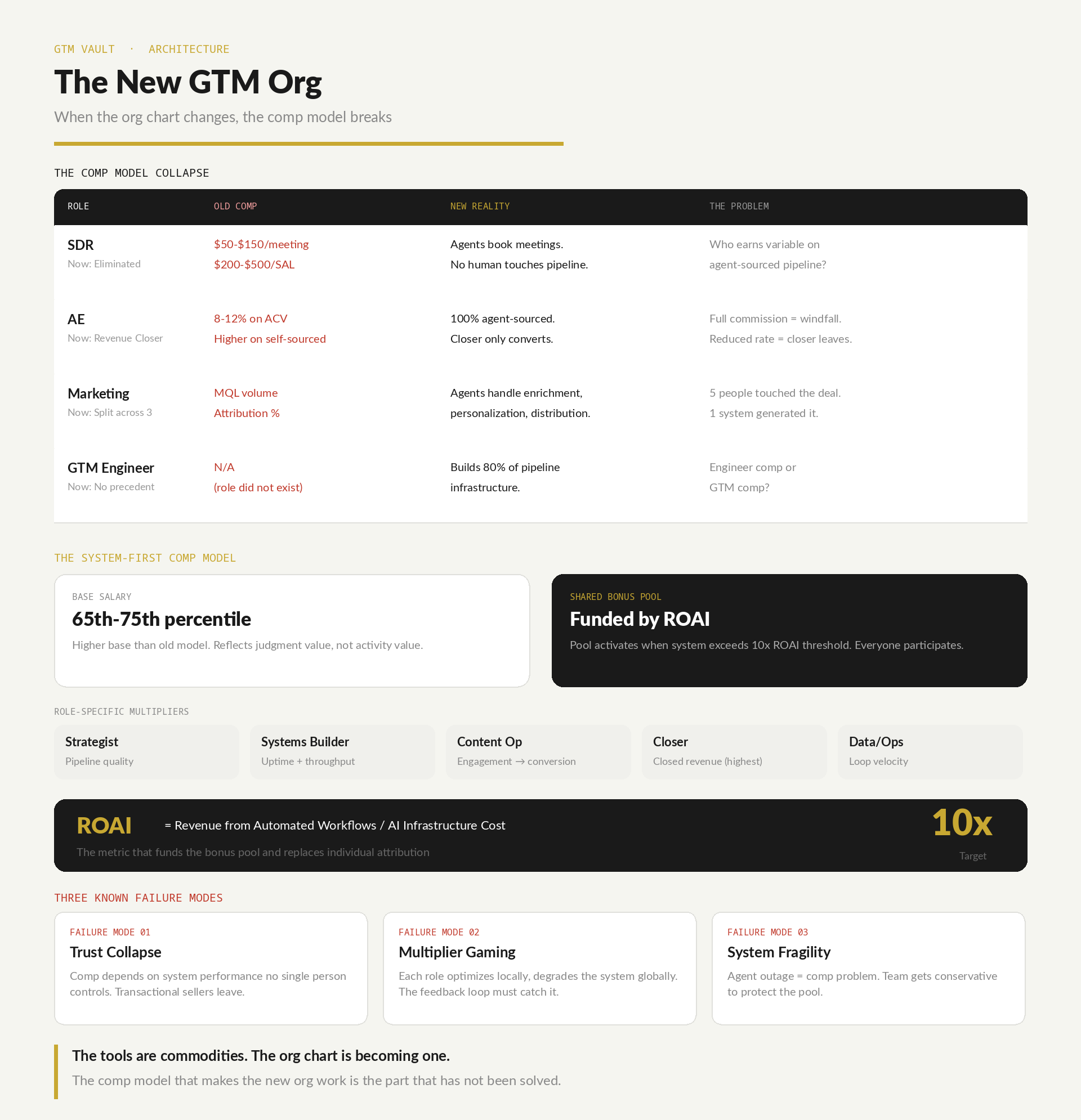
They are all skipping the same thing. The moment you compress fifteen roles into five, every compensation model in the org stops working. The SDR’s variable comp has no human to pay it to. The AE’s commission structure rewards pipeline they did not source. The attribution model that held the old org’s fiction together collapses entirely.
Comp is not a detail. Comp is the incentive layer that determines whether the new org actually functions or quietly recreates the same dysfunction wearing a different org chart.
The Accumulated Org
The traditional GTM org was never architected. It was assembled by exception.
The SDRs exist because marketing could not generate enough pipeline. Marketing ops exists because nobody could attribute what was working. The CRM admin exists because the system sales inherited from the previous CRM admin is a graveyard of bad data and abandoned workflows. Each hire was reasonable in isolation. Nobody audited the result as a system.
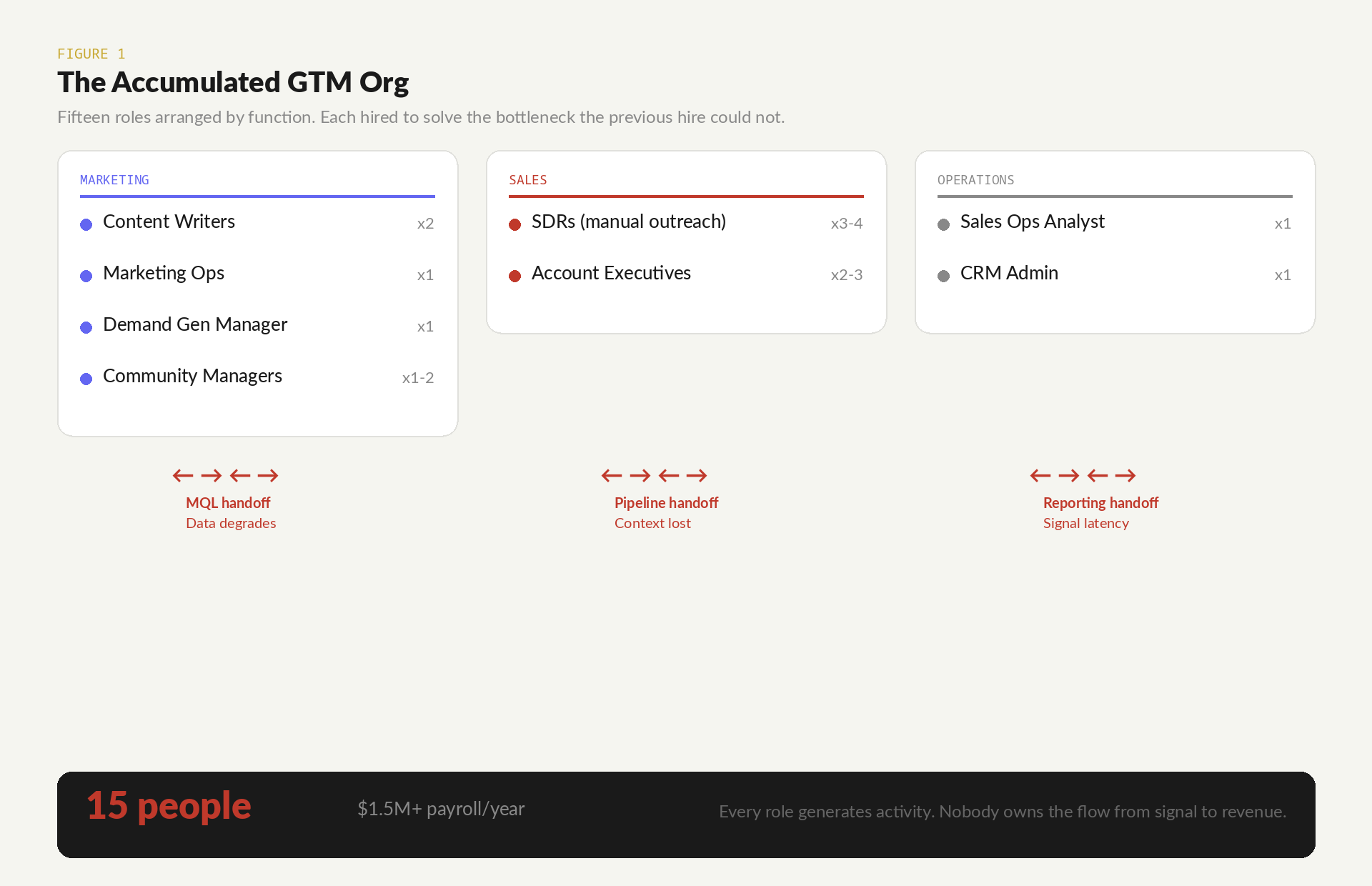
Map the signal flow from first touch to closed deal and the problem becomes structural. Data degrades at every handoff between marketing and sales. Context evaporates when an SDR passes an opportunity to an AE. Reporting latency means the CEO sees last month’s pipeline metrics while making this month’s hiring decisions.
Here is what compounds in that org: refining ICP definitions based on closed-won patterns, building relationships with champions inside target accounts, improving the system logic that routes signals to the right action. Here is what does not compound: logging call notes into a CRM field nobody reads, reformatting a blog post into a LinkedIn carousel, sending a follow-up email that says “just checking in.”
Most of what a 15-person GTM team does falls into the second category. Not because the people are bad at their jobs. Because the system was never designed to separate compounding work from maintenance work.
The Execution Layer Compression
What AI actually did is compress the execution layer. The tasks that previously required dedicated headcount (prospect research, initial outreach personalization, content repurposing, CRM hygiene, follow-up sequencing, pipeline reporting) are now handled by agents and workflows that run continuously.
Consider what a single SDR does in a day. Forty-five minutes researching accounts. Thirty minutes writing personalized openers. Two hours sending sequences. Thirty minutes logging activity. Another hour in meetings about pipeline they cannot actually influence. Maybe four hours of that day produce something that moves a deal forward. The rest is system maintenance that exists because the system was not automated.
The infrastructure to automate all of it exists today. Clay, n8n, agent frameworks built on Claude and GPT. Open-source GTM skill libraries are replacing entire workflows, not individual tasks. The infrastructure matured faster than most GTM leaders realized because they were not looking at the engineering layer. They were looking at the SaaS vendor layer, which has every incentive to sell them more seats instead of fewer.
The result is a new org. Five humans. One agent execution layer. A closed loop, not a linear handoff chain.
One GTM Strategist owns positioning and ICP logic. One AI Systems Builder runs the agent infrastructure. One Content Operator maintains voice across everything the system publishes. One Revenue Closer converts the qualified pipeline the system delivers. One Data/Ops Lead closes the feedback loop between output and conversion.
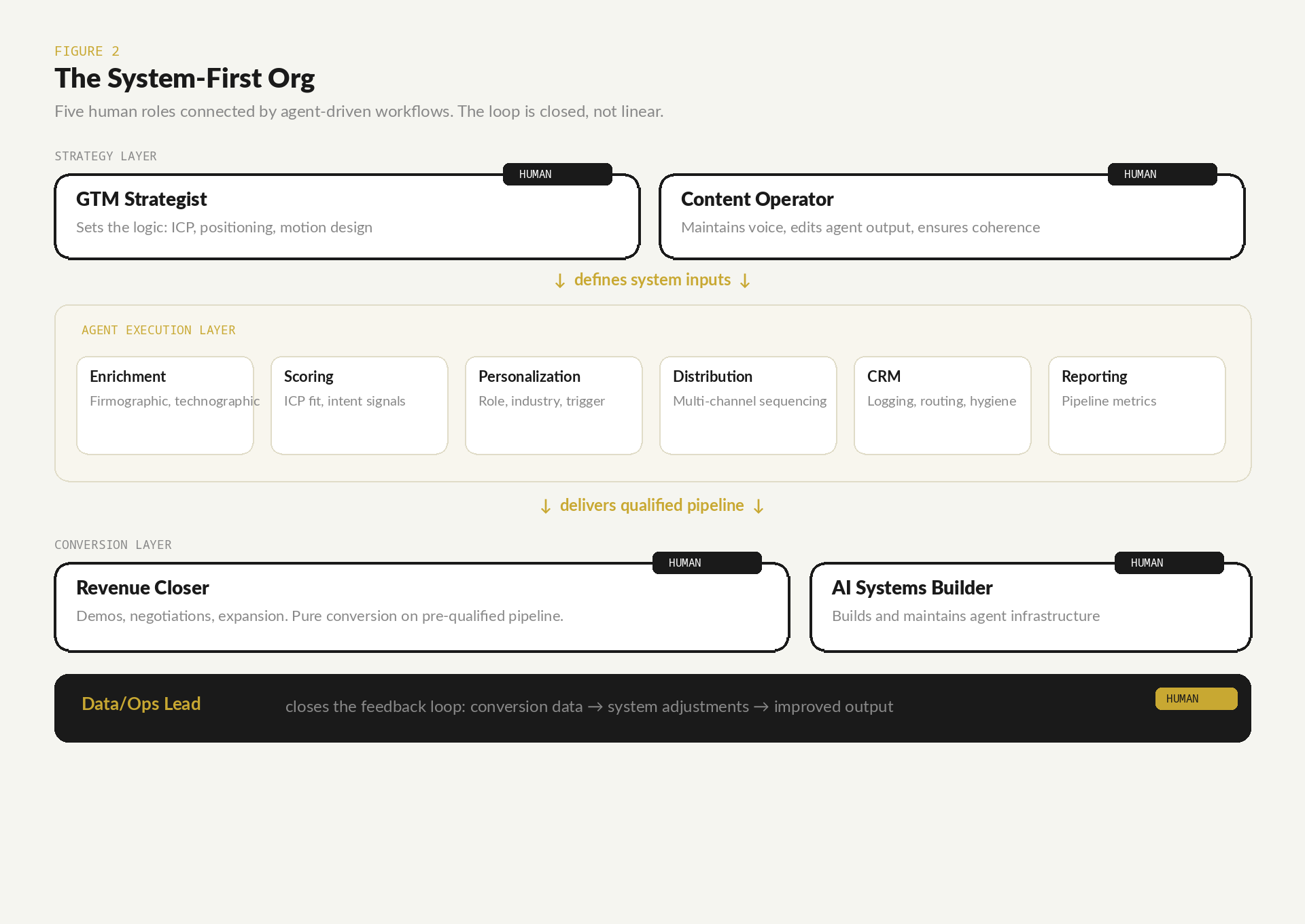
Everyone posting about this stops here. New org chart, new roles, new tools. Clean diagram. Ship it.
But there is a structural problem hiding inside that diagram that nobody is addressing. And it will surface the first quarter you try to pay these five people.
