



👋 Hi, it’s Rick Koleta. Welcome to GTM Vault - a breakdown of how high-growth companies design, test, and scale revenue architecture. Join 26,000+ operators building GTM systems that compound.
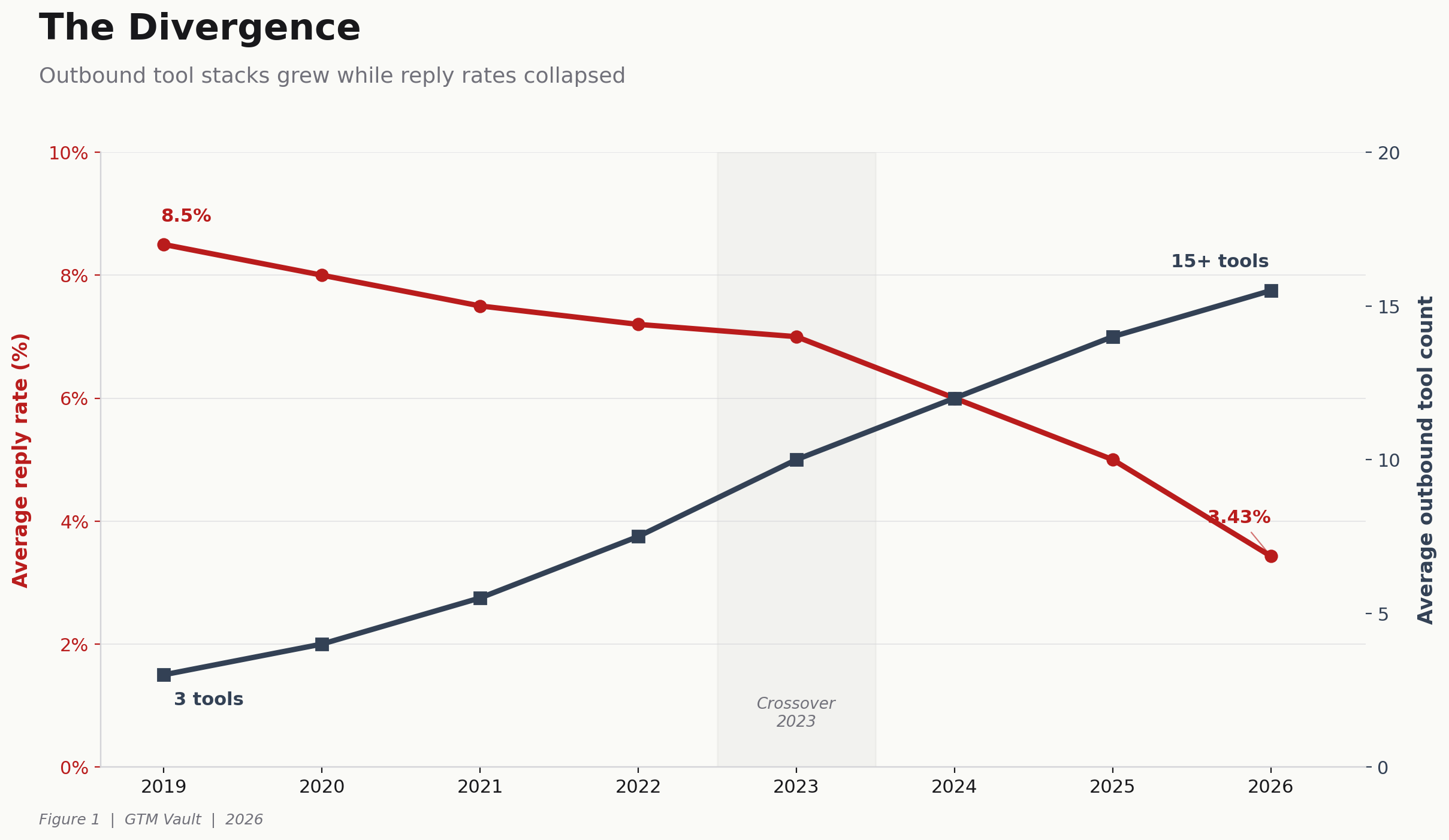
Something structural happened to outbound between 2019 and 2026. The infrastructure got faster. The tools got smarter. The stack got deeper. And the outcome got worse.
Average cold email reply rate declined from 8.5% in 2019 to 7% in 2023 to 5% in 2025 to 3.43% in 2026. Open rates slid from roughly 36% to 27.7% over the same window. Global inbox placement sits at 84%, meaning one in six legitimate emails never arrives. Spam landing rate is 9.1%, roughly one in eleven. Over the same seven years, the average outbound team tripled the size of its stack.
The thing that compresses in ten minutes was never the thing that converts.
This playbook names the four architecture layers tooling did not compress, why the 3x gap between median and top-decile reply rate lives entirely inside those layers, and how to stand them up over twelve weeks. It is written for operators who already know how to wire a sequencer and who are wondering why the sequencer is not producing pipeline.
The November 2025 Deliverability Cliff
One piece of context before the plays. Every send in 2026 operates against a hard constraint that was a soft preference before November 2025.
Gmail moved from temporary delays and soft bounces to permanent 5xx rejections for senders who fail SPF, DKIM, or DMARC authentication, or who post a spam complaint rate above 0.3%. Yahoo runs the same policy. Microsoft is close behind. The operational consequence is that a 500-send campaign now ships roughly 420 into inboxes, 45 into spam, and 35 into SMTP rejection the recipient never sees. The sequencer records all 500 as sent. The sender reputation dashboard, if you have one, is the only layer that knows the truth.
Once a mailbox crosses the 0.3% threshold, recovery is measured in weeks. Not hours. The ten-minute workflow has no mechanism to detect this has happened until the downstream pipeline goes flat and the team is left guessing what changed.
Play 1: Validate Intent Before Volume
The data. Intent-matched outbound converts 2.5 to 2.9 times higher than unmatched outbound. Demandbase Pipeline Predict accounts flagged “Highly Likely” convert at 31.5% within thirty days, a 2.9x lift over manual prioritization. Intent-flagged accounts advance through pipeline at 88% versus 77% without the flag, an 11-point gap. Bynder saw a 2.5x pipeline increase after layering 6sense on its outbound motion, with full ROI inside four months.
The move. Every account passes through two filters before it enters the sequencer. The ICP filter names who could buy (role, headcount, funding, region, stack). The intent filter names who is buying this quarter. Accounts that clear both filters go to the working list. Accounts that clear ICP but miss intent go to the bench and stay there until a signal fires. The bench is the 60 to 90% of your addressable market that is not in-market right now. It is not dead. It is dormant.
Signals that count. Visited pricing page in the last 14 days. New executive hired into the buying role in the last 90 days. Funding event in the last 90 days. Category keyword engagement on content. Competitor displacement in a public job description. Named event on the calendar: conference, fiscal cutover, compliance deadline, grant deployment window.
The 14-day action. Pull your top 500 accounts. Tag each one with which intent signals have fired in the last 60 days. Move anything with zero signals to a named bench list inside the CRM. Anything with two or more signals is the working list. The working list at any moment should be 50 to 150 accounts, not 500, and it should refresh weekly as signals fire and expire. If you have no intent tool, start manually with public signals (earnings calls, hiring announcements, funding news, product launches, press) and instrument as you go.
What to stop. Stop sending to accounts with zero signal in the last 60 days. Stop treating volume as a proxy for effort. Sending 100 signal-matched emails is operationally harder than sending 1,000 undifferentiated ones, and it is the only version that produces a reply.
Every send to an out-of-market account is a charge against the sender score that will eventually cost you the in-market sends.
Play 2: Tie Narrative to a Named Operating Constraint
The data. Generic cold emails get roughly 9% response rates. Emails with advanced personalization tied to the recipient’s context get roughly 18%, a 2x lift from the same stack and the same day of the week. Highly personalized campaigns using multiple custom fields produce 142% more replies than non-personalized baselines. Teams running AI personalization at depth report reply rates up to 35% on high-signal accounts. Only 5% of senders personalize every email. The 5% who do capture 2 to 3x the reply rate of the 95% who do not.
The move. Every opener names the prospect’s current operating constraint in language they would recognize as true. Not category-level (”I noticed you are in B2B SaaS”). Not resume-level (”Saw you hired 3 AEs after your Series B”). Constraint-level: what is actually making their quarter hard, and how do you know.
“The CTEIG allocation you received on October 27 has a June 30 encumbrance deadline and your current CTE vendor does not cover the biomedical pathway named in your grant application.” “Your Q3 board deck listed pipeline coverage at 2.4x against a 4x plan and the reason your 12 reps are not closing the gap is not a rep problem.” Those openers reference specific public information the sender had to read to write. They also imply a solution the prospect will hear when they reply.
The 14-day action. For the top 20 accounts on the working list, write a three-sentence opener that names a specific operating constraint, sourced from public signal (earnings call, job description, grant award, press release, board deck summary, LinkedIn announcement). Run each opener past the question: would this recipient recognize this as true about their current quarter. If no, research more before sending.
What to stop. Stop calling first-line personalization “personalization.” Stop using AI to mass-generate opener lines that reference category truths. Stop shipping sequences before the opener has been tested against three prospects in the same persona. The stack commoditized sending. Narrative specificity is the only leverage left.
If the opener could plausibly have been sent to three other companies in the same industry, it is not a constraint. It is a category pitch in a personalized shell.
Play 3: Treat Deliverability as Infrastructure, Not as a Tool
The data. One in six legitimate emails misses the inbox globally. One in eleven lands in spam. Gmail’s hard threshold is 0.3% spam complaints. Once you cross it, the sending domain is functionally dead for weeks.
The move. Three architectural decisions most ten-minute workflows skip. First, separate outbound sending domains from the corporate domain by at least one registration layer. Never send cold from the domain that also hosts your marketing site, your customer support, or your billing. A deliverability incident on outbound should not collapse the deliverability of the revenue-generating side of the business. Second, run your operational ceiling at 0.1% spam rate, not at Google’s 0.3% rejection line. By the time you cross 0.3% you have already been rejected. 0.1% is the warning. Third, ramp every new mailbox slowly. 20 to 30 sends per day for the first 14 days. 40 to 80 for the next 14. Full volume only after day 28, and only on mailboxes with a reputation score above a defined threshold.
The 14-day action. Audit the sending domains currently active. Any outbound still coming from the primary corporate domain moves to a dedicated outbound domain this week. Set DMARC to enforcement policy (quarantine or reject), not to monitor. Install per-mailbox spam rate, bounce rate, and inbox placement monitoring outside the sequencer. This last one is non-negotiable.
What to stop. Stop trusting sequencer dashboards for deliverability truth. Stop running outbound off the domain that serves customers. Stop treating a warm-up app as a deliverability strategy. Warm-up is one tactic inside a broader discipline.
The sequencer dashboard’s business model depends on showing you send volume. The inbox placement layer does not pay the sequencer to tell you the truth.
Play 4: Close the Feedback Loop Every Week
The data. Average reply rate is 3.43%. Top-decile senders clear 10%. The top decile is not running a different stack. They are running a different loop.
The move. Three metrics measured every Friday, independent of what the sequencer reports. First, reply type distribution across the week’s sends. Positive interest, negative interest, wrong person, unsubscribe, silence. Silence is the dominant category at 3.43% reply rate and it is the most useful to instrument, because silence means either the signal was wrong, the narrative was wrong, the deliverability failed, or some combination of the three. Second, signal-to-send correlation: of the sends this week, how many were tied to an intent signal that fired in the last 30 days, and what was the reply rate on those versus sends that had no recent signal. This tells you whether Play 1 is working. Third, narrative outcome mapping: which opener themes produced positive replies, which produced “wrong person” replies, which produced silence. Positive-reply openers get doubled the next week. Wrong-person openers get investigated for persona error. Silence openers get retired.
The 14-day action. Build the Friday review as a 30-minute operational ritual, not a quarterly retro. Three outputs per week: the retired opener, the doubled opener, the signal type that produced the best reply rate. Over twelve weeks of this ritual, the reply rate on the sends you are still making climbs from 3% to 8-to-10%, because the motion iteratively kills what does not work and amplifies what does.
What to stop. Stop reviewing sequencer dashboards as a substitute for running the loop. Stop pushing more volume when the reply rate is flat. Stop treating individual sends as disposable. Every silent send is data that should have retired an opener, a persona theory, or a signal type.
Outbound without a feedback loop is not compounding. It is running open-loop on assumptions that were true the day the sequence was built.
The Top-Decile Gap Is an Architecture Gap
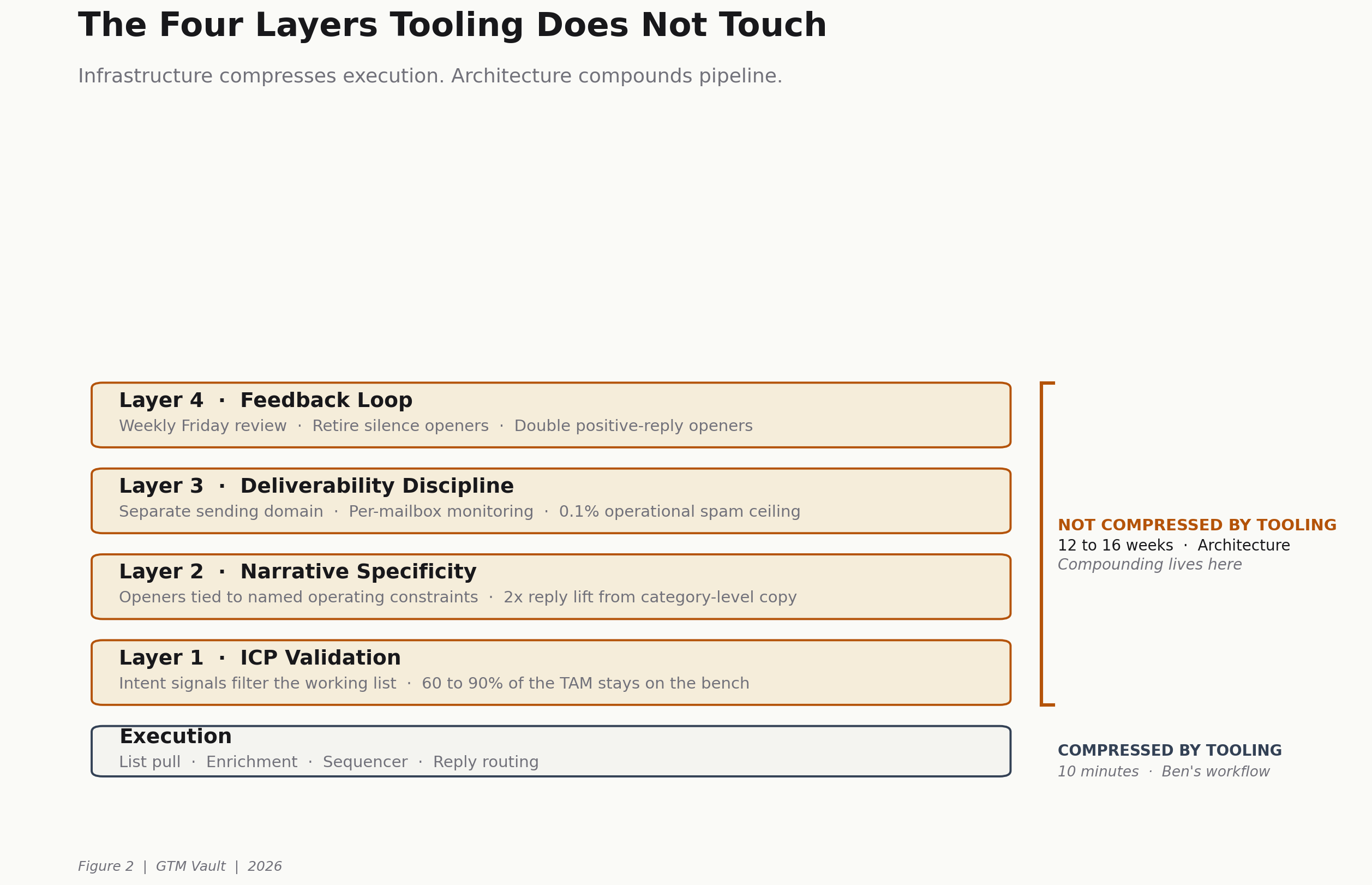
The teams clearing 10%+ reply rates are running the same stack as the teams stuck at 3.43%. What they have that the median does not is four architecture layers running in lockstep: intent-validated ICP, narrative tied to named operating constraints, deliverability treated as infrastructure with per-mailbox monitoring, and a weekly feedback loop that kills and amplifies.
None of these four layers are compressible by tooling. They take weeks to stand up and months to tune. That is why they produce a moat. Anyone can copy a ten-minute workflow in ten minutes. Almost no one is willing to put the twelve to sixteen weeks into the four layers above it.
The 3x reply rate gap is a patience gap disguised as a tools gap.
Twelve Weeks to Top Decile
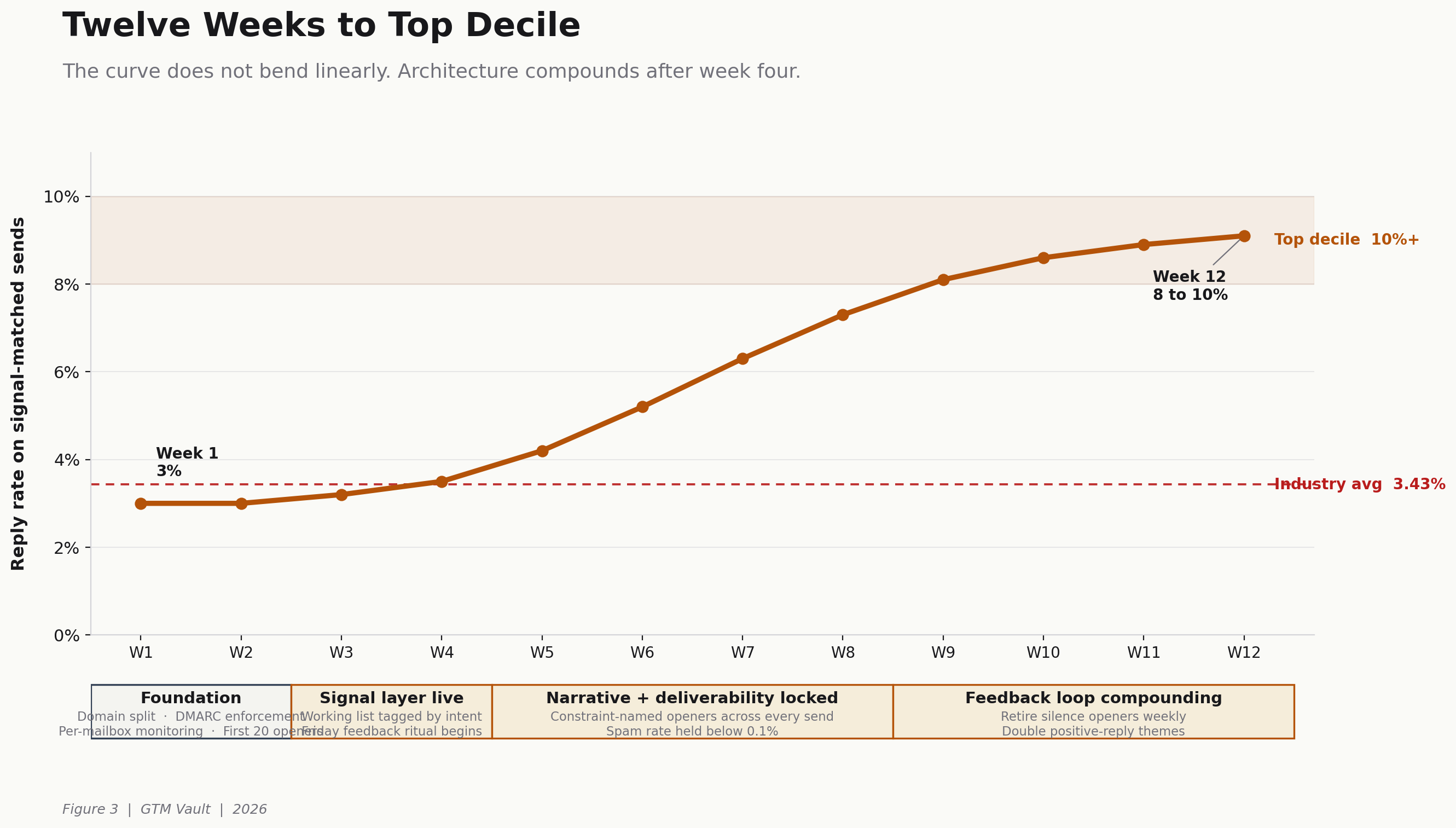
Execute the four plays in sequence. Each layer is a prerequisite for the next one producing lift. Adding a tool before the underlying layer is built is how teams end up with fifteen tools and 3% reply rates.
Weeks 1-2. Foundation. Separate outbound domain from the corporate domain. Install per-mailbox deliverability monitoring. Set DMARC to enforcement. Audit the current 500-account list and move anything without signals to the bench. Write constraint-named openers for the top 20.
Weeks 3-4. Signal layer live. Tag every account on the working list with fired signals in the last 60 days. Refresh the list weekly. Start the Friday feedback review as a 30-minute operational ritual.
Weeks 5-8. Narrative and deliverability locked. Every sent opener names an operating constraint, tested against the recognition question. Sender reputation held under 0.1% spam rate per mailbox. Retire the silence openers each Friday. Double the positive-reply openers.
Weeks 9-12. Feedback loop compounding. The Friday review has eight to twelve weeks of data. Reply rate on signal-matched sends should be 8-to-10%. Expand mailbox and domain count only after per-mailbox reputation is stable for four consecutive weeks.
By week twelve, a team running this sequence will be booking more qualified conversations than a team running the ten-minute workflow at ten times the send volume. The volume team will not know why they are losing, because the sequencer dashboard will show their numbers are up.
Doctrine for Pre-Revenue Founders
Three principles worth internalizing before the first send of the new motion.
Infrastructure compresses execution. Architecture compounds pipeline. Tools speed up the layer that was already fast. The layers that actually produce conversion (intent, narrative, deliverability, feedback) are architecture, and architecture is not compressible by design. Treating a sequencer as a GTM system is the default failure mode of 2026 outbound.
List size is a function of the motion, not a substitute for it. Seventy signal-matched accounts with constraint-named openers outperforms 500 undifferentiated ones at every stage of the funnel: inbox placement, reply rate, meeting acceptance, pilot conversion. Volume without architecture is expensive noise that spends sender reputation.
The stack you can stand up in ten minutes can be stood up by everyone. Things everyone can do are worth what everyone can pay for them. The moat is not the tools. The moat is the four layers the tools cannot touch.
The Stack Is Not the Campaign
The ten-minute workflow is infrastructure. Infrastructure compresses execution. GTM campaigns are architecture. Architecture compounds pipeline. Those two statements are not the same statement, and the difference is what separates teams that build revenue systems from teams that stack tools.
The industry traded reply rate for setup speed every year since 2019. The trade is no longer producing net gains. The teams that will win outbound in 2026 are the teams that invest in the four architecture layers before they add the sixteenth tool. The first three weeks look slower than the ten-minute playbook. The next nine weeks compound. By week twelve, the two motions are not in the same category of system.
Pick the architecture. The tools will still be there when you need them.
Sources
Instantly, Cold Email Benchmark Report 2026 (reply rate, open rate, inbox placement trends)
Validity, 2025 Email Deliverability Benchmark Report (global inbox placement, spam landing rate)
Google and Yahoo, 2024 and 2025 Sender Requirements (spam threshold, one-click unsubscribe, November 2025 5xx enforcement)
Landbase, Intent Signal Statistics 2026 (conversion lift, pipeline advance rate, Demandbase Pipeline Predict, Bynder case data)
SalesCaptain, Cold Email Statistics 2025 (personalization lift, generic vs advanced response rate, AI at depth)
Martal, B2B Cold Email Statistics 2026 (year-over-year trend data, top-decile benchmarks)