



👋 Hi, it’s Rick Koleta. Welcome to GTM Vault - a breakdown of how high-growth companies design, test, and scale revenue architecture. Join 27,000+ operators building GTM systems that compound.
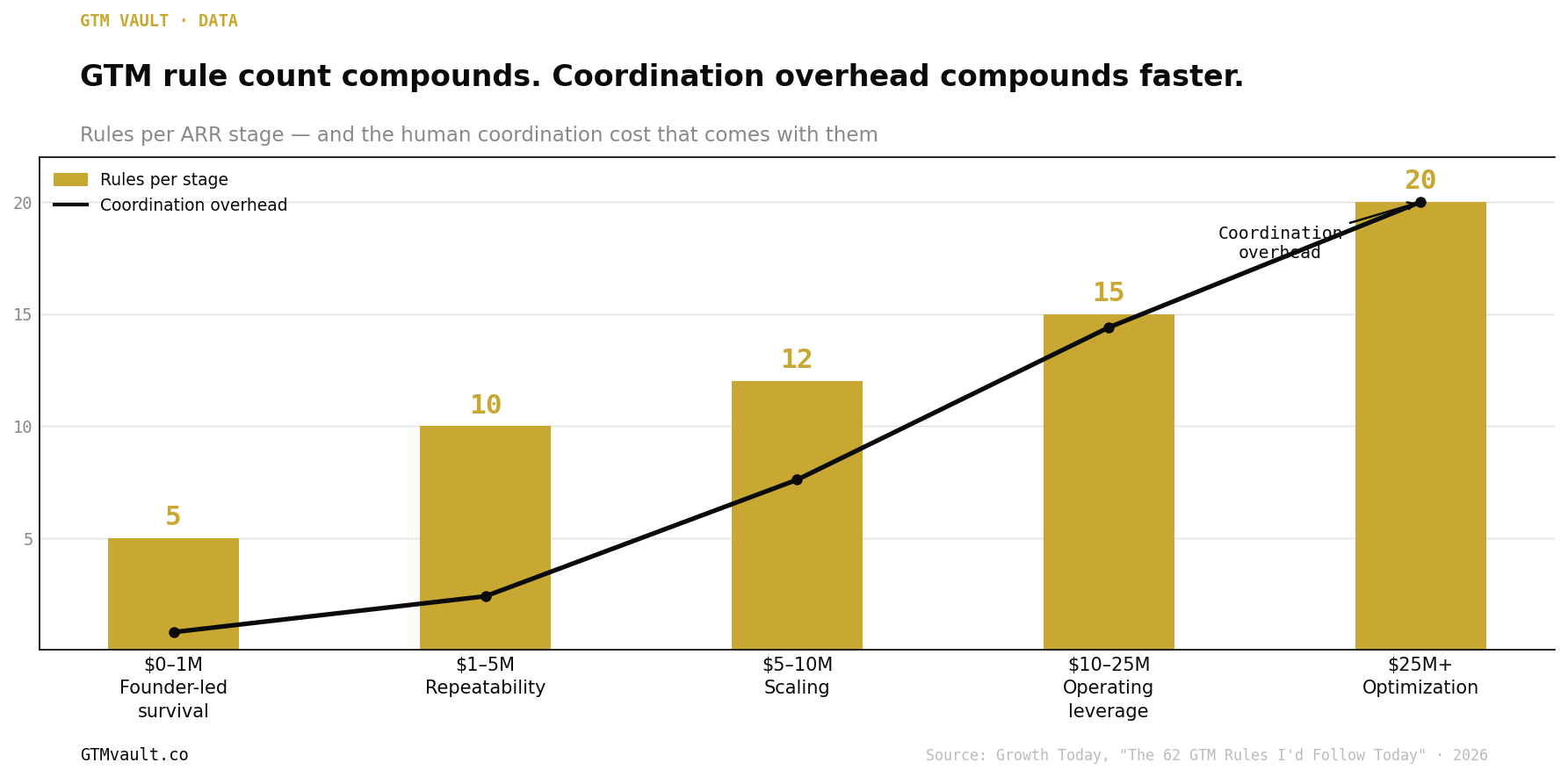
At $0-1M ARR, you need 5 GTM rules to stay alive. At $25M+ ARR, you are running 62.
That number is the diagnosis. Not a benchmark or an aspiration. A failure mode in the making.
At 5 rules, a founder can manage the list manually. Post on LinkedIn, close the first deals personally, do not hire an SDR until the playbook is proven. Five rules fit in your head. They do not require infrastructure. They require discipline.
At 62 rules, the list has become the coordination problem. Somebody owns the LinkedIn ads. Somebody owns the Clay sequences. Somebody owns the ABM motion. Somebody owns the ICP scoring refresh. Each rule is a project. Each project is a queue. The plays are real. The problem is that 62 real plays, managed as 62 separate initiatives, compound overhead faster than they compound pipeline.
The best GTM teams are not running more plays. They are running fewer, better-connected ones.
Why the Play Mental Model Breaks
The play is a useful unit for explaining what should happen. It is a poor unit for building what actually runs.
A play requires someone to own it. Someone to update the list, pull the accounts, write the copy, QA the sequence, and push the button. At $1-5M ARR, ten rules are manageable. The founder documents the playbook, the first AE closes most deals, the first inbound motion starts to compound. The coordination cost is friction, not failure.
At $5-10M ARR, the rules double. The five-tool stack arrives: CRM, Clay, Instantly, Common Room, n8n. Per-account AI research before every cold email, sub-$0.10 per account. Multi-touch attribution replaces last-touch. Each of these is a real capability. Each requires ownership. What kills teams at this stage is treating $5M like $1M: keeping the founder in every deal, running plays without the system underneath them.
At $10-25M ARR, 50% or more of GTM research, scoring, and drafting is supposed to be automated. Dedicated demand gen, performance marketing, product marketing, and ABM as separate functions, not generalist roles. CAC payback under 18 months. What kills teams here is ABM without RevOps support. The motion is right. The infrastructure to run it is not there.
The deeper issue is that plays do not share infrastructure. A closed-lost re-engagement play and a champion tracking play might draw from the same CRM data, the same enrichment layer, and the same outbound tooling, but if they were built separately, they operate separately. The signal that would trigger one play has no visibility into whether the other play already contacted the same account last week. Overlap, contradiction, and redundancy accumulate invisibly.
The GTM teams that have solved this noticed that most plays draw from the same four or five signal types and built a single infrastructure layer that monitors all of them continuously, routes outputs to the right workflow, and enforces the rules that prevent plays from contradicting each other.
When you build that layer, the play count becomes irrelevant. The system decides what runs and when.
The Five Signal Types That Drive Most of It
The plays that produce pipeline in B2B compress into five underlying signal categories. Every play is a response to one of them. Building the system means building infrastructure around the signal, not around the play.
Account motion
Companies changing their infrastructure, headcount, or technology stack in ways that indicate budget, urgency, or displacement opportunity. Job postings, tech stack changes, funding events, and leadership transitions all belong here. The system version monitors all of these simultaneously, scores the account against your ICP in real time, and initiates the sequence without a human reviewing a list. The manual version surfaces the same signal three weeks later when someone runs a Bombora export.
Relationship change
Champions leaving, former customers changing roles, mutual connections arriving at target accounts. A champion who moved to a new company six months ago has already formed a vendor preference. The one who moved last week has not. The window is 48 hours, not 48 days. The manual version runs a monthly Salesforce report and gets to it when someone has bandwidth. At that point, the window is gone.
Buying intent
Product behavior, high-value page visits, G2 reviews, competitor evaluation signals. Intent decays in hours, not weeks. By the time a rep sees the alert in their inbox, reviews it, pulls the account, and decides whether to reach out, most windows have already closed. The system that acts on the signal automatically is not a luxury. It is the only version that works at the speed the signal requires.
Expansion surface
Accounts approaching usage limits, multiple users from the same domain on a free tier, admin behavior that indicates enterprise readiness. The system version connects product data directly to the outbound motion, triggering a sales touch when the behavioral threshold is crossed. The manual version catches it in the next QBR.
Competitive displacement
Accounts visibly dissatisfied with a competitor, evaluating alternatives, or entering a renewal cycle. The signal is harder to source and easier to misread, but the accounts it surfaces are the highest-intent pipeline in your TAM. The system version monitors review platforms, job postings, and LinkedIn activity continuously. The manual version checks quarterly.
The rest of this post is for paid subscribers: the architecture underneath these signals, and what it looks like when a GTM engineer actually builds it.