



👋 Hi, it’s Rick Koleta. Welcome to GTM Vault - a breakdown of how high-growth companies design, test, and scale revenue architecture. Join 27,000+ operators building GTM systems that compound.
The short version. Channel Drag is the lag, measured in quarters, between the moment a company changes stage and the moment its channel mix changes to match. Most GTM teams carry four to six quarters of it across half their budget, running channels added at a previous ARR or ACV bracket that no longer fit the buyer. The channels that built a company are usually the ones it has to retire to grow.
In early 2020, Apollo.io was nearly out of cash. The company had been running a sales-led motion at a $10,000 average contract value, and the unit economics had inverted. They were spending one dollar to acquire eighty cents of revenue. The channel mix that had built the company to that point was the same channel mix that was about to kill it.
The team retired the channel. They moved Apollo to a freemium product-led model, dropped the ACV from $10,000 to $1,000, and committed to a programmatic SEO motion that the existing leadership had every reason to distrust. The new motion produced no qualified pipeline for the first several months. Sales-led numbers kept declining. The bet was that programmatic landing pages, indexed against high-intent search queries, would eventually surface a different buyer segment at a different price point. The validation came from an A/B test that showed the new pricing converting at twenty times the rate of the old. The motion grew to 430,000 monthly organic visits at zero marginal cost. Twenty-four months later, Apollo was at $100M ARR. Today, more than 90% of new sign-ups come from organic word of mouth.
The structural lesson hiding inside Apollo’s pivot is the lesson hiding inside every GTM channel mix conversation. The channels that built your company are usually the channels you have to retire to grow it. The constraint is not the channel. It is whether the team is honest enough to retire the channel that built it.
Most teams are not. The result is a measurable structural failure I am calling Channel Drag.
Channel Drag
Channel Drag is the lag between the moment a company’s stage transitions and the moment its channel mix updates to match. Measured in quarters. It is the operational measurement underneath the law that channel accumulation is not distribution architecture. The law names the failure pattern. Channel Drag names the rate at which the failure compounds. A team running the channel mix that fit at the previous ARR or ACV bracket has Channel Drag of one to two quarters. A team running the mix from two stages ago has six to eight quarters of Channel Drag, and the pipeline math is degrading every month they do not update.
The metric is observable. Pull the channels currently in your budget. For each one, identify the stage the company was at when that channel was added. Subtract from the current stage. The gap is the Channel Drag for that line item.
Most GTM teams I look at have Channel Drag of four to six quarters across half their budget. The team running LinkedIn organic at $8M ARR added the LinkedIn motion at $1M ARR. The team running cold outbound at $25K ACV added the SDR org at $5K ACV. Each individual channel was working when it was added. None of them have been re-evaluated since the company’s market shifted underneath them, and the team is running on muscle memory while the data has moved.
The pattern is the same across every team I see
Across the GTM teams I have watched make this transition, the channel mix that wins at each stage is consistent enough to be a pattern, not a coincidence.
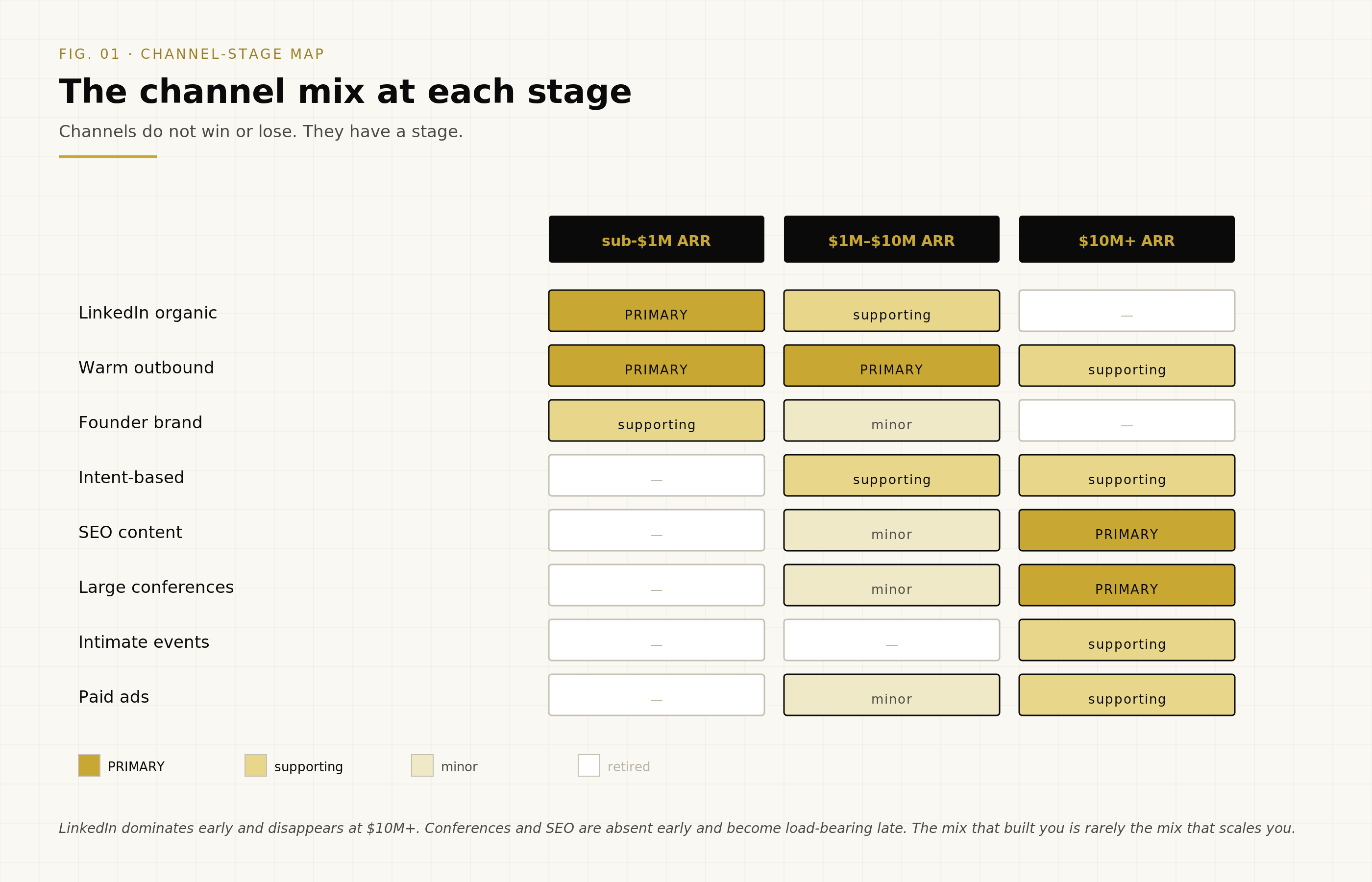
At sub-$1M ARR, the motion is high-touch, founder-driven, and runs on personal networks. LinkedIn organic and warm outbound carry most of the pipeline, with founder brand sitting just behind them. The mix is free or nearly so, which matches the stage’s economics. None of these channels scale past the founder’s reach, but at this stage the founder’s reach is still the largest available pool.
At $1M to $10M ARR, the mix shifts. Warm outbound becomes the operational backbone. LinkedIn is still relevant but no longer the lead channel. Intent-based motions enter the picture, because the team is no longer running on the founder’s network. It is running on identified accounts with identified buying signals.
At $10M+ ARR, the mix transforms. LinkedIn and founder brand drop out of the top tier. Large conferences become the lead channel because the buyer is now a committee, and conferences are the only setting where you can put a VP, an engineering lead, and an ops director in the same room across two days. SEO becomes a serious pipeline source, because content invested in two years earlier is finally compounding. Paid ads enter the mix as a brand layer that supports inbound, not as a primary acquisition channel.
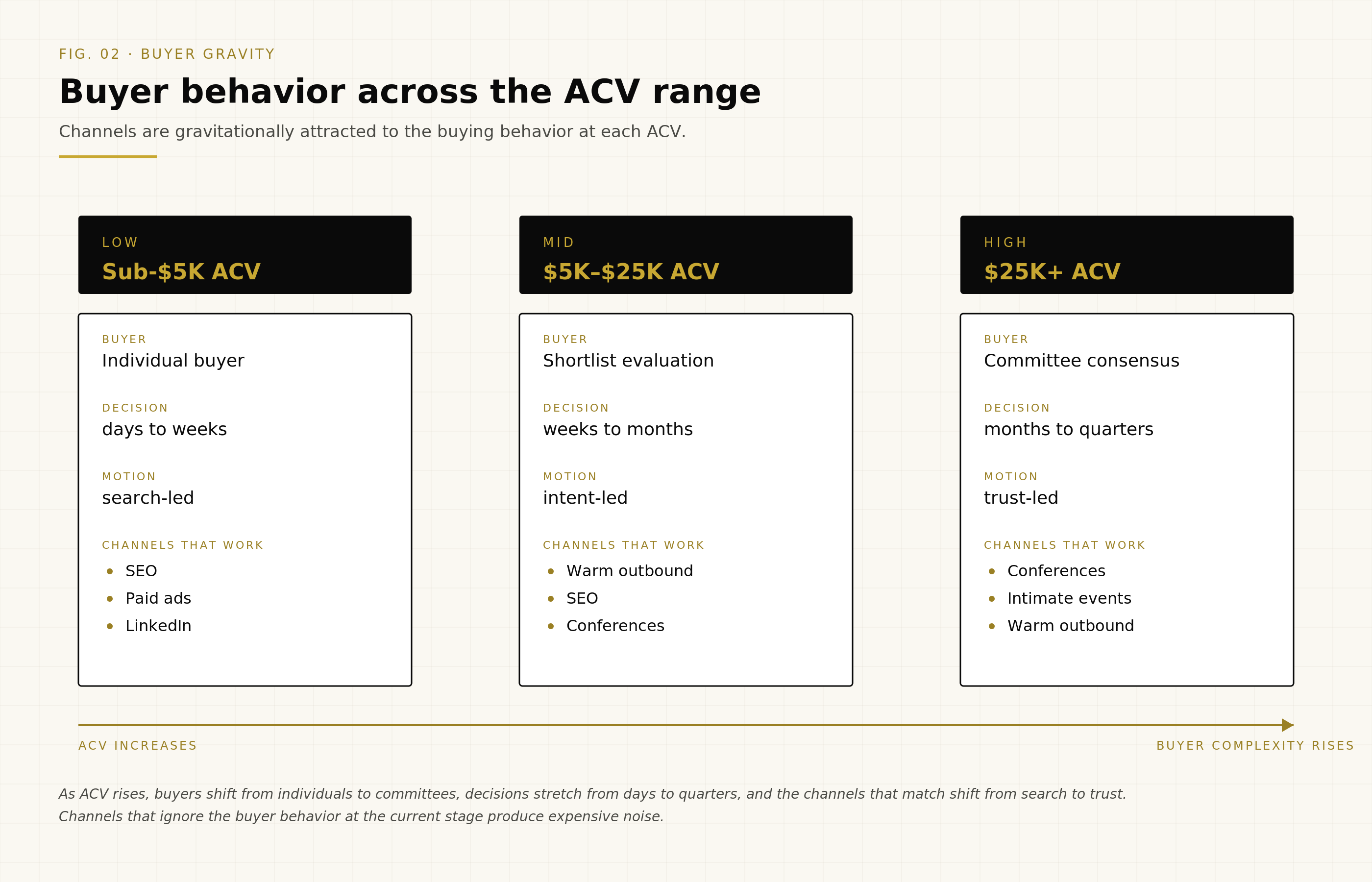
The same shift happens along the ACV axis, on a faster clock. At sub-$5K ACV, the buyer is one person making a self-serve decision in days. SEO and paid ads dominate because they intercept the buyer at the moment of search. LinkedIn confirms the brand exists but does not carry the conversion. At $5K to $25K ACV, the buyer is researching with intent across a shortlist over weeks. Warm outbound becomes the lead channel because it offers a structured comparison at the moment the buyer is actually evaluating. At $25K+ ACV, the buyer is building consensus across a committee over months. Large conferences and intimate events become the dominant channels because they are the only ones structurally suited to reach committees in a single setting.
The pattern is mechanical, not surveyed. The buyer behavior at each stage decides which channel mix works. Channels that ignore the buyer behavior at the current stage produce expensive noise.
Why the mechanism matters more than the recipe
The data is a description of what works at each stage. The mechanism is what tells you why, and the mechanism is what survives when the data does not exactly match your situation.
Channels are gravitationally attracted to the buying behavior at each ACV range. At sub-$5K ACV, the buyer is one person making a small purchase against a budget they control. The decision is made in days or weeks. SEO and paid ads work because they intercept the buyer at the moment of search. LinkedIn confirms the brand exists. The buying cycle does not have room for high-touch motions, so high-touch motions waste budget at this ACV.
At $5K to $25K ACV, the buyer is researching with intent. They have a shortlist, they want proof, they will take a meeting if the meeting will save them evaluation time. Warm outbound works because it offers a structured comparison. Intent-based motions work because the timing matches when the buyer is actually shortlisting.
At $25K+ ACV, the buyer is building consensus. They are not researching alone. They are bringing colleagues into evaluations, sitting through procurement, defending the decision to a CFO. Large conferences and intimate events work because they are the only channels structurally suited to reach an entire buying committee in a single setting. Warm outbound is no longer dominant, but it has not disappeared either, because committee members still need to be reached individually.
The mistake most teams make is reading the data as a recipe. The recipe says: at $25K+ ACV, run conferences. The mechanism says: at $25K+ ACV, your buyer is a committee, and conferences are the highest-leverage way to reach committees in person. The mechanism is what tells you what to do when conferences are not available, the budget is constrained, or the timing is wrong. Without the mechanism, you copy the channel and miss the principle.
The transition zones break most teams
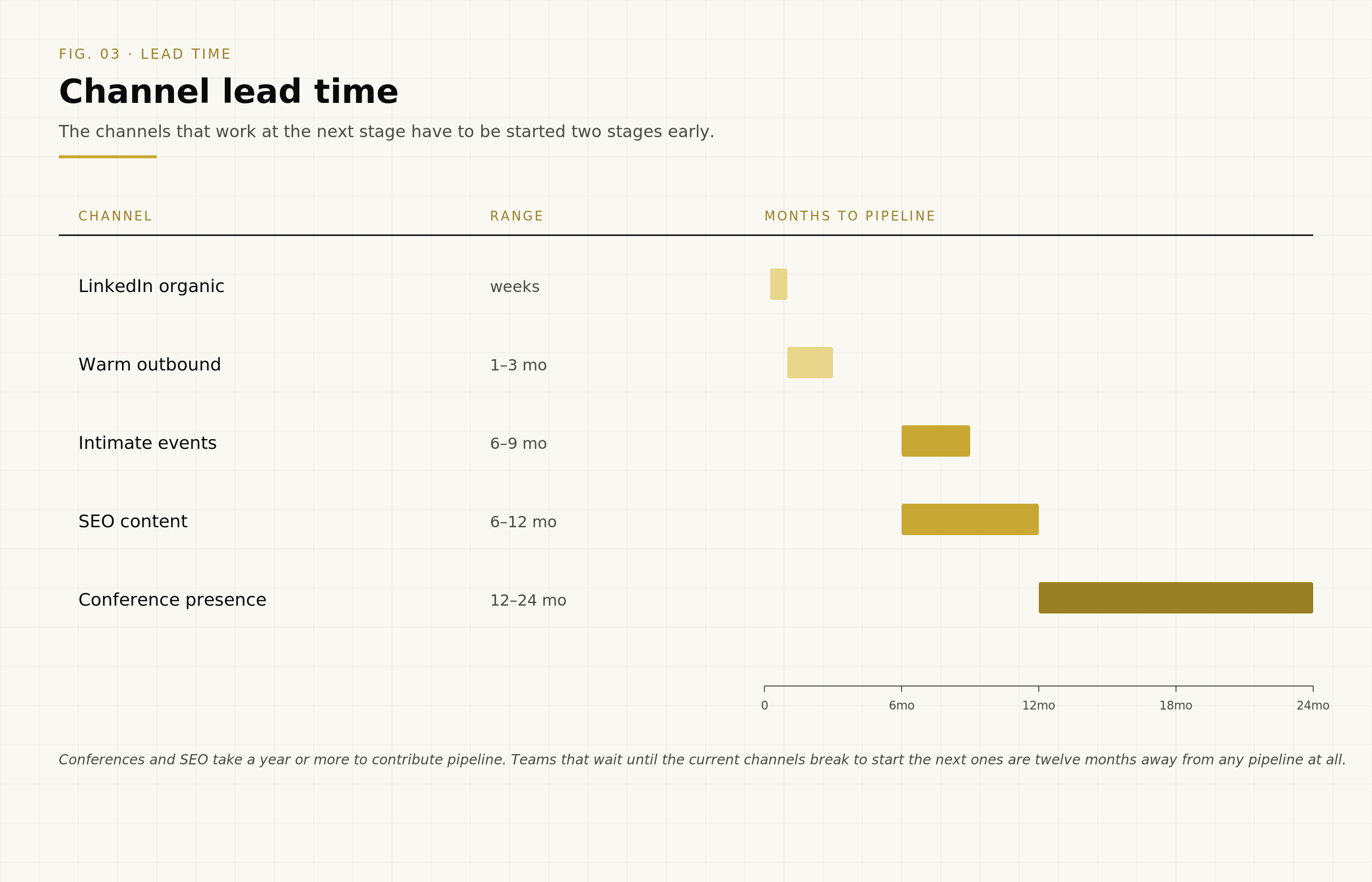
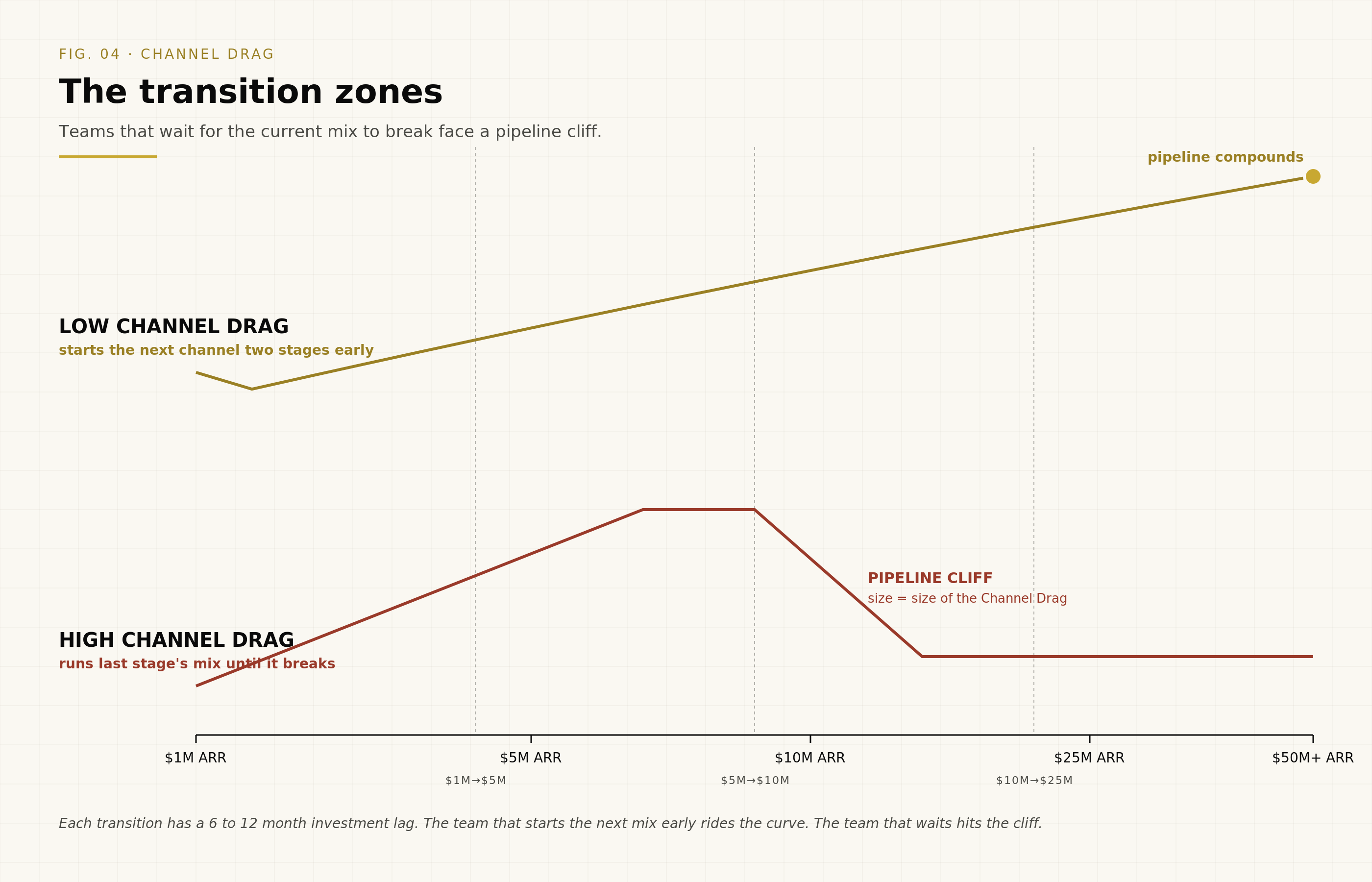
The hardest part of channel-mix maintenance is the transition. The team at $4M ARR is not running a $1M ARR motion or a $10M ARR motion. It is in transition. Channel Drag accumulates fastest during transitions because channels have lead time, and the team that waits for the current channels to break before starting the next ones is twelve months from the next channels working.
SEO content that produces qualified pipeline takes six to twelve months from first content to first conversion. A conference presence that produces meaningful pipeline takes one or two annual cycles to optimize. Intimate events that produce trust take two or three quarters to find the right format. Channels you should be investing in two stages early, not at the moment the current channels start to break.
The team that waits until LinkedIn pipeline declines before standing up SEO is one year of zero pipeline contribution away from SEO producing pipeline. Apollo’s pivot worked because they made the SEO investment before the sales-led motion broke completely, and they had the runway to ride out the lag. Most teams do not have that luxury, which is why the discipline of starting the next stage’s channels early is the single highest-leverage move a CMO can make at a transition.
The Reference-Feedback Split applies here
The channel mix is a reference artifact unless paired with a feedback loop. Most teams have a quarterly board slide that lists the channels they are running and the budget allocated to each. That slide is reference material. It describes a strategy. It does not update from outcomes.
The feedback file is different. The feedback file logs which channels actually contributed to closed-won pipeline this quarter, segmented by ACV and segment. Not lead source. Not first-touch attribution. Source of pipeline that converted. After three or four quarters, the feedback file tells the team which channels are still in fit and which channels have aged out, in a form that overrides the reference slide. The Reference-Feedback Split is the structural discipline that prevents any GTM artifact, channel mix included, from calcifying into stale reference material.
A team that does not run a feedback file on its channel mix is making channel decisions on data from when the mix was last in fit. By definition, last stage’s data. By definition, accumulating Channel Drag.
Build Reach is the test for high-ACV channels
At higher ACV, the question of whether a channel works has a structural test that most teams do not run. The test is whether the channel reaches the buying committee, not just an individual buyer.
A LinkedIn message that lands with a single VP at a $50K ACV deal has reached one of six committee members. The deal does not move forward unless the other five also move forward. The channel produced an output (a meeting) that did not actually advance the buying motion at the committee level. By the metric that matters, the channel had a Build Reach of one when the deal required a Build Reach of six.
Large conferences and intimate events dominate at high ACV not because they are exclusive. They dominate because they are structurally suited to reach committees in a single setting. A conference puts the VP, the engineering lead, and the ops director in the same room over the same two days. The channel has built-in Build Reach across the buying committee. Cold outbound at $50K ACV requires the SDR to manually reach each committee member, and most SDRs reach two of six and call it a day.
The Build Reach test sharpens the channel selection question. Pick channels by their structural ability to reach committees, not by their cost-per-meeting. The channel that reaches one committee member at low cost is producing the same output as the channel that reaches six at high cost, and only the second channel closes the deal.
What this changes for an operator
The Channel Drag audit takes an afternoon and most teams have not run one in two years. Pull every channel currently funded. For each channel, ask three questions.
What was our ARR and ACV when this channel started working? Most channels in the budget were chosen at a stage you have already passed. The gap between then and now is the Channel Drag on that line item.
What does the buyer at our current ACV require from a channel that this channel does not deliver? If you cannot answer concretely, the channel is in fit. If you can, the channel is in transition or out of fit.
What is the lead time on the channel we should be standing up next? Whatever your answer is, you are already late.
The audit produces a working list of channels to ramp down, channels to maintain, and channels to start. The ramp-down is the hardest part. It requires admitting that a channel that worked is no longer producing pipeline at the rate it used to, and that the team’s identity around that channel is the only thing preventing the reallocation. Apollo retired a sales-led motion they had spent years building. Most teams cannot bring themselves to retire a LinkedIn motion they have spent six months building.
What this changes for a leader
Stop reviewing channels annually. The right cadence is quarterly, with a feedback file that tracks contribution-to-closed-won by channel, by ACV bracket, by segment.
The harder discipline is the future channel pipeline. At every stage, two channels should be in development that will not contribute pipeline for the next two to three quarters. If the current quarter’s channel mix is producing all of the team’s pipeline, the team is one stage away from a pipeline cliff that nobody has scheduled.
The teams I have watched cross from $5M to $20M ARR all paid the same toll. Each one made channel investments that produced no pipeline for two or three quarters before they did. SEO content that took nine months to start ranking. Conference presences that took two cycles to find the right format. Founder-brand motions that took a year before the inbound started landing. That cost is the price of low Channel Drag. The teams that refused to pay it stopped scaling at the stage their channel mix could carry, which is rarely the stage they wanted to be at.
Common questions
What is Channel Drag?
Channel Drag is the gap between a company’s current stage and the stage it was at when each channel in its budget was added, measured in quarters. To measure it, list every channel you pay for, note the ARR or ACV bracket when it was added, and subtract from where the company is now. The gap is the drag on that line item.
Which GTM channels work at each ARR stage?
Below $1M ARR, founder-led LinkedIn and warm outbound carry pipeline. Between $1M and $10M, warm outbound becomes the backbone and intent-based motions enter. Above $10M, large conferences lead because the buyer is a committee, SEO invested in years earlier starts compounding, and paid supports inbound rather than leading it.
How does ACV change the right channel mix?
Under $5K ACV, one buyer decides in days, so SEO and paid ads win by intercepting the search. Between $5K and $25K, the buyer compares a shortlist over weeks, so warm outbound and intent motions lead. Above $25K, a committee builds consensus over months, and events are the only channels built to reach a committee in one room.
How did Apollo.io get to $100M ARR?
In 2020 Apollo was spending a dollar to acquire eighty cents of revenue on a sales-led motion. It moved to a freemium, product-led model, cut ACV from about $10,000 to $1,000 and built programmatic SEO that reached around 430,000 monthly organic visits. It reached $100M ARR within 24 months, with over 90% of new sign-ups coming from organic channels. Sources: Notorious PLG, growthmarketing.ai, Daydream.
The constraint reframed
Channel Drag is not a marketing problem. It is a structural problem about how a GTM motion stays aligned with the market it is selling into as the company grows. The channels that earned the first $1M of ARR are not the channels that earn the next $9M. The channels that earn the next $9M are not the channels that earn the $10M after that.
The teams that win update the mix on the cadence the data demands, run a feedback file that overrides the reference slide, and start the next stage’s channels two quarters before the current ones break. The teams that lose run last stage’s playbook on this stage’s market and call the resulting pipeline decline a market problem.
The constraint is not the channel. It is whether the team is honest enough to retire the channel that built it.