


GTM Vault is a breakdown of how high-growth companies design, test, and scale revenue architecture. Join 27,000+ operators building GTM systems that compound.
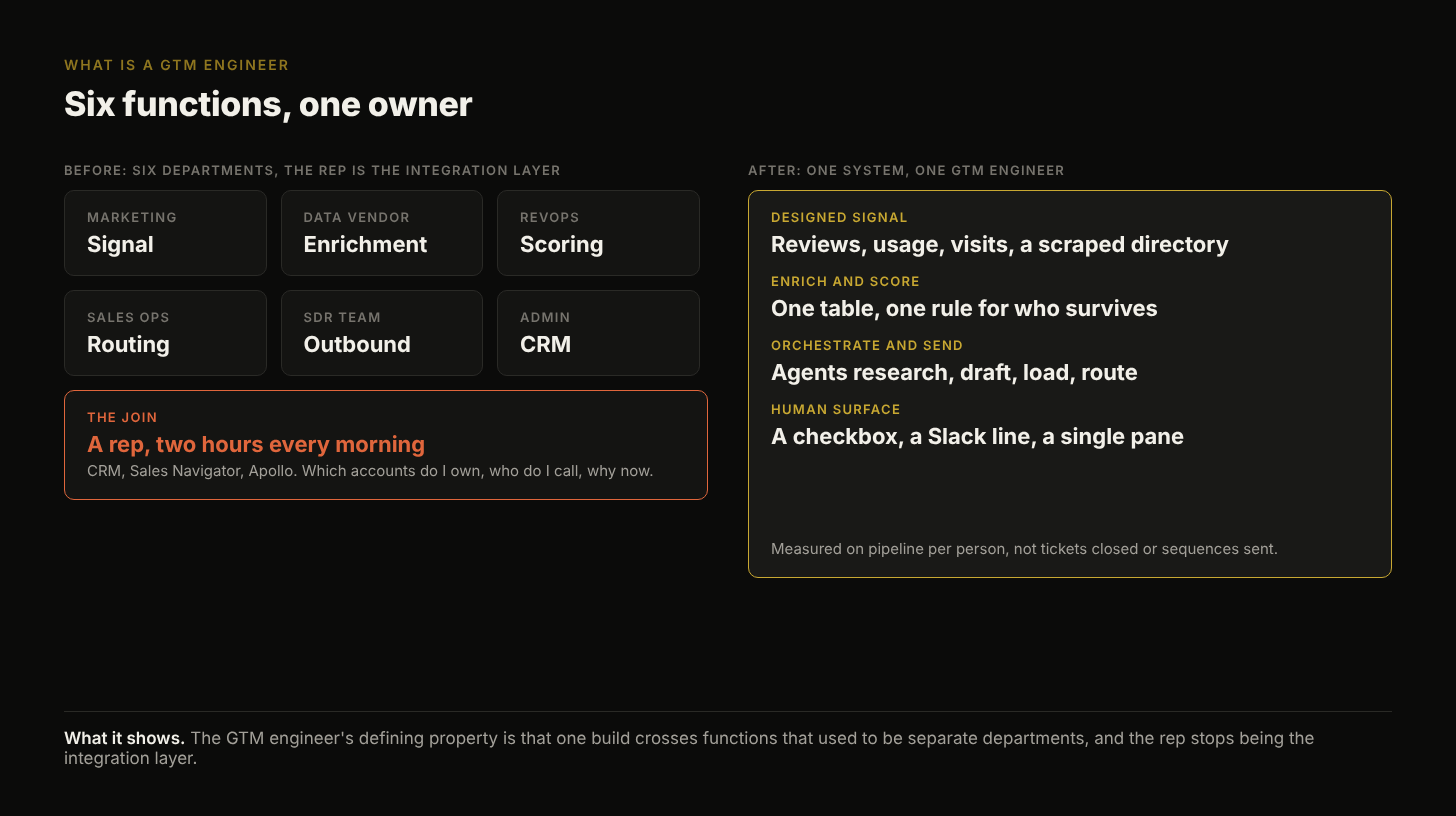
A GTM engineer is an operator who builds and runs the revenue system as software. Where a RevOps team maintains the CRM and a sales team runs plays by hand, a GTM engineer wires the signals, the enrichment, the routing and the outbound into one system, and then operates it. The output is pipeline per person, not tickets closed or sequences sent. The role exists because execution became cheap: when an agent can research, write and send, the scarce skill is designing what it should do, in what order, and with what data.
That is the definition. The rest of this essay covers where the title came from, how the role differs from RevOps, sales ops and a sales engineer, what the GTM engineers on the GTM Vault record have built, and how to tell whether a company needs one.
Where the Title Came From
The title spread from the Clay operator community in 2024 and 2025. Clay made it possible for one person to build enrichment waterfalls, scoring tables and personalised outbound without an engineering team, and the people doing that work needed a name. Michael Saruggia, who has trained more than 600 operators on Clay, described the shift on GTM Vault as automation eating RevOps: the work moved from maintaining systems to building them, and the people building them were measured on revenue per employee rather than on process health. By 2026 the first State of GTM Engineering report had surveyed more than 225 practitioners, and the title appears on job postings at companies from seed stage to public. The tools GTM engineers run, by operator count tracks what the role is built on now.
The name is new. The work is not entirely new. Growth engineers did a version of it for product-led companies a decade ago. What changed is the surface area: a GTM engineer today touches targeting, data, messaging, routing and the CRM, because the tools that used to sit in separate departments now sit in one table or one terminal.
What a GTM Engineer Is Not
A GTM engineer is not a RevOps hire. RevOps runs the revenue system that exists: data hygiene, routing rules, reporting, the process between functions. A GTM engineer builds the system that should exist and ships it. The two overlap in the CRM and diverge everywhere else. A company with strong RevOps and no GTM engineer has a clean system that does what it did last year. A company with a GTM engineer and no RevOps has a fast system that nobody can report on.
A GTM engineer is not a sales engineer. A sales engineer sits in the deal and proves the product works. A GTM engineer sits above the deal and decides which deals should exist.
A GTM engineer is not a marketing ops specialist with a new title. Marketing ops owns one function's tooling. The GTM engineer's defining property is that the build crosses functions: a signal from product usage routes to a rep through an agent that wrote the email from the CRM record. Three functions, one system, one owner.
What the Ones on the Record Build
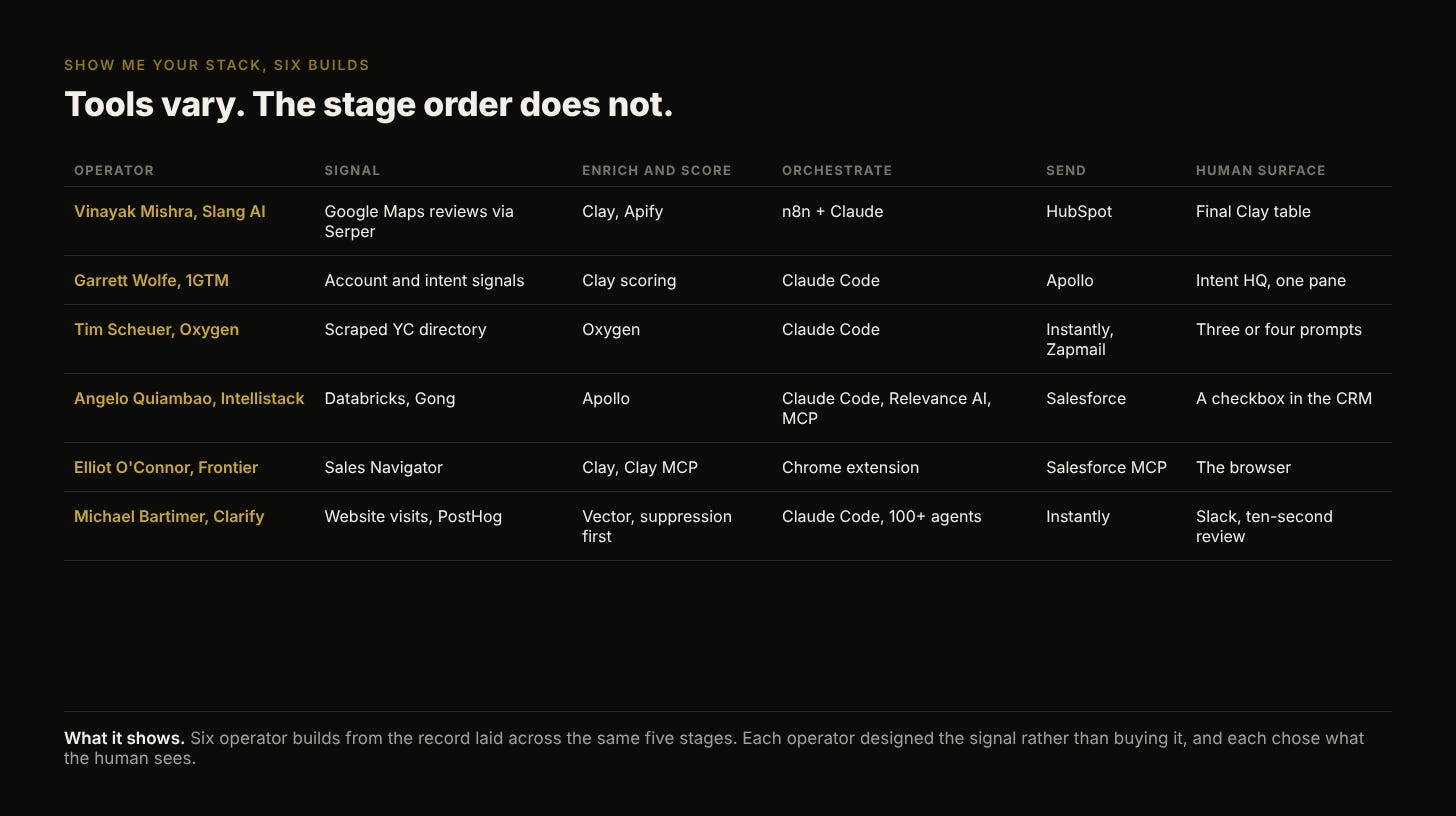
Show Me Your Stack exists to record this work with the operator's screen shared, so the definition above can be checked against what GTM engineers do. Six builds from the record, in the order they published.
Vinayak Mishra built a review intelligence system for Slang AI, a voice reservation product for restaurants. Five tools, five layers: Serper to discover restaurants from Google Maps, Clay to hold the table, Apify to pull the reviews, n8n and Claude to classify every review that mentions phones or reservations, and a final Clay table of restaurants whose own customers had documented the problem Slang AI solves. The signal was designed, not bought.
Garrett Wolfe built the action layer for BDRs at Unify, then at his consultancy 1GTM. The account list, the signals and the intent data all existed. The rep still spent two hours a morning toggling between the CRM, Sales Navigator and Apollo to answer three questions: which accounts do I own, who should I call, why now. His diagnosis is the clearest statement of the role: the rep was the integration layer. He replaced the rep as integration layer with a Clay scoring pipeline and a web app built in Claude Code, and the program went from zero to more than $15M in pipeline in twelve months.
Tim Scheuer at Oxygen collapsed campaign setup from three to five hours in Clay to forty minutes in a terminal. Scraping, enrichment, personalisation and launch ran from three or four natural-language exchanges with Claude Code. The first 180 emails into the Y Combinator founder pool, one of the most over-targeted lists in B2B, produced eight positive opportunities. The point was not the tool. When campaign creation stops being the expensive step, the number of angles a team can test in a week changes by an order of magnitude.
Angelo Quiambao at Intellistack runs the opposite of the demo-driven build. His principle is that the best use of AI is the indirect use of AI: a rep checks a box in the CRM and never sees the agents that research the account, draft the sequence and load it. At his previous company the same architecture went from opt-in to mandatory, with every BDR required to send fifty agent-generated emails a day. The stack is Claude Code, Relevance AI, MCP, Databricks, Salesforce, Gong and Apollo. The reps never meet the agents.
Elliot O'Connor at Frontier rebuilt outbound around the browser as the interface, so the system acts where the data is rendered rather than where an API happens to exist.
Michael Bartimer at Clarify runs more than a hundred agents inside one CRM. His website visitor agent takes a de-anonymisation payload and, before classifying anything, throws signal away: employees, competitors and existing customers are suppressed first. His PQL agent passes seven signals out of a hundred. The first job of a signal agent is subtraction, and a GTM engineer is the person who decides what gets subtracted.
The Stack Pattern Behind Every Build
The six builds share a shape even though the tools differ. There is a signal source the company designed rather than bought: reviews, product usage, website visits, a scraped directory. There is an enrichment and scoring layer, Clay in three of the six. There is an agent or workflow runtime, which in 2026 is increasingly Claude Code with MCP connectors rather than a no-code canvas. There is a sequencer or the CRM as the point of send. And there is a deliberate choice about what the human sees: a single pane, a checkbox, a Slack message, never the whole machine.
The Stack Index records every tool these operators named, with the operator who named it, at pro.gtmvault.co/stack. As of October 2026 the index holds 100 tools across eleven instrumentation layers, with 23 operators on the record. Clay, Claude Code and Slack are each named by seven operators, Apollo by six, Salesforce by five.
Does the Company Need One
Three conditions, and a company that meets two of them is already paying for a GTM engineer in rep hours.
First, the data to decide who to contact and why already exists in three or more systems and a human joins it by hand. Garrett's two hours a morning is the symptom.
Second, campaign creation is the bottleneck, not sending capacity. If the team can test one or two angles a week because setup costs hours, the constraint is build time.
Third, there is a signal the company could design that no vendor sells: usage events, support tickets, public reviews, hiring pages, anything specific to the product's problem. Bought intent data is the same list everyone else is emailing.
A company that meets none of these does not need the role yet. It needs an ICP and a motion, which are sequencing decisions and come first. Automation amplifies the system it inherits, and a GTM engineer hired into an undefined ICP builds a faster way to reach the wrong accounts.
Common Questions
What does a GTM engineer do day to day?
Builds and operates the revenue system: designing signal sources, building enrichment and scoring tables, writing the prompts and workflows that research and draft, wiring routing into the CRM, and watching what the system produces. The measure is pipeline per person.
What is the difference between a GTM engineer and RevOps?
RevOps maintains the revenue system that exists and reports on it. A GTM engineer builds the system that should exist and ships it. The CRM is where they overlap.
What tools do GTM engineers use?
On the GTM Vault record: Clay for enrichment and scoring, Claude Code with MCP connectors for orchestration (named by seven operators on the record), Apollo or Sales Navigator for contacts, Instantly or the CRM for sending, n8n or Relevance AI as agent runtimes, and HubSpot or Salesforce as the system of record. The Stack Index lists every tool with the operator who named it.
Is GTM engineering a sales role or a marketing role?
Neither. It is a systems role that crosses both. The defining property is that one build touches targeting, data, messaging and the CRM.
How much does a GTM engineer cost compared with SDRs?
The companies on the record did not add the role to a full SDR team; they used it to avoid hiring one. Garrett's program reached $15M in pipeline with the rep count held flat. The comparison that matters is pipeline per person, not salary against salary.
Where can I see real GTM engineer systems?
Show Me Your Stack, every two weeks, at pro.gtmvault.co/shows/show-me-your-stack. Every episode is the operator's screen, written up with the stack and the full transcript.
Every tool and operator named above is on the record at pro.gtmvault.co/stack. The definition at the top of this essay is the one the Stack Index uses to decide whose evidence counts as operator grade.