



Hi, it’s Rick Koleta. Welcome to GTM Vault, a breakdown of how high-growth companies design, test, and scale revenue architecture. Join 27,000+ operators building GTM systems that compound.
Revenue architecture is the structural design of a company’s revenue system: how positioning, pricing, motion design, RevOps, and AI-native workflows fit together, and in what order they get built. It is not a tool choice and not a growth tactic. The core claim is that revenue problems at working companies are usually structural, not effort problems: when the product works and the pipeline does not, the constraint is the architecture, not the activity. Revenue architecture treats sequencing as the first decision, because the same tools installed in the wrong order produce fragmentation instead of compounding.
That is the definition. This essay covers the rest: where the discipline came from, what is propelling it now, the eight layers it consists of, and why lean organizations that install it are pulling away from larger ones that accumulate instead.
Why the Term Needs Defining
“Revenue architecture” is currently used three ways. In the SaaS metrics world it circulated as a sales methodology, a system of models for measuring recurring revenue. In the consulting world it shows up as a rebrand for RevOps services. In vendor copy it means whatever stack the vendor sells. All three usages share the word. None of them carry the claim this essay makes: that architecture is the design and build order of the entire revenue system, and that in the AI era it has become the primary constraint on growth.
Loose terms produce loose decisions. A founder who thinks revenue architecture means a metrics model will buy dashboards. A founder who thinks it means a stack will buy tools. Both will wonder, eight months later, why the pipeline still does not compound. The definition matters because the diagnosis depends on it.
What Revenue Architecture Is Not
It is not RevOps. RevOps runs the revenue system that exists: the data hygiene, the routing, the reporting, the process. Architecture decides what system should exist and in what order it gets built. RevOps is a function. Architecture is the layer of decisions above it. A company can have an excellent RevOps team operating a badly architected system, and most do.
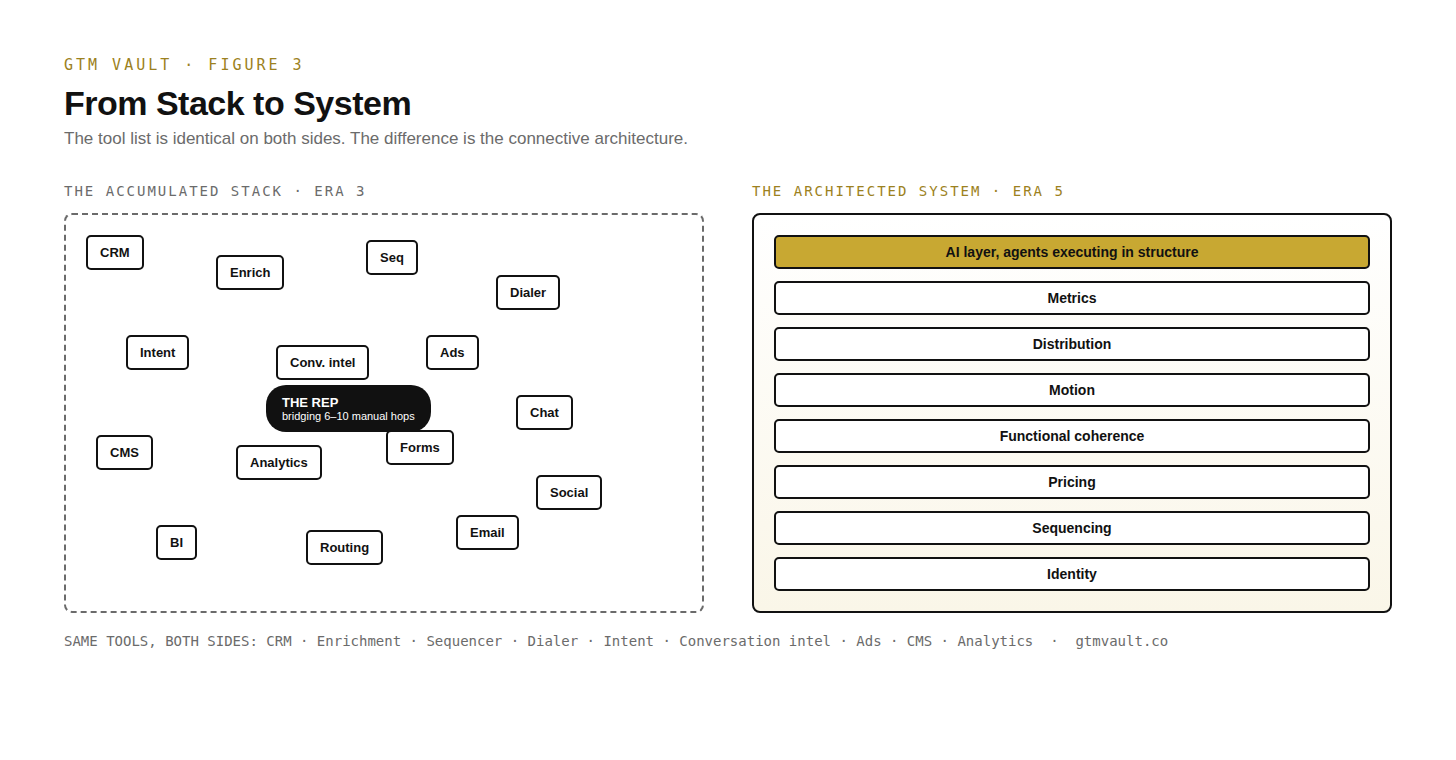
It is not a tool stack. The same eight tools produce compounding growth in one company and expensive chaos in another. The difference is not vendor selection. It is the structure the tools were installed into and the order they arrived in. Anyone selling architecture as a shopping list is selling the stack, not the structure.
It is not strategy in the slide-deck sense. Strategy says which market to win and why. Architecture says how the machine that wins gets assembled. Between the strategy offsite and the SDR hitting send, there is a layer of structural decisions that most companies never make deliberately. That layer is the subject of this essay.
The Five Eras of the Revenue System
The discipline did not appear from nowhere. It is the fifth era of a system that has been rebuilt four times, and each era is defined by what was scarce in it.
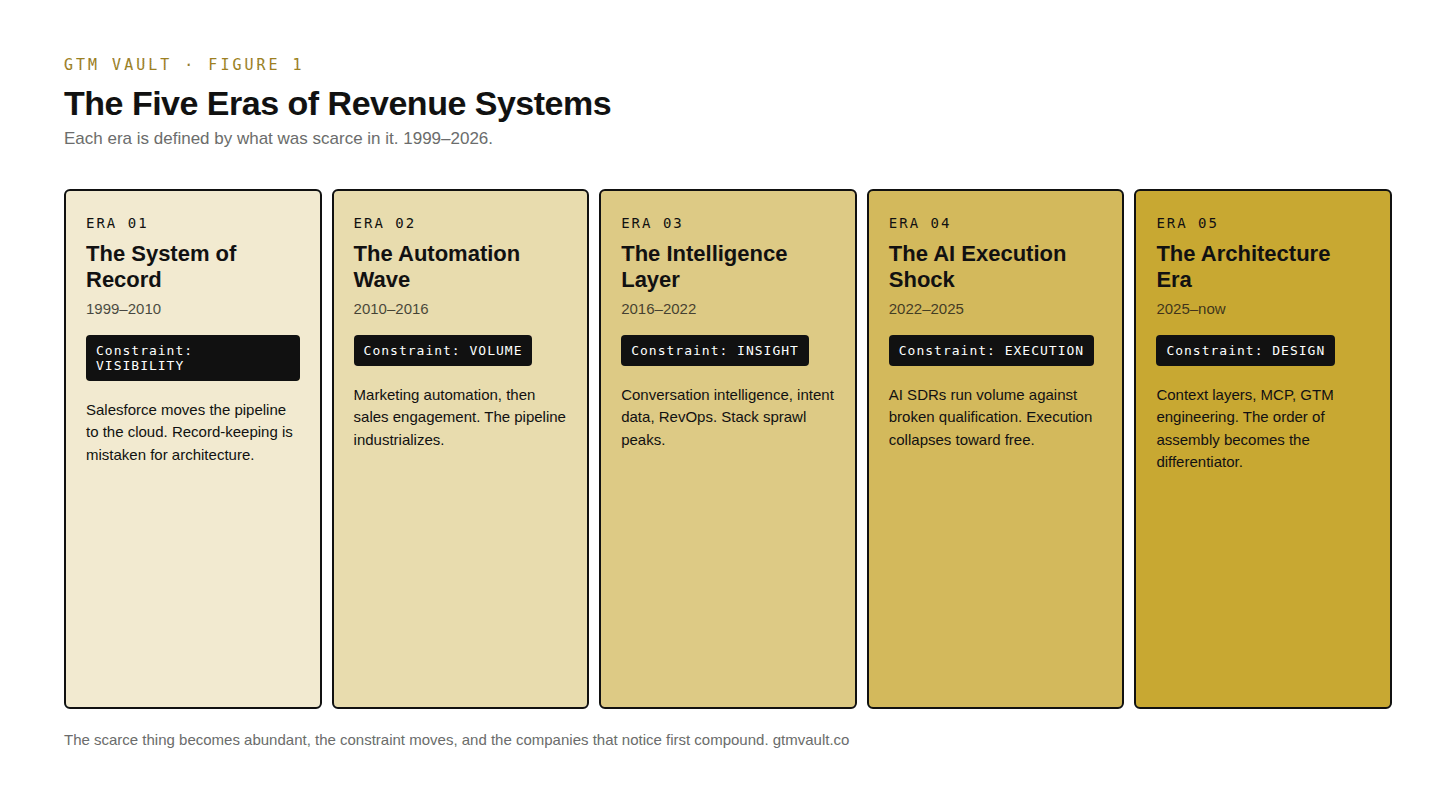
The System of Record, 1999 to 2010. Salesforce moved the pipeline out of spreadsheets and into the cloud. The scarce thing was visibility. For a decade, answering “what is happening in the pipeline” was the frontier, and the CRM answered it. Companies mistook record-keeping for architecture because the record was the most structured thing they owned. The era’s legacy is still with us: revenue data organized around what happened, not around what should happen next.
The Automation Wave, 2010 to 2016. Marketing automation arrived first, then sales engagement. Eloqua, Marketo, Outreach, Salesloft. The scarce thing was volume: more emails per rep, more sequences per campaign, more touches per account. The pipeline industrialized. Almost nobody asked whether the assembly line was pointed at the right buyers, because the line itself was new and the throughput gains were real. The era ended with every competitor running the same sequences into the same inboxes.
The Intelligence Layer, 2016 to 2022. Conversation intelligence, intent data, ABM platforms, and the rise of RevOps as a titled function. The scarce thing was insight: recording, scoring, and interpreting what the volume era produced. This is also the era of stack sprawl. A mid-market GTM org accumulated six to eight distribution channels running through fifteen to twenty tools, each optimizing one function’s metric. Each function improved in isolation. The system as a whole degraded at every functional boundary. The diagnosis has its own law: function-level optimization is system-level debt.
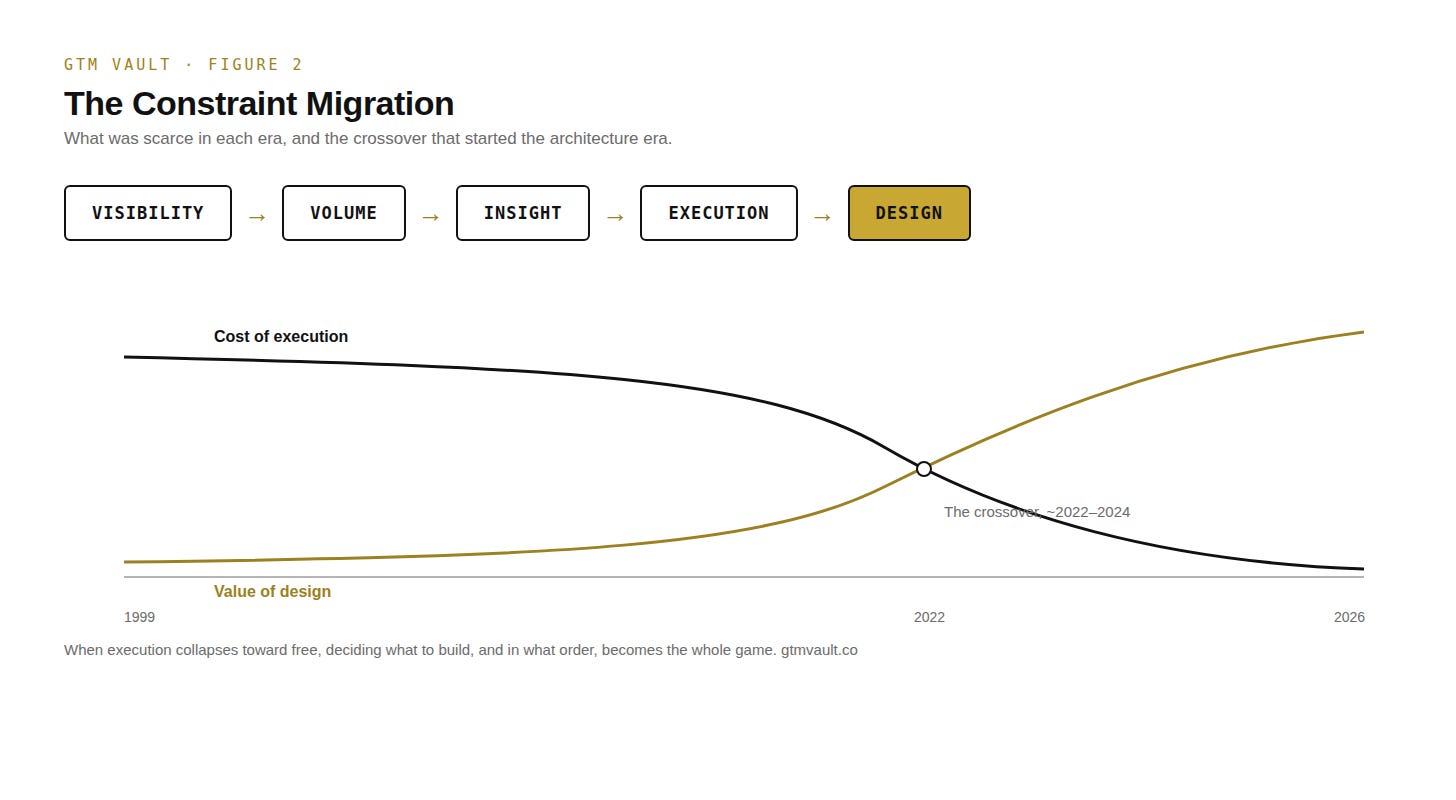
The AI Execution Shock, 2022 to 2025. ChatGPT shipped in November 2022. Within eighteen months, a category of AI SDR companies promised to replace the humans running the automation era’s playbooks. The first wave largely failed, and the failure was instructive: the tools ran volume against the same broken qualification the humans had been running, at machine speed, and the category’s early leaders watched most of their early revenue walk once break clauses opened. The lesson was not that AI does not work. The lesson was structural: automation amplifies the system it inherits. Execution collapsed toward free, and for the first time in five eras, the constraint moved to design. Why AI SDRs Failed sets out the first wave’s failure modes. What Is AI-Native GTM? sets out what replaced it.
The Architecture Era, 2025 to now. Context layers, MCP connectors, copilots over autopilots, GTM engineering as a named discipline, agents that reason over unified data instead of spraying from fragmented data. As of 2026, every company can afford every play. When execution is abundant, the differentiator is the order and structure of assembly. This is the era the definition at the top of this essay belongs to.
The Four Forces Behind the Architecture Era
Eras do not change because analysts announce them. They change because underlying costs move. Four moved at once.
Execution became software, then became nearly free. Work that consumed SDR teams, ops analysts, and content teams now runs through agents. Account research that took ninety minutes takes four. Sequence drafts that took an afternoon take a prompt. When doing costs almost nothing, deciding what to do is the entire game, and deciding-what-to-do is architecture.
The integration substrate matured. First APIs everywhere, then MCP in late 2024, which turned tools from destinations into layers an agent reasons across. A stack that could not talk to itself in 2020 is a queryable system in 2026. The technical precondition for architecture, connective tissue between layers, went from custom engineering project to configuration.
The context layer became a product category. Call data, CRM state, and intent signals are converging into graphs that agents act on directly. The vendor landscape is reorganizing around architecture’s raw material. When the market starts selling you the connective layer, the structure it connects becomes the differentiating asset.
Services flipped from staffing to systems. Agencies sold hands. The new wave, GTM engineers, fractional architects, systems consultancies, sells installed and documented systems that run without the vendor in the room. The services market is repricing execution toward zero and judgment toward premium, which is the same migration the software market made, one layer up.
The Eight Layers
Revenue architecture is not a metaphor. It has layers, each governs a specific class of decisions, and each has a law that names its failure mode. The eight layers, in build order:
Identity. Who the system is for, defined tangibly enough to disqualify in real time. Everything downstream inherits this decision, which is why it comes first. Every downstream decision inherits the ICP.
Sequencing. What gets built and scaled in what order. The layer this essay keeps returning to, because it is the one most teams skip. What scales first constrains everything after.
Pricing. Not a number, a structural decision that reshapes qualification, motion, and margin at once. Pricing restructures every layer it touches.
Functional coherence. Whether the functions optimize the system or their own dashboards. Function-level optimization is system-level debt.
Motion. How the company actually sells, and whether the playbook matches the stage the company is in now rather than the stage it was written for. Every playbook encodes the stage it was built for.
Distribution. Whether channels compose into a system or accumulate into a pile. Channel accumulation is not distribution architecture.
Metrics. Whether the numbers compound understanding or conceal decay. Every metric compounds or conceals.
The AI layer. Last on purpose. Agents installed on top of the seven layers below inherit whatever state those layers are in. AI amplifies the architecture it inherits.
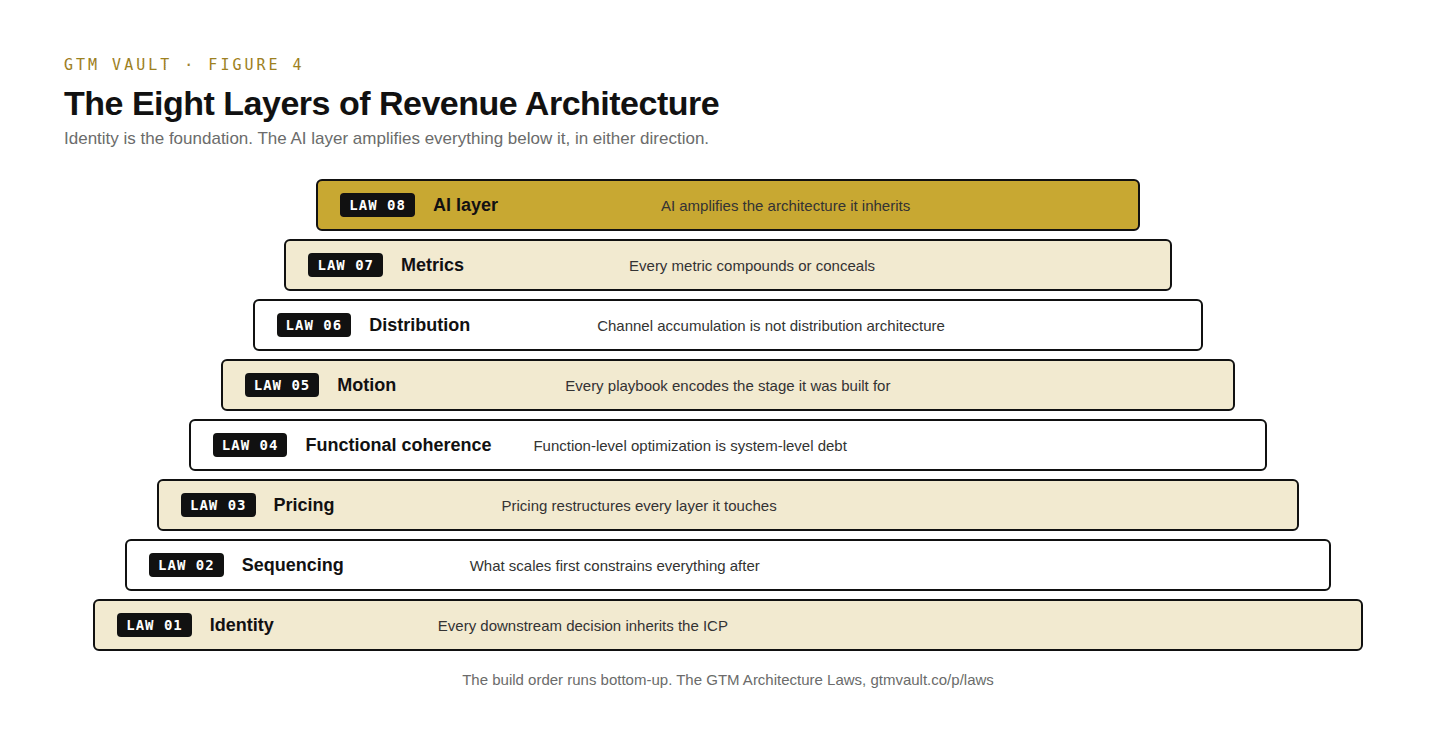
Each layer, its governing question and its failure signature are set out in The 8 Layers of a Modern Revenue System, along with why diagnosis runs bottom-up and what would falsify the ordering claim.
Sequencing Is the First Decision
The layers are not a checklist to run in parallel. They are a build order, and violating the order is the single most common architectural failure in AI-native GTM.
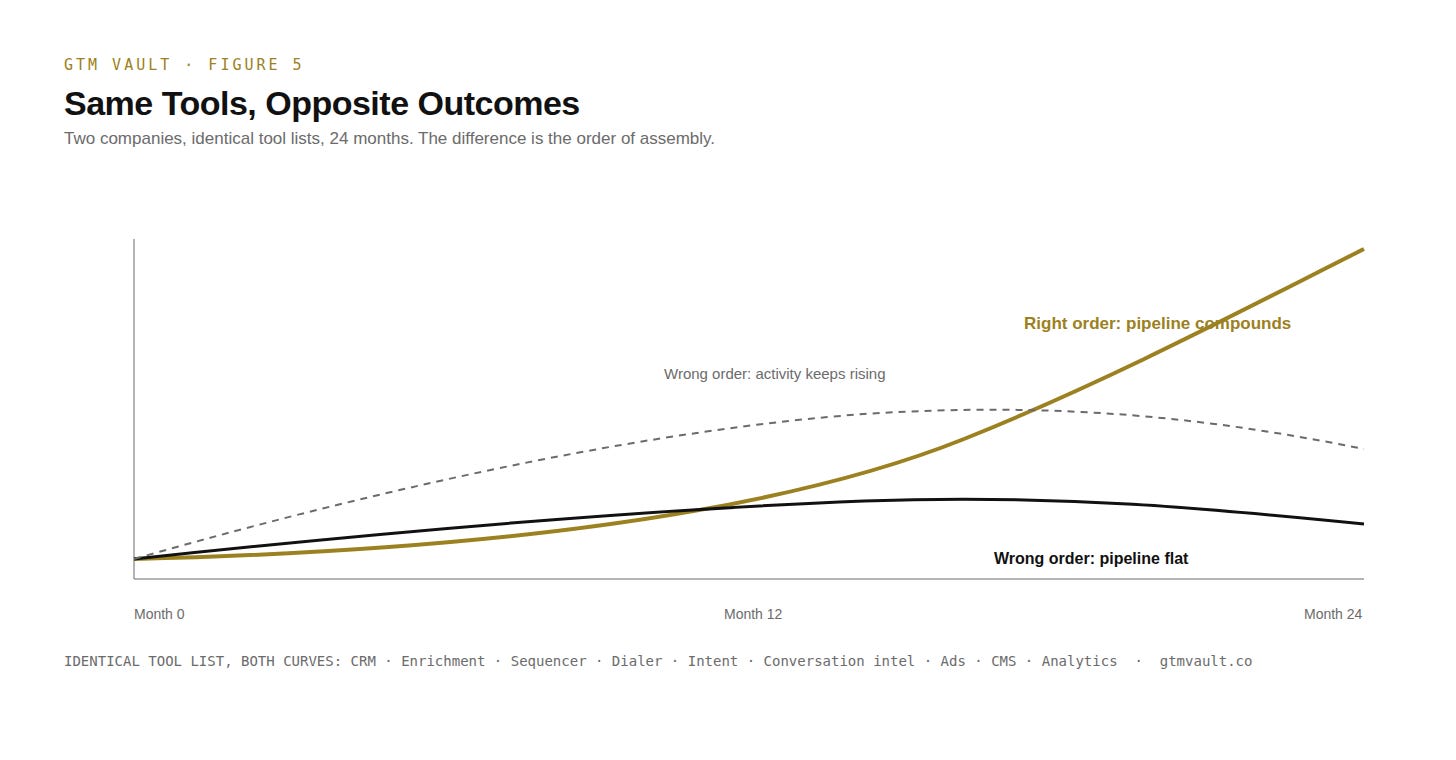
The pattern is familiar to anyone who has watched a funded team tool up. The company buys the full stack at once: enrichment, engagement, intent, conversation intelligence, and an agent layer on top. Every tool works as advertised. The system produces more activity than the company has ever generated, and the pipeline does not move, because the agents are reasoning over stale CRM data, the qualification layer still encodes an ICP from two stages ago, and every function is optimizing its own metric. The company did not install an architecture. It automated its existing fragmentation at higher speed.
The corrective sequence is unglamorous. Eliminate the manual data hops first, starting with the CRM update, because every agent downstream reasons over that data. Fix qualification before scaling volume, because volume against a broken filter produces expensive noise. Install agents on clean structure, not instead of it. The full argument is in AI-Native GTM Is a Sequencing Problem, and its one-line version is the closest thing this publication has to a motto: the tools are not the problem. The order is.
The Leverage Repricing
Here is why this matters more than the usual category essay, and why the stakes are organizational rather than technical.
The architecture era is a one-time repricing of organizational leverage. A five-person team with the right architecture now outperforms a fifteen-person team running automation-era playbooks at intelligence-era costs. This is not a productivity-tool claim. It is a structural claim: the small team’s system compounds, every signal accelerating the next action, while the large team’s accumulation produces increasing activity and decreasing leverage. The gap between them is structural, which means it does not close with effort. The fifteen-person team cannot outwork a compounding system. It can only out-spend its own noise for a while.
The comfortable framing of this moment is “companies that fall behind on AI will lose.” That framing is wrong, and the wrongness matters. Every laggard will buy the same AI. The models are available to everyone, the agents are subscription products, and the stack is a credit card away. The actual risk is bolting abundant execution onto fragmented structure, funding your own noise at machine speed while a leaner competitor funds compounding. Two companies will run the same tools next year. One of them architected the system underneath. That difference, not AI access, is what the next several years will price.
If your product works and your pipeline does not, the constraint is structural.
The Revenue Architect
Someone has to do this work, and at most companies nobody formally does. At Seed, the founder is the revenue architect whether they accept the title or not: every early decision about ICP, pricing, and motion is an architectural decision made under a different name. By Series B, architecture needs to be a designed responsibility, held by a specific person, because the system has grown past what any one function sees.
The revenue architect is not the GTM engineer. The architect decides what the system should be and in what order it gets built. The GTM engineer builds and runs it: the workflows, the pipelines, the agents. One is a design function, the other an engineering function, and conflating them produces systems that are beautifully built to the wrong spec.
The honest boundary: companies without product-market fit do not need revenue architecture. They need a product people want. Architecture compounds a working motion. It cannot create one, and installing it early is how teams end up with elegant systems for selling something nobody buys.
Questions Operators Ask
What is the difference between revenue architecture and RevOps? RevOps operates the existing revenue system. Revenue architecture designs the system and its build sequence. RevOps is a function. Architecture is the layer of decisions above it.
Who needs revenue architecture? Companies past product-market fit where the pipeline has stopped compounding: rising CAC, softening win rates, headcount scaling faster than system coherence. Pre-product-market-fit companies need a product, not an architecture.
When did revenue architecture emerge? The term predates the AI era, but revenue architecture as a discipline emerged between 2022 and 2025, when AI collapsed the cost of execution and moved the constraint to design.
Is revenue architecture only for AI-native companies? No, but AI raised the stakes. When execution is abundant, structure becomes the only durable differentiator, because everyone can afford the same activity.
What replaces the traditional GTM org? Smaller teams running architected systems: humans on judgment and relationships, agents on execution, and the structure between them doing the compounding.
Where the Eras Leave Us
Four eras ended the same way. The scarce thing became abundant, the constraint moved, and the companies that noticed first spent a few years compounding while everyone else optimized the previous era’s bottleneck. Visibility, volume, insight, execution. Each was the frontier until it was table stakes.
Design is the constraint now. It will not stay scarce forever either, but the repricing window is open, and windows like this one do not announce their closing. The eight layers above are the map. Start Here is the reading path, and Law 01 is where the build order begins.
Every term above is defined in one sentence in the glossary on The Stack Index, beside the tools operators named on each layer.