


What is AI-native GTM?
A revenue system is AI-native when the work happens behind a trigger the rep already touches, rather than inside a tool the rep has to open, learn, and choose to use. AI-assisted GTM puts the model in front of the human and inherits every adoption problem software has ever had. AI-native puts it behind the system, where the architecture runs whether or not anyone changes their behavior.

Hi, it’s Rick Koleta. Welcome to GTM Vault, a breakdown of how high-growth companies design, test, and scale revenue architecture. Read inside OpenAI, Anthropic, Meta, and Google, and by 27,000+ operators across 140+ countries building GTM systems that compound.
The short version
Every page-one result I checked defines AI-native GTM by the same test: is AI in the core of the product or bolted on the side. That test describes software. It does not predict outcomes, because a product can be AI at the core and still sit unopened on a rep’s second monitor. The test that predicts outcomes is adoption burden. Ask who has to change their behavior for the system to run. If the answer is the rep, the system is AI-assisted no matter what is under the hood.
The Term Means Two Things and Nobody Has Said So
Search the phrase and page one returns two incompatible definitions sitting next to each other.
One group means a way of running revenue: a system that researches accounts, scores them, drafts outreach, and writes back to the CRM. The other means a way of selling AI: how a company with a model and a usage-based price gets to its first thousand customers. Both call it AI-native GTM. Both rank for the same query. Not one of the pages I read acknowledges the other meaning exists.
That collision is why the answers are useless. A founder who asks an engine what AI-native GTM is gets a blend of two subjects, delivered with confidence, resolving to a demo request. This essay means the first thing. How revenue work gets done when agents do most of it.
The Test Is Adoption Burden
The incumbent definitions I read all run the same architectural test. Is intelligence woven into the core, or is it an add-on. It is a real distinction and it is the wrong one to lead with, because it describes how a vendor built their product rather than what happens inside your company on Tuesday.
Run the adoption test instead. For each piece of AI in your revenue motion, ask what a rep has to do differently for it to produce anything. If the answer involves opening something, learning something, or remembering to use something, the AI is in front of the human. Every gain it produces is now gated behind behavior change, which is the thing revenue orgs are worst at.
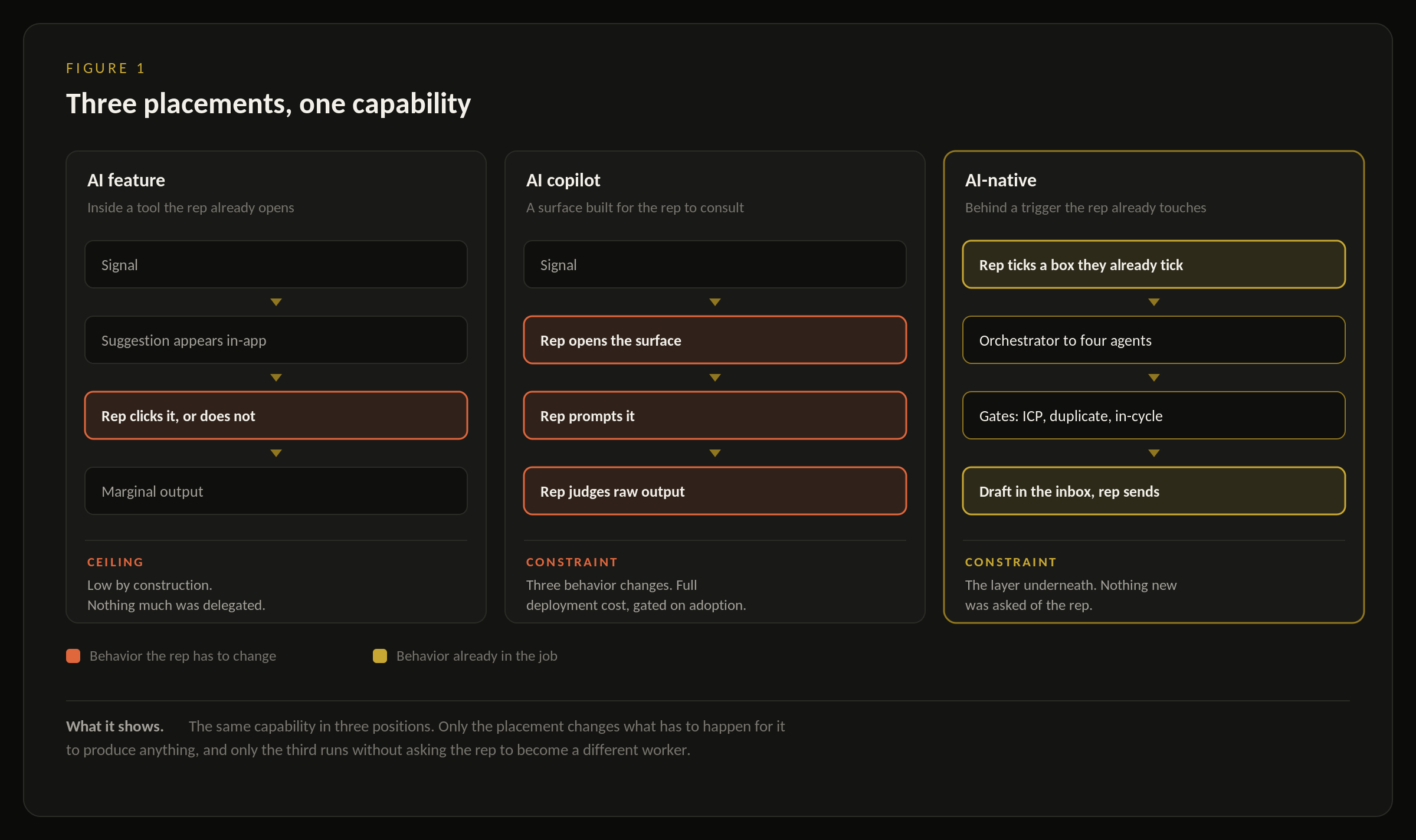
This is not a tooling distinction. It is a placement distinction.
Most writing on this collapses the field into two boxes, which is why the copilot question keeps escaping. There are three placements, and the middle one is where most revenue orgs are sitting right now.
AI featureAI copilotAI-nativeWhere the model sitsInside a tool the rep already opensIn a surface built for the rep to consultBehind the systemWhat the rep doesClicks a suggestionOpens it, prompts it, judges the outputTouches a trigger they already touchWhat has to change for it to workAlmost nothing, and it does almost nothingRep behavior, dailyNothing the rep was not already doingWhat breaks itNothing, the ceiling is just lowAdoption stalls at the tinkerersThe layer underneath, data or definitionsHow it is measuredFeature usageSeats, prompts sent, weekly activesPipeline per seller, cost per opportunityFailure modeInvisible, because expectations were lowQuiet non-useTraceable, if the logging layer was built
The middle column is the expensive one. A copilot carries the full cost of a real deployment, the integration work, the security review, the seat spend, and then routes every gain through the one variable the org controls least. That is why copilot rollouts produce a strong pilot and a flat quarter. The pilot self-selects the people who like tools. The quarter includes everyone else.
Two rows deserve a caveat, because the honest version of this argument is more useful than the clean one.
The third row does not say nothing changes. It says nothing changes that was not already the job. A rep in an AI-native system still reads a draft, judges it, edits it, and sends it. That is a real burden and it carries a real training cost, because trusting a draft is a learned behavior and so is knowing what the gates did not catch. The reason this survives where tool adoption fails is narrow and worth stating plainly: reading and sending an email was already in the job description. Opening a new interface never was.
The last row is conditional, and the condition is the whole design. An AI-assisted deployment fails silently by default. Usage drifts down, nobody escalates, and the renewal conversation is the first time anyone says it out loud. An AI-native system can fail either way. Built with error logs and gates that block and record, it fails where you can see it. Built without them, it fails quietly and expensively, which is the state described further down.
What the Benchmark Measures
ICONIQ’s State of Go-to-Market in 2026, a January 2026 survey of GTM executives at more than 150 B2B software companies, splits its sample on a variable worth reading twice. Not tool count, not spend. Their two cohorts are companies with AI “fully embedded into GTM processes” and companies where it is not.
Be careful about what that measures. Embeddedness is depth of adoption, not placement, and a company where every rep diligently opens three AI tools a day counts as fully embedded while being textbook AI-assisted. So the benchmark does not prove the distinction this essay is drawing. It is the closest instrument in the field, its cohort language is suggestive, and the direction of its findings is worth having.
In the $25M to $100M revenue band, companies with AI fully embedded averaged 45 GTM full-time employees in 2025 against 65 for their peers, counting sales, post-sales, marketing, and RevOps, with services and support excluded. That exclusion matters, because it rules out the obvious objection that the leaner cohort simply moved the work to a support team. Ramped account executives hit quota at 67% against 59%.
Hold those ratios loosely. The high-adoption cell runs between three and eleven companies in every revenue band, and ICONIQ publishes no sample size at all for the productivity scorecard the quota and cost figures come from.
The number that matters most is the one no vendor page I read quotes. Companies with AI fully embedded pay more per lead, $670 against $600, and less per opportunity, $8.5K against $8.9K. The most natural reading of that inversion is that the embedded cohort spends more to produce each lead and converts more of them, so the system is not a volume machine but a filter, and the filtering costs money at the top and saves more of it downstream. ICONIQ reports the two figures as independent averages rather than as stages of one funnel, so treat that as my reading of the data rather than their finding.
There is a limit in the same report, stated plainly, and any honest definition has to carry it. Comparing companies with more than half their pipeline AI-influenced against those below that line, conversion improves 11 percentage points from lead to MQL and 8 from MQL to SQL, then 1 point from SQL to closed-won and 3 from demo to closed-won. Their conclusion: AI-driven pipeline generation “currently does not materially change outcomes once deals are in an active cycle.”
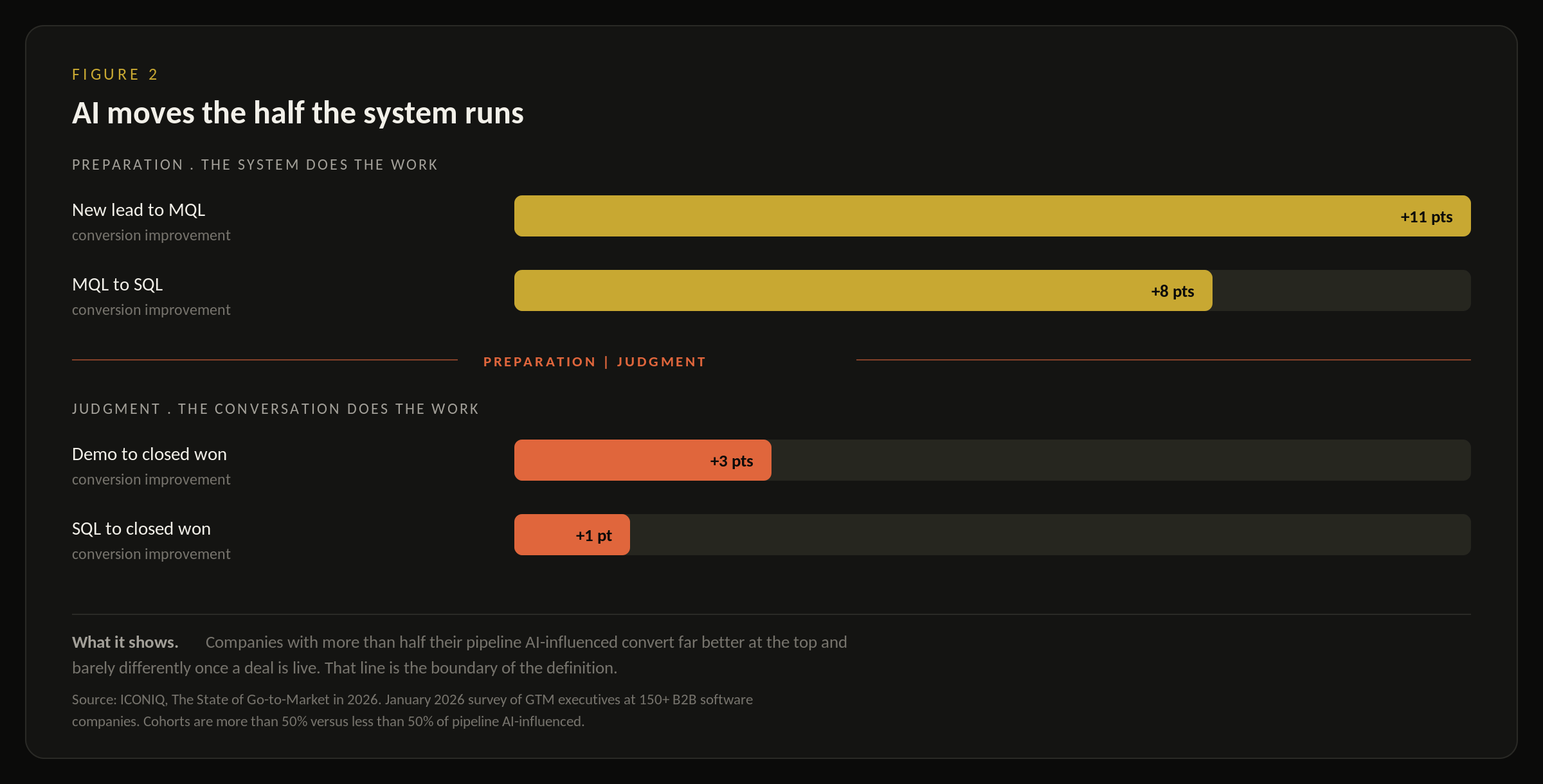
That is not a disappointing result. It marks where the boundary currently sits. AI-native describes the preparation half of the revenue motion, the part that is research, matching, gating, drafting, and logging. The judgment half stays human, and a system designed as though it does not will produce the failure documented in why AI SDRs failed.
One Checkbox, Seven Layers
The clearest production example I have seen came from Angelo Quiambao, a GTM engineer at Intellistack, who ran his live system on screen for twenty minutes in Show Me Your Stack 7.
His architecture is Claude Code as the terminal, Relevance AI hosting the agents, and MCP as the connective tissue, sitting over Databricks, Salesforce, Gong, and Apollo. One orchestrator sits in front of four single-job agents covering prospecting, account research, contact research, and emailing. No agent makes two decisions, because an agent that makes multiple decisions creates too many places to fail.
The design choice worth copying is what the research agent does first. It checks internal data before it touches anything external. Is there an open opportunity. Is there closed-lost history worth re-engaging. Is there first-party intent. Are there MQL or MQA personas on the account. Third-party signal comes last, after the company’s own knowledge has already narrowed the field. Then the gates run: ICP, duplicate check, and a pre-check for accounts already in a deal cycle. Anything that fails is blocked and logged rather than emailed. Deduplication is not cleanup at the end. It is a gate enforced before work happens twice.
The rep never sees the machinery. Their entire interface is a checkbox in Salesforce, or a message in Slack where the team already lives. They are never told that seven layers fired. They are told a draft will be in their inbox, and reading that draft is the one thing the architecture asks of them, which was already the job.
Two things about that are worth stating directly. First, it is the ICONIQ inversion in a single system. The architecture’s main job, as the episode frames it, is deciding who not to contact, which is what paying more per lead and less per opportunity looks like from the inside. Second, rep adoption is the number one thing he measures, ahead of any measure of agent capability, and his test for whether a build is sound is whether he can describe what an agent does to leadership in five to ten words.
A vendor cannot write this section. It requires an operator who built the thing and is willing to say what breaks.
Why the Order Still Decides This
Nothing above changes the sequence. An agent reasons over whatever structure sits beneath it, so an AI-native architecture installed on fragmented data produces that fragmentation at machine speed, quietly and expensively. Angelo’s first move on any build is not a build. Before a single agent exists he maps account tiering, ICP definitions, product information, and buying teams, then takes them to RevOps, marketing, and sales until the definitions match across all three.
His read on the market condition is the sharpest line in the episode. Companies are very data rich, because AI can pull data from anywhere, but nobody is context rich. The data is available to anyone now. The definitions are not, and the definitions are what an agent reasons against.
The full build order is in AI-native GTM is a sequencing problem: data, then intelligence, then agents. This essay defines the destination. That one is the route.
The AI Layer Is the Eighth
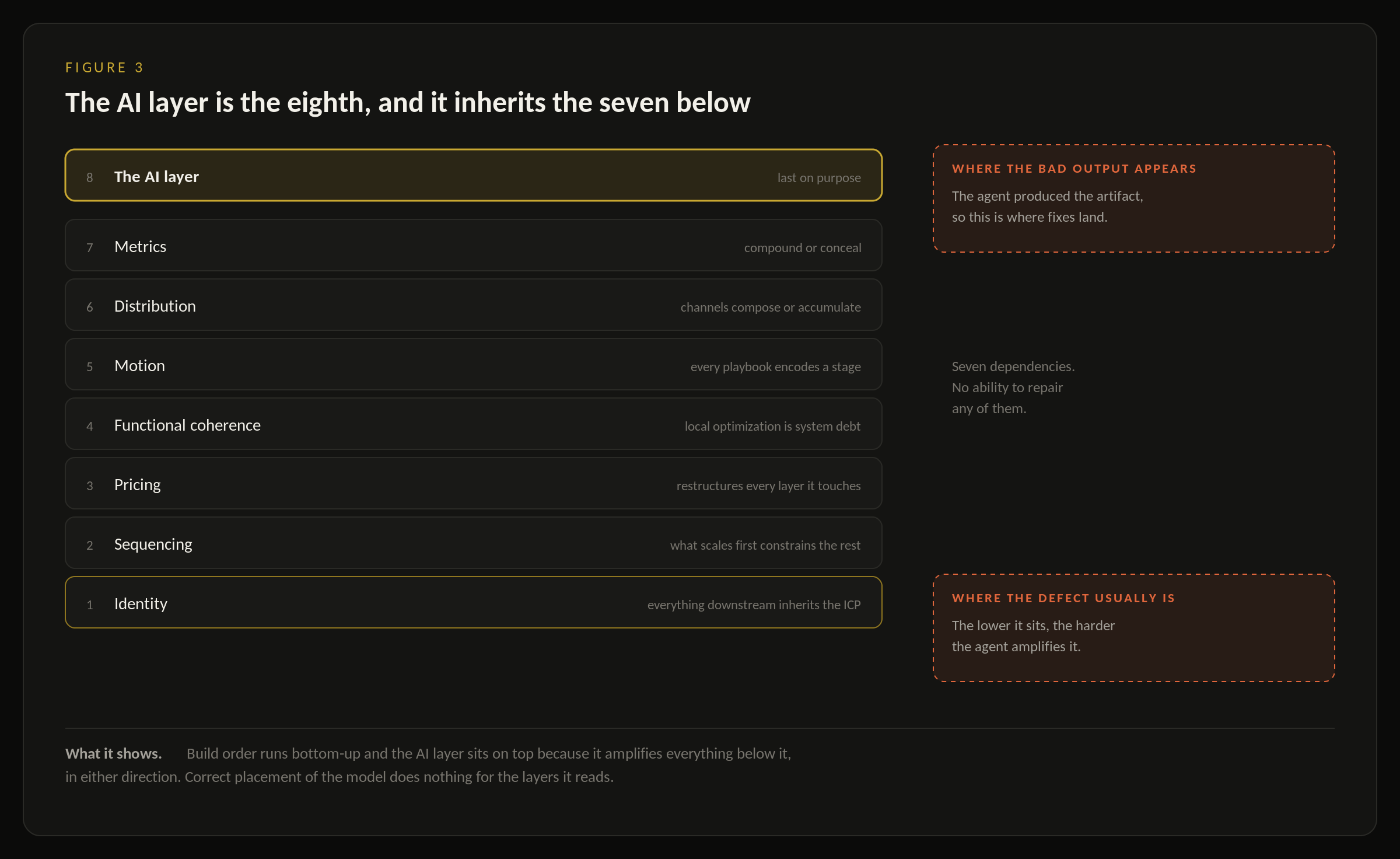
Revenue architecture has eight layers, and they are a build order rather than a checklist. Identity, sequencing, pricing, functional coherence, motion, distribution, metrics, and then the AI layer on top. Each one governs a class of decisions and reads the state of everything beneath it, which leaves the AI layer as the only layer in the stack carrying seven dependencies and no ability to repair a single one of them. Agents installed on top of the seven layers below inherit whatever state those layers are in.
That is why placement alone is not protective. Putting the model behind the system is the correct move and it does nothing for the layers underneath. An AI-native architecture sitting on an unresolved identity layer will disqualify the wrong accounts faster and more consistently than any human could, and it will do it quietly, because the ICP gate is working exactly as specified against a specification nobody agreed on.
This is not an argument for holding the AI layer until the other seven are finished, which is a state no company has reached. It is an argument for knowing which layer you are failing at when the output is wrong. Teams reliably diagnose a layer-one problem as a layer-eight problem, because layer eight is the one that produced the artifact they can see.
What a Half-Built System Looks Like
None of the pages defining this term describe the middle state, which is where most teams reading this will be.
It looks like an orchestrator wired to agents whose definitions came from three different documents, so the ICP gate passes accounts the AE team would never work. It looks like a dedupe check that runs on email address while the CRM keys on domain, so the same account gets touched twice a quarter and nobody can reproduce it. It looks like an agent with write access to the CRM and no error log, which means the first sign of a problem is a rep asking why the account owner changed.
The pattern in each case is the same. The placement is right and the layer underneath is not finished. Note that none of those three failures announce themselves, which is the condition attached to the last row of the table earlier. Placement alone does not buy you visibility. Gates that block and record, and agents that log their errors, are what turn a silent failure into a traceable one, and they are the part teams skip because they look like plumbing rather than capability.
The fix is never a better agent. It is going back one layer.
The Audit
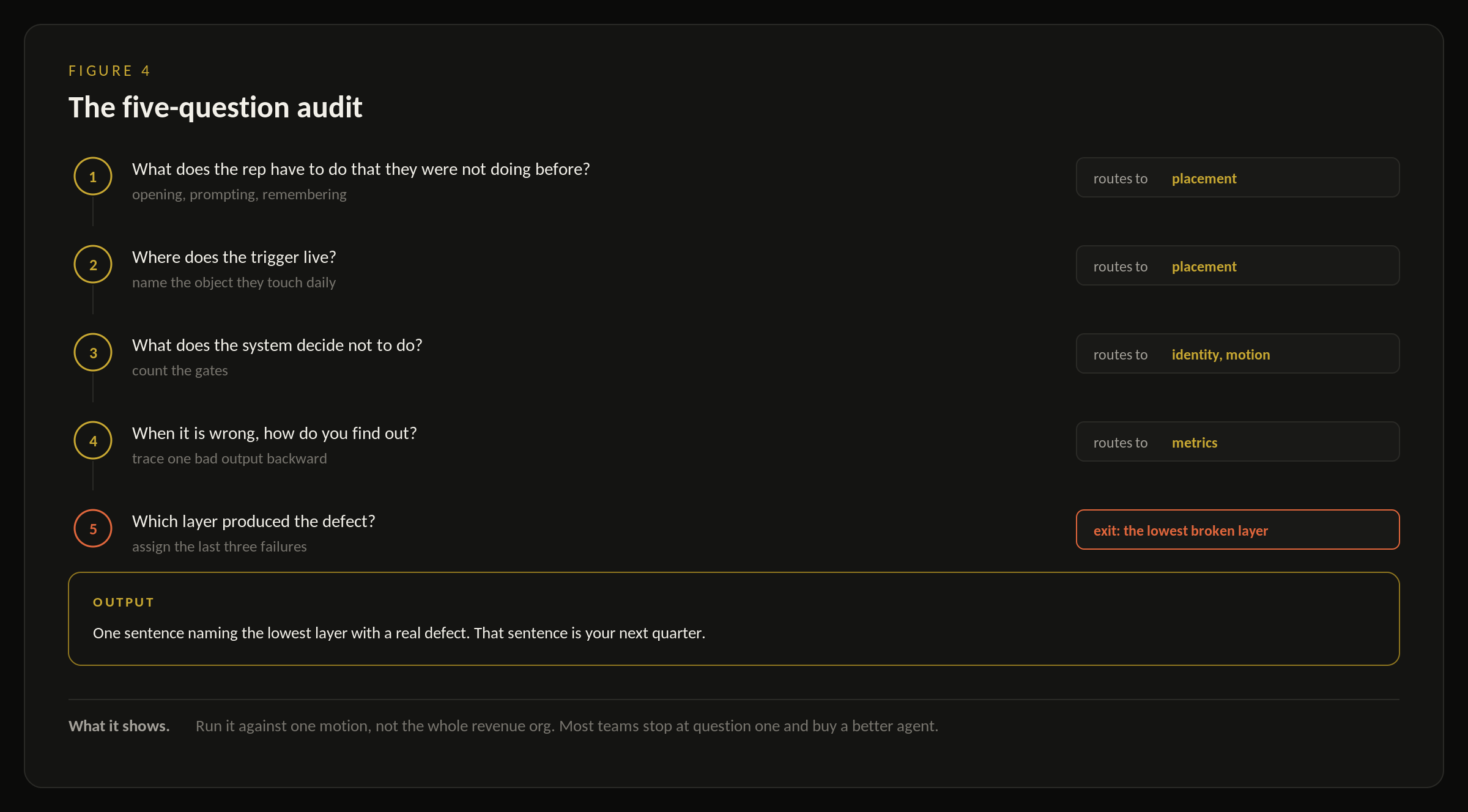
Five questions, in order. Run them against one motion rather than the whole revenue org, because the answers differ by motion and an average across all of them tells you nothing.
What does the rep have to do that they were not doing before? If the honest answer includes opening, prompting, or remembering, you are running a copilot and every projected gain is multiplied by an adoption rate you have not measured. Measure it before you plan against it.
Where does the trigger live? Name the specific object the rep touches. A field on a record, a message in the channel they already sit in. If the trigger lives anywhere the rep does not already go daily, the placement is wrong regardless of what the architecture does after the trigger fires.
What does the system decide not to do? An architecture that only produces is a volume machine, and volume against a weak filter is the AI SDR failure with better branding. Count the gates. If there is no ICP gate, no duplicate gate, and no check for accounts already in a deal cycle, the system has no opinion about who to leave alone.
When it is wrong, how do you find out? Trace one bad output backward. If the path from a rep noticing something odd to a logged, reproducible cause takes more than a few minutes, you do not have an observable system, you have an unobservable one that happens to be behind the rep instead of in front of them.
Which layer produced the defect? Take the last three things the system got wrong and assign each to one of the eight layers. If all three land on the AI layer, the assignment is wrong. Almost nothing originates there.
The output of that audit is not a score. It is a single sentence naming the lowest layer with a real defect, and that sentence is your next quarter.
Where This Framing Breaks
Three limits, because a definition that survives only in the cases it was built for is a slogan.
The first is stage. Adoption burden is the right test once a motion is repeatable and the rep’s job is defined well enough to say what was already in it. Before that, in founder-led sales and the first complex enterprise deals, the research is the selling. Hiding the preparation from the person having the conversation removes the thing they were supposed to learn. Early on, put the human in front on purpose and accept the ceiling.
The second is opacity. Hiding seven layers behind a checkbox buys adoption and spends something to get it. A rep who cannot see the system cannot debug it, cannot tell you the drafts got worse in the last two weeks, and cannot distinguish an agent error from a data error. The mitigation is the translation layer, which is why Angelo weights enablement equal to the build and tests every agent against a five-to-ten-word explanation. Skip that and you have traded an adoption problem for a trust problem, which is slower to detect and harder to reverse.
The third is that adoption burden says nothing about ownership. A system nobody has to adopt is also a system nobody obviously owns, and agents with CRM write access and no named owner are a governance problem waiting for a quarter-end. The test tells you where to put the model. It does not tell you who answers for it.
What This Decides
The practical consequence is a reallocation, not a purchase.
Most GTM AI budget currently buys surfaces that reps have to choose to open, and most GTM AI disappointment traces to the gap between the pilot group who chose to and the org that did not. Moving that spend behind the system does not require a platform migration. It requires deciding that the interface is a design constraint rather than a feature, and that every new capability gets placed before it gets built.
The question to take into the next planning cycle is not which AI to buy. It is which triggers your reps already touch, and what could run behind them.
Common Questions
What is AI-native GTM?
A revenue system is AI-native when the work happens behind a trigger the rep already touches, rather than inside a tool the rep has to open, learn, and choose to use. The test is adoption burden, not whether AI is in the core of a product. If the system requires rep behavior change to produce anything, it is AI-assisted regardless of the architecture underneath.
What is the difference between AI-native and AI-assisted GTM?
Placement. AI-assisted puts the model in front of the human, which means every gain is gated behind adoption. AI-native puts it behind the system, so the architecture runs whether or not anyone learns a new interface. The practical tell is what the rep has to do differently, and in an AI-native system the answer is nothing that was not already the job. Reading and sending a draft was already the job. Opening a new tool was not.
Is an AI copilot the same as AI-native GTM?
No, and the copilot is the more expensive of the two to get wrong. A copilot is a surface built for the rep to consult, so it carries the full cost of a deployment, the integration, the security review, and the seat spend, then routes every gain through whether people open it. AI-native puts the same capability behind a trigger the rep already touches, which is why copilot pilots look strong and copilot quarters look flat. The pilot self-selects for people who like tools.
Is AI-native GTM a platform you buy?
No. It is a property of how your revenue system is arranged, and you can build it on tools you already own or fail to build it on the most AI-native platform on the market. Vendors define the term as a product category because that is the version they can sell. The arrangement is the part that decides whether it works.
Does AI-native GTM mean replacing sales reps?
No, and the benchmark data argues against it. ICONIQ’s 2026 survey shows AI-influenced pipeline improving lead-to-MQL conversion by 11 percentage points and MQL-to-SQL by 8, then 1 point and 3 once a deal is in an active cycle. AI-native describes the preparation half of the motion. The judgment half stays human, and systems built as though it does not are the ones that failed publicly in the AI SDR wave.
How do you know if your GTM is AI-native?
Ask what a rep has to do differently for the system to produce output, and ask where a failure shows up. In an AI-native system the rep does nothing that was not already part of their job, and failures surface as blocked records and error logs if the logging layer was built. In an AI-assisted system the rep has to open something, and failure looks like usage quietly declining until someone notices at renewal.
Where does AI-native GTM improve the numbers?
At the top of the funnel and in headcount leverage. Companies with AI fully embedded in GTM processes averaged 45 GTM full-time employees in 2025 against 65 for peers in the $25M to $100M band, with 67% of ramped AEs hitting quota against 59%. They also pay more per lead and less per opportunity, which is the signature of a system built to filter rather than to produce volume. Sample sizes on the high-adoption side are small, so read the direction rather than the ratio.
Related Reading
AI-Native GTM Is a Sequencing Problem. This essay defines the destination, that one gives the build order: data, then intelligence, then agents.
Your Reps Should Never Meet Your Agents. Angelo Quiambao’s full stack on screen, the seven layers behind the checkbox, and the gates that run before any work happens.
Why AI SDRs Failed. What happens when a system is built as though the judgment half of the motion can be automated too.
What Is Revenue Architecture. The eight layers in build order, and why the AI layer is last on purpose.
What Is a Revenue Architect? Who owns the layer order, and the test that separates holding that role from advising on it.
This is for teams where CAC is rising, win rates are softening, or headcount is scaling faster than system coherence. If your product works and your pipeline does not, the constraint is structural.
Subscribe for the architecture behind what the best operators are building.
Thanks for a valuable framework to present AI-based solutions. Good stuff!