


Hi, it’s Rick Koleta. Welcome to GTM Vault, a breakdown of how high-growth companies design, test, and scale revenue architecture. Read inside OpenAI, Anthropic, Meta, and Google, and by 27,000+ operators across 150+ countries building GTM systems that compound.
The short version
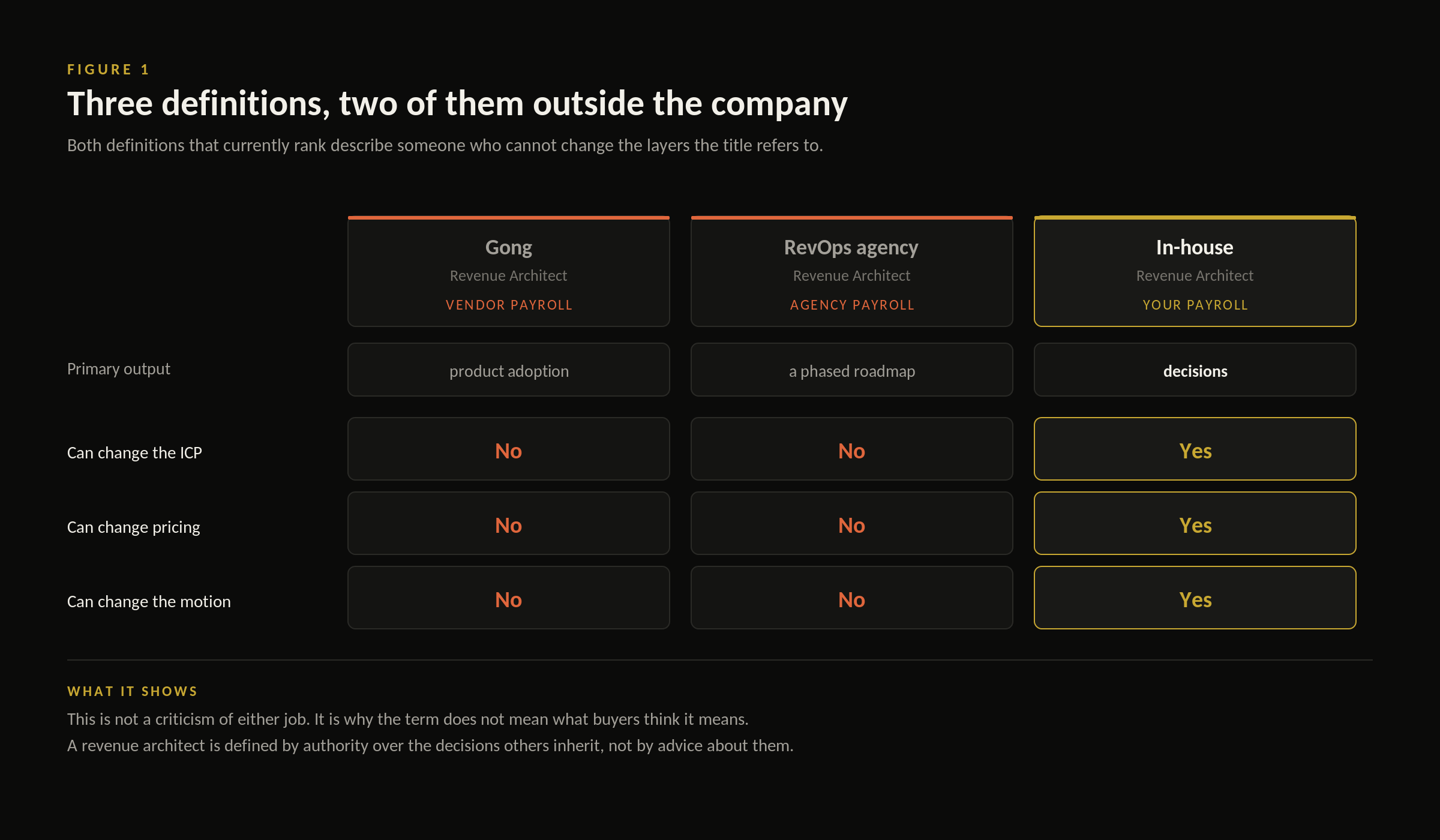
Search the role and you get two answers. Gong’s help centre defines a Revenue Architect as your strategic partner for getting value from Gong, and states plainly that it is the role you previously knew as your Customer Success Manager. A RevOps agency defines it as a director-level consultant who leads client engagements and hands over a phased roadmap. Both are real jobs. Neither can change your ICP, your pricing, or your motion, which are the decisions the title refers to. A revenue architect is defined by authority over the decisions that every other decision inherits. Advice about those decisions is a different job, and the gap between the two is why companies buy revenue architecture and do not get it.
The Two Definitions That Rank
Take them at their word, because both are explicit.
Gong’s help centre, published April 2026 and updated in June, says a Revenue Architect is “your primary strategic partner for getting business value from Gong,” and then adds the line that settles it: “You might previously have known this role as your Customer Success Manager (CSM).” The same page lists what the role does not handle: implementation, technical troubleshooting, pricing, contracts, and commercial negotiations. It is an adoption role, working on the vendor’s side of the relationship, and it is a good one. It is not architecture.
NewEdge Growth, a Kansas City RevOps agency, posts a Revenue Architect job that reads very differently. Director level, eight or more years, executive point of contact, leads internal delivery teams, defines the end-to-end revenue architecture including roles, processes, handoffs, and technology. That is a serious role and much closer to the discipline. But read the verbs. Evaluate, define, document, develop, communicate, advise. The output is a roadmap with Now, Near, and Far milestones, delivered to a client who then decides whether to follow it.
What the two share is the thing nobody says out loud. Both sit outside the company whose revenue system is being architected. One works for the vendor. One works for the agency. Neither can change the ICP, reprice the product, or redesign the motion, because those decisions belong to people who are not them.
That is not a criticism of either. It is a description of where the term currently lives, and it explains a pattern operators keep reporting: a company engages someone to architect its revenue system, receives a competent document, and eighteen months later has the same architecture it started with.
The Test Is Authority, Not Advice
A revenue architect is whoever can change the decisions that other decisions inherit.
That is the same boundary as the one between architecture and RevOps, applied to a person instead of a discipline. Architecture decisions are expensive to reverse and are inherited by everything below them. If a person can recommend a change to the ICP but cannot make it, they are advising the architect. They are not the architect.
The test is one question, asked about a specific human: when this person concludes that the pricing model is wrong, what happens next? If the answer is that the pricing changes, they hold the role. If the answer is that a deck gets presented and a decision gets scheduled, someone else holds it, and the useful next question is who.
Most companies cannot answer that question, which is the finding rather than a failure of the exercise.
What the Role Decides
Mapped onto the eight layers of a revenue system, the architect owns five and shares three.
Identity, who the system is for, defined tightly enough to disqualify in real time. Sequencing, what gets built and scaled in what order. Pricing, which is a structural decision rather than a number, because it reshapes qualification, motion, and margin at once. Functional coherence, meaning what each function is measured on and whether those measures compose. Motion, how the company sells and whether the playbook matches the stage it is in now.
Distribution, metrics, and the AI layer are shared. The architect decides which channels the company competes in, which number governs the forecast, and whether agents run inside the system of record. RevOps operates all three.
Notice what is absent from that list. No tooling decisions. No dashboard builds. No CRM administration. A revenue architect who is spending their week in the CRM has either been given the wrong job or taken it.
Not the GTM Engineer
The two roles get conflated constantly, and the distinction is clean.
The architect decides what the system should be and in what order it gets built. The GTM engineer builds and runs it: the workflows, the pipelines, the agents, the integrations. One is a design function. The other is an engineering function. Conflating them produces systems that are beautifully built to the wrong specification, which is the most expensive failure available because it looks like progress the whole way through.
The interesting evidence here comes from the agency job posting, which describes its Revenue Architect leading internal teams of Solutions Architects, Technical Solutions Architects, Developers, and GTM Engineers. Even the definition that treats the role as consulting puts the architect above the engineer in the order of operations. The disagreement in the market is about where the role sits relative to the company, not about where it sits relative to engineering.
Both roles are real and a company at scale needs both. A GTM engineer without an architect builds whatever was asked for. An architect without a GTM engineer produces documents.
Who Holds It at Each Stage
At seed, the founder is the revenue architect whether they accept the title or not. Every early decision about ICP, pricing, and motion is an architectural decision made under a different name, usually while doing four other jobs. This is fine, and formalising it early is overhead.
By Series B it needs to be a designed responsibility held by a named person, because the system has grown past what any single function can see. Marketing sees the top, sales sees the middle, CS sees the renewal, finance sees the model, and the interactions between those layers are visible to nobody. That is the specific condition the role exists to fix.
The failure mode in between is not that the wrong person holds it. It is that nobody does, and the decisions get made anyway, one at a time, by whoever owns the nearest function. Pricing gets set by whoever built the pricing page. The ICP drifts by accumulation as sales chases what closes. The motion changes because a new VP brought a playbook from their last company. Every one of those is an architecture decision made without an architect, and the result is a system nobody designed and nobody can explain.
Where This Framing Breaks
Below product-market fit the role does not apply. Architecture compounds a working motion; it cannot create one. A pre-PMF company needs a product people want, and anyone doing revenue architecture at that stage is building elegant systems for selling something nobody buys.
Authority is rarely total, and the test has to survive that. Almost nobody can unilaterally reprice a product. The realistic version of the test is not “can this person act alone” but “is this person in the room, with standing, when the decision is made.” A revenue architect who has to request a meeting to discuss pricing does not hold the layer.
The consultants are not doing nothing. An external architect who works with an executive who does hold the authority is a functioning arrangement, and often the only way a company gets the work done at all. The claim is narrower than it sounds: the consultant supplies the design, the executive supplies the authority, and the arrangement fails when everyone assumes the other party had both.
What This Decides
If you are hiring for this, the job description is a list of decisions, not a list of tools. If you are evaluating someone who calls themselves one, ask what they changed rather than what they recommended.
And if you are trying to work out who holds it at your company right now, ask who could change the ICP by the end of the quarter. The name that comes back, or the silence that comes back, is your answer.
Common questions
What is a revenue architect?
The person with authority over the decisions that every other revenue decision inherits: identity, sequencing, pricing, functional coherence, and motion. The test is not job title or seniority, it is what happens when they conclude a layer is wrong. If the layer changes, they hold the role. If a recommendation gets scheduled for discussion, someone else does.
What is the difference between a revenue architect and a GTM engineer?
The architect decides what the system should be and in what order it gets built. The GTM engineer builds and runs it: workflows, pipelines, agents, integrations. Design function against engineering function. A company at scale needs both, and conflating them produces systems built precisely to the wrong specification.
Is a revenue architect the same as a Customer Success Manager?
At Gong, yes, by their own definition. Their help centre states that the Revenue Architect is the role customers previously knew as their CSM, and that it does not handle implementation, technical work, or commercial terms. That is a vendor adoption role using the title. It is not the same thing as the person inside your company who owns architectural decisions.
Do you need to hire a revenue architect?
Usually not as a new headcount. At seed the founder already holds the role. By Series B it needs to be a named responsibility, which is more often an assignment to an existing executive than a hire. The question to answer first is who holds it today, because most companies find the honest answer is nobody, and that is a cheaper problem to fix than a hiring problem.
Can a consultant be your revenue architect?
A consultant can supply the design. They cannot supply the authority, because they do not hold the decisions. The arrangement works when an internal executive who does hold them is accountable for the outcome, and it fails when both sides assume the other had both the design and the power to enact it.
Who owns revenue architecture in a company?
Whoever can change ICP, pricing, and motion as a connected set. At early stage that is the founder or CEO. Past scale it is usually a CRO or a designated revenue architect. It is rarely the RevOps leader, which is why handing architectural defects to RevOps does not resolve them. If nobody can be named, that is the finding.
Related reading
What Is Revenue Architecture?
The discipline this role is named for, and the eight layers it decides across.
Revenue Architecture vs Revenue Operations
The same authority boundary drawn between two functions rather than around one person.
AI-Native GTM Is a Sequencing Problem
What happens to the build order when nobody owns the sequencing layer.
The Revenue Architecture Map
The layers as a diagnostic surface, with the reading order for each one.
The Stack Index Glossary
The role and the GTM engineer defined side by side, with the eight layers the role decides across.