



👋 Hi, it’s Rick Koleta. Welcome to GTM Vault - a breakdown of how high-growth companies design, test, and scale revenue architecture. Join 27,000+ operators building GTM systems that compound.
The short version. When an AI agent does the buying, it arrives with the task, the constraints and the budget already set, and it evaluates vendors in seconds on structured data it can find. Demand generation built to capture human attention becomes invisible to it, qualification inverts because the buyer now qualifies the seller, and the sales layer compresses toward zero for anything an agent can assess from documentation. Machine-readable pricing is the first layer to fix, not the only one.
Ramp just gave AI agents their own credit cards. Mastercard and Google are building verification standards for agent-initiated transactions. Stripe published a six-month retrospective on its Agentic Commerce Protocol. Vercel lets you buy credits, subscriptions, and domains from the command line.
The conversation so far has been about pricing. How to make your pricing page machine-readable. How to structure documentation so an LLM can parse your tiers. How to show up in AI answer engines when an agent is evaluating vendors.
That conversation is necessary. It is also incomplete. Pricing is one layer. When the buyer is a machine, the disruption runs through every layer of the revenue architecture, from signal detection through execution. The companies preparing for this by optimizing their pricing page are solving the surface problem. The structural problem is that their entire go-to-market system was designed for a buyer that reads emails, attends demos, and makes emotional decisions. That buyer is being replaced.
The Demand Generation Layer Was Built for Attention
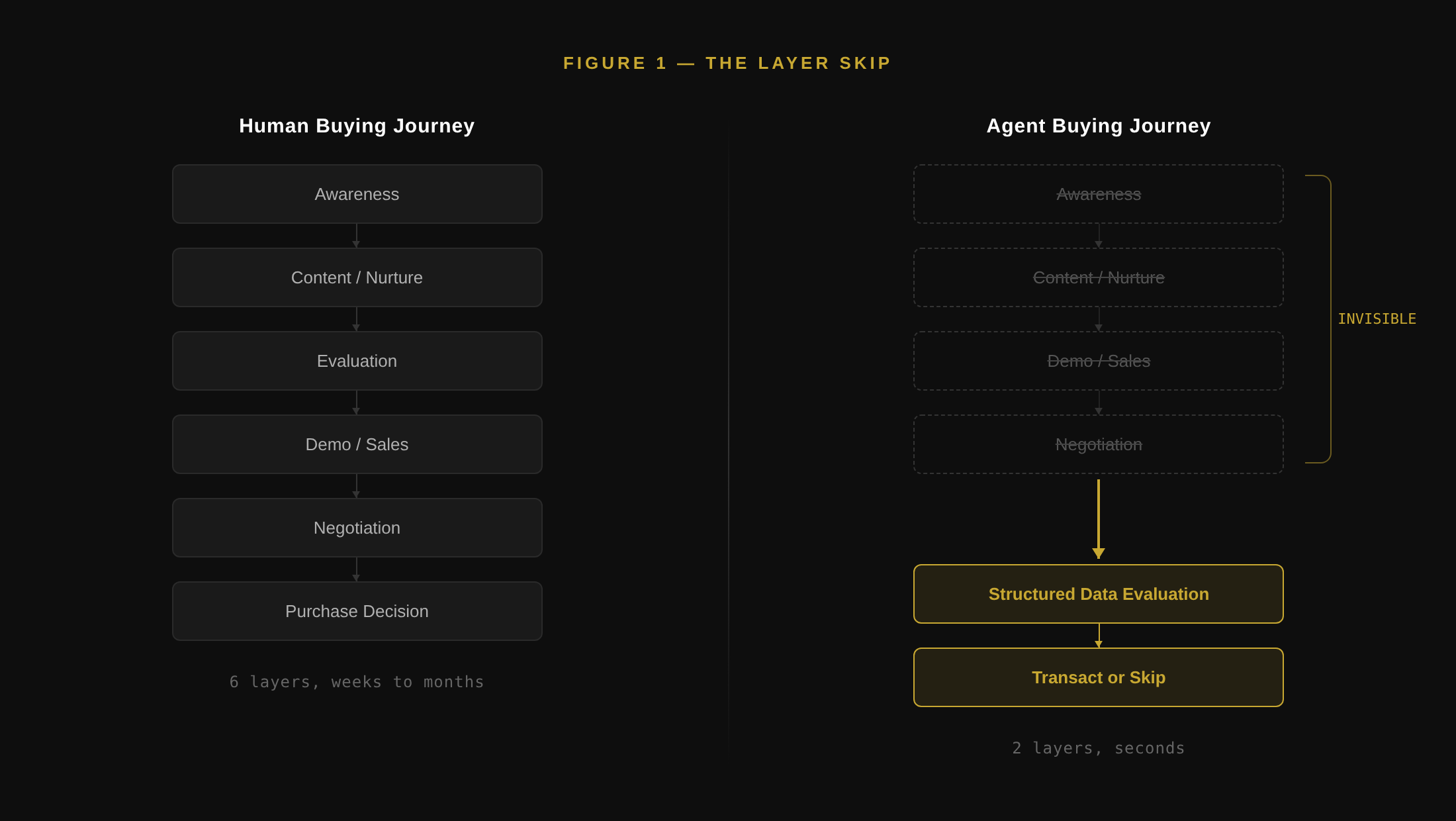
The entire demand generation apparatus of modern B2B GTM assumes a human on the other end. Webinars. Ebooks. Nurture sequences. LinkedIn ads. Event sponsorships. Content syndication. All of it is designed to do one thing: capture the attention of a person who has a problem but has not yet decided to solve it.
AI agents do not browse. They do not get curious. They do not stumble across your brand while scrolling. They get dispatched with a task, a set of constraints, and a budget. The agent does not need to be nurtured into awareness. It arrives with full intent and zero patience. It will evaluate you in seconds based on structured data it can find, and if it cannot find enough structured data, it will move to the next vendor.
This is not a content marketing problem. It is a layer collapse. The entire top-of-funnel infrastructure that most B2B companies spend 30 to 50 percent of their marketing budget on becomes invisible to agent buyers. Not inefficient. Invisible. The agent never enters the layer.
Distribution Channels That Require Human Participation Stop Working
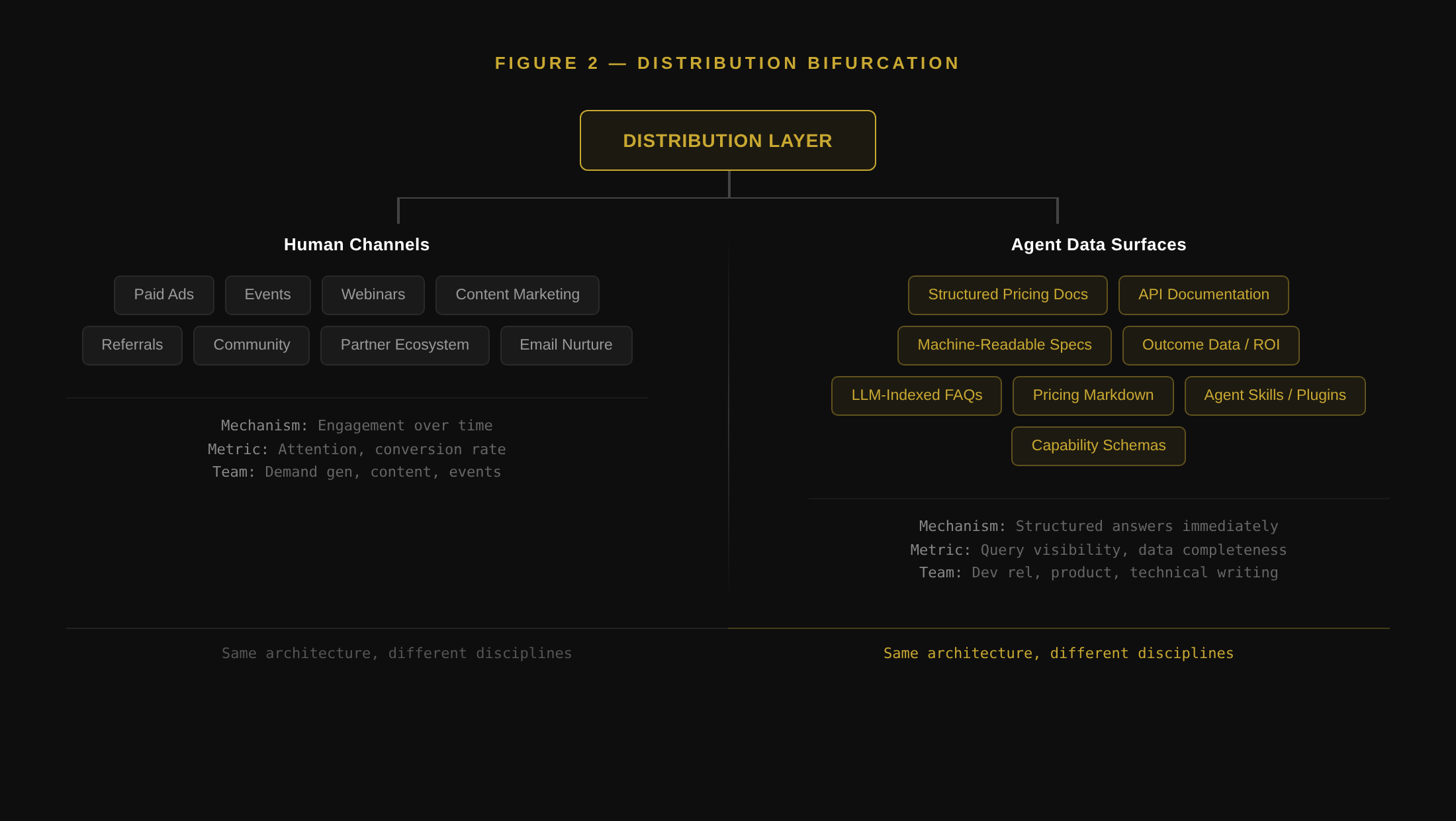
Distribution architecture in most GTM systems is a collection of channels that assume human interaction at every node. A prospect clicks an ad. A prospect registers for a webinar. A prospect downloads a report and enters a nurture sequence. A prospect gets referred by a colleague. Each channel depends on a human choosing to participate.
Agent buyers do not participate in channels. They query data sources. The distinction matters because channels are designed to create engagement over time, and data sources are designed to return structured answers immediately. Your SEO strategy, your paid acquisition funnels, your community-led growth loops, your partner ecosystem referrals: none of these channels exist in the agent’s evaluation path unless they produce machine-readable data that surfaces in the agent’s query results.
The distribution layer does not disappear. It bifurcates. Human buyers still need channels. Agent buyers need data surfaces. Most companies will need to architect for both simultaneously, and the organizational challenge is that the teams, tools, and metrics for each are completely different. The marketer who runs your webinar program is not the same person who structures your pricing documentation for LLM ingestion. These are different disciplines operating on different layers of the same architecture.
Qualification Inverts
In a human buying process, the seller qualifies the buyer. Does this prospect match our ICP? Do they have budget? Are they the decision maker? Is there urgency? The seller controls the qualification criteria and applies it through discovery calls, BANT frameworks, lead scoring models, and SDR conversations.
When an AI agent is buying, the buyer qualifies the seller. The agent arrives with pre-defined evaluation criteria set by its human principal. It knows the budget. It knows the requirements. It knows the integration constraints. It is not waiting for your SDR to ask discovery questions. It is running its own scoring model against every vendor simultaneously.
This inverts the power structure of the entire qualification layer. The seller’s lead scoring model becomes irrelevant because the agent does not enter through a form, does not have a job title to score, and does not exhibit behavioral signals that marketing automation can track. The agent is not a lead. It is a procurement system with a decision tree.
The implication is that your qualification infrastructure (scoring models, SDR teams, MQL definitions, routing logic) needs a parallel track. One track for human buyers who still enter through traditional channels. One track for agent buyers who arrive fully qualified with their own criteria and need structured data to complete their evaluation. Building the second track is not a marketing project. It is an architecture project.
The Sales Layer Compresses to Zero
An AI agent does not take a demo. It does not sit through a pitch. It does not need to build trust with an account executive over three meetings before signing a contract. The agent evaluates based on documented capabilities, published pricing, API quality, integration compatibility, and outcome data. If those inputs are sufficient, the agent transacts. If they are not, the agent moves on.
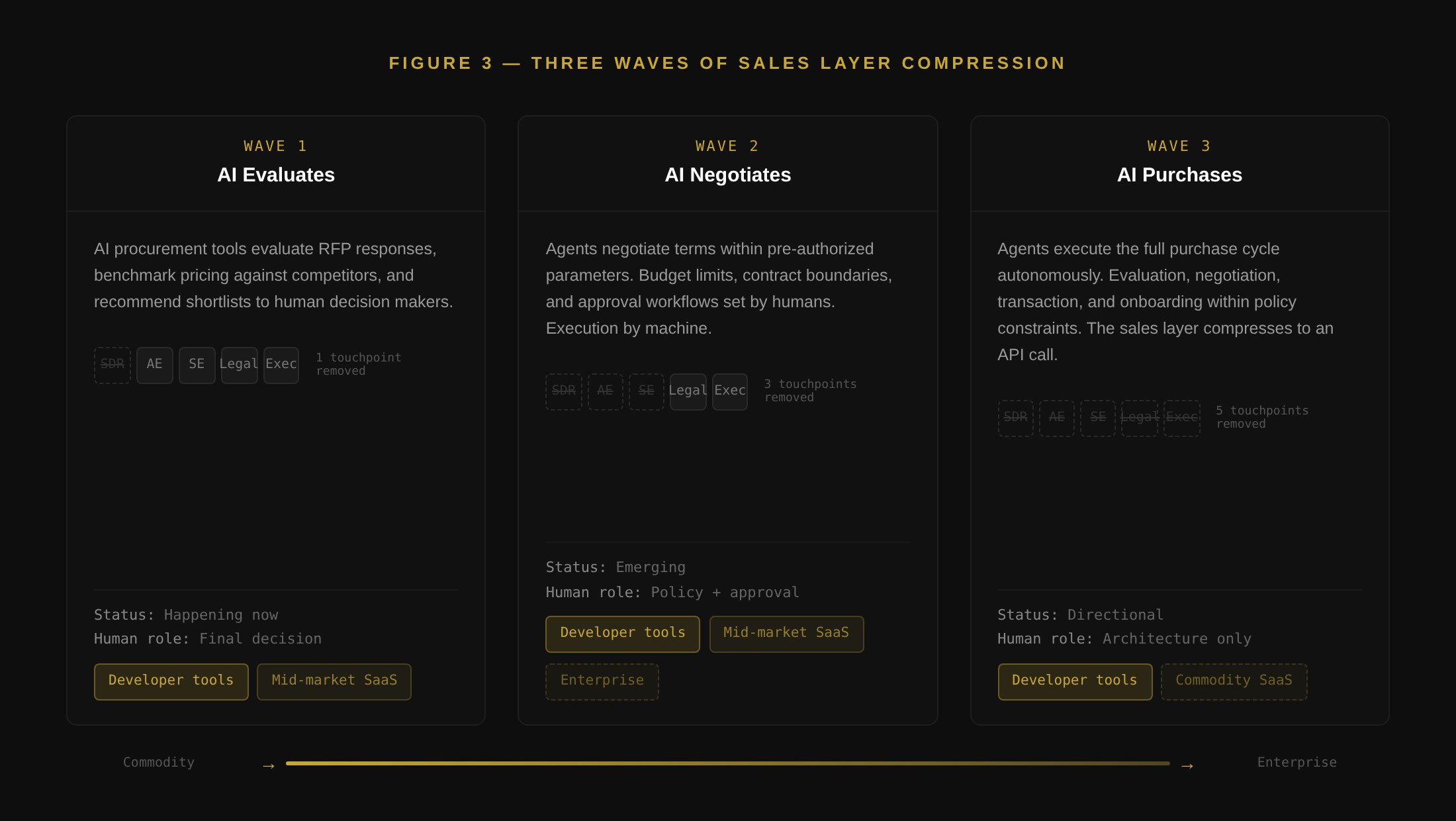
This compresses the entire sales layer. For commodity products and developer tools, the compression is already happening. A coding agent that selects your database, your payment processor, or your analytics tool does not call your sales team. It reads your documentation, checks your API, and either integrates or does not.
For enterprise products, the compression is slower but directional. The first wave is AI procurement tools that evaluate RFP responses, benchmark pricing, and recommend shortlists. The second wave is agents that negotiate terms within pre-authorized parameters. The third wave is agents that execute the full purchase cycle autonomously within policy constraints set by a human buyer.
Each wave removes a human touchpoint from the sales process. Not because the product got simpler, but because the structured data that the agent needs to make a decision either exists and is accessible, or it does not. Companies that expose their capabilities, pricing, and outcomes as structured, machine-readable data will transact with agents. Companies that gate everything behind “contact sales” will not appear in the agent’s evaluation set.
Pricing Restructures Every Layer It Touches
This is the Third Foundational Law for a reason. Pricing is never an isolated variable. It cascades through distribution, qualification, conversion, and expansion.
When the buyer is a machine, the pricing cascade accelerates. A human buyer tolerates ambiguity. “Contact sales” means “I will call and negotiate.” An agent buyer treats ambiguity as disqualification. “Contact sales” means “insufficient data, skip.” The pricing layer does not just need transparency. It needs structure. Machine-readable tiers, documented feature-to-price mappings, published usage calculations, maximum budget parameters.
But here is the part the pricing optimization advice misses: restructuring pricing for agents forces you to restructure everything downstream. If pricing is transparent and structured, the sales motion changes. If the agent can self-serve evaluation, the SDR layer changes. If the agent can compare you against competitors in seconds, the positioning layer changes. If the agent measures outcomes rather than promises, the expansion layer changes.
You cannot optimize the pricing page for agents and leave the rest of the architecture intact. The pricing change propagates. This is the Law at work.
The Feedback Loop Changes from Sentiment to Outcome
Human buyers generate soft feedback. NPS scores. Support ticket sentiment. Renewal conversations where the CSM reads between the lines. Expansion signals from usage patterns. The entire customer success apparatus is designed to detect human satisfaction and convert it into retention and growth.
Agent buyers generate hard feedback. The agent measured the outcome. It compared the outcome to the parameters its principal set. It either continues the subscription or terminates it. There is no loyalty. There is no relationship. There is no switching cost based on familiarity. The evaluation runs continuously, and the decision recurs at every contract boundary.
This changes the expansion and retention layers structurally. Customer success as a relationship management function loses relevance when the customer is a machine. What replaces it is outcome documentation: structured, real-time proof that the product delivered the results the agent’s criteria specified. Companies that can expose performance data programmatically (via API, via dashboard, via structured reports) give the agent a reason to renew. Companies that rely on a CSM calling the VP once a quarter will lose the renewal to a competitor whose outcome data is better structured.
Where This Sits in the Architecture
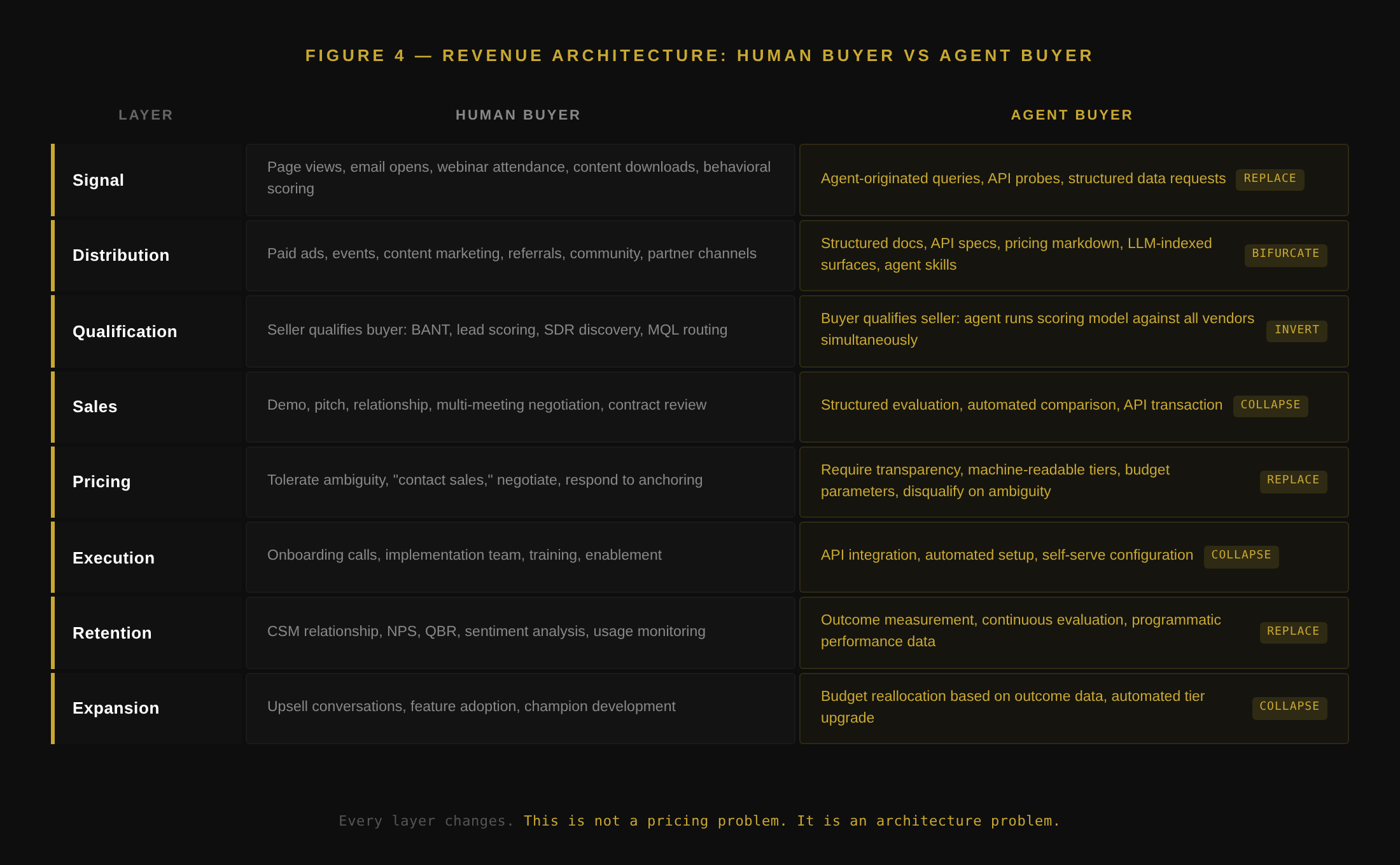
Agent-led purchasing is not a pricing problem, a marketing problem, or a sales problem. It is an architecture problem that touches every layer.
At the Signal layer, the signals change. Agent-initiated evaluations do not produce the same behavioral data as human buying journeys. You cannot track an agent’s page views, email opens, or webinar attendance. The signal layer needs new detection mechanisms for agent-originated queries and evaluations.
At the Distribution layer, the channels bifurcate. Human channels remain necessary. Agent-readable data surfaces become a parallel distribution architecture that requires its own tooling, metrics, and ownership.
At the Execution layer, the motion compresses. For some segments, the entire sales cycle collapses into a single API transaction. For others, the human sales process persists but with an agent handling evaluation and shortlisting upstream.
The companies that treat this as a pricing page optimization will capture the easiest 10% of the opportunity. The companies that restructure their revenue architecture to serve both human and agent buyers will capture the rest. The question is not whether to prepare your pricing for AI agents. The question is whether your architecture can serve a buyer that does not behave like a human at any layer.
Common questions
How do AI agents change B2B buying?
An agent is dispatched with a task, requirements and a budget set by its human principal. It does not browse, attend demos or respond to nurture sequences; it queries data sources and scores every vendor at once. If it cannot find enough structured data to evaluate a vendor, it moves to the next one.
What happens to demand generation when the buyer is an AI agent?
It becomes invisible rather than inefficient. Webinars, ebooks, nurture sequences and ads exist to capture the attention of a person who has not yet decided to solve a problem. An agent arrives with full intent and never enters that layer, so the budget spent there does not reach it.
How does lead qualification change with AI agent buyers?
It inverts. In a human process the seller qualifies the buyer through scoring, discovery and BANT. An agent arrives already qualified by its principal and qualifies the seller against its own criteria. Scoring models cannot score it, because it has no job title, fills no form and leaves no behavioral trail.
What should B2B companies build for AI agent buyers?
A parallel track, not a replacement. Human buyers still need channels; agent buyers need data surfaces: documented capabilities, machine-readable pricing, API quality and outcome data an agent can verify. The teams, tools and metrics for each track are different, which makes it an architecture project rather than a marketing one.
The Structural Bet
The Second Foundational Law states: What Scales First Constrains Everything After. The companies that scale their current human-optimized GTM architecture further before addressing agent buyers are building on a foundation that will constrain them when the buyer mix shifts.
Nobody knows the timeline. Agent-initiated purchasing is already real in developer tools and commodity SaaS. It is emerging in mid-market through AI procurement tools. It is directional in enterprise. The structural bet is not about predicting the date. It is about whether your architecture is designed for one buyer type or two.
The AI does not amplify your marketing. It does not improve your sales pitch. It does not optimize your funnel. It replaces the buyer. That is not an optimization problem. It is an architecture problem. And architecture problems do not get solved by updating a pricing page.