



Hi. I’m Rick Koleta. Welcome to GTM Vault - a breakdown of how high-growth companies design, test, and scale revenue architecture. Join 26,000+ operators building GTM systems that compound.
Nineteen days at full speed
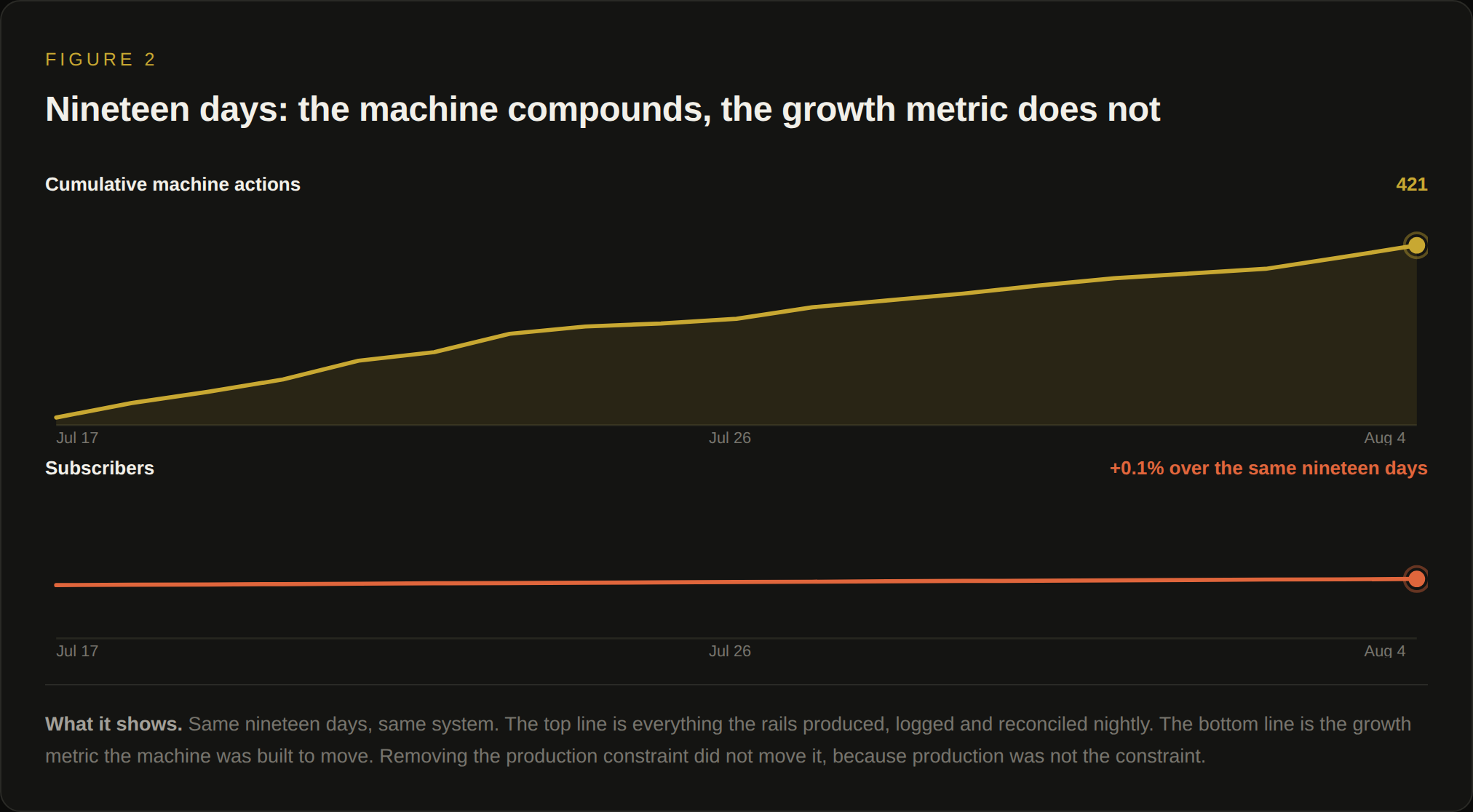
GTM Vault runs on the same doctrine I write about here: positioning, motion design, RevOps, and an AI-native execution layer, installed as a system instead of accumulated as a pile of tools. For nineteen days, from July 17 to August 4, 2026, I let that system run at full speed and logged every action it took. Four hundred and twenty one of them.
The machine never slowed down. Subscriber growth did. That gap is the entire lesson: we removed the production constraint in about three weeks, and the constraint did not disappear. It moved to the one layer we never automated, the human decision. If you are pointing your AI budget at generating more, this is the field report on what happens after generation stops being scarce.
What the machine actually is
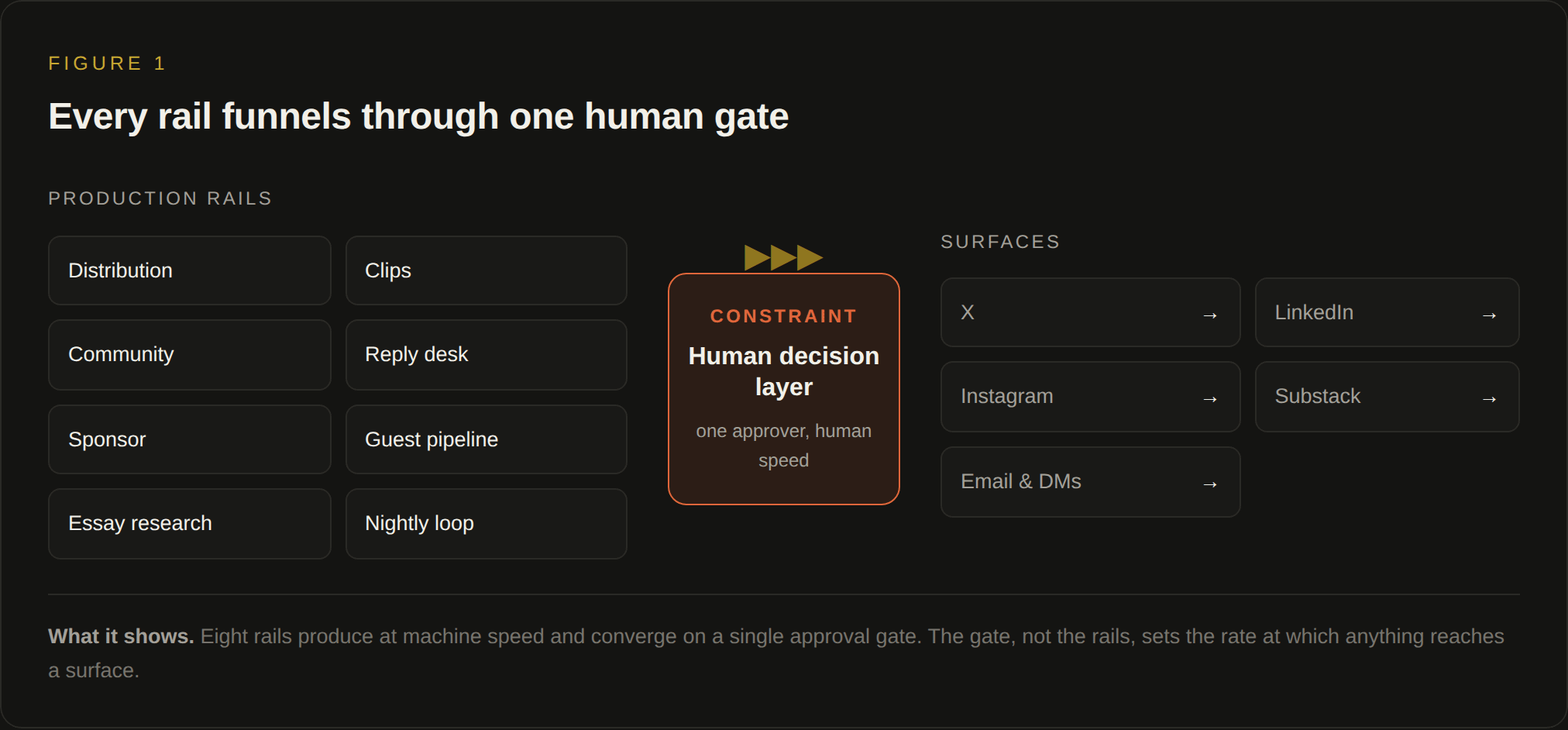
It is not one agent. It is a set of rails, each owning one layer of the go-to-market motion, each writing to a shared log so no rail can misreport what it did.
The distribution rail takes a published essay and puts a carousel across X, LinkedIn, Instagram, and Substack Notes on a synchronized schedule. The clips rail cuts podcast episodes into shorts and stages them across three surfaces. A community rail drafts substantive answers to real questions on Reddit and elsewhere. A reply desk drafts responses to every inbound guest, sponsor, and partner thread. A sponsor rail ranks prospects, finds contacts, and writes first-touch and follow-up. A guest rail sources operators for the podcast and Show Me Your Stack and tracks them through a pipeline. An essay-research rail assembles the next topic before I write it. A nightly loop reconciles all of it against the logs and scores the week.
None of these are demos. They ran against the live business, into the live 26,000 subscriber list, every day.
Where it is strong is exactly where you would expect
Production. The machine is very good at production.
In one recent day the community rail landed three substantive answers on three different subforums, all verified, and in the process found that a nine and a half minute spacing between posts was the difference between landing and getting filtered. The guest pipeline crossed one hundred seventy five enriched rows. The distribution rail now ships a single essay across four surfaces at one synchronized nine a.m. Eastern slot without me touching a composer. The research rail had two full essay packs staged and sourced before I had decided which one to write.
This is the part of the AI-native promise that is real. The cost of producing a competent draft, a competent answer, a competent outreach sequence has collapsed to near zero. If your bottleneck was ever that you could not make enough, that bottleneck is gone. We removed it in about three weeks.
And then the number that matters did not move.
The constraint moved to the layer nobody automated
Here is the pattern the nightly loop named on its own, in its own words: the drafting layer is healthy, the sending layer is stalled.
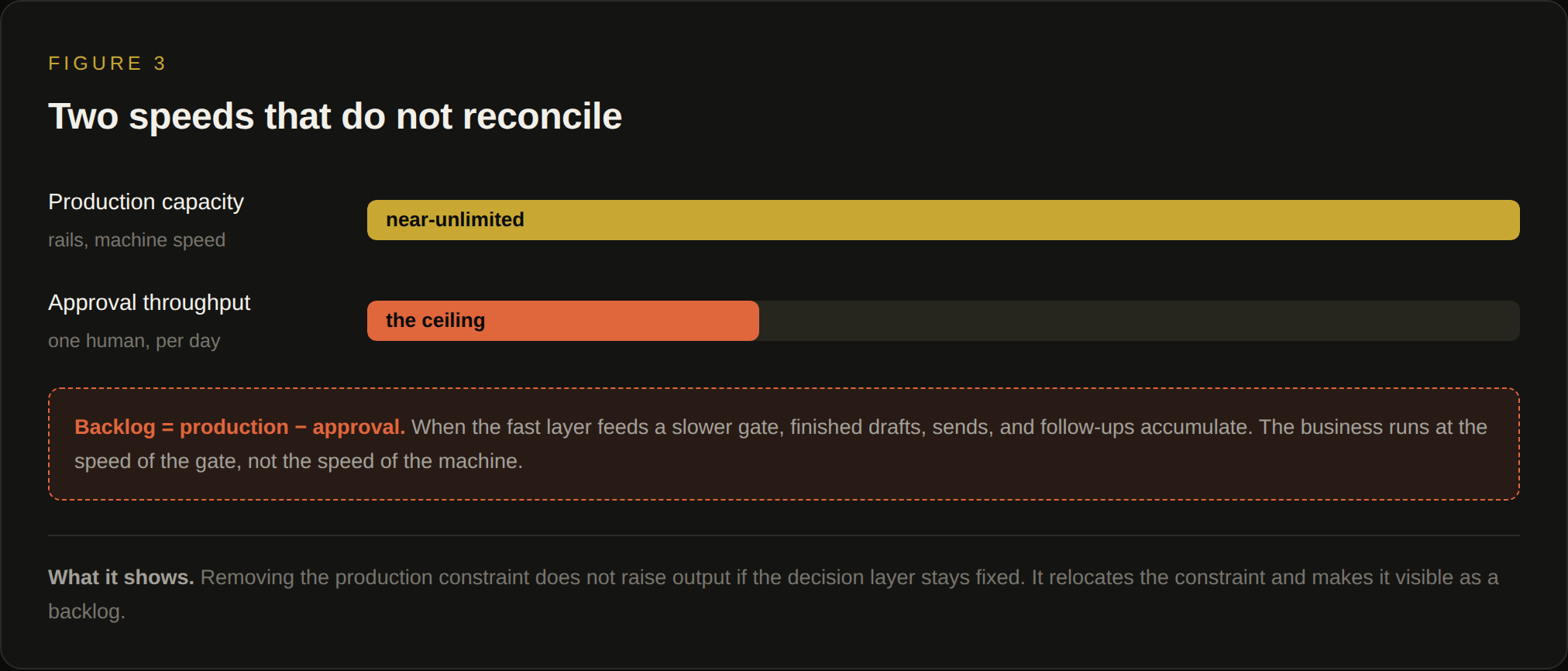
The machine produces faster than any human can approve. Sponsor outreach went out at volume and the reply rate lagged the production rate badly. Dozens of finished drafts, connection requests, and follow-ups sat in a queue waiting on a single human decision, mine. The rails that generate never stopped. The one gate they all funnel through, a person deciding what is good enough to send, became the ceiling on the entire system.
This is not a staffing problem. It is a structural one. We installed machine-speed production on top of a human-speed decision layer, and the two speeds do not reconcile. The output of the fast layer piles up against the throughput of the slow layer, and the slow layer sets the real rate of the business.
If that mechanism sounds familiar, it should. It is the same one I described in “Why AI SDRs Failed.” Agents installed on top of a broken or slower layer do not fix the layer. They amplify the mismatch. AI on a coherent system produces leverage. AI on a system with an un-designed decision layer produces a backlog at machine speed. We did not escape our own doctrine by running it. We proved it on ourselves.
What is actually broken, said plainly
Two of the fleet’s roughly thirty rails currently produce no output I can verify. One fires on schedule and leaves no trace in either log location, which means for auditing purposes it did not run at all. A second logged two runs with no record of what it touched. In a system whose entire integrity depends on every rail writing to a shared log, a rail that acts without logging is worse than a rail that does nothing, because it looks like coverage while providing none.
I am naming this because build-in-public that only reports the wins is marketing with a timestamp. The honest state is that the production rails outran the observability around them, and observability is now on the same repair list as the decision layer.
The lesson, and what it changes
The reflex in AI-native GTM is to point the budget at generation. Better models, more agents, more surface area. We did that. It worked, and it revealed that generation was never the scarce resource in this business. The scarce resource is qualified human judgment applied fast enough to keep up with what the machine already makes.
So the next thing we architect is not another producing rail. It is the decision layer itself. Batching approvals instead of handling them one at a time. Pre-qualifying drafts so the human gate sees fewer, better candidates. Raising the bar for what a rail is allowed to send with no human at all, and lowering it only where the cost of a wrong send is small. Designing the gate as deliberately as we designed the pipeline that feeds it.
The distribution rail sitting idle this week is not a failure of the rail. It is idle because I have not published the next essay yet, and that decision, like the sponsor sends and the guest follow-ups, lives in the human layer. The machine is waiting on the same constraint everything else is waiting on. The production problem is solved. The next problem was hiding behind it the whole time, and it is the one worth building for.
The redesign of that decision layer, the batching, the pre-qualification, and the exact rules for what earns the right to send without a human, is the next deep dive, and it lives in GTM Vault Pro at gtmvault.co/subscribe.
Common questions
Is AI the bottleneck in go-to-market?
No. In our own system, AI removed the production bottleneck entirely inside three weeks. The bottleneck moved to the human decision layer, the point where a person approves what the machine produced. Generation is no longer the scarce resource. Qualified judgment applied at speed is.
What is an AI GTM machine?
A set of rails, each owning one layer of the go-to-market motion (distribution, content clips, community answers, reply drafting, sponsor outreach, guest sourcing, research, and nightly reconciliation), running autonomously and writing to a shared log. It is not a single agent. It is an architecture where each rail produces and one gate decides.
Why did automating GTM not increase subscriber growth?
Because output volume was never the constraint on growth. Automating production raised how much got made, not how much cleared the approval gate or converted. When the fast layer feeds a fixed-speed decision layer, the extra output becomes backlog, not results. Growth is set by the slowest layer, and that layer was human.
What is the decision layer in GTM?
The point in the system where finished work waits on a human to approve, send, or publish it. Most AI GTM stacks invest heavily in generation and leave this layer un-designed. Once production is cheap, the decision layer becomes the actual throughput ceiling and has to be architected on purpose: batched, pre-qualified, and selectively delegated.
Does this mean AI in GTM is overhyped?
No. It means the value moved. AI on a coherent system with a designed decision layer compounds. AI on a fragmented system, or a system with a bottlenecked human gate, produces noise and backlog at machine speed. The tool is real. Where you install it decides whether it helps.
Related reading
Why AI SDRs Failed. The same mechanism at category scale: generation installed on top of broken qualification, stale data, and rented channels.
What Is Revenue Architecture?. The layer model this machine is built on, and why build order determines whether agents compound or amplify.
GTM Is Not a Headcount Plan. Why adding capacity to an un-designed system scales the problem, not the outcome.
Subscribe to GTM Vault: revenue architecture for founders and GTM leaders, read by 26,000+ operators building systems that compound.
If this edition was useful, help it travel by clicking the ❤️ and 🔄 at the top of this post.