



👋 Hi, it’s Rick Koleta. Welcome to GTM Vault - a breakdown of how high-growth companies design, test, and scale revenue architecture. Join 27,000+ operators building GTM systems that compound.
Why did AI SDRs fail? The first wave optimized volume instead of reasoning: more sends against the same broken qualification, which produced spam at machine speed and churn to match, with the category’s early leaders losing most of their early revenue once break clauses opened. What replaces them is not a better SDR imitation. It is a different architecture: signal-based prioritization, human-in-the-loop copilots, and context layers that give agents something real to reason over. The lesson is structural: automation amplifies the system it inherits.
That is the answer. The rest of this essay is the evidence, the mechanism, and the taxonomy that predicts which of today’s agentic sales products live or die.
The Promise, Stated Fairly
The 2023 pitch deserves an honest reconstruction, because the diagnosis only means something if the pitch was reasonable. It was. SDR labor is expensive, repetitive, and churns faster than almost any role in the building. The work is structured: find accounts, find contacts, write a relevant message, send, follow up, book. Large language models had just demonstrated they could do the writing. The syllogism assembled itself: an agent that prospects, personalizes, and books meetings replaces the function at a tenth of the cost, and every company with an outbound motion is a customer.
Hundreds of millions in venture funding followed that logic into the category. The logic was not stupid. It was architecturally naive, and the gap between those two things took about eighteen months to price.
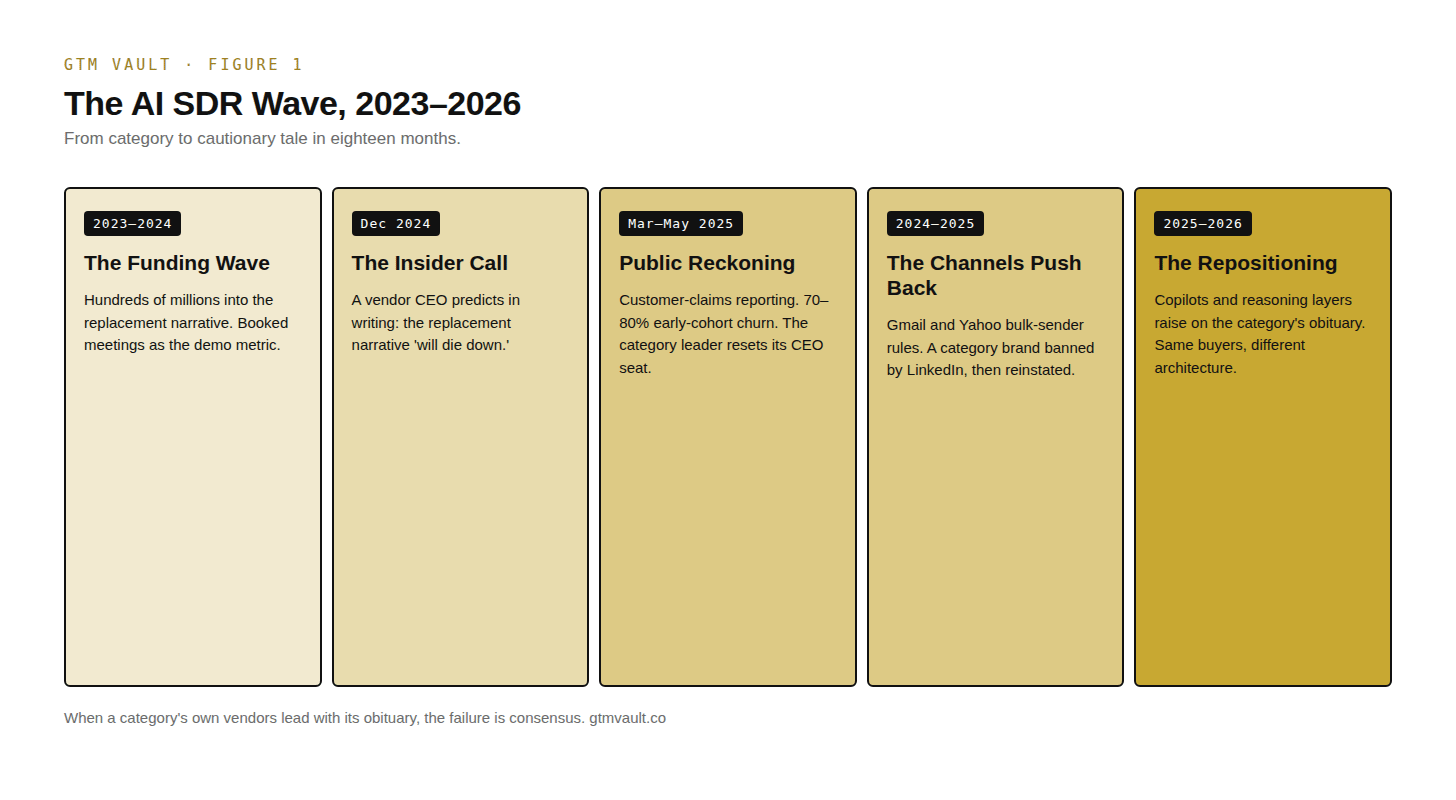
Eighteen Months From Category to Cautionary Tale
The dates matter, because the collapse was fast and public.
Through 2023 and 2024 the category scaled on the replacement narrative. The first structural warning came from inside the vendor pool: in December 2024, Amplemarket’s CEO João Batalha published a prediction that “AI SDR companies will pivot away from what they were offering in 2024. The narrative that sales reps will be replaced by AI will die down.” A vendor whose product line sat next door to the category was calling the pivot before the press did.
The press caught up in the spring. In March 2025, TechCrunch reported that 11x, the category’s most visible company, had displayed logos of companies that were not customers, and that trial contracts with three-month break clauses had been counted as full-year ARR while early-cohort churn ran 70 to 80 percent. Sifted’s reporting the same week put the figure at roughly 70 percent of customers closed or paused by mid-2024. Six weeks later, the founder stepped down to non-executive chairman and the company’s CTO took the CEO seat. Whatever else that sequence was, it was the company accepting the diagnosis and starting the rebuild.
The channels pushed back on the category too. Google and Yahoo’s bulk-sender requirements, effective February 2024, put authenticated sending, one-click unsubscribe, and an enforced spam-rate ceiling under every high-volume outbound motion. And in late 2025, LinkedIn banned Artisan, one of the category’s loudest brands, for roughly two weeks before reinstating it. The specifics were about naming and data vendors rather than agent spam, but the structural message was legible to everyone building on the platform: the landlord was watching, and the category was the tenant it watched most.
The strangest marker came from the category’s own sellers. In April 2025, Actively AI raised $22.5 million with a pitch TechCrunch headlined as, verbatim, “says AI SDRs failed”, its co-founder arguing the first wave chased pure volume instead of reasoning about high-value opportunities. A year later the same company raised $45 million selling per-account reasoning to the same buyers. When a category’s fastest-growing vendors lead with its obituary, the failure is not a contrarian take. It is consensus with a marketing budget.
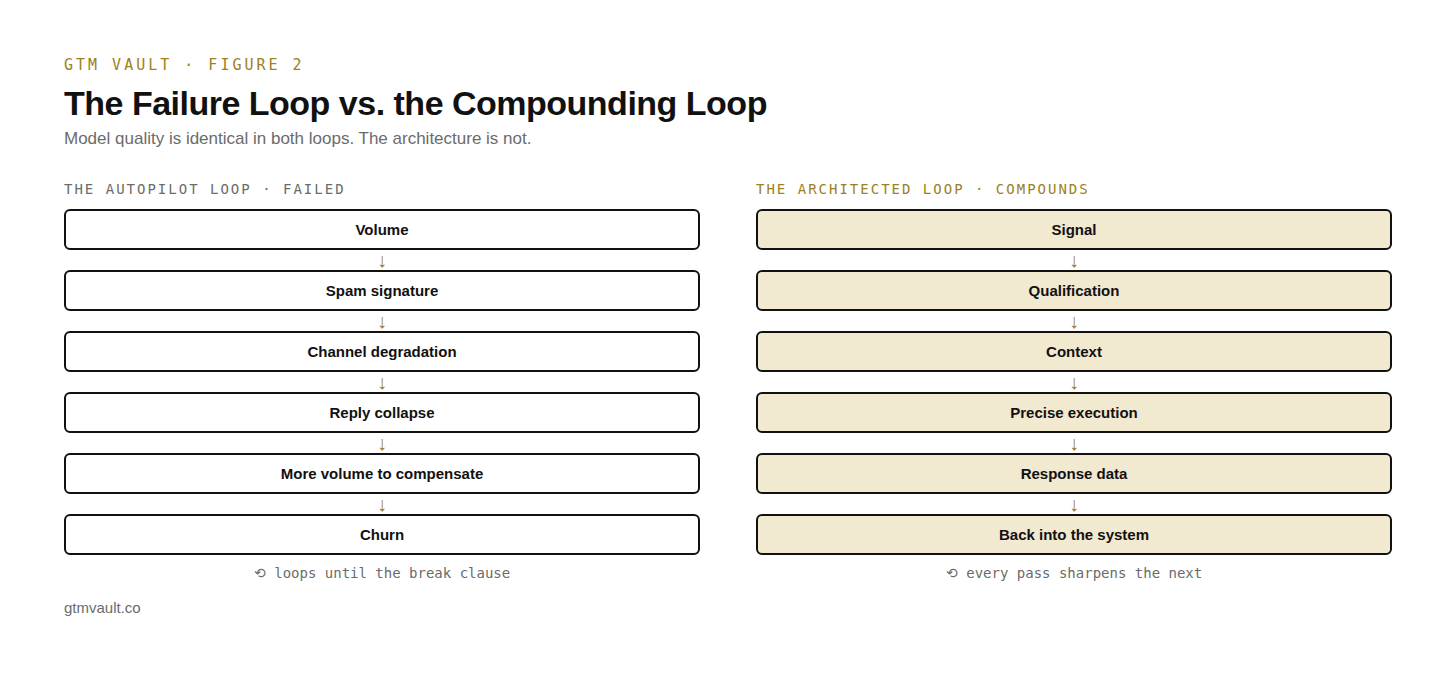
The Mechanism: Four Structural Failures
The failure was not model quality. The models wrote competent emails in 2023 and write better ones now. The failure happened in the layers the models were installed on top of, and it happened four ways.
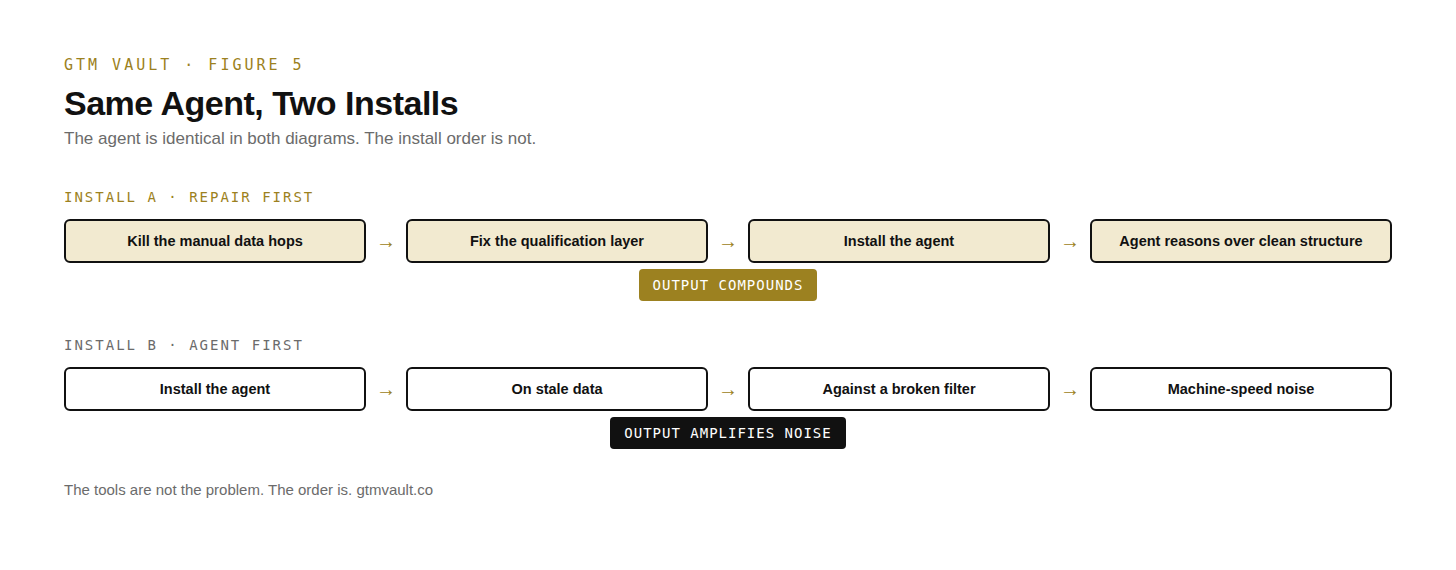
Failure 1: Volume inherited a broken qualification layer. An agent amplifies whatever ICP definition it is given, and at most buyers that definition was a category, not an ICP. “Series B SaaS, 50 to 500 employees” is a filter, not a qualification layer. Machine-speed outreach pointed at a human-speed targeting error produces spam with perfect grammar, and the recipient can tell. Every downstream decision inherits the ICP, and the agents inherited it at a thousand sends a day.
Failure 2: The data underneath was stale. The agents reasoned over CRMs that were hand-updated, late, and wrong, because almost nobody had eliminated the manual hops between signal and record before installing automation on top of them. The sequencing essay calls this Step 1 for a reason. Skipped, the automation automates the staleness. AI amplifies the architecture it inherits, and what it inherited was six to ten manual hops and a database describing last quarter.
Failure 3: Rented channels punished machine volume. Deliverability is a commons. Every AI SDR degraded the inbox for all of them, and the platform owners responded exactly as landlords do: authentication requirements, spam-rate ceilings, enforcement actions. A category whose unit economics required volume built itself on channels whose owners profit from punishing volume. That is not bad luck. It is a structural contradiction that was visible in the pitch deck.
Failure 4: The economics never survived the break clause. The category sold on booked meetings, a demo metric. Renewal happens on pipeline that closes, a system metric, and the two diverge exactly as far as the qualification layer is broken. The three-month break clause became the category’s actuarial table: per the public reporting, most early revenue did not survive its first exit window. There is no independent dataset on AI SDR renewal rates, which is itself telling, but the reported cohort numbers and the leadership resets that followed them tell a consistent story.
What Actually Failed, and What Didn’t
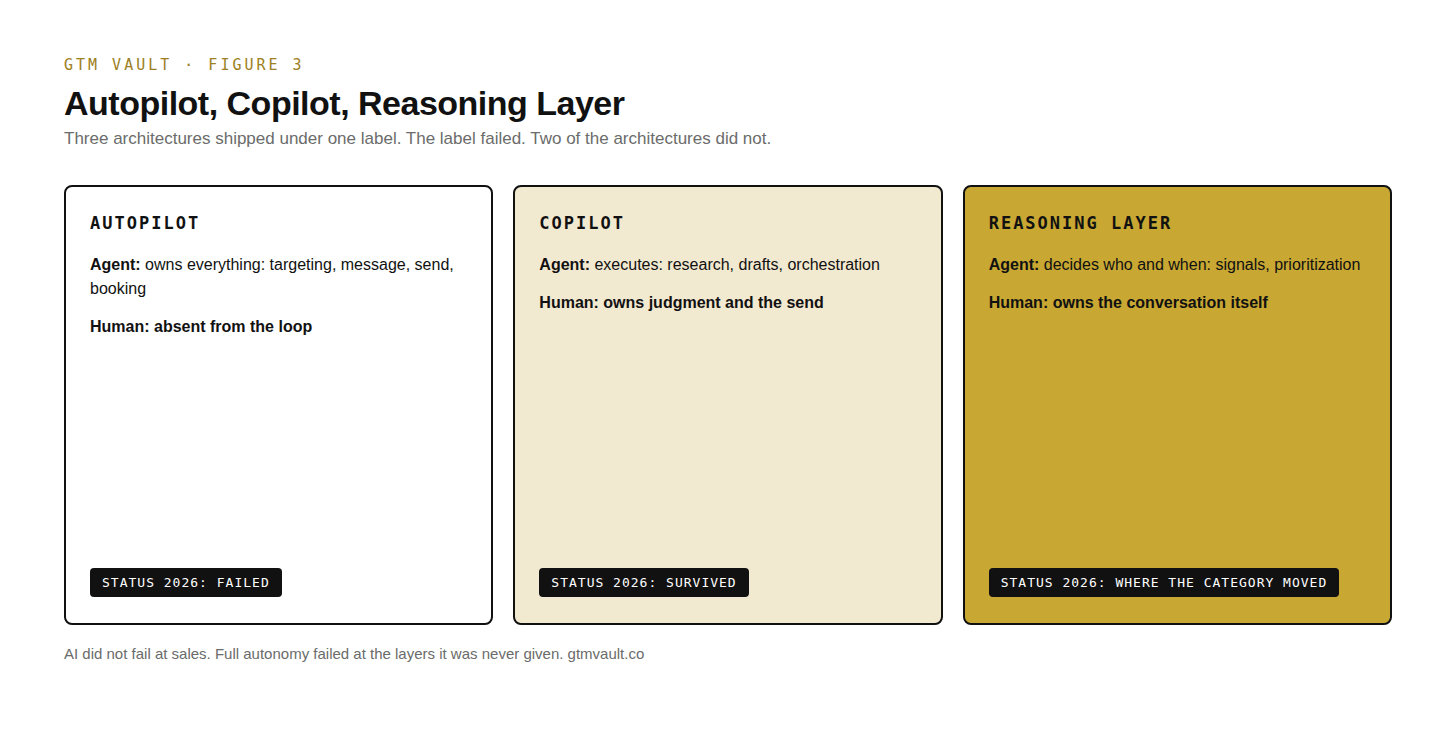
The category’s deepest problem was taxonomic. Three different architectures shipped under one label, and the label failed while two of the architectures did fine.
Autopilot. The agent replaces the rep end to end: finds the account, writes the message, owns the send, books the meeting. This is the architecture that failed, for the four reasons above. It concentrated every structural weakness of the buyer’s revenue system into an unsupervised loop running at machine speed.
Copilot. The agent does the execution, the human owns judgment and the send button. This is the architecture that survived and grew, and its vendors are the ones who called the collapse in advance. Amplemarket’s own framing of the distinction is explicit, and Regie.ai’s public position that AI belongs in “enhancing, rather than replacing, human sellers” is the category’s surviving wing saying the quiet part early.
Reasoning layer. The agent decides who and when, not what to say: signal-based prioritization over generation. This is where the survivors repositioned, and where the new money went. Actively’s per-account reasoning, the context-graph vendors, the warm-signal orchestrators. The generation that the first wave sold became a commodity; the deciding that the first wave skipped became the product.
The claim, stated flatly: AI did not fail at sales. Full autonomy failed at the qualification and context layers it was never given. The taxonomy is not academic. It predicts which current products live, because any agentic sales tool you evaluate today is one of these three architectures wearing a new name.
Where the Value Settled
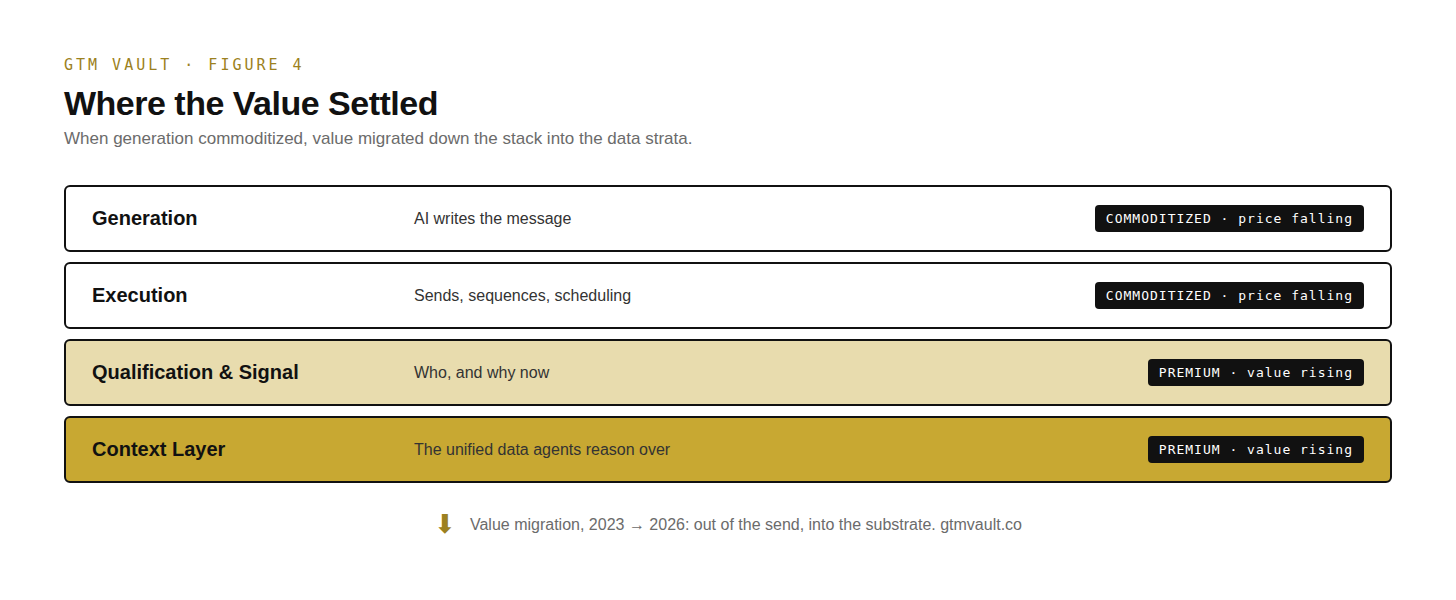
When generation commoditized, value moved to what generation needs: clean data, unified context, real signals. The vendors thriving in 2026 sell exactly that layer. Context graphs built from call and deal data. Per-account reasoning over live signals. Orchestration that treats the send as the last step of a system rather than the product itself.
This is the same migration this publication has been documenting from other angles: episode 46 argued context is GTM infrastructure, not a tool connector, and the argument runs through the AI SDR story in reverse. The category that owned the send but not the context is gone. The layer that owns the context is where the premium settled. The full architecture of that claim, and where it sits among the eight layers, is in What Is Revenue Architecture.
How to Evaluate Agentic Sales Tools Now
The practical residue of eighteen months of category tuition is four questions, each of which resolves to architecture rather than demo quality.
What data does the agent reason over, and who keeps it current? If the answer is your CRM as it exists today, the agent inherits your data debt at machine speed.
Where does the human sit in the loop, and is that placement designed or residual? A copilot with a deliberate judgment gate is an architecture. A copilot that is an autopilot with a checkbox is a liability with better positioning.
What happens to your domain and your brand when the agent is wrong at scale? Deliverability and platform standing are shared assets that burn faster than they rebuild, and the vendor does not carry that risk. You do.
Is the vendor selling replacement or leverage, and does the contract structure match the claim? Replacement claims with quarterly break clauses are a pricing model for churn.
And underneath all four, the sequencing rule this publication keeps returning to: repair the data hops and the qualification layer first, because an agent installed on top of them amplifies whichever state they are in. The tools are not the problem. The order is.
The Falsifiable Version
A diagnosis that cannot be wrong is a slogan, so here is the test that would break this one. If a full-autonomy product sustains renewal-grade pipeline, not booked meetings, across two years, without human judgment in the loop and without degrading the channels it runs on, then the autopilot architecture works and this essay becomes a period piece about early implementations. As of 2026, no vendor has published numbers that meet that test, and the category’s own capital is betting on the other two architectures. The test stands open.
Questions Operators Ask
Why did AI SDRs fail? The first wave optimized volume instead of reasoning, ran it against broken qualification layers and stale data, and burned rented channels doing it. Churn followed the architecture, not the model quality.
Did AI SDRs fail because the AI wasn’t good enough? No. Generation quality was never the constraint. The failures were the qualification layer, the data layer, and the channel economics underneath the generation.
What is the difference between an AI SDR and an AI sales copilot? An autopilot replaces the rep and owns the send. A copilot executes while a human owns judgment and the send. The first architecture failed. The second survived and grew.
Are AI SDRs dead? The autopilot architecture is. The category repositioned toward copilots and reasoning layers, often under the same brand names, and the recent funding follows the repositioning.
What should replace an AI SDR? A sequence, not a substitute: repair the data hops, fix qualification, then install agents as leverage on clean structure. The order is the product.
The First Casualty Report
The AI SDR wave was the execution shock’s first casualty report, and its lesson is the architecture era’s founding lesson. Execution collapsed toward free, everyone bought it, and the companies that bolted it onto fragmented structure paid to discover what the structure was worth. Automation amplifies the system it inherits. The category learned it at venture scale so that operators reading this can learn it at the price of an essay.
The map of what to build instead is in What Is Revenue Architecture, and the build order starts at Law 01.