


Something is breaking in the GTM stack, and the earnings calls are starting to show it.
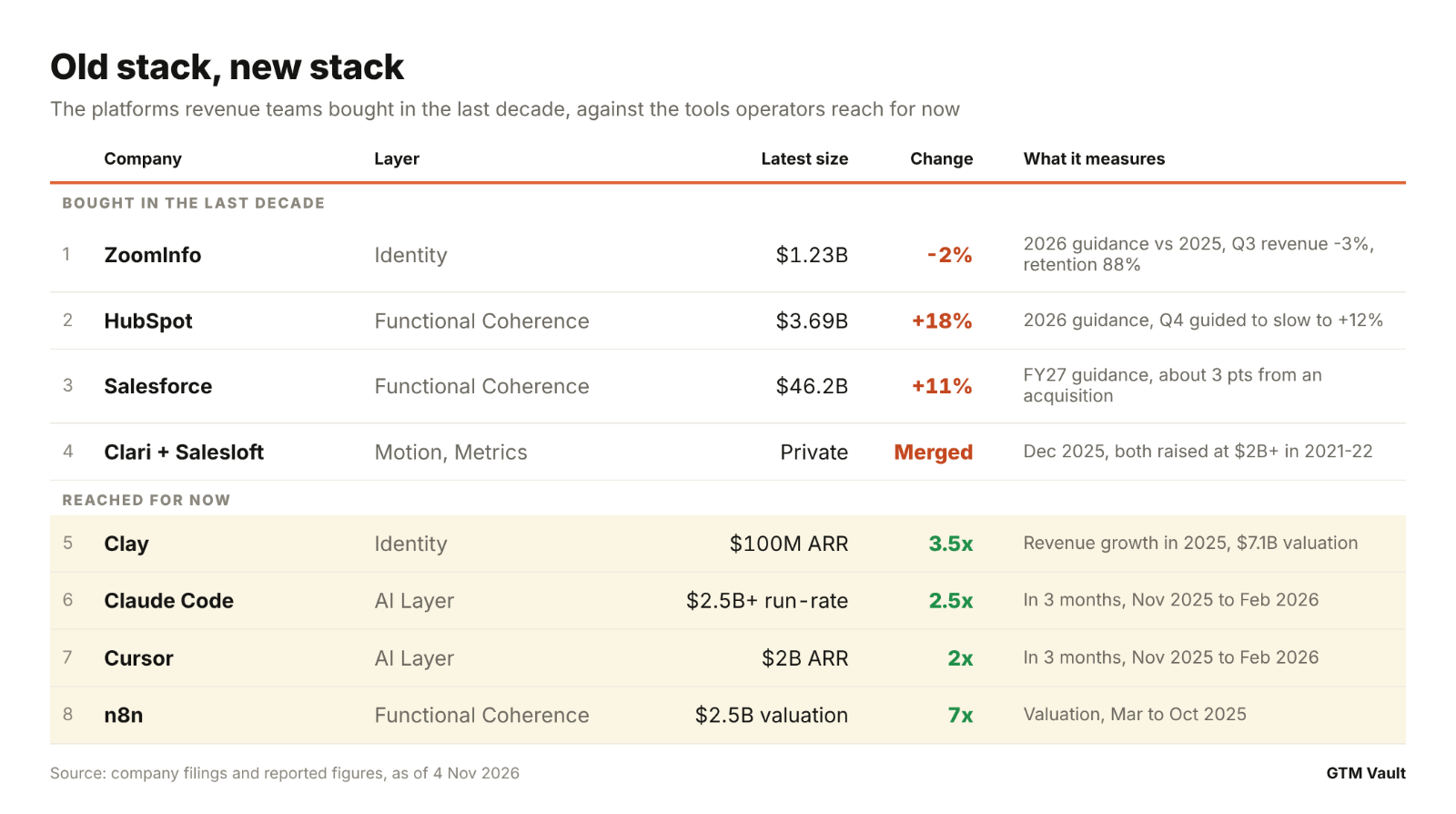
ZoomInfo is guided to shrink in 2026. HubSpot is slowing. Over the same stretch Clay grew more than 3.5x, and the tool operators name most often is not a GTM product at all.
For 2 years I have asked every guest on the GTM Vault Podcast and Show Me Your Stack the same question: what do you run? 24 operators answered on the record. Today I am publishing what they told me as a map.
The shift is already in the numbers. The platforms revenue teams bought in the last decade are slowing or shrinking. The tools operators reach for now grew 2x to 3.5x.
So why is the stack moving now? 3 reasons:
Building got cheap. When describing a workflow costs about as much as building it, operators stop buying categories and start assembling them. 8 operators on the record run Claude Code for GTM work.
Agents need context, not seats. Per-seat software assumed a human in every tool. Agents read and write across tools, so the value moves to whoever holds the context. ZoomInfo now sells a headless context layer, and Clari and Salesloft opened their data to outside AI through an MCP server.
Budgets got audited. HubSpot cut its 2026 retention outlook to roughly flat as customers downgraded and scrutinized renewals. Every tool now has to show which layer it serves.
The AI-Native Revenue Stack Landscape 2027
102 tools, each placed once on the layer of revenue architecture it serves. Every tool on it was named by an operator on the record or recommended in a GTM Vault essay.

To make the map easy to read, it runs on the Eight Layers:
Identity: find and resolve the right accounts and people. Most named: Clay (7 operators) and Apollo (6).
Sequencing: decide what to install first. No tool can make this call, so the map leaves it empty on purpose.
Pricing: quote, bill and recognize revenue. 1 tool, and no operator on the record.
Functional Coherence: one shared record, orchestrated across teams. HubSpot and Salesforce (3 operators each), with n8n and Power Platform wiring them together.
Motion: the signals that say when, and the surface where reps and agents act. Slack (5), Instantly (4), Outreach, PostHog and Vector.
Distribution: where the argument gets published and paid for. LinkedIn (3), Reddit, Marketo, and now AI answer engines like Perplexity.
Metrics: what happened, and what closes next. Gong (2) and Search Console. 4 tools in total.
AI Layer: the context and models that decide, draft and build. Claude Code (8), Claude (4), ChatGPT and Cursor, with context arriving over MCP.
3 Things the Map Shows
A coding agent leads. Claude Code is named by 8 operators. Salesforce, ZoomInfo and Outreach are named 7 times between them.
The interface is moving, not the data. Tim Scheuer took a 5-hour campaign build in Clay down to 40 minutes in a terminal (SMYS 6). At Lusha, the AEs have almost stopped opening Salesforce (GTM 50). The record stays. Reps stop visiting it.
Pricing is empty. Motion and Distribution hold 29 tools each. Pricing holds 1, and no operator has put a pricing tool on the record.
Is Your Stack on the Map?
See where your stack sits against the 24 operators on the record. It takes 21 taps, and the State of the GTM Stack 2027 report ships in March, free, built from every response.
Built a GTM system worth showing? Reply to this email or leave a comment. The best go on Show Me Your Stack and get a permanent page with their full stack by layer.
Vendors: tools enter the map when an operator names them on the record. Placement is not for sale.
Common Questions
What is the AI-native revenue stack?
The tools a B2B company uses to find, win and keep revenue, arranged so agents can read context and act across them. In The Stack Index, 16 of the 17 AI Layer tools are run by operators on the record, the highest share of any layer.
Do revenue teams still need a CRM in 2027?
Yes, as a ledger. Operators on the record describe reps who rarely open the CRM and agents that write back to it for them. Plan it as the system the business reports from, not the screen reps live in.
How is this map different from other GTM tool landscapes?
Each tool appears once, on the layer it serves, not under every department that might buy it. Tools operators run are marked apart from essay picks. And no vendor can pay for placement.
Next in This Series
This is the first of 3 maps. Next is The GTM Operators to Watch in 2027: the builders behind these stacks, grouped by layer. After that, The GTM Media Landscape: the newsletters, podcasts and communities revenue leaders read.
Recently on GTM Vault:
A Tool List Cannot Tell You What to Build First: how The Stack Index places every tool.
SMYS 10: The Expensive Campaign Is the One You Never Ran: Riley Timmins builds an ad manager with Claude Code.
GTM 50: The Next Buyer of Your Data Is Not a Person: the system of record goes headless at Lusha.
Sources: The Stack Index public export (pro.gtmvault.co/stack/stack.json, updated 20 October 2026); ZoomInfo, HubSpot and Salesforce filings and earnings releases; Clay, n8n, Anthropic and Cursor reported figures, as of 4 November 2026.