


Eight operators have named Clay on GTM Vault. Vinayak Mishra runs it at Slang AI as a master data layer across three tables. Garrett Wolfe runs account scoring and an enrichment waterfall in it at 1GTM. Umar Farooq Adam uses it for account research at Hitachi Vantara. Tim Scheuer built Oxygen's campaign layer in it, then replaced that layer with orchestration run from a terminal.
Same tool. Four different jobs. One of them was retired.
A tool list would file all four under "enrichment" and move on. That is the failure of every GTM stack roundup I have read, including the ones I wrote. They tell you what exists. They cannot tell you what job a tool does inside a working system, which layer that job belongs to, or what has to be built before it.
The Short Version
The Stack Index is every GTM tool operators named on GTM Vault, placed on the layer of revenue architecture it serves. It draws on 16 podcast episodes, all 8 Show Me Your Stack episodes, and 8 essays, and it holds 98 tools today. 58 were described by a named operator running them in a working system. 40 rest on a GTM Vault essay alone, and the two grades are never blended. It opens with an eight-question audit that names the layer where your revenue system is breaking, and it ends with a build order for your company. It is free at pro.gtmvault.co/stack.

Tool Categories Are Not Architecture Layers
Vendors sort themselves by category: enrichment, intent, sequencing, conversation intelligence. Categories describe what a product claims to do. They say nothing about where it sits in the system or what it depends on.
The 8 Layers of a Modern Revenue System describes the decision structure of a revenue system in build order: Identity, Sequencing, Pricing, Functional Coherence, Motion, Distribution, Metrics, and the AI Layer. Each layer reads everything beneath it.
The Stack Index sits underneath that doctrine, not beside it. Every tool is placed by the function it performed in an operator's system, not by the category on its homepage. Clay at Slang AI is Identity work. Claude Code at Oxygen is AI Layer work. Salesforce at Intellistack is the system of record the agents read from and write back to. The placement follows the job.
Underneath the eight layers, tools group into eleven instrumentation layers by the job they do, such as Source, Signal and Orchestration. Each instrumentation layer reports up to exactly one doctrine layer.
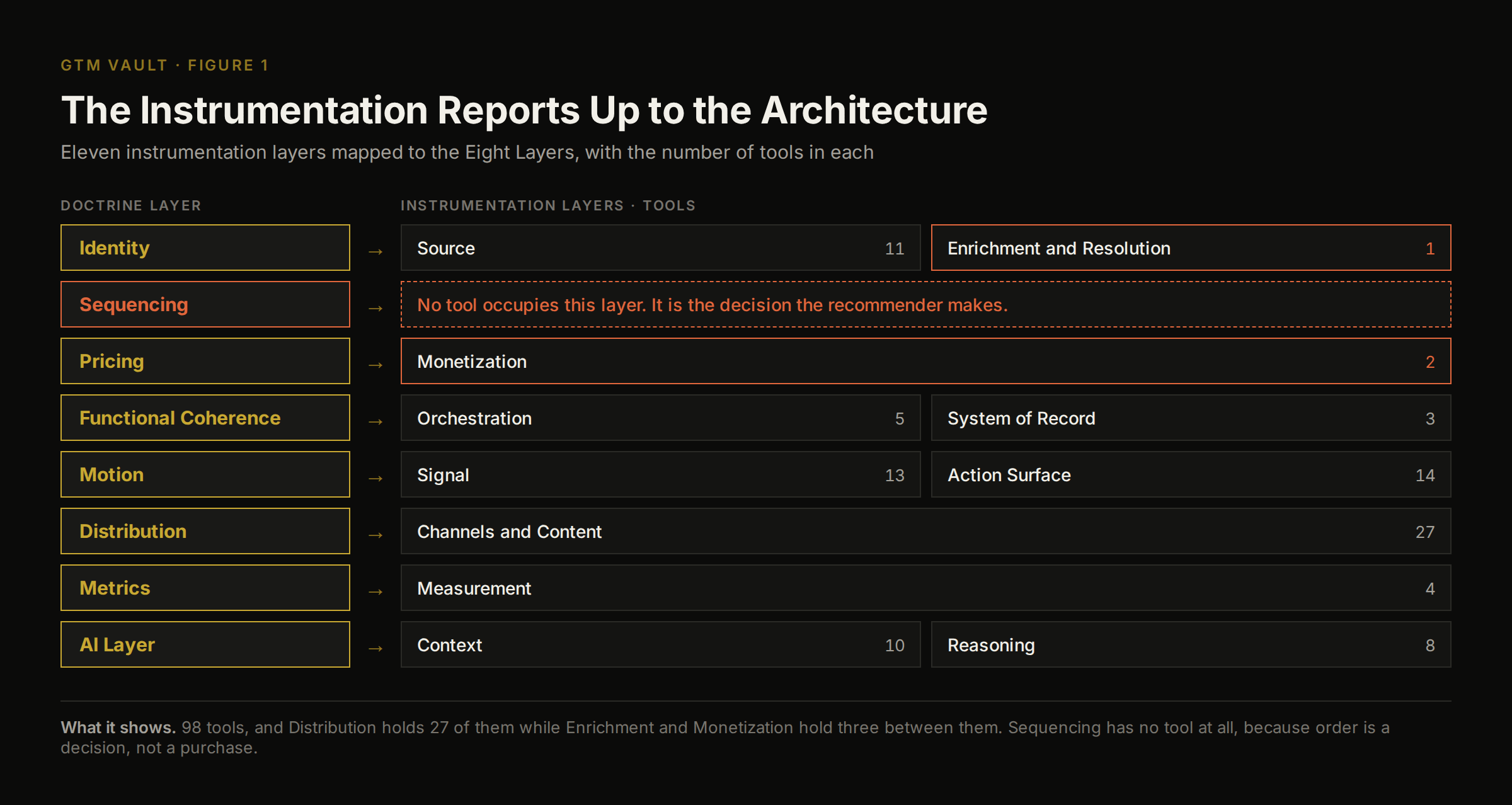
How a Tool Gets In
A tool enters one of two ways: a named operator described running it in a working system, or a GTM Vault essay recommended it. The index shows both and never blends them. Placement is not for sale. There is no field in the data model for it, and a vendor gets in one way, a customer describing the product on Show Me Your Stack. Displacements go on the record too: Elliot O’Connor said Clay displaced ZoomInfo, Tim Scheuer said Claude Code displaced Clay, both because someone said so, neither inferred from usage or reviews. The full inclusion rules are on the Method page.
Start With the Layer That Is Breaking
Most readers do not arrive knowing which layer is theirs. So the index opens with an audit: eight questions, one per layer, in build order. Can your team disqualify an account in under a minute, from data, without a call? Was the order you built your GTM in a decision, or the order vendors reached you? Would you bet the forecast?
The answer is a layer, not a score. The audit names the lowest layer that is breaking, because every layer above it reads from it and inherits the break. Fix Metrics before Identity and the dashboard turns green while revenue stays flat. The result shows what operators run in that layer and hands the constraint straight into Build Your Stack.
From the Index to a Build Order
The index answers what operators run. Build Your Stack answers what you should build, and in what order.
It takes four inputs: revenue band, motion, binding constraint, and budget posture. From those it returns the layers in build order for your company, the plays for each one, and the tools operators run there at the depth your access opens.
A $2M to $20M sales-led company whose pipeline does not convert gets a different first layer than a $20M to $100M enterprise company whose forecast is wrong. The tools can overlap. The sequence does not.
Your four answers live in the link, so a build can be bookmarked, sent to whoever owns the number, or emailed to yourself from the page.
Every Operator Gets a Page
Every operator who has described a working system on GTM Vault has a page. Elliot O'Connor's stack shows the five tools he named, placed on the layers they served, with what each one did in his words and the episode beside it. There are 24 operator pages today.
You can compare any two layer by layer. Where they agree is the consensus. Where they differ is the argument. Elliot and Garrett Wolfe share Clay and Sales Navigator and disagree on everything above Identity, which is the more interesting half.
What Each Reader Gets
Anyone, with no sign-in: the audit, the full index, every tool, layer and operator page, compare, the method, and the complete build order from Build Your Stack.
Free subscribers: the top pick in each layer for your budget, wherever two or more operators agree, plus each new operator stack by email as its Show Me Your Stack episode lands.
Annual Pro members: every tool in every layer matched to your budget, with the operator evidence behind each one, a printable build order for your Blueprint Session, plus the Pro Library.
Where the Free Version Stops
The index tells you what operators run. It stops at the moment you have to choose. Motion holds 27 tools. A $5M sales-led company on a lean budget needs one of them, and the reason an operator picked one over another is buried in an episode. That is the gap between reading an index and installing a stack, and it is the gap Pro closes.
Every tool in every layer, matched to your revenue band, motion and budget, with the operator evidence behind each pick. Not the top pick, the whole layer, so the second choice is there when the first does not fit your CRM.
The Pro Library: every GTM Vault Podcast and Show Me Your Stack episode as a written playbook, with the full transcripts searchable by phrase down to the timestamp. When you remember that someone explained why they left Outreach but not who, this is where you find it in thirty seconds instead of three episodes.
A 45-minute Blueprint Session for annual members, where the build order gets locked against your numbers, not a generic company in your band.
Pro is $49 a month or $499 a year. The audit and the full index stay free, and they will tell you whether you need any of this before you pay for it.
How It Stays Current
Every Show Me Your Stack episode adds to the index. The operator walks through the system they built, every tool they run gets placed on its layer, they get a page, and the counts change. Show Me Your Stack publishes every two weeks, so the index moves every two weeks. The latest addition is SMYS 8, Elliot O'Connor at Frontier, who put five tools on the record, two of them for the first time.
The counts in this post are a snapshot. The index is the current version.
Common Questions
How do I find where my revenue system is breaking?
Run the audit at pro.gtmvault.co/stack/audit. Eight questions, one per layer of revenue architecture, answered as the system behaves today. The result names the lowest layer that is breaking, since every layer above it inherits the break, and shows which tools operators run there.
Can a vendor pay to be placed in The Stack Index?
No. Placement is not for sale, and sponsorship moves nothing into a layer or up a list. There is no field in the data model for paid placement. A vendor is added when a named operator describes running the tool on Show Me Your Stack. A guest's own product is excluded from recommendations and listed separately.
How do I get a recommended GTM stack for my company?
Use Build Your Stack at pro.gtmvault.co/stack/build. Enter your revenue band, sales motion, binding constraint, and budget posture, and it returns the layers in build order with the plays for each. Free subscribers also see the top pick per layer, and Annual Pro members see every matched tool with the operator evidence behind it.
Related Reading
The 8 Layers of a Modern Revenue System: the doctrine the index is placed against, and why tool categories are not layers.
AI-Native GTM Is a Sequencing Problem: why the empty layer decides what every other layer produces.
Your Skills Are Not a Stack: the difference between owning tools and running a system.
What Is Revenue Architecture?: the full definition behind the eight layers.