



Hi, it’s Rick Koleta. Welcome to GTM Vault, a breakdown of how high-growth companies design, test, and scale revenue architecture. Read inside OpenAI, Anthropic, Meta, and Google, and by 27,000+ operators across 140+ countries building GTM systems that compound.
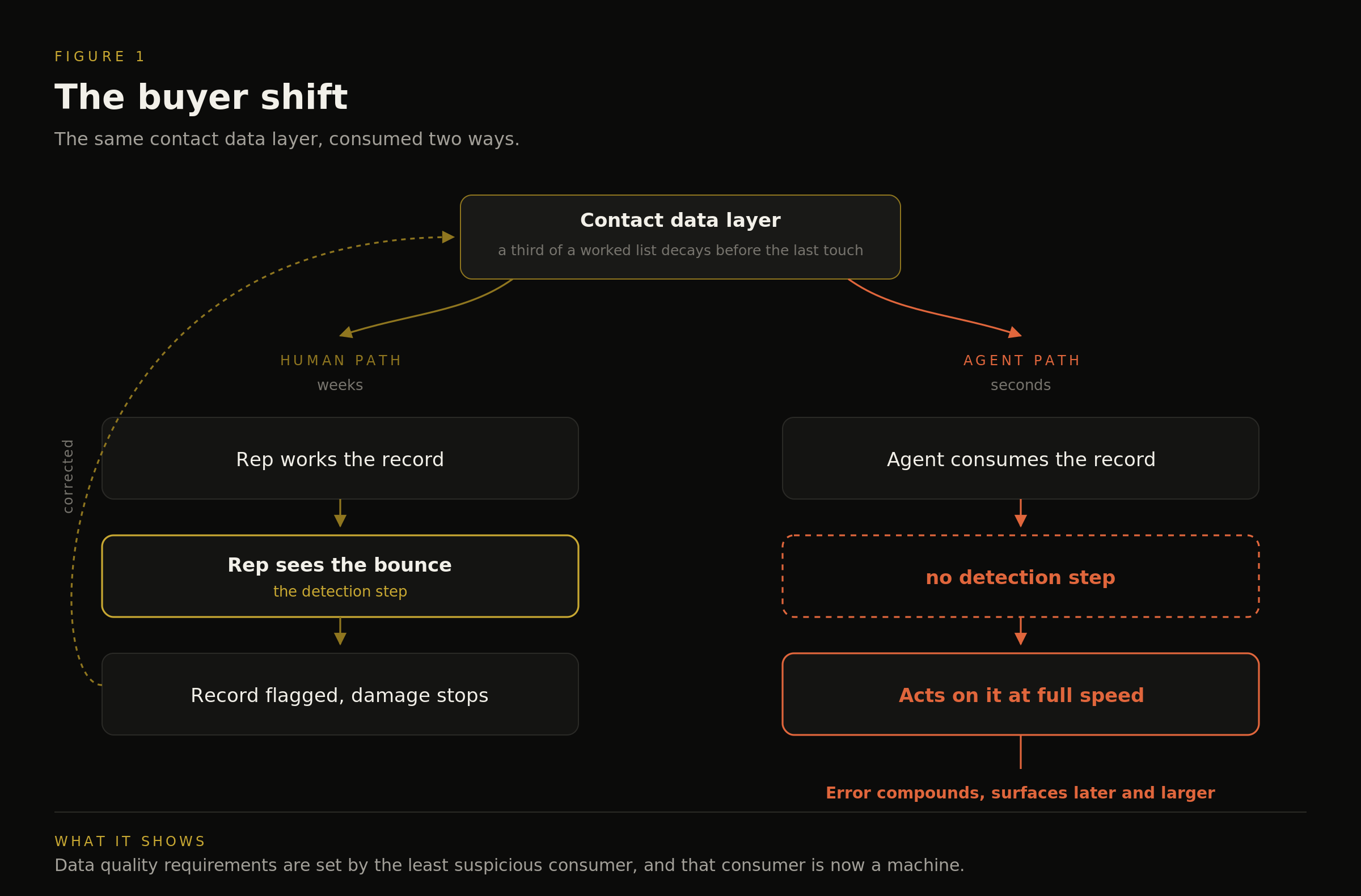
The list was exported, the sequence was loaded, and the reps worked it for three weeks. By the time the last contact was touched, a third of the data was already wrong. That decay rate was tolerable when humans worked lists over weeks, because a rep sees the bounced email and flags it. It is fatal when agents work signals in seconds, because the agent does not know the data is wrong. It acts on it.
The entire contact data industry was built for the tolerant version of that buyer: a person, in an interface, self-serving through a slick UI. Yoni Tserruya spent ten years winning that market. A few months ago he watched SDR and BDR agents go into production at customer accounts, doing certain work better than the humans they sit beside, and concluded the buyer of his data is about to stop being a person.
This is not a data quality story. Quality was always the product. The hard part is that the customer consuming the data is losing the ability to notice when it is wrong, which changes what a data company has to be.
Yoni Tserruya is the co-founder and CEO of Lusha, which he started as a side project in 2016 and bootstrapped for years before scaling it into one of the largest B2B contact data platforms in the market. Ten years in, he is rebuilding it as the layer AI agents query live: a verified provider in Clay’s ecosystem, waterfalls with Scale Stack, extensions inside Claude and ChatGPT, and a decision-makers API built for machine callers. He is explicit about the stakes: the agent is becoming the future persona of the data.
In GTM 50, Yoni breaks down why the buyer of contact data is stopping being a person, what survives of a ten-year-old product when the interface stops mattering, how waterfalls reset vendor economics, what an agent needs from a data vendor that a human never did, the two-layer retrofit forcing a ten-year-old company into the AI era, and how Lusha’s own GTM went headless.
This is not a conversation about data vendors. It is a conversation about which parts of your GTM system have to be true at the moment an agent acts.
Inside this episode
This episode maps what happens to the bottom layer of the GTM stack when the thing consuming it changes species.
Yoni opens with the inflection. It was not a keynote, it was production: a few months ago, early-adopter customers started running SDR and BDR agents live, trusting them with work they used to give reps, and seeing results. The majority of the market is not there, but enough early adopters are that he treats the next one to two years as the window in which agents become the real persona of his data.
We go deep on what breaks when the buyer is a machine. When a human worked the list, wrong data got caught: the rep knew it was wrong and flagged it. Put an agent on bad data and the damage is bigger and the detection is slower, because nothing in the loop knows to be suspicious. His conclusion runs against the commoditization story: inside a waterfall era, accuracy matters more, not less, and customers who need compliant, trusted data still pick their vendors carefully.
We cover the rebuild. Lusha won its first decade on two things, data quality and a self-serve UX simple enough that any user could log in, start free, and buy alone. The second thing is now irrelevant. If customers consume the data through Clay, Claude, or their own agents, they may never see Lusha’s interface again, so the product is being rebuilt as API and MCP based, integrated everywhere, chosen by machines on quality rather than by users on feel. He calls it a different way of thinking about the whole business, and it is still in progress.
We cover waterfall economics from the vendor’s side of the table. Waterfalls are the natural end state, one orchestrator stacking providers where customers used to buy three vendors and manage the mess themselves, and Yoni expects everyone to have one eventually. Lusha’s answer is to be agnostic and be everywhere: Clay, Claude, n8n, Make, Zapier. He is direct about the trade inside someone else’s waterfall: Lusha typically wins on quality and coverage, loses on price, and starts at forty-nine dollars a month, which he frames as quality any company can afford.
We go into agent-to-agent selling. When a buyer agent meets a vendor agent, both arrive having read everything public, so the discovery call dies and the conversation goes straight to pricing, integrations, and the needs that are not on the open web. The spam-to-spam worry gets the same answer: detection improves in parallel with generation, phones already screen callers, and the thing that passes the filter is a relevant reason for the contact. Laser-focused targeting stops being best practice and becomes the only thing that works.
We cover the retrofit, which he is honest about being harder than starting fresh. It runs on two layers, making the product AI-ready and making the organization AI-powered, and both are iterative and never finished. The mechanisms are concrete: every employee gets access to the AI tools they need, all-hands sessions share AI initiatives across divisions, and a team called Builders for Builders ships internal skills other teams adopt. The sharpest move is the constraint: where a team resists adoption, he shrinks the team while holding the workload constant, so AI becomes necessary rather than optional. There is no playbook and no expert to hire, because, as he puts it, eight months ago nobody was talking about Claude eating the world. The asset is a culture where trying and failing is cheap.
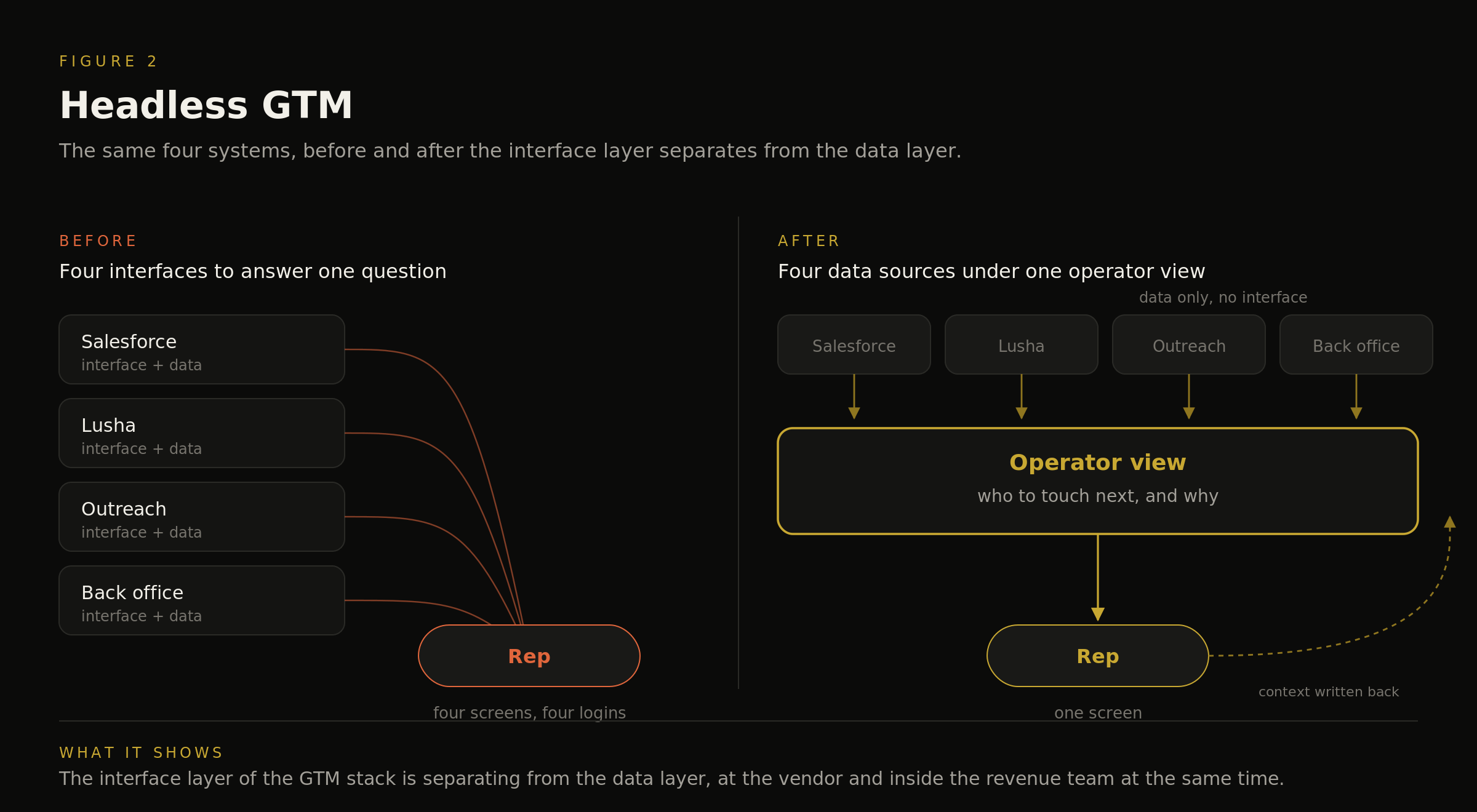
We go into how Lusha runs Lusha. Everything dogfoods: lead scoring, enrichment, prioritization, outbound, and churn risk all run on Lusha’s own data. The stack is going headless. The AEs almost never open Salesforce anymore, working instead from a custom dashboard that aggregates Salesforce, Lusha, outreach, and back office data into one view that says who to target and why, with engagement and call transcripts summarized and written back automatically. He expects go-to-market to go headless at more companies for the least glamorous reason available: it is a simpler operation.
We cover the pressure test. Operators are killing six-figure ZoomInfo contracts with Clay-native stacks, and Yoni’s answer is that Lusha was never the six-figure trap: it is usage-based, pay-as-you-go, bottom-up PLG. The position he claims against Apollo, Clay, and ZoomInfo simultaneously is the context layer feeding every agent in the market, including for SMBs. The LLM absorption question gets his most specific answer: a model can find five or ten contacts on the open web, it cannot return five thousand sorted, trusted results, because that requires a database designed for GTM. Claude and ChatGPT extensions already route those queries to Lusha. Compliance, he argues, is both moat and tax, and more moat, because very few companies can serve data compliantly at all.
We close on 2028 and the rapid-fire section. Reps today spend twenty to thirty percent of their time with customers; two years out he expects fifty to sixty, with agents absorbing the research, sequencing, and admin, quotas rising as manual work falls. Rapid fire lands API adoption as the underrated metric, transcripts and call recordings as the most overrated capability in revenue AI, company data as the next commodity, start small and iterate fast as the habit, and one sentence completed without hesitation: in three years the static lead list is irrelevant.
Watch or listen now across YouTube, Apple Podcasts, and Spotify
Discussed in this episode
(0:00) Cold Open: A Third of Your List Is Already Wrong
(2:58) The Moment the Buyer Stops Being a Person
(4:51) What Survives When the Interface Stops Mattering
(6:11) Waterfall Economics From the Vendor Side
(9:31) Agent to Agent Selling, Step by Step
(12:44) Spam to Spam, and the Relevance Filter
(14:24) The Two-Layer Retrofit of a Ten-Year-Old Company
(20:38) How Lusha Runs Lusha: Going Headless
(23:02) The Pressure Test: Apollo, Clay, ZoomInfo, and the LLMs
(26:10) The 2028 Revenue Team and Rapid Fire
Key takeaways
The buyer of GTM data is stopping being a person, and that is an architecture event, not a marketing one. The moment agents became the entity consuming contact data in production, the product requirements changed: API and MCP replace the interface, machine trust replaces user feel, and the vendor gets chosen by whatever the agent’s orchestrator ranks highest on quality. Everything downstream of that sentence is product strategy, which is why Yoni calls this the biggest evolution in Lusha’s history rather than a feature release.
Bad data compounds faster through a machine than through a rep. A human catches the wrong title and the dead number, flags it, and the damage stops. An agent executes on the bad record at full speed and the failure surfaces later and larger, because nothing in the loop knows to be suspicious. This inverts the commoditization story: as agents take over execution, accuracy gets more valuable, not less, and the waterfall makes the quality ranking explicit on every call.
Half of what won the last decade is now worthless, and knowing which half is the game. Lusha’s first decade ran on data quality plus a slick self-serve UX. The UX half is dead weight in a world where the customer may never open the interface. The discipline worth copying is the willingness to name which historic strength no longer matters and rebuild around the one that does, while the business still runs on both.
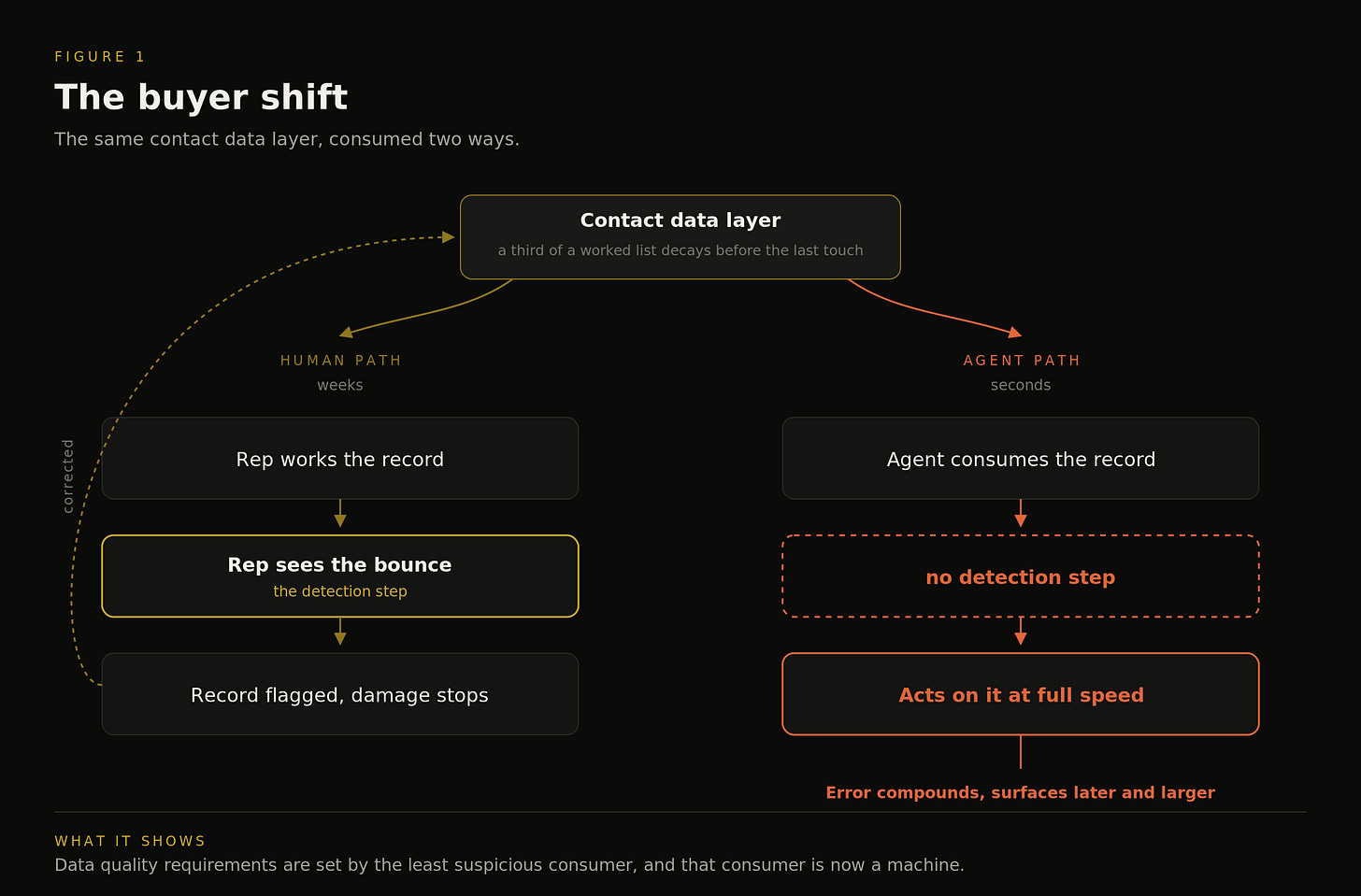
Figure 1. Same record, two consumers. The difference is not speed, it is the box that is empty on the right. Everyone will have a waterfall, so position inside all of them. Fighting the orchestration layer is a losing move; being the highest-quality provider inside every orchestrator is a durable one. That means Clay, Claude, n8n, Make, and Zapier equally, winning on quality and coverage, losing on price, and saying both halves out loud. The honest trade is the position.
The retrofit is a forcing function, not a memo. Two layers, product and operations, both iterative and never finished. The mechanisms that make it real: universal tool access, all-hands AI show-and-tell across divisions, a Builders for Builders team shipping internal skills, and the constraint move of shrinking resistant teams while holding workload constant. Culture that makes failing cheap substitutes for the playbook that does not exist.
GTM is going headless, and the reason is boring: it is simpler. Lusha’s AEs stopped opening Salesforce because one custom view aggregating Salesforce, Lusha, outreach, and back office data answers the only question that matters, who to touch next and why, with context written back automatically. The suite interfaces become databases underneath an operator surface. Expect this at any company where reps cross more than three tools to answer that question.
Frameworks from the episode
The Two-Layer Retrofit. Yoni’s structure for moving an existing company into the AI era. Layer one is the product: make it AI-ready, API and MCP based, consumable by agents, or the market routes around you. Layer two is the operation: run the company itself on AI, or you carry too many humans to stay efficient. Both layers are iterative and neither is ever done. The output is a company whose product can be bought by machines and whose org can be run lean enough to keep shipping it.
Builders for Builders. The internal mechanism that makes layer two real: a dedicated team that builds skills and automations other teams adopt, paired with all-hands sessions where divisions demo their AI initiatives to each other. The output is horizontal adoption without a mandate, because every team is borrowing working examples instead of reading policy.
Headless GTM. The end state Lusha’s own stack is reaching: the CRM and the tools stay, but as data sources underneath a custom operator view that aggregates them into one prioritized surface, with context inserted back automatically. The output is reps who work one screen, and an org whose interface layer is designed around its own motion instead of its vendors’ products.
What to do this week
Measure your data decay against your sequence length. Pull the last list your team worked and check what share had decayed by the final touch. That number decides whether your data layer is agent-ready or a liability you are about to automate on top of.
Ask every data vendor for their machine interface. If the answer is an export button rather than an API or an MCP, you are buying static lists in a market whose static list is, on Yoni’s timeline, three years from irrelevant.
Count the interfaces your reps cross to answer “who do I call next.” If it is more than three, pilot one aggregated view for the top workflow and watch whether your reps stop opening the CRM voluntarily.
Run one ranked brainstorm. Yoni’s growth mechanism is a session where ideas arrive without pre-approval, get ranked by cost and impact, and the top few get run without knowing whether they will work. One session, this week, with the explicit rule that trying and failing is acceptable.
Why this matters
Every GTM team is wiring agents into a stack whose bottom layer was built for a different buyer. The lists, the forms, the interfaces, and the refresh cadences all assume a human is in the loop to notice what is wrong, and the agents being deployed on top of them assume nothing at all.
The uncomfortable part of Yoni’s argument is that it prices the mistake. Bad data used to cost a wasted dial. Through an agent it costs compounding, undetected error at execution speed, which is why the quality of what your automation consumes is becoming the ceiling on how much automation you can afford.
The vendor-side lesson generalizes inward. Lusha is deleting the half of its product that stopped mattering while the business still runs on it, and most revenue teams have not run that exercise on their own stack: which historic strength is now dead weight, and which quiet layer is now the whole game.
The orgs that act on this will audit the data layer before they scale the agent layer, and buy on machine interfaces rather than dashboards. The ones that wait will find out about decay the way agents find out about everything: not at all, until the pipeline shows it. This is GTM Vault.
Send this one to whoever owns your data vendors and whoever is building your first agent, because they are about to be the same problem.
Connect
Follow Yoni Tserruya // Lusha
Follow Rick Koleta // GTM Vault
Thanks for listening. See you in the next episode.
P.S. Annual paid subscribers get a Private GTM Blueprint Session.


