


GTM Vault is a breakdown of how high-growth companies design, test, and scale revenue architecture. Join 27,000+ operators building GTM systems that compound.
Sequencing in go-to-market is the order in which the layers of a revenue system are built, and the rule that each layer depends on the one before it. Identity before motion, motion before distribution, distribution before metrics, and AI last, because AI amplifies whatever it inherits. The same tools installed in the wrong order produce fragmentation instead of compounding. Sequencing is the first decision in revenue architecture, not a planning detail, because every later layer inherits the one it was built on.
That is the definition. The rest of this essay covers why the word is used three different ways, the eight-layer order GTM Vault works from, what the operators on the record did in which order, and the four sequencing errors that produce most of the pipeline problems this publication gets asked about. AI-Native GTM Is a Sequencing Problem is where that order meets agents.
Three Uses of the Word
"Sequencing" circulates with three meanings and only one of them is the subject here.
In sales engagement tools it means a sequence: the cadence of emails and calls a rep sends to a contact. Outreach and Salesloft sold the word, and most people hearing it in a sales team mean this.
In fundraising and company building it means which market or segment to go after first, then second. Useful, and adjacent, but it is a strategy decision about where to point the machine, not about how the machine is assembled.
In revenue architecture it means the build order of the system itself: which structural layer is decided and installed before which. That is the meaning the GTM Architecture Laws use, and it is the one that decides whether the other two meanings ever matter. A perfect email sequence into an undefined ICP is activity. A sharp market sequence run through a fragmented stack is effort without compounding.
The Eight-Layer Order
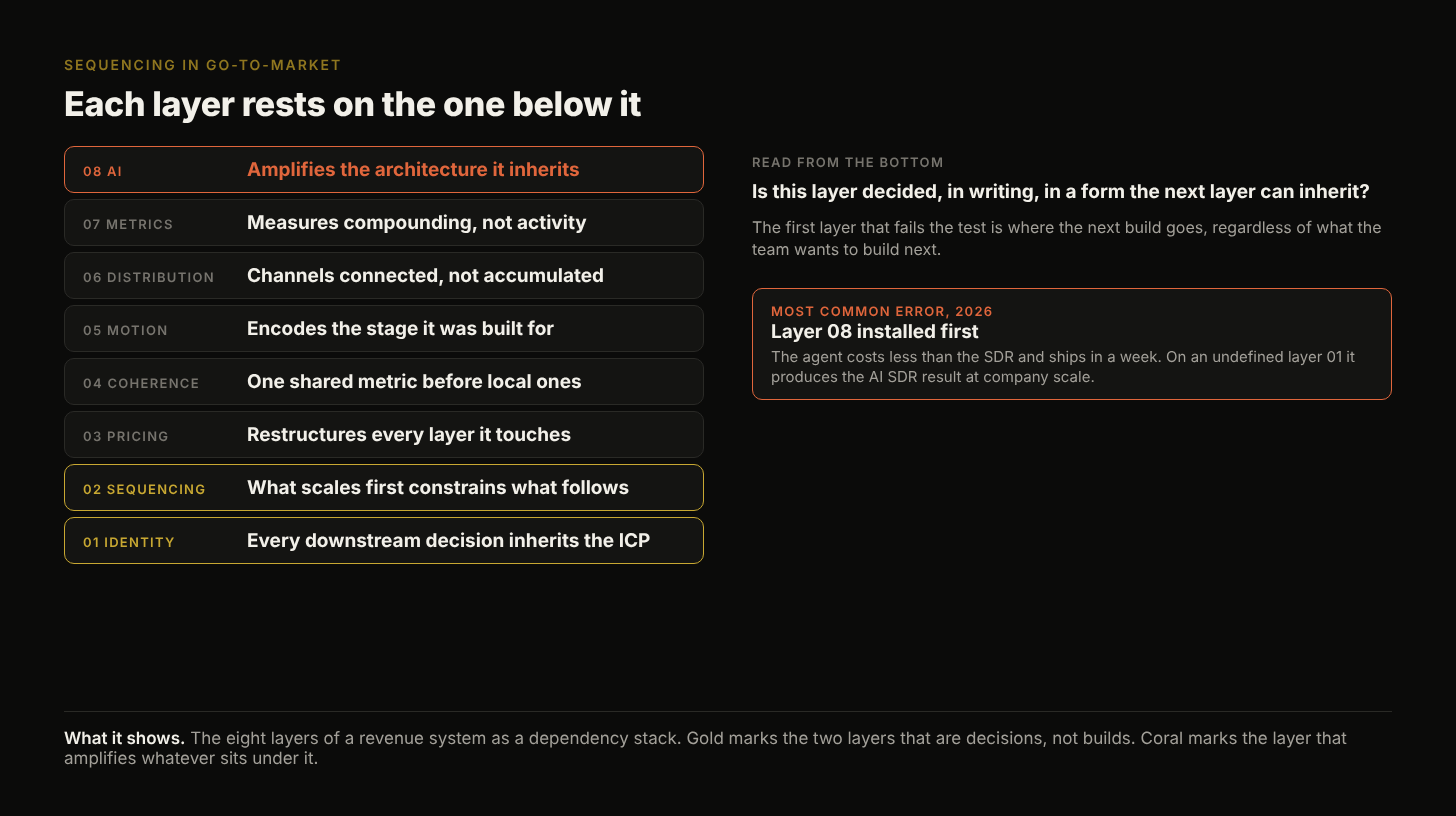
GTM Vault's Revenue Architecture Map orders a revenue system in eight layers. The order is the point.
Identity. The ICP as the architectural definition every later decision is tested against. Not a targeting filter; the definition of who the system is for.
Sequencing. What scales first constrains everything after. This layer is the decision about the order of the remaining six, which is why it sits second: it is made once the ICP exists and before anything is built.
Pricing. Pricing restructures every layer it touches, so it is set before motion, because the motion that fits a $2,000 product is not the motion that fits a $200,000 one.
Functional coherence. One metric the functions share, before each function builds its own. Function-level optimisation is system-level debt.
Motion. The playbook for the current stage. Every playbook encodes the stage it was built for.
Distribution. Channels connected, not accumulated. Added channels increase activity; connected channels produce reach.
Metrics. Measurement that reports compounding rather than activity, built after there is a system to measure.
AI. Last, because it amplifies the architecture it inherits. On a coherent system it compounds. On a fragmented one it scales the fragmentation.
The law for layer two reads: expansion before architectural readiness is not growth, it is a structural violation that accelerates the distance between effort and output. The gap between a compounding curve and a plateauing one is rarely a performance difference. It is a sequencing decision made early and never revisited.
What the Record Shows About Order
Show Me Your Stack records systems with the operator's screen shared, and the order they built in is visible in every episode.
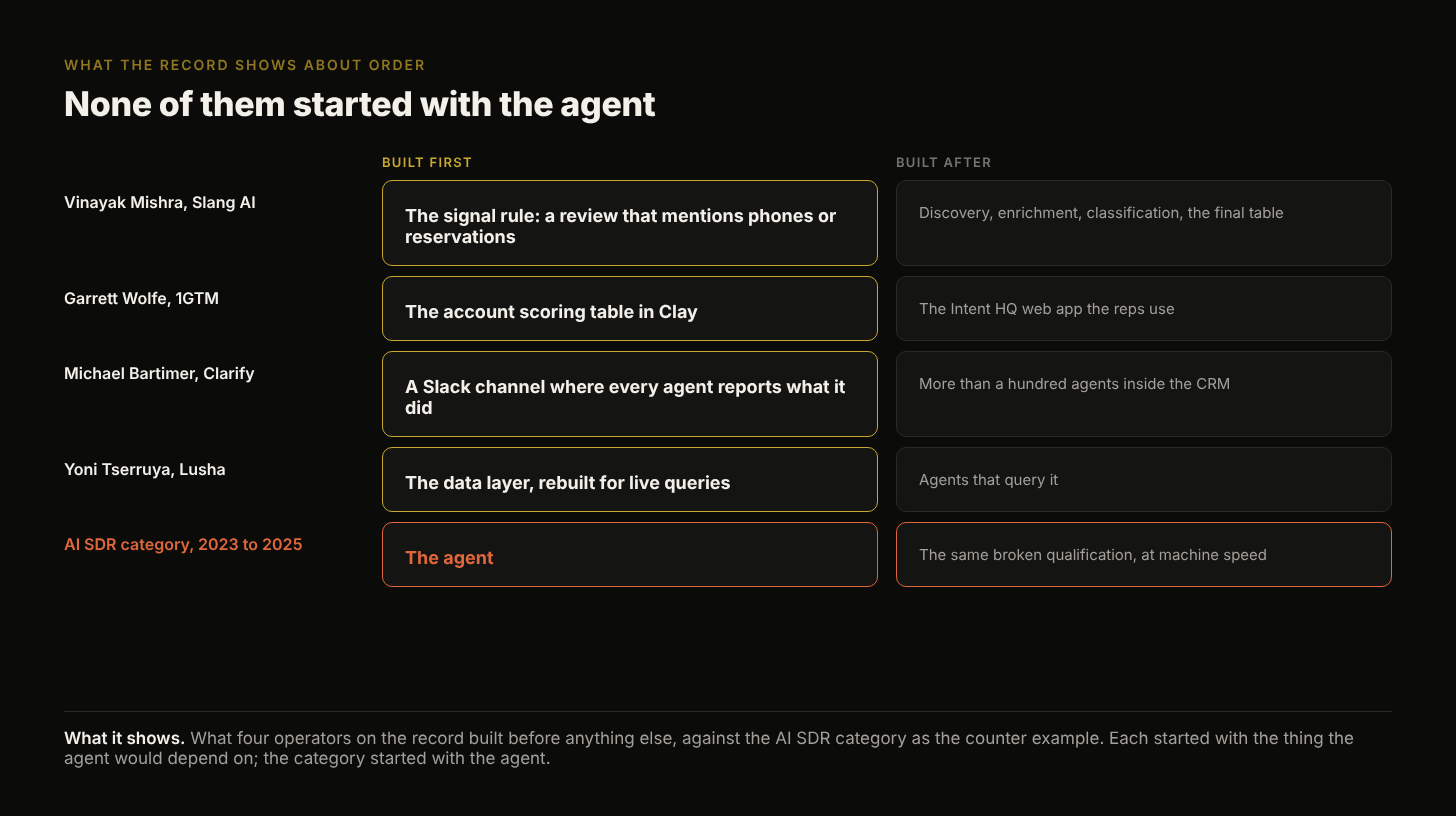
Michael Bartimer at Clarify runs more than a hundred agents inside one CRM, and his first step was none of them. Step one was visibility: a Slack channel where every agent posts what it did, so a human can read a run in ten to twenty seconds. Agents came after the surface that lets a person check them. The order was observe, then act.
Garrett Wolfe's BDR action layer began with the account list and the scoring table in Clay, and only then the web app in Claude Code that reps use. The app on top of an unscored list would have been a faster way to call the wrong accounts. Scoring before interface.
Vinayak Mishra's review intelligence system for Slang AI started with the signal definition, a negative review that mentions phones or reservations, before any discovery, enrichment or outreach was built. Signal definition before pipeline. The system narrows from thousands of restaurants to a qualified few because the narrowing rule was decided first.
Yoni Tserruya rebuilt Lusha for agents that query live because a third of a static list is wrong by the time the last rep touches it. The sequencing lesson sits underneath: a data layer built for a weekly export cannot be fixed by adding an agent on top. The data layer had to be rebuilt before the AI layer could be trusted.
The AI SDR category, 2023 to 2025, is the sequencing error at industry scale. The tools ran volume against the same broken qualification the human SDRs had been running, at machine speed, and early revenue walked once break clauses opened. Layer eight installed on top of an undefined layer one. The lesson was not that AI does not work. Automation amplifies the system it inherits.
The Four Sequencing Errors
Most of the pipeline problems this publication is asked about reduce to one of four orderings.
Motion before identity. The company hires SDRs and buys a sequencer before the ICP is an architectural definition. The symptom is a full calendar of meetings that do not close, reported as a sales execution problem. The cause is that every downstream decision inherited a blank.
Distribution before motion. Channels get added because each one is cheap to try: a LinkedIn program, a partner motion, paid, events. The symptom is a reporting deck with six channels and no compounding. The cause is channel accumulation with no motion to connect them.
Metrics before coherence. Each function builds a dashboard for its own metric. Marketing reports MQLs up, sales reports meetings up, customer success reports churn up, the CEO reports revenue flat. The dashboards are accurate. The system is measuring activity at every functional boundary because no shared metric was set first.
AI before everything. An agent is installed to generate pipeline on a system that has not decided who it is for. This is the most common error in 2026 because it is the cheapest to make: the agent costs less than the SDR it replaces and ships in a week. It produces the AI SDR result at company scale.
How to Read Your Own Order
The test is one question per layer, asked from the bottom up: is this layer decided, in writing, in a form the next layer can inherit? An ICP that lives in the founder's head is not decided. A motion that changes by rep is not decided. A metric each function defines differently is not shared. The first layer that fails the test is where the next build goes, regardless of what the team wants to build next.
The Stack Index runs this as a tool. Build Your Stack takes the revenue band, the motion, the binding constraint and the budget posture, and returns the sequence first: install first, install next, not yet. The plays come after the order, because the order is what the operators on the record got right before the tools.
Common Questions
What does sequencing mean in go-to-market?
The order in which the layers of a revenue system are built, with the rule that each layer depends on the one before it. In GTM Vault's framework: identity, sequencing, pricing, functional coherence, motion, distribution, metrics, AI.
Is sequencing the same as a sales sequence?
No. A sales sequence is a cadence of touches to one contact. Sequencing in revenue architecture is the build order of the whole system. The first only produces results inside a system that got the second right.
What should be built first in a GTM system?
The ICP, as an architectural definition rather than a targeting filter. Every later layer inherits it. Then the sequencing decision itself: which of the remaining layers is installed in which order for this stage.
Why does AI come last?
Because AI amplifies the architecture it inherits. On a coherent system it compounds output; on a fragmented one it scales fragmentation at machine speed. The AI SDR failures of 2023 to 2025 are the industry-scale example.
What happens when a company scales out of sequence?
Effort rises and output does not. The law for the sequencing layer calls expansion before architectural readiness a structural violation: the distance between effort and output accelerates, and the gap shows up later as a sales, marketing or tooling problem that is none of those.
Where is the full framework?
The GTM Architecture Laws at gtmvault.co/p/laws, one law per layer, and the Revenue Architecture Map in the What Is Revenue Architecture essay. The operator evidence for each layer is in the Library at pro.gtmvault.co/library.
The order above is the order the Stack Index uses to place every tool an operator names. A tool is recorded on the layer it served, and a build is read by which layer it started from.