


GTM Vault is a breakdown of how high-growth companies design, test, and scale revenue architecture.
Koray Bahar on selling Foriba to Sovos, then building a platform that finances $100M of SME invoices a month
Koray Bahar built Foriba into Turkey's e-invoicing leader and took it into 8 European countries. He was raising to buy a company in Germany when a UK investor opened the data room and came back with a different offer: buy Foriba instead. The deal closed in three months. He had not planned any of it.
“One of the documents I signed is my quit letter. And the last page was the new employment contract for me.”
Meet Koray Bahar, Co-founder and CEO of Figopara. After the exit he gave himself a rule: no new business for twelve months. It lasted a couple of months. Turkish SMEs carry 70% of the country's employment and receive 8% of its credit, and Figopara finances over $100M of those invoices a month while still meeting only a quarter of demand. Walking through Beyoglu, Koray explains why government mandates built his first market, why he went down market twice, and why the constraint is the supply of credit, not the demand for it.
About Figopara
Figopara is a receivables financing platform that connects large corporate buyers, their suppliers and more than 25 banks, so small and medium businesses can turn approved invoices into cash the same day. It was founded in 2016 in Istanbul by Koray Gultekin Bahar, CEO, and Arman Eker, CTO, as a subsidiary of Foriba, and was carved out before Foriba's 2019 sale to Sovos. Figopara reports more than $2.7B in financing volume and 10,000 SMEs reached. It has raised $23.7M, including an $11M Series A in 2022 led by L2G Ventures with IFC, Sabanci Ventures and ScaleX Ventures participating.
The full episode is on YouTube. Subscribe to the channel for the clips and cuts that never make the write-up.
Episode highlights
0:00 Ten Years in E-Invoicing, Starting in Beyoglu
6:15 The 4 Years Between the Pitch Deck and Europe
7:46 Following Government Mandates Country by Country
15:47 Going Down Market: Hundreds of Thousands of Euros to Hundreds
18:58 The Exit Nobody Planned
20:15 Signing the Quit Letter and the New Contract
26:36 Why Figopara Starts With Blue Chips to Reach SMEs
29:05 70% of Employment, 8% of Credit
33:37 $400M of Demand, a Quarter Fulfilled
39:43 Firing Too Late, Twice
What you’ll learn:
How a 2010 Ministry of Finance mandate obliged 16,000 Turkish companies to adopt e-invoicing in its first year, and why Foriba was ready for it
Why the European expansion promised in the 2014 pitch deck took 4 years, and what finally made it happen in 2018
Why Foriba entered Italy, Hungary and the UK by following mandates instead of picking markets, and partnered with the Big Four for the tax know-how
How Foriba served 8 EU countries without hiring anyone outside Turkey
Why the first SME sales team of 20 to 30 reps failed its year-end numbers, and what changed in how the product was sold
How an investor approach in late 2018 became a full acquisition within 3 months, and what the quit letter on the last page felt like
Why Figopara starts with large buyers, brings in their suppliers, and lets bank appetite follow the anchor
Why Turkish SMEs get 8% of credit while providing 70% of employment, and the 3 reasons banks hold back
Why over $100M financed a month against $400M of demand keeps Figopara in one country
What an Endeavor panelist asked about firing, and why Bahar still waited too long the second time
Key takeaways
Regulation built the market, and the company that was ready won it.
Foriba had e-signature and SAP integration capabilities before Turkey's Ministry of Finance mandated electronic invoicing in 2010. In the first year, 16,000 companies were obliged to adopt it, and Foriba already served hundreds of blue-chip clients. The expansion followed the same logic: Italy, then Hungary, then the UK's Making Tax Digital, with the Big Four supplying local tax know-how. Bahar calls it a different go-to-market strategy: the government creates the demand, and the earliest credible vendor takes the segment.
Going down market is a new company, not a new price list.
Blue-chip tickets ran to a couple of hundred thousand euros. SME tickets ran to a couple of hundred, which rules out dedicated support and on-site integration. Foriba built a separate web app, partnered with local accounting software, and hired 20 to 30 reps across Turkey. At year end, the team cost and marketing spend against SME revenue told Bahar it was not working, because nobody had run customer acquisition cost properly. The sales team grew from 5 before the first round to 40 to 50 at the exit.
Anchor the network on large buyers, and the small businesses come with it.
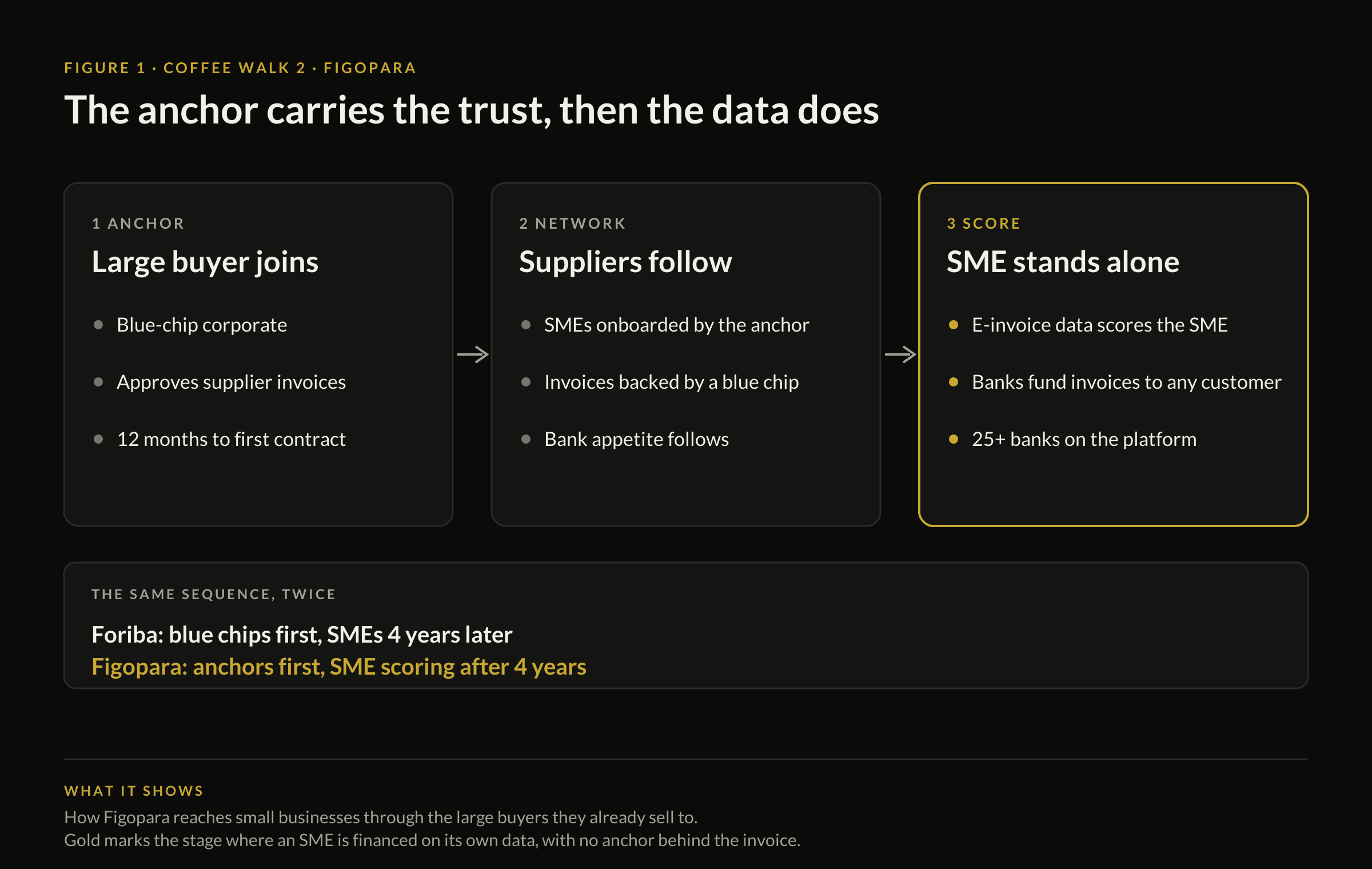
Figopara applied the Foriba sequence again. Large corporates join first and bring their suppliers onto the platform, and banks finance those receivables because a blue-chip buyer stands behind every invoice. After 4 years, the e-invoice data fed Figopara's own working-capital scoring engine, so banks now finance SME invoices to any customer, not only to the anchors. The cost of the play is time: the first blue-chip contract can take 12 months to sign.
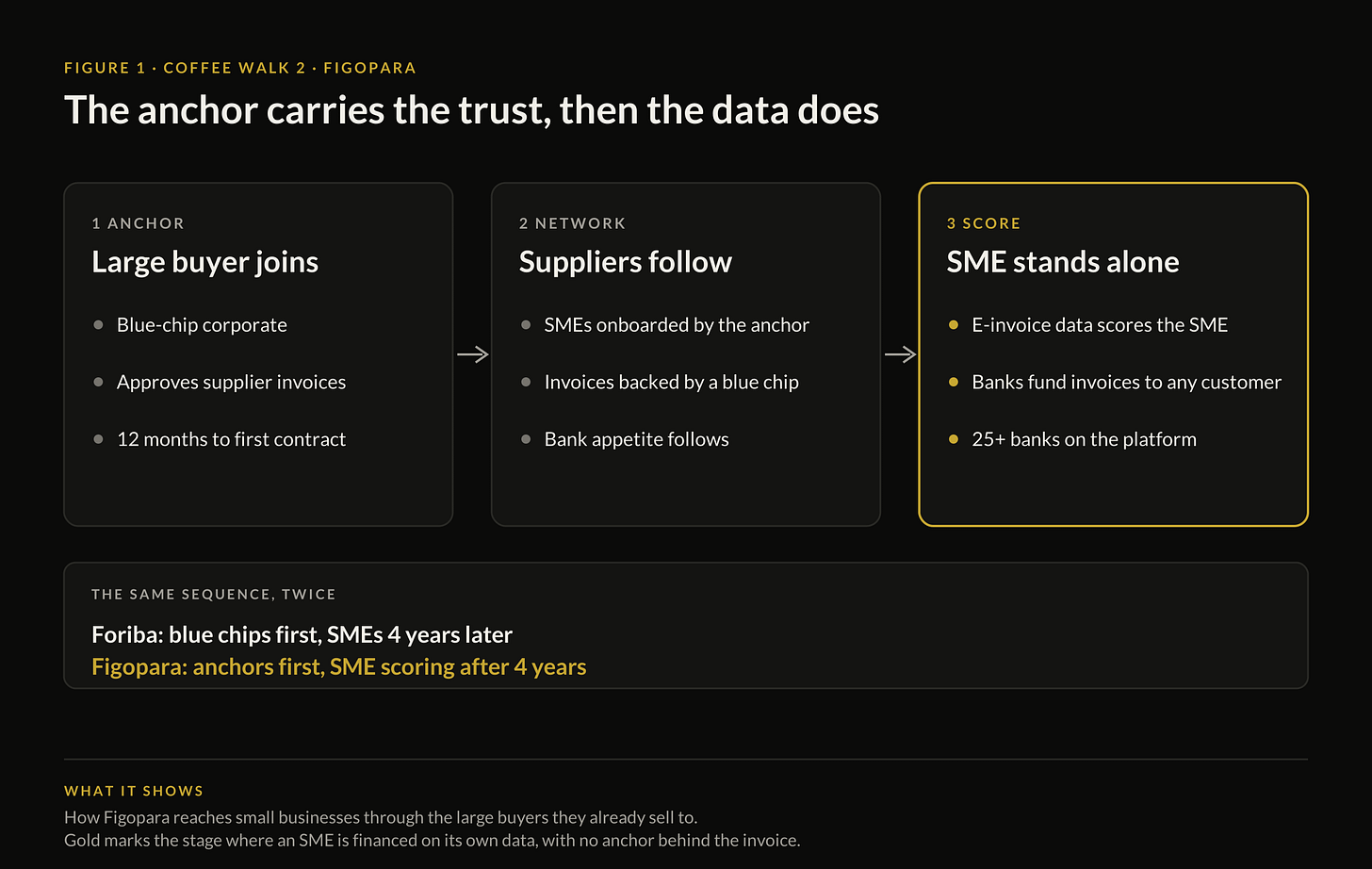
Figure 1. The anchor buyer carries the trust that a single small business cannot, and the data then lets it stand on its own. 70% of the jobs, 8% of the credit, and a quarter of the demand met.
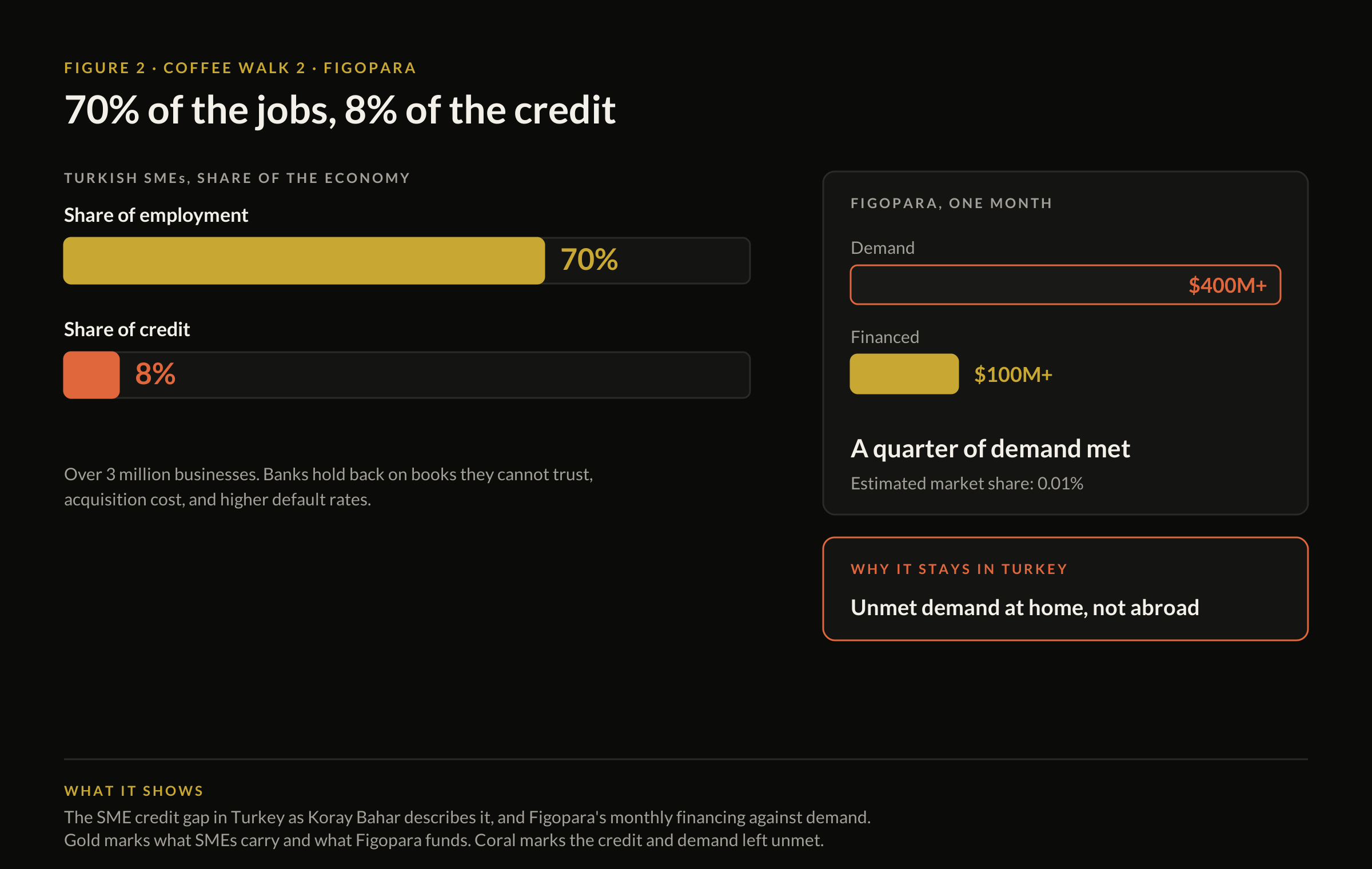
Turkey has more than 3 million businesses, and small and medium ones provide 70% of employment. Bahar puts their share of the credit book at 8%, held back by books banks cannot trust, high acquisition cost, and higher default rates. Figopara finances over $100M a month against more than $400M of demand last month, and he puts its share of the market at 0.01%. That is why the company has stayed in Turkey, after his own rule from Foriba said to expand sooner.
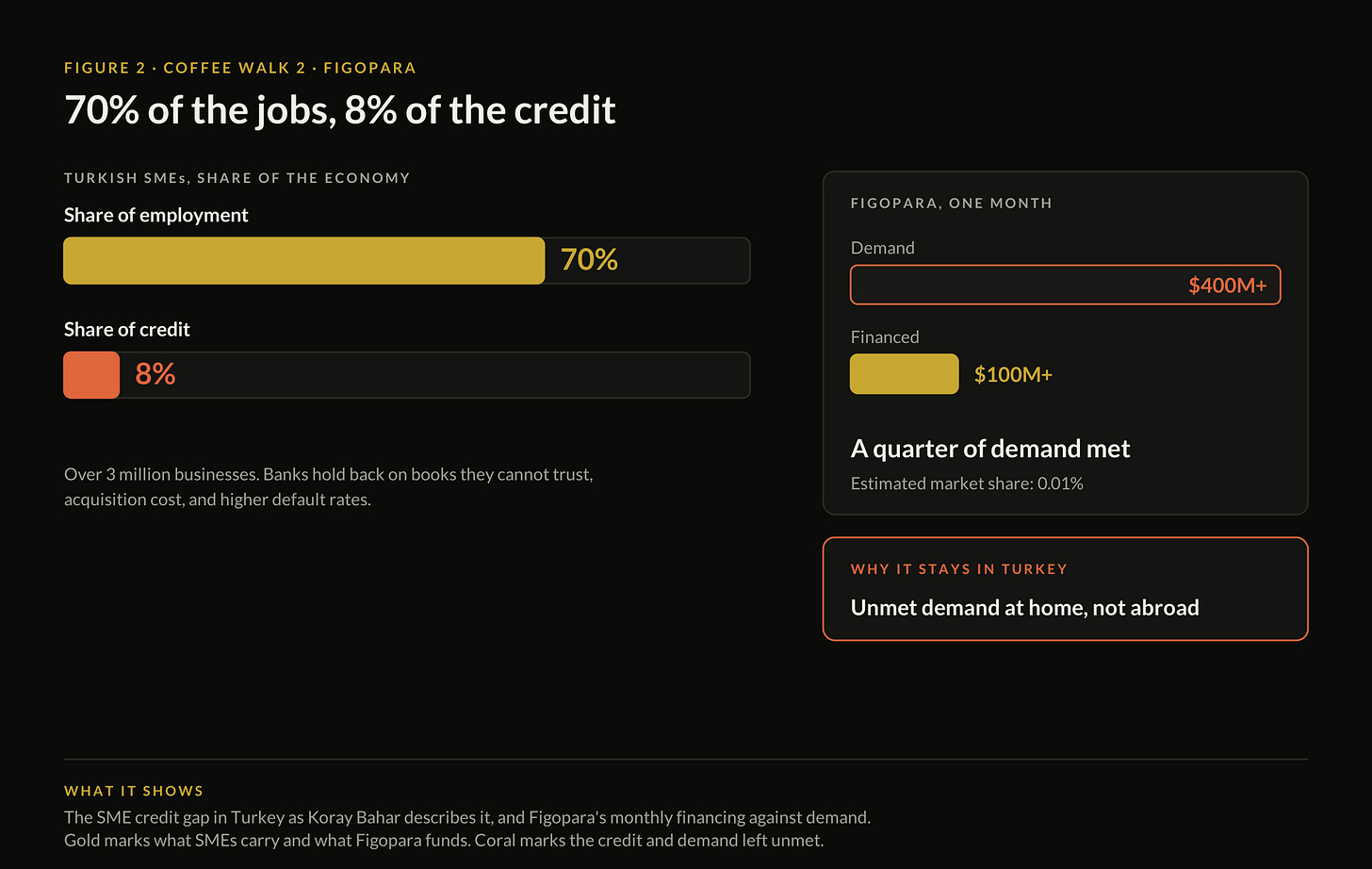
Figure 2. The constraint is supply of credit, not demand for it, which is why expansion waited. The exit you do not plan still ends with your signature on a quit letter.
Foriba was raising for a German acquisition when a UK investor opened the data room and came back offering to buy the company for a portfolio business. It closed within 3 months. On the last pages Bahar signed his quit letter and then his new employment contract, worked 6 months at Sovos, and left when a company event and a free fix for an unhappy customer were refused on policy. His advice to that version of himself: do not wait that long.
Koray Bahar
LinkedIn: https://www.linkedin.com/in/koraybahar/
Figopara: https://figopara.com/en
Rick Koleta (Host)
LinkedIn: https://www.linkedin.com/in/rickkoleta/
Instagram: https://www.instagram.com/rickkoleta
GTM Vault
LinkedIn: https://www.linkedin.com/company/gtmvault
YouTube: https://www.youtube.com/@gtmvault
Website: https://gtmvault.co/
Previous episodes include


See all previous episodes here
Koray built at $100M+ scale. See how your revenue system compares with the operators on the record: 7 taps at pro.gtmvault.co/survey, and the State of the GTM Stack 2027 report ships in March, free.
Coffee Walk is a GTM Vault series: unscripted walks with Europe's most experienced founders, one city at a time. Visit gtmvault.co for more episodes, the GTM Vault newsletter, and Show Me Your Stack.


