



GTM Vault is a breakdown of how high-growth companies design, test, and scale revenue architecture. 27,000+ operators read it. Join them.
Every vendor in revenue AI is pointed the same way. Automate the seller, draft the outbound, hand the follow-up to an agent. Which leaves a question nobody on that side of the market is funded to answer: what happens to the conversations an agent does not get to take, and who is responsible for making the humans in them better. Ariel Hitron has been running the other way since 2019, building AI that plays the buyer so the seller gets better. The co-founder and CEO of Second Nature joins GTM Vault for episode 52 to explain why an enterprise buyer signing off on a large number is not buying capability, where he draws the line between an agent conversation and a human one, and why the training product was only ever the wedge.
About Second Nature
Second Nature builds a data model of a company’s sales playbook out of its recorded calls, collateral, scripts and CRM stage criteria, then generates AI roleplays that let reps practice against it and scores them afterwards against that company’s own criteria, in more than twenty languages. It was founded in 2019 by Ariel Hitron, who helped scale Kaltura from startup to global business, and Alon Shalita, a former lead engineer at Facebook, and runs out of New York. Its customers include Zoom, Oracle, Adobe, Teleperformance and Check Point, and the company reports sales up more than twenty percent after an average of thirty minutes of practice per trainee, with onboarding at some accounts cut by three weeks off a nine week process. Second Nature has raised $38M in total, including a $22M Series B in October 2025 led by Sienna VC with Bright Pixel, StageOne Ventures, Cardumen, Signals VC and Zoom, which is also a customer.
Watch or listen now across YouTube, Apple Podcasts, and Spotify
Download the transcript

Episode highlights
(0:00) Who Do You Hold Accountable When It Breaks
(1:38) The Category Automates the Seller. He Went the Other Way
(5:07) 2019, Before ChatGPT, and the Objection Every Enterprise Gave
(7:33) Digitizing the Playbook Into One Machine-Readable Model
(9:35) What the Scoring Layer Catches That a Manager Misses
(13:22) Which Conversations Should Go to an Agent, and Which Never
(19:18) Bundling, Unbundling, and Why Enterprises Unbundle Upward
(24:53) From Roleplay to Agentic Sales
(30:49) Demos Are Free. Maintenance Is the Moat
(38:24) The 2028 Revenue Org and the Test That Would Prove Him Wrong

What you’ll learn:
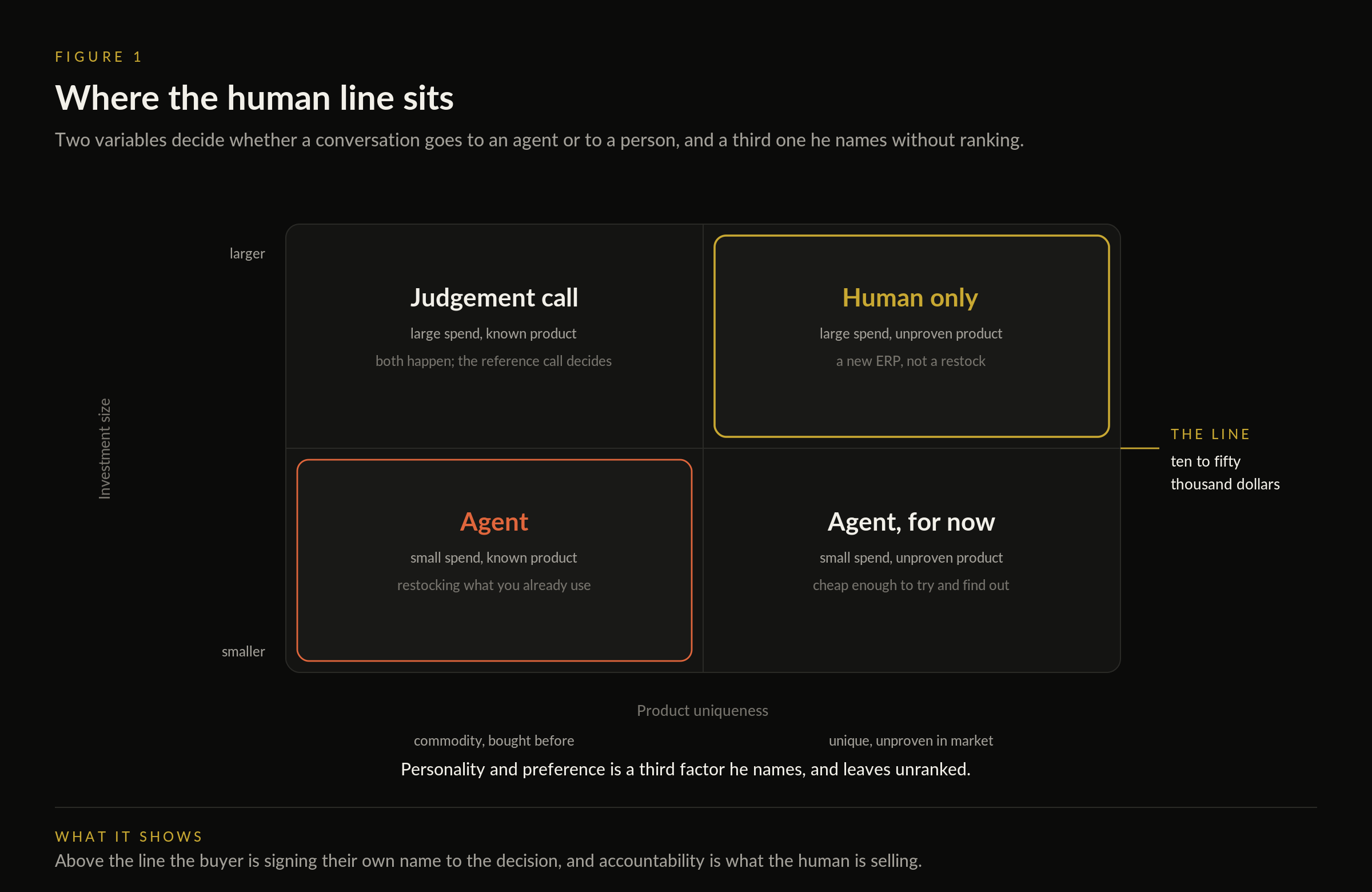
Why an enterprise buyer approving fifty thousand or five hundred thousand dollars is buying accountability, which an agent has none of
The two variables that draw the human line: size of the investment and how far the product sits from a commodity
Why personality and preference is a third factor he names, and pointedly does not rank against the other two
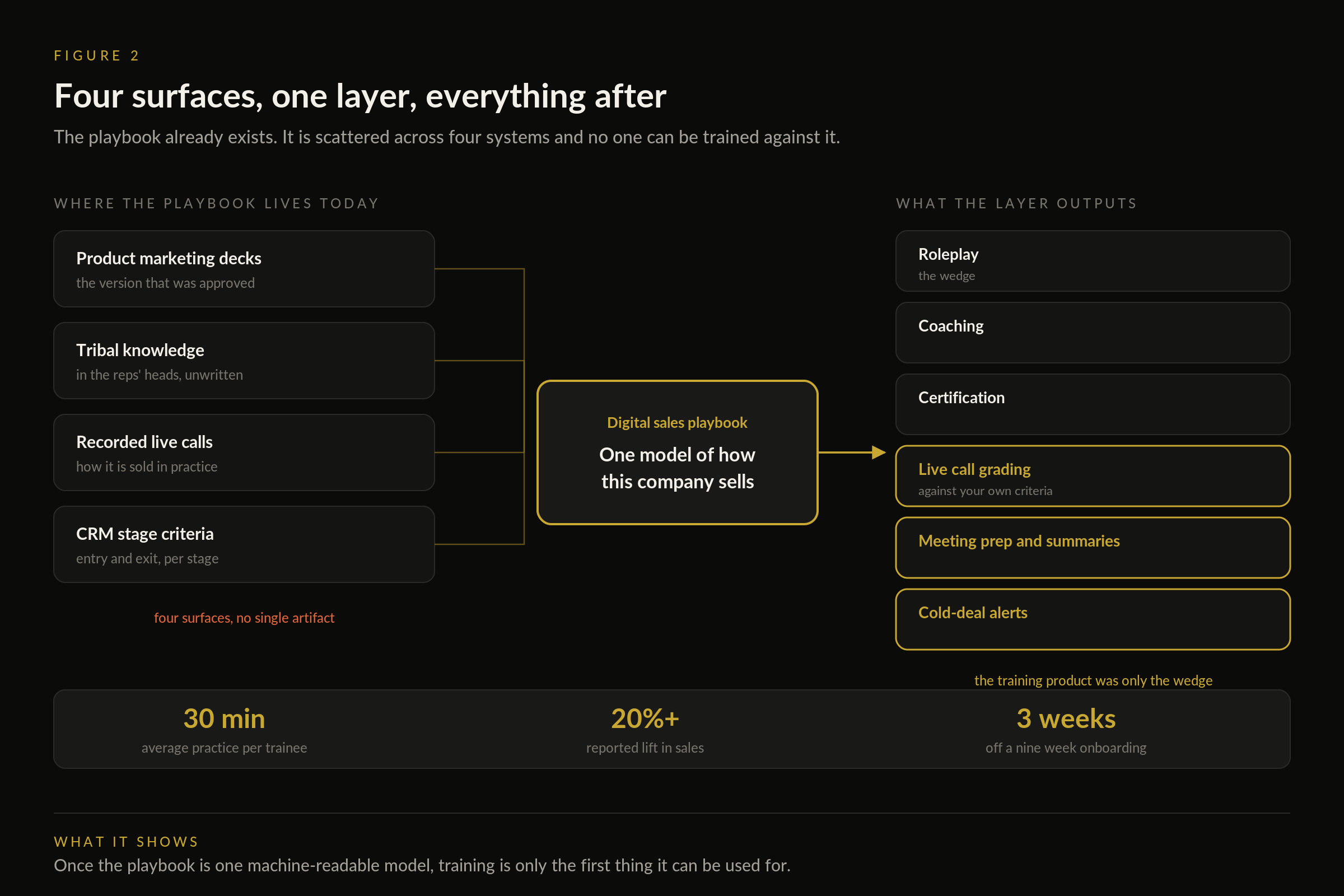
A playbook lives in four places at once, and none of them can be trained against until it is compiled into one model
The machine does not beat a sales manager on judgment, it beats them on patience across a seven-parameter scorecard
Building a hostile buyer is trivial, and the silent one is the hardest to sit across from
Why enterprises are unbundling their enablement suite upward, buying the one capability the platform layer has not absorbed
Demos are free and maintenance is the moat: what happens to every in-house roleplay build after the hackathon
Why large competitors shipping roleplay as a feature made the sale easier rather than harder, and what he had to stop arguing
The falsifiable test, on a clock: if the sales workforce shrinks, he was wrong
Key takeaways
1. Enterprise buyers are not buying capability. They are buying someone to answer the phone when it breaks.
Ariel gives away the whole capability argument without a fight. An agent can run discovery, ask the questions, solution, and put a proposal in front of you. What it cannot do is absorb the consequence, and a buyer signing off on fifty thousand or five hundred thousand dollars has put their own standing inside the company on the line to do it.
2. Two variables draw the human line, and a third one he names without ranking.
Size of the investment, and how far the product sits from a commodity. He puts the first threshold somewhere between ten and fifty thousand dollars, and the second at the gap between restocking something you have bought before and deploying a system nobody in the market can vouch for yet. Toilet paper goes to a bot and a new ERP does not, and the third factor he names is personality and preference, which he leaves unranked against the other two.
3. A playbook you have not compiled cannot be trained against, by an agent or a new hire.
The playbook is real and it is scattered across four surfaces: product marketing decks, tribal knowledge sitting in reps’ heads, recorded live calls, and the stage entry and exit criteria in the CRM. Second Nature’s job is to consolidate all of it into one machine-readable model of how that specific company sells. Every org runs its own mutation of MEDDPICC or SPIN, so the named methodology tells you almost nothing about the process that survives contact.
4. The scoring layer does not beat a manager on judgment. It beats them on patience.
Humans read the room, catch the nuance, and bring everything they have seen before into the call. What they do not do is walk a seven-parameter scorecard, call by call, rep by rep, and justify each score. Ariel’s framing is that sales leaders are not accountants, so the feedback that lands is that you were not convincing, not exciting, not bringing energy, which is true and unusable, and the machine advantage is consistency rather than insight.
5. Demos are free. Maintenance is the moat, and it is why the in-house build decays.
The pattern repeats across enterprises: a hackathon, an internal team, a working prototype, then decay. The builders return to their day jobs, the voices go stale, credits run out, access controls are wrong, and nothing consolidates the data. Every layer underneath moves fast enough, from the models to speech to text to the agent harnesses, that maintaining it becomes irrational for anyone whose job is not this.
Ariel Hitron
LinkedIn: https://www.linkedin.com/in/arielhitron/
Second Nature: https://www.secondnature.ai
Rick Koleta (Host)
LinkedIn: https://www.linkedin.com/in/rickkoleta/
Newsletter: https://gtmvault.co/
GTM Vault
YouTube: https://www.youtube.com/@gtmvault?sub_confirmation=1
Website: https://gtmvault.co/
Previous episodes include


See all previous episodes here.
The GTM Vault Podcast is a breakdown of how high-growth companies design, test, and scale revenue architecture. Visit gtmvault.co for more episodes, the GTM Vault newsletter, and Show Me Your Stack.


