


GTM Vault is a breakdown of how high-growth companies design, test, and scale revenue architecture.
Every dollar in revenue AI is chasing the agent that sells. Almost nobody is funding the one that keeps the system those agents run on from rotting, which is strange, because the org they all read from is the thing quietly decaying underneath them. Jelle van Geuns spent over a decade inside hundreds of Salesforce orgs before he built anything, and what he saw was not breakage. It was accumulation. The founder and CEO of Cirra AI joins GTM Vault for episode 54 to explain why the admin layer is a company rather than a feature, where the guardrails on an AI that can touch Setup actually sit, and why an independent survives the platform vendor and the frontier labs on grounding and history rather than on model capability.
About Cirra AI
Cirra AI builds an AI admin for enterprise software, starting with Salesforce: someone describes a change in plain language, and Cirra reads the org, proposes an implementation, builds the metadata in a sandbox, and documents what it did and why. It was founded in 2024 by Jelle van Geuns, a Dutch-born engineer and decade-plus veteran of the Salesforce ecosystem, and runs out of San Francisco. It ships what it calls the first commercial Model Context Protocol server built for Salesforce administration, so an admin can change an org from Claude or another agent rather than logging into Setup. Cirra has raised no outside capital; before it, Jelle bootstrapped Decisions on Demand, a lead-routing AppExchange app, to seven-figure ARR without external funding.
Watch or listen now across YouTube, Apple Podcasts, and Spotify
Episode highlights
(0:00) The Agent Nobody Is Funding
(2:48) Orgs Do Not Break, They Accumulate
(4:36) The Backlog At A 200 Person Company
(7:11) The Seven Figure ARR Correction And No Outside Capital
(8:55) One Change Request From Slack To Production
(11:37) Four Guardrails On An AI That Touches Setup
(17:13) Why Agentforce Does Not Absorb This
(19:26) What Stays Yours When The Models Improve
(31:45) The Autonomous AI Admin And What Early Autonomy Got Wrong
What you’ll learn:
Why orgs do not break but accumulate, and why only about two percent of surveyed Salesforce orgs are described as clean and well maintained
The norm at a 200-person company: one part-time admin, often the VP of sales, and forty to sixty open requests that never shorten
What the backlog costs where no line item shows it: a spreadsheet on the side, a shadow Asana instance, and reports that stop matching reality
One change request end to end, from a Slack sentence to a confirmation gate, an admin approval, a sandbox build, and the customer’s own DevOps pipeline
Four guardrails on an AI that touches Setup: the OAuth permission ceiling, role-based access, read before write, and the promotion flow
Why Agentforce does not absorb the admin layer, and the tell: Salesforce’s own MCP servers read metadata but will not change it
The headless bet, which is configuring Salesforce from the agent you already use rather than logging into the platform to do it
What stays durable when the models improve: org-specific grounding, the accumulated record of why a change was made, and the approval trail
The answer to “why not wait for Salesforce”, which is two or three releases, nine months to a year, and a year and a half before it hardens
The eighteen-month test: first-level admin traffic goes to the AI, and nothing gets reworked after it is approved
Key takeaways
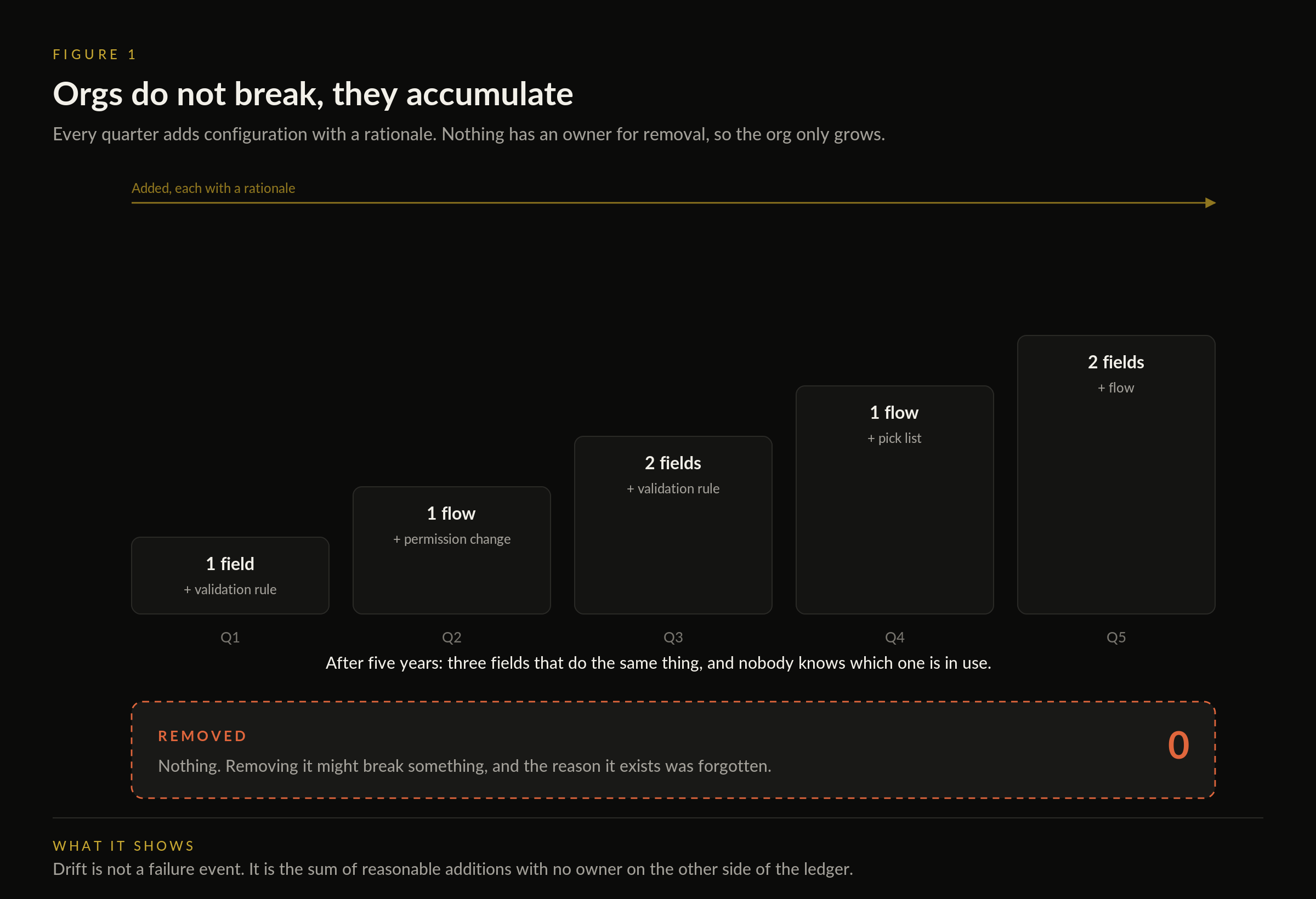
1. Orgs do not break. They accumulate, because nobody is accountable for removal.
Every quarter somebody adds a field, a validation rule, a flow, or a permission change, and each one has a rationale at the time. Nothing comes back out, because removing it might break something and the reason it exists has been forgotten. After five years you have three fields that do the same thing and nobody knows which one is live, plus a flow nobody dares open. A Salesforce Ben survey Jelle cites puts orgs described as clean and well maintained at about two percent.
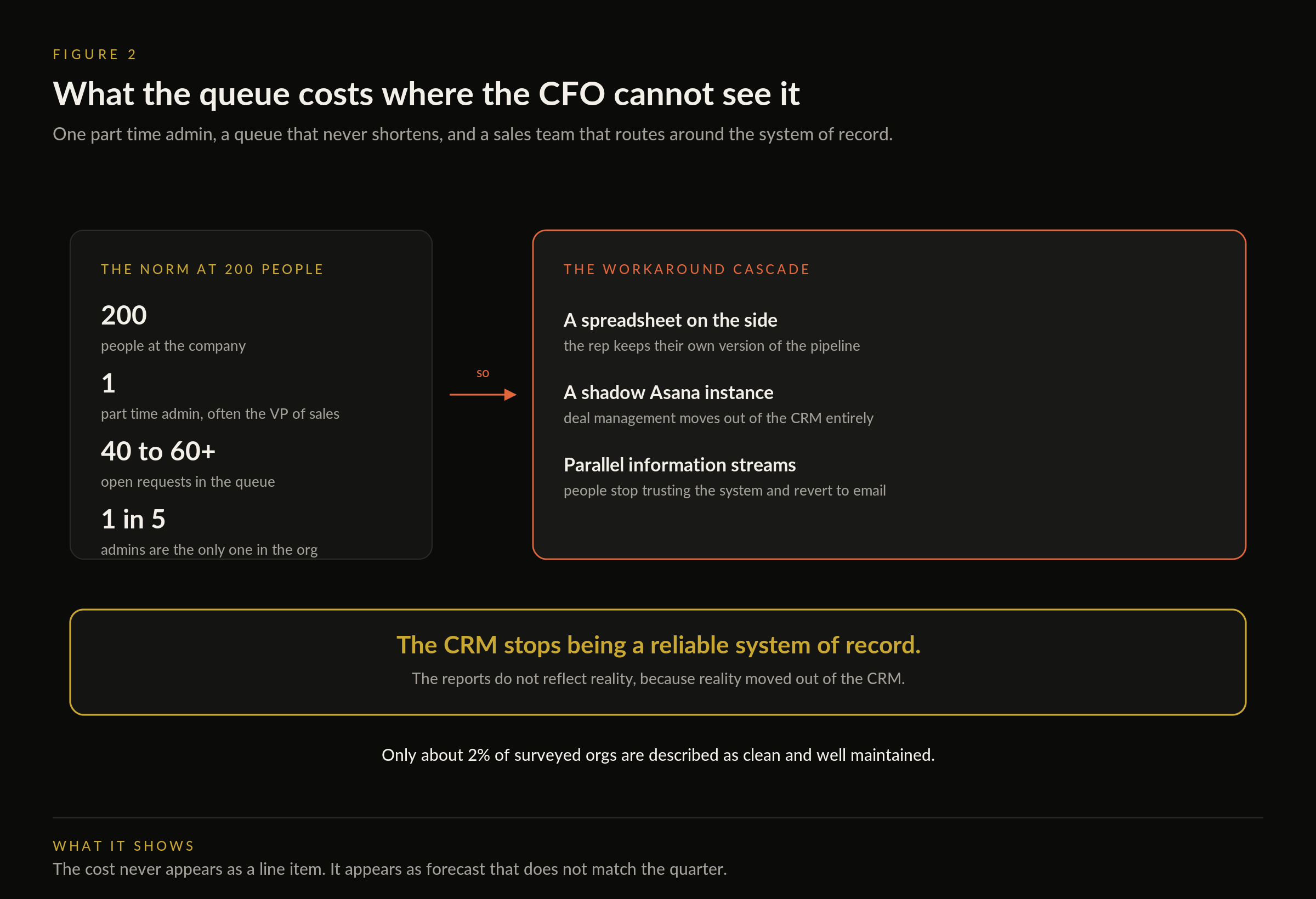
2. The backlog is not an admin staffing problem. It is a system of record problem.
The norm Jelle describes is 200 people with one part-time admin who grew into the role without choosing it, often revenue operations or the VP of sales, and a queue of forty, sixty or more open requests that never shortens because new ones arrive daily. Sales does not wait. They build a spreadsheet on the side, or stand up an Asana instance and run deal management there. The reports stop reflecting reality, because reality moved out of the CRM.
3. The guardrail is not the model. It is the permission ceiling and the read-before-write rule.
Cirra runs as a connected user through OAuth and can never do anything that user could not do by hand in Setup, so the blast radius is bounded before any model reasoning happens. Role-based access sits on top of that, fine-grained by individual, by role, even by object and field, so a team can start read-only in production and open it up incrementally. Then it reads before it writes and proposes a specific plan first, which is what stops it adding a fourth duplicate field. Promotion still runs through whatever the customer already has, DevOps Center, Flosum or Gearset.
4. Against the platform the bet is headless. Against the labs the bet is the history.
Agentforce builds agents that face customers and employees; changing how the org is built is a different job, and the tell is that Salesforce’s own MCP servers read and write records and read metadata but will not change metadata. So Cirra’s bet is that you configure Salesforce from the AI tools you already use rather than logging into the platform to do it. The frontier models know Salesforce in general but have no access to your specific org. What compounds is the record of what was there, what changed, and the reasoning behind it.
5. Bootstrapping is a timing instrument, not a badge.
To be precise, and Jelle corrected this on air, the seven-figure ARR belongs to Decisions on Demand, not to Cirra. The reason for no outside capital is that neither the models nor the standards around them were ready for a full AI admin when he started, so he iterated through product formats that did not work without burning a round to find out. That patience is also the sales answer to “why not wait for Salesforce”: two or three releases is nine months to a year, and Salesforce has a history of taking a couple more releases to harden what it ships.
Jelle van Geuns
LinkedIn: https://www.linkedin.com/in/jgeuns/
Cirra AI: https://cirra.ai
Rick Koleta (Host)
LinkedIn: https://www.linkedin.com/in/rickkoleta/
Newsletter: https://gtmvault.co/
GTM Vault
YouTube: https://www.youtube.com/@gtmvault?sub_confirmation=1
Website: https://gtmvault.co/
The GTM Vault Podcast - subscribe on your platform of choice
Subscribing on YouTube, Apple, or Spotify is what tells each platform to put the next episode in front of more operators, which is how the show keeps booking the guests worth an hour of your week.
Previous episodes include


See all previous episodes here: https://www.gtmvault.co/podcast
The GTM Vault Podcast is a breakdown of how high-growth companies design, test, and scale revenue architecture. Visit gtmvault.co for more episodes, the GTM Vault newsletter, Show Me Your Stack, and Coffee Walk, the on-location founder series that opens with Barbaros Ozbugutu in Istanbul.


