


GTM Vault is a breakdown of how high-growth companies design, test, and scale revenue architecture.
Every GTM engineer runs the same quiet sprawl. An enrichment workflow here, a follow-up agent there, a Zapier chain nobody remembers building, each one solving a real problem and all of them together a second job. Michael Bartimer works inside a CRM workspace running more than a hundred agents and almost none of that sprawl, because they all live in the system of record. The GTM engineer at Clarify joins Show Me Your Stack for episode 9 to screen-share the two he is willing to open in public, a website visitor agent and a PQL scoring and routing pair, and to decline the premise the episode was booked on. He does not think the automation layer is being deleted.
About Clarify
Clarify is an AI-native CRM that connects to a team’s email, calendar and call data and uses a built-in agent to log interactions, summarise meetings, update pipeline and run workflows without being asked, which is what the company means by autonomous CRM. It was founded in 2024 in Seattle by Patrick Thompson, who previously co-founded the data tooling company Iteratively and sold it to Amplitude, alongside Ondrej Hrebicek, Iteratively’s former CTO, and Austin Hay, who had been an Iteratively customer. The company onboarded hundreds of teams through a pilot before opening the platform publicly, and employed roughly two dozen people at its Series A. Clarify has raised $22.5M, including a $15M Series A led by USVP and Gradient with Madrona, Recall, Ascend, Essence, New Normal Fund and Fika participating, and in 2026 it acquired the San Francisco startup Seam AI.
Watch now on YouTube
Download the transcript

Episode highlights
(0:00) Cold Open: Over A Hundred Agents Inside One CRM
(0:40) The Sprawl Every GTM Engineer Is Quietly Running
(3:49) Inside The Agents Section: The Website Visitor Agent
(4:42) How He Briefs Rep: A Ramble, A Ticket, Or A PRD
(6:42) The Stale Data Problem And The LinkedIn Fix
(9:07) Reading A Live Run, And How Fast It Stood Up
(11:02) Start With Visibility: Why Slack Is Step One
(12:31) The PQL Agent: Seven Signals Out Of 100
(14:34) Four Routing Paths And The Ten To Twenty Second Review
(18:20) Why He Calls It Consolidation, Not Deletion
What you’ll learn:
Why a website visitor agent spends its second step deleting people, before anything is classified or written anywhere
Employees, competitors and existing customers: the three suppressions that run before any classification is allowed to happen
How to treat a data vendor’s company field as a hypothesis, using the LinkedIn profile already in the payload
Vendor data is often six or twelve months stale, and sometimes twenty-four or more, pointing at a previous role
Why visibility in a Slack channel is the deployable version of this play and outbound is the upgrade
How much less of your own site traffic sits inside your named personas than your model assumes
Seven signals scoring a PLG signup out of 100, half of them tool calls out to the product analytics
The four routing paths, and the ten to twenty second human review that nobody on the sales team wanted removed
Why the workaround runs through an outside vendor and still has an end date
Why he declines “deletion” and measures speed to deploy and iteration cycle time instead of tool count
Key takeaways
1. The first job of a signal agent is to throw signal away.
The website visitor agent takes a de-anonymization payload through a webhook and parses out name, title, LinkedIn and company. Its very next move is removal: employees browsing the site, named competitors, and existing customers are all suppressed before any classification runs. Only what survives gets sorted into an ICP, and only then does persona resolution happen at the person level.

2. Stale vendor data is a pipeline step, not a procurement decision.
Michael’s name for it is the stale data problem, and his numbers are blunt: provider data is often six or twelve months old and he has seen instances twenty-four months or more out of date, still pointing at the person’s previous employer. His fix does not involve a second vendor. The agent opens the LinkedIn profile already sitting in the payload, resolves the current company, and then re-runs the whole workflow against the corrected record.
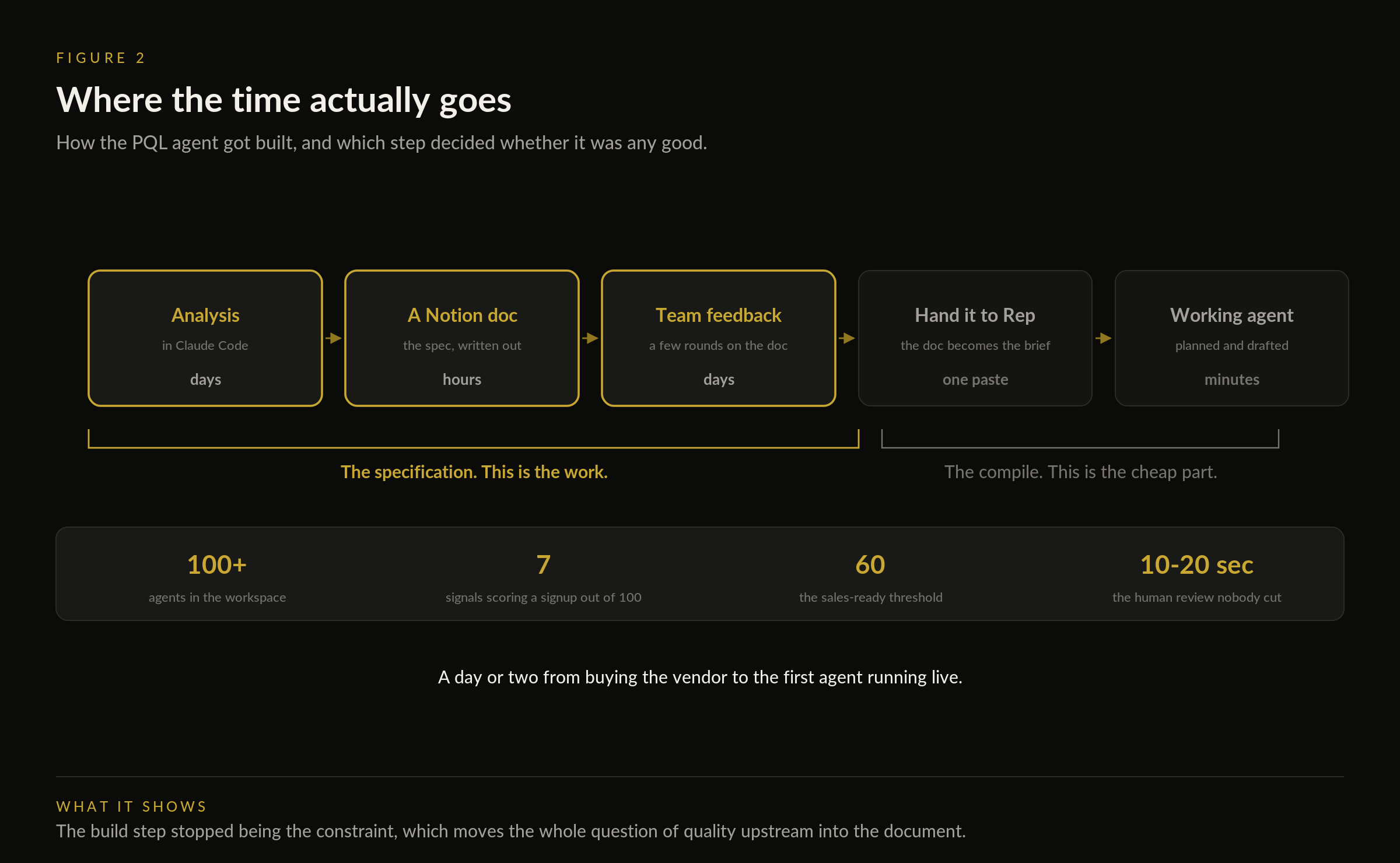
3. The specification was the work. The build took minutes.
The PQL agent was one of the first things he built after joining four months ago. The build path is the interesting part: analysis in Claude Code, output into a Notion doc, a few rounds of team feedback on that doc, then the doc handed to Rep, Clarify’s built-in AI, which planned and drafted the working agent in minutes. Seven signals score a PLG signup out of 100, about half of them tool calls to the product analytics and the rest properties already in the CRM.
4. Nobody removed the human. They removed the hour around the human.
The routing agent splits into four paths. Path one is immediate sales outreach on firmographic criteria and it still passes through a person, because the sales team wants a ten to twenty second look before enrolling the account in a campaign with one click. Path two nurtures toward a PQL score of sixty or greater, the threshold at which an account is classified sales ready, which makes this a lightweight first version of a product-led sales motion.
5. He declines “deletion” and calls it consolidation, which is a claim about speed rather than tool count.
Clarify campaigns suit sales-led outbound and have gaps for marketing-led, so persona-specific enrollment runs through an outside sending tool with the outcomes written back for reporting. Michael treats that as two moves: build the workaround with outside tooling, then take the gap to product and engineering so the workaround expires. Six months ago the same work was spread across HubSpot, assorted automation tools and Claude Code, and what changed is that the pipes, the data and the reporting stopped living in different buildings.
Michael Bartimer
Rick Koleta (Host)
LinkedIn: https://www.linkedin.com/in/rickkoleta/
Newsletter: https://gtmvault.co/
GTM Vault
YouTube: https://www.youtube.com/@gtmvault
Website: https://gtmvault.co/
Show Me Your Stack - subscribe on YouTube
Show Me Your Stack lives on YouTube, because the screen is the episode. Subscribing is what tells the platform to put the next operator’s stack in front of more people who build these systems for a living.
Previous episodes include


See all previous episodes here.
Show Me Your Stack is a GTM Vault series. Each episode features one operator walking through the system behind their outbound, their prioritization, or their pipeline motion. No slides. Just the stack.


