


Hi, it’s Rick Koleta. Welcome to GTM Vault, a breakdown of how high-growth companies design, test, and scale revenue architecture. Read inside OpenAI, Anthropic, Meta, and Google, and by 27,000+ operators across 140+ countries building GTM systems that compound.

In 2023 the industry standard for revenue AI was to pass an entire call transcript into a language model and hope. Gorish Aggarwal tried it. It failed at producing something as basic as next steps unless you massaged the input first, feeding the model context about the output you wanted, the customer, and the deal. So he stopped treating the transcript as the product and started treating it as raw material. Six to eight months later the rest of the market was still dumping full transcripts into models and calling it AI.
That gap became the company. His read was that as models improve, the value of what you pass them improves faster than the models themselves. If that is true, the durable asset is not the model and it is not the recording. It is the structured understanding of your business that decides what gets passed in.
This is not an argument about transcription quality. It is an argument about which layer of the revenue stack is being repriced to zero, and Sybill spent eighteen months building the other layer while better-funded competitors shipped features.
Gorish Aggarwal is co-founder and CEO of Sybill. Sybill launched as an AI sales assistant for account executives, then spent eighteen months building an org-level context graph underneath it, a self-evolving layer connecting customers, team, and company process that updates daily from every new conversation. The bet was made with a fraction of the capital his category raised, which is the part that shaped the architecture rather than just the burn rate. Gorish now argues the next Cursor-scale company in GTM tech emerges from exactly this layer inside twelve to eighteen months, and he is explicit that he is building to be it.
In GTM 48, Gorish breaks down why passing the full transcript into a model was never the product, what a context layer means operationally across its three pillars, why Sybill shipped an MCP connector into Claude’s directory instead of defending its own dashboard, why incumbents cannot bolt a context layer onto platforms architected before language models existed, where agents with complete context still produce garbage, what identity resolution is quietly doing to every CRM in the market, and the single roadmap question that let a smaller team out-build the field for eighteen months.
This is not a conversation about note takers. It is a conversation about which half of your revenue stack is the commodity and which half is the asset, and what that means before your next renewal cycle.
Watch or listen now across YouTube, Apple Podcasts, Spotify, and X
Inside this episode
This episode maps the structural difference between recording what happened and understanding it, and what happens to a category when the first one becomes free.
Gorish opens with the 2023 realization. Passing a full transcript into a model did not work, and it failed in a specific way that mattered. Even getting usable next steps required feeding the model context about the desired output, the customer, and the deal alongside the raw text. The transcript was an input, not a signal. He assumed the market would catch on quickly. It did not. Six to eight months later the standard was still transcript in, output out. That lag is where the head start came from, and he is candid that he expected it to be much shorter.
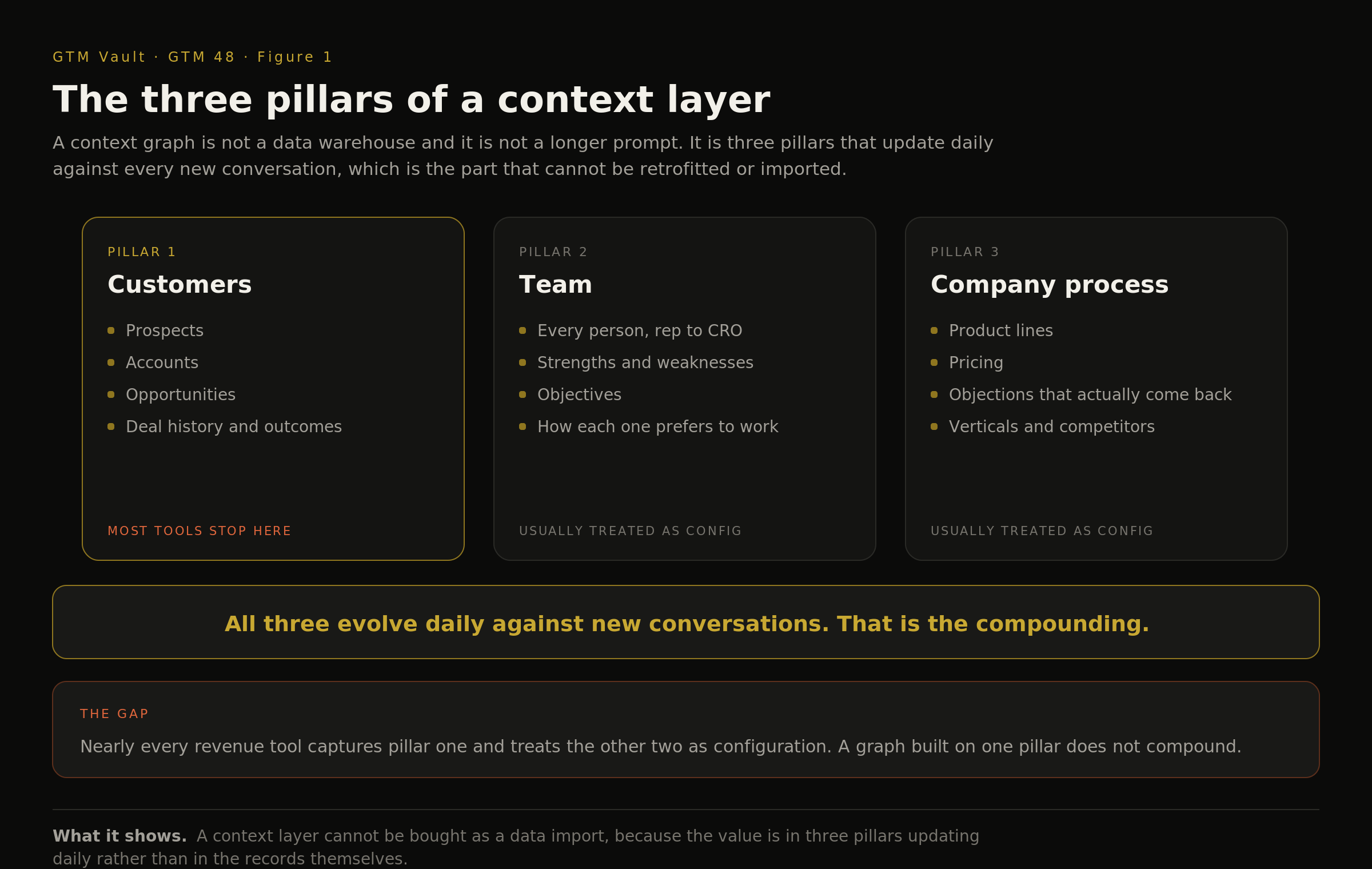
We go deep on what a context layer means operationally, because the phrase has been diluted into meaninglessness over the last year. Gorish defines it as three pillars. Customers, meaning the prospects, accounts, and opportunities. Team, meaning every person from rep to CRO, their strengths, weaknesses, objectives, and preferences for how they work. Company process, meaning product lines, pricing, the objections that come back, market verticals, and the competitors you keep running into. Most revenue tools capture the first pillar and treat the other two as configuration. The graph only compounds when all three evolve daily against new conversations, and that daily evolution is the part that cannot be retrofitted.
We cover why he does not consider this a repositioning. Gorish pushes back on the framing directly. The technology moved and the product moved with it, and the visible change was that a second buyer appeared. Sybill started as an automation layer over an AE’s deals, helping one rep write a better follow-up and save time. As the org-level graph came together, the CRO and the VP of Sales became buyers of the same asset for entirely different reasons. He is honest that this made the offering muddier before it made it stronger.
We go into the MCP decision, which is the counterintuitive move in the episode. Most vendors Sybill’s size were building another dashboard. Sybill exposed its context layer through an MCP connector in Claude’s directory, then built an ingest MCP running the other direction so website data, Notion, Drive, and Slack flow in, get systematized against the graph, and become available downstream. Giving up the screen cost them depth of insight into how the work gets done. What they gained was a builder persona in RevOps creating agents on top of the layer, and those agents scale across an entire organization. One builder’s workflow becomes a thousand reps’ default. Gorish is clear that the interface still matters for a typical seller who wants the job done rather than a system to build, so this is a segmentation call rather than a religion.
We cover the demo that keeps closing deals, which is not a demo of Sybill. It is running Claude twice against the same deals and the same calls, once with the Ask Sybill MCP connected and once without. The delta in output is the pitch. Nothing about that comparison requires the buyer to trust a vendor claim, which is why Gorish reports MCP usage skyrocketing past what he predicted.
We go into personal agents versus GTM agents and where they collide, which is the architecture question most teams have not thought about yet. Gorish runs five personal agents through an OpenClaw setup covering fundraising, people ops, GTM, product, and a personal assistant he calls Dobby. A personal agent knows his preferences and his relationships, so a LinkedIn message referencing this podcast gets connected to this conversation without being told. A GTM agent is organizational. It knows process, product lines, pricing, and objections, it ingests data sources that actively compete with each other, and it scales across hundreds or thousands of reps. His resolution of the ownership fight is the useful part. The company’s benefit is that no knowledge walks out the door when a strong rep leaves. The individual’s benefit is a preference layer they carry from company A to company B. No sane org graph imports a single rep’s perspective. It triangulates across fifteen to fifty and picks the best pattern per domain.
We cover the honest failure mode, and it is not the one people expect. Give an agent all the context in the world and it still fails at creativity. Genuinely novel choices, the strategic decision unique to this deal in this organization, remain human work. Gorish points at the LinkedIn auto-commenter era as the market learning this in public. Everything templated or close to templated, agents handle. The line sits exactly where critical thinking begins.
We go into why incumbents cannot ship this as a feature, and Gorish gets specific about architecture rather than hand-waving about innovator’s dilemma. Revenue platforms were designed before language models existed. Their data pipelines, storage models, indexing strategies, and application architecture were all optimized for capturing structured data and querying it. Continuously connecting people, conversations, emails, meetings, CRM changes, and outcomes into a living model of how a company wins is a different problem needing a different foundation. His image for the retrofit: replacing a skyscraper’s foundation while millions of customers are still inside it, working.
We cover identity resolution, the unglamorous thing breaking the CRM. Rick Koleta on LinkedIn, Rick K in email, RK in the CRM. If an agent cannot collapse those into one node, it does not know where to look before it acts. The same failure runs through internal meetings, where a single pipeline review covers twenty to thirty deals, each carrying real decisions about discounts, MSA terms, and next steps, and most tools cannot attribute what was said to which deal. Slack is worse, a firehose with no labels and no reliable classification, where nobody tags the account record when they mention a customer. Agents bolted onto that data inherit every fragment of it.
We go into Sybill’s own stack, which is the part operators will want. They run their entire sales process on it: forecast calls, coaching, deal execution, follow-up, dashboards, decks, and proposals. Marketing and product use it to read what messaging is landing and where the product gaps are. The interesting build is the in-house signals engine, made after evaluating the well-known tools in the space and finding nothing that did the job. Watchers run across LinkedIn and Slack communities to see who is talking about what, output flows into a master list with enrichment and joining, and records connect by the actual LinkedIn identifiers rather than the canonical ones. The result tracks a single person across Slack, a Pavilion community, LinkedIn, and internal context, with news layered on top. Gorish notes in passing that the message which booked this podcast carried his agent’s fingerprints.
We close on capital discipline and the rapid fire. Sybill did not go wide early, and Gorish is blunt that doing so would have failed epically. Every roadmap item had to clear one question. Then the rapid fire compresses the entire thesis: the metric that deserves more attention is win rates, the most overrated capability in revenue AI is note taking, the thing a founder should delete from their stack today is Gong, and in three years the CRM is a database.
Discussed in this episode
(0:00) The Bet: Transcript Is the Commodity, Context Is the Asset
(4:50) What a Context Layer Means: The Three Pillars
(5:53) The MCP Connector Bet: Distribution Over Dashboard
(8:55) Personal Agents vs GTM Agents
(12:10) Failure Modes and Category Casualties
(15:40) Why Incumbents Cannot Bolt This On
(17:26) What Breaks When Agents Run on Stale CRM
(19:19) Inside Sybill's Own Stack
(22:20) Capital Discipline and the Roadmap Question
(25:02) The 2028 Picture and Rapid Fire
Key takeaways
1. The transcript was never the product, and the market took eight months to notice.
Even in 2023, getting usable next steps out of a model required feeding it context about the desired output, the customer, and the deal. The raw text alone produced nothing worth sending. The inversion underneath this is the load-bearing idea in the episode: as models improve, the value of what you pass them improves faster than the models themselves. That makes the model the commodity and the input the asset, which is the opposite of how most revenue AI is priced today.
2. A context layer has three pillars, and most tools touch one.
Customers, meaning prospects, accounts, and opportunities. Team, meaning every person’s strengths, weaknesses, objectives, and working preferences from rep to CRO. Company process, meaning product lines, pricing, real objections, verticals, and competition. Nearly every revenue tool in the market captures the first pillar and treats the other two as configuration. The graph only compounds when all three update daily against new conversations, which is why this cannot be bought as a data import.
3. Identity resolution is the unglamorous failure quietly breaking every CRM.
Rick Koleta on LinkedIn, Rick K in email, RK in the CRM. If the agent cannot collapse those into a single node, it does not know where to look before acting, and it will act on a fraction of what the company knows. The same fragmentation runs through internal meetings, where one pipeline review covers twenty to thirty deals with real decisions inside each, and through Slack, where a firehose of relevant context arrives with no labels and no consistent account references. Every agent deployed on top of that data inherits the fragmentation and produces confident, partial answers.
4. Distribution through the agent layer beat defending the dashboard.
Sybill exposed its context layer through MCP rather than forcing usage through its own screen, and adoption grew faster than Gorish predicted for a reason he did not anticipate. RevOps builders create agents on top of the layer, and those agents scale across the whole organization. One builder’s workflow becomes a thousand reps’ default. The vendor gives up depth of insight into how the work is done and gains a distribution surface it did not have to build. The screen was never the moat.
5. Incumbents cannot bolt on a context layer, because it is a foundation and not a feature.
Revenue platforms were architected before language models existed, with pipelines, storage, and indexing optimized for structured capture and query. Continuously connecting people, conversations, emails, CRM changes, and outcomes into a living model of how a company wins is a different problem requiring a different foundation. Gorish’s image is a skyscraper whose foundation has to be replaced while millions of customers are still inside working. This is the strongest argument in the episode for why a startup owns this layer, and it is architectural rather than cultural.
6. One roadmap question enforced eighteen months of discipline.
Every feature request, and there were many, including a forecasting module, a coaching module, a performance dashboard, and a deal room, had to answer two things. Does this help the context graph learn, and does it compound the intelligence already built. Two nos meant not built. That is capital discipline expressed as architecture rather than as a spending cap, and Gorish credits it directly with surviving where wider, shallower competitors stalled.
Frameworks from the episode
1. The context graph
A self-evolving information layer built on three pillars: customers, team, and company process. It ingests conversations, emails, meetings, and CRM changes daily, resolves identities across every surface a person appears on, and outputs the context an agent needs to act without a human feeding it instructions each time. The test for what belongs in it is the same test Sybill uses on its roadmap: does this input help the graph learn, and does it compound what the graph already knows. The measured output Gorish reports is a 95 percent reduction in the human actions required to produce a single follow-up email.
2. The roadmap question as capital allocation
For a company with a fraction of its category’s funding, the constraint is not what to build, it is what to refuse. Sybill’s filter was one question applied to every request: does this help the context graph learn and does it compound existing intelligence. Feature parity with better-funded competitors was never the goal, so the requests that would have consumed the eighteen months, the forecasting module and the coaching module and the deal room, were declined. The output is a company with one deep asset instead of six shallow ones, and a foundation that is now the thing being scaled rather than the thing being rebuilt.
3. The org layer and the personal layer
Two graphs with a deliberate boundary between them. The org graph holds process, product, pricing, and objection handling, triangulated across fifteen to fifty reps rather than imported from any single one, which is how knowledge stops walking out the door when a strong rep leaves. The personal layer sits on top and holds an individual’s preferences, relationships, and working style, and it travels with them from company A to company B. The architecture question is not who owns the context. It is where that boundary sits, and most teams have not yet asked it.
What to do this week
Run the with-and-without test on your own data
Ask your AI assistant one real deal question using CRM data alone, then ask it again with calls, email, and Slack context connected. This is the comparison Sybill runs in sales conversations, and it works because it requires no vendor claim. The gap between the two outputs is the size of your context problem, measured before you spend anything on solving it.
Count your identity fragments
Pick ten active deals and count how many name variants each buyer has across the CRM, email, LinkedIn, and Slack. Then check whether any system in your stack collapses them into one record. Every unresolved variant is a place where an agent will act on partial information and report it as complete.
Apply the roadmap question to your stack, not just your roadmap
For every tool you pay for, ask whether it makes your account context compound or whether it records activity. Recording is available from Zoom, free from Fathom, and bundled into a dozen tools already on your laptop. Per this episode, the recorders are the commodity layer and the first candidates for deletion at renewal.
Audit one internal pipeline review for lost context
Take the recording of your last forecast or pipeline call, list every deal discussed, and check what made it into the CRM against the right record. The decisions inside those meetings, on discounts, on MSA terms, on next steps, are the richest context your company produces and the least likely to be captured correctly. Whatever is missing is what your agents will not know.
Why this matters
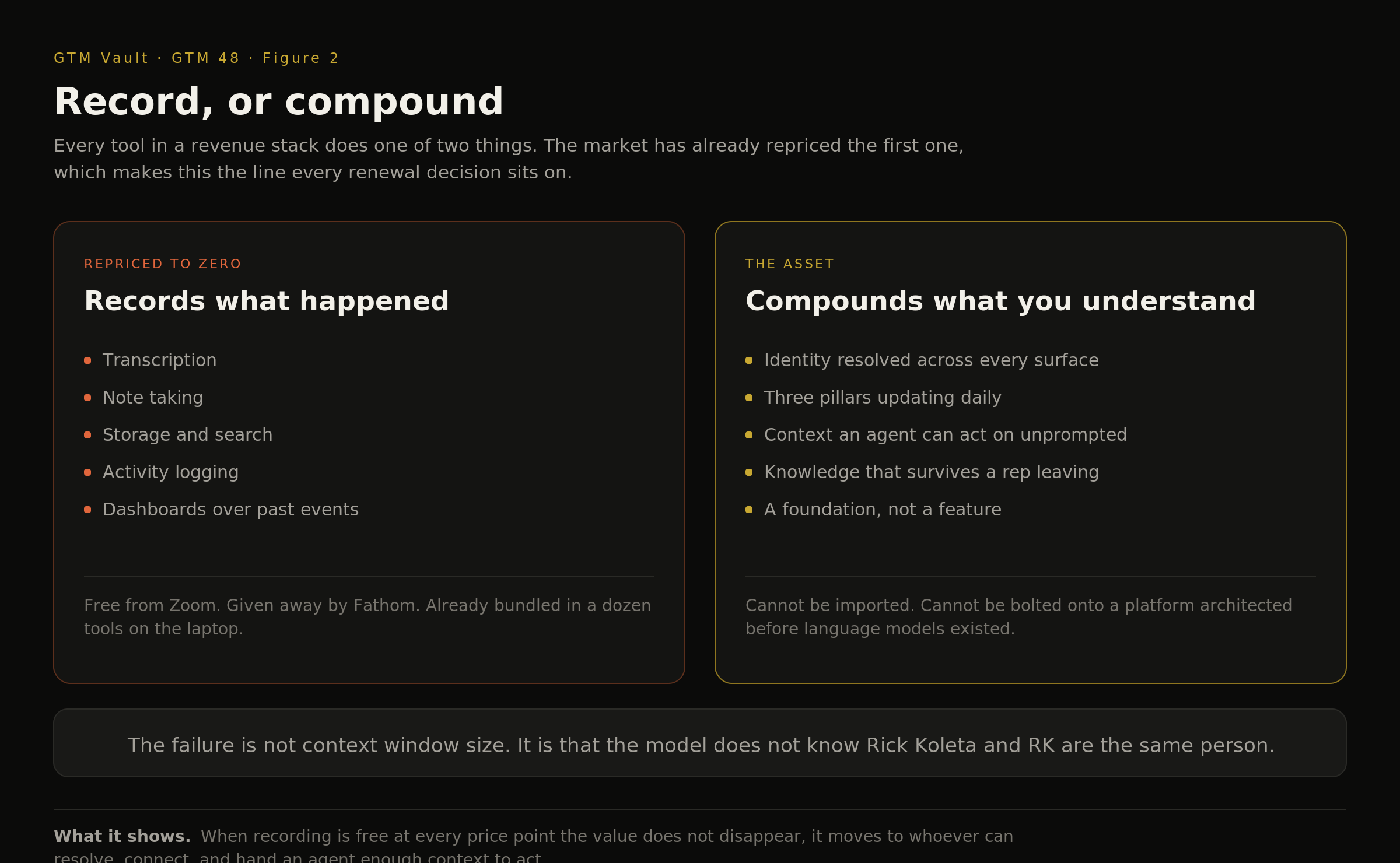
Every tool in your revenue stack does one of two things. It records what happened, or it compounds what your company understands. For most of the last decade the distinction did not matter, because recording was expensive and understanding was a human job performed on top of the record. Gong built a multi-billion dollar company in that world, and it was the right company to build.
The market has repriced the first half. Recording comes with Zoom, is given away by Fathom, and is bundled into a dozen tools already running on the laptop. When a capability is free at every price point, the value does not disappear. It moves. It moves to whoever can take the recording, resolve who is being referenced across fifteen surfaces, connect it to what was said in Slack two months ago, and hand an agent enough context to act without a human writing the instructions.
That is a different piece of software than the one most revenue teams bought. It cannot be assembled from a data import, because the pillars have to evolve daily against new conversations. It cannot be shipped as a feature by a platform architected before language models existed, because the pipelines, storage, and indexing were optimized for structured capture rather than continuous learning. And it cannot be solved with a longer context window, because the failure is not capacity. The failure is that the model does not know Rick Koleta and RK are the same person.
The teams that feel this first are the ones deploying agents on top of a CRM they already know is fragmented. The agent will be confident and it will be wrong, and the fragmentation will get blamed on the model. The teams that feel it second are the ones paying for four tools that record and none that compound.
Before your next renewal cycle, know which side of that line each line item sits on.
This is GTM Vault.
If this changed how you read your own stack, send it to whoever signs the renewals.
Connect
Follow Gorish Aggarwal // Sybill
Follow Rick Koleta // GTM Vault
Thanks for listening. See you in the next episode.
P.S. Annual paid subscribers get a Private GTM Blueprint Session. One working session to identify your primary GTM constraint and design the 90-day architecture to resolve it.
Every tool operators name on GTM Vault is in The Stack Index, placed on the layer of revenue architecture it serves. Build your own stack at pro.gtmvault.co/stack.


