



Hi, it’s Rick Koleta. Welcome to GTM Vault, a breakdown of how high-growth companies design, test, and scale revenue architecture. Read inside OpenAI, Anthropic, Meta, and Google, and by 27,000+ operators across 150+ countries building GTM systems that compound.

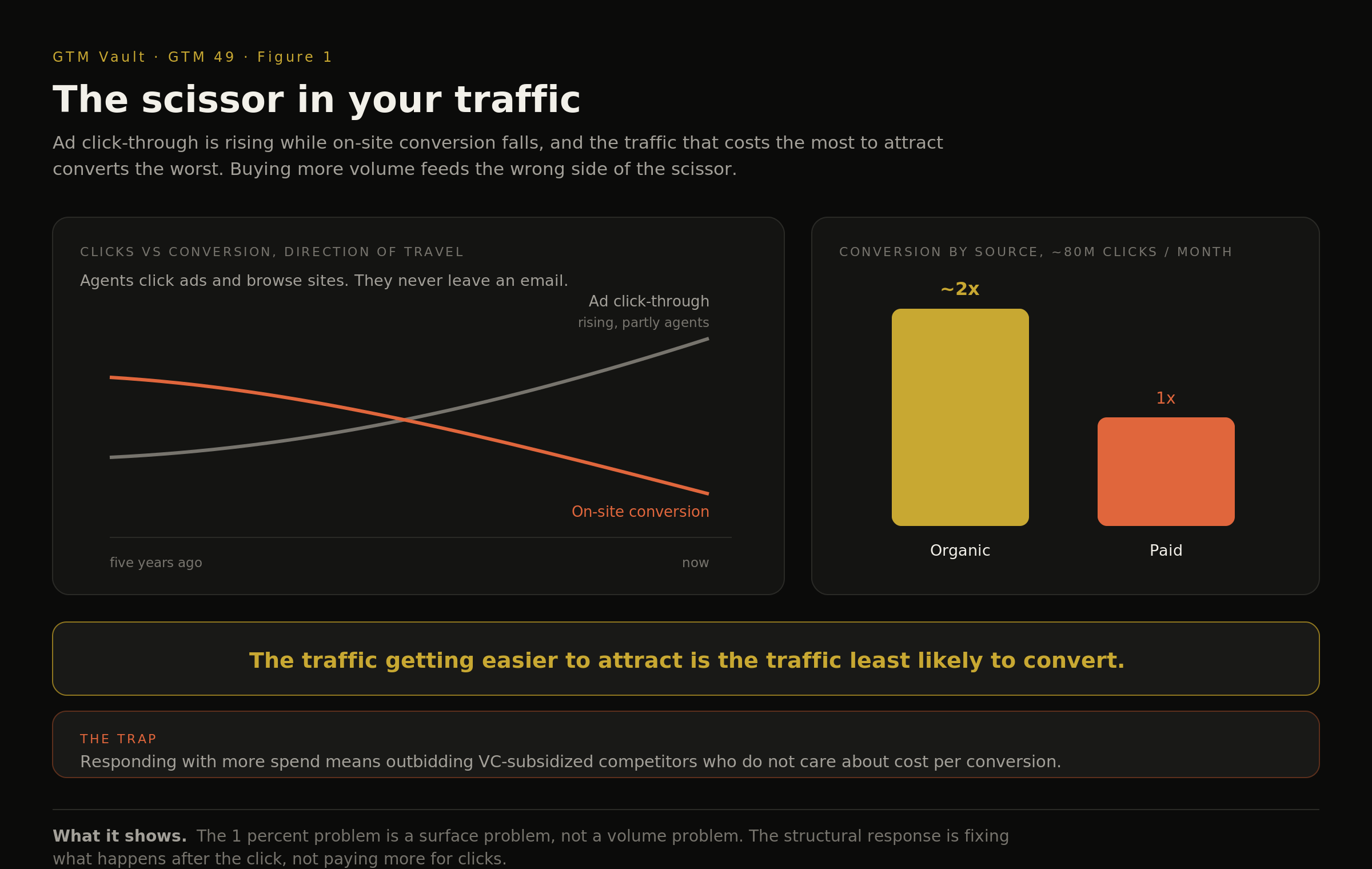
Ad click-through rates are going up. On-site conversion is going down. Hao Sheng watches both sides of that scissor across roughly 80 million clicks a month, and his diagnosis is uncomfortable: part of the traffic you are paying for is agents clicking your ads, and an agent never fills out a form. Your 1 percent conversion rate is measuring the wrong population.
The standard response is to buy more traffic, feeding a number that does not move, while the visitors who matter decide whether to stay in the first 10 to 15 seconds. That gap is not a traffic problem. The hard part is the surface: a website built for reading, asked to do the work of buying.
Hao Sheng is co-founder and CEO of expertise.ai, repositioned from Chat Simple, which he founded in 2023 and scaled to 25,000 companies, profitably. He spent years building the decision-tree generation of agents at Google and Cresta, and is now replacing it with expertise installed onto agents rather than trained into people.
In GTM 49, Hao breaks down why falling intent is partly a bot problem, why organic converts at nearly twice the rate of paid, the operational difference between a chatbot and an agent, and the commit rule he applies to GTM automation.
This is not a conversation about chatbots. It is a conversation about what your website is for when most of its visitors stop being human.
This episode in the Library: the written playbook, the stack and the full transcript, free and open. Open it at pro.gtmvault.co.
Inside this episode
Hao opens with the diagnosis. Ad click-through is rising while conversion falls, because agents are clicking ads without ever leaving an email. Your 1 percent is measuring a population that is less human than you think.
We go deep on why buying more traffic fails: VC-subsidized bidders inflate the auction while organic converts at nearly twice the rate of paid. And on the most clicked button on a B2B website: pricing, not book a demo, in the 15 seconds almost every site leaves unstaffed.
Hao draws the line between chatbot and agent. A chatbot answers questions. An agent installs expertise as modules, and generates the page in real time instead of fetching one that already exists.
We cover the Amazon commit rule, automate only what you have done manually, and the failure case: the hundredth email reveals the template, addressed to Shuama King.
We close on 2028, when agent visitors outnumber humans, and the human-to-bot ratio becomes the metric that tests the whole bet.
Watch or listen now across YouTube, Apple Podcasts, and Spotify
Discussed in this episode
(0:00) Cold Open: The First 15 Seconds
(5:32) Diagnosing the 1 Percent Problem
(11:17) Organic Converts at Twice the Rate of Paid
(14:32) Chatbot vs Agent: The Operational Difference
(19:16) The Most Clicked Button on a B2B Website
(21:01) Generative UI: Pages Generated, Not Fetched
(22:04) The Amazon Commit Rule for GTM Automation
(33:59) Where Agent Outreach Breaks: The Hundredth Email
(39:54) B2B Inbound in 2028
(43:41) The Rapid Fire Section
Key takeaways
Your conversion rate is measuring a population that is less human than you think. Rising ad click-through with falling on-site conversion is the signature of agents in the traffic. An agent clicks, browses, and leaves no email, which means the denominator of your conversion math includes sessions that were never convertible. Before concluding the website is failing, split the traffic. The human-to-bot ratio is becoming a first-class GTM metric, and Hao tracks it as the signal that tests his entire bet.
Buying more traffic means outbidding people who are not playing your game. VC-subsidized AI companies drive ad auctions without caring about cost per conversion, winning campaigns saturate fast, and cost per click inflates the moment you scale budget into them. Organic converts at nearly twice the rate of paid across the roughly 80 million monthly clicks Hao observes, because trust arrives with the visitor or it does not. The next dollar belongs in the channels that build trust before the click.
The first 15 seconds of a visit are the highest-leverage unstaffed moment in B2B. The most clicked element on a B2B site is pricing or get a quote, which means visitors are self-qualifying before they will speak to anyone. A static page answers that moment with reading material, and live chat that connects in four minutes answers it after the visitor has left. Whatever engages inside that window, and can answer is this for me, owns the conversion.
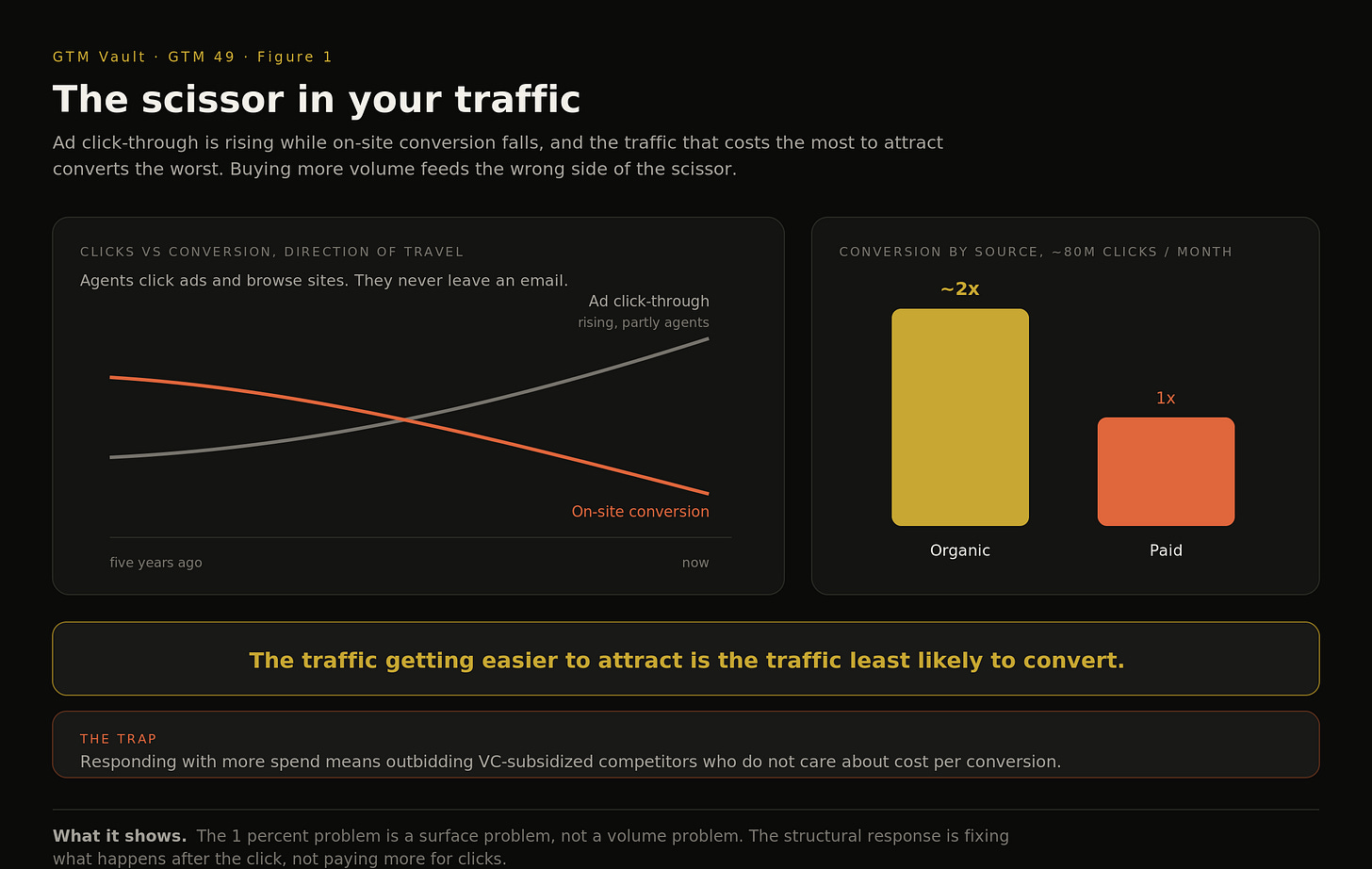
Figure 1, The scissor in your traffic: left panel shows ad click-through rising (grey, the vanity number, “rising, partly agents”) crossing on-site conversion falling (coral, the constraint); right panel shows the organic-versus-paid conversion gap at roughly 2x from the 80 million monthly clicks. Gold band carries the claim, coral band names the trap of outbidding VC-subsidized competitors. A chatbot answers questions, an agent installs expertise. The operational difference is not response quality. It is that qualification, objection handling, and follow-up become modules built by experts and installed onto agents, so the agent performs like the person who spent decades learning the workflow. Humans learn expertise, agents install it. That moves GTM knowledge out of heads and playbooks and into components, which is the entire logic of the Chat Simple to expertise.ai repositioning.
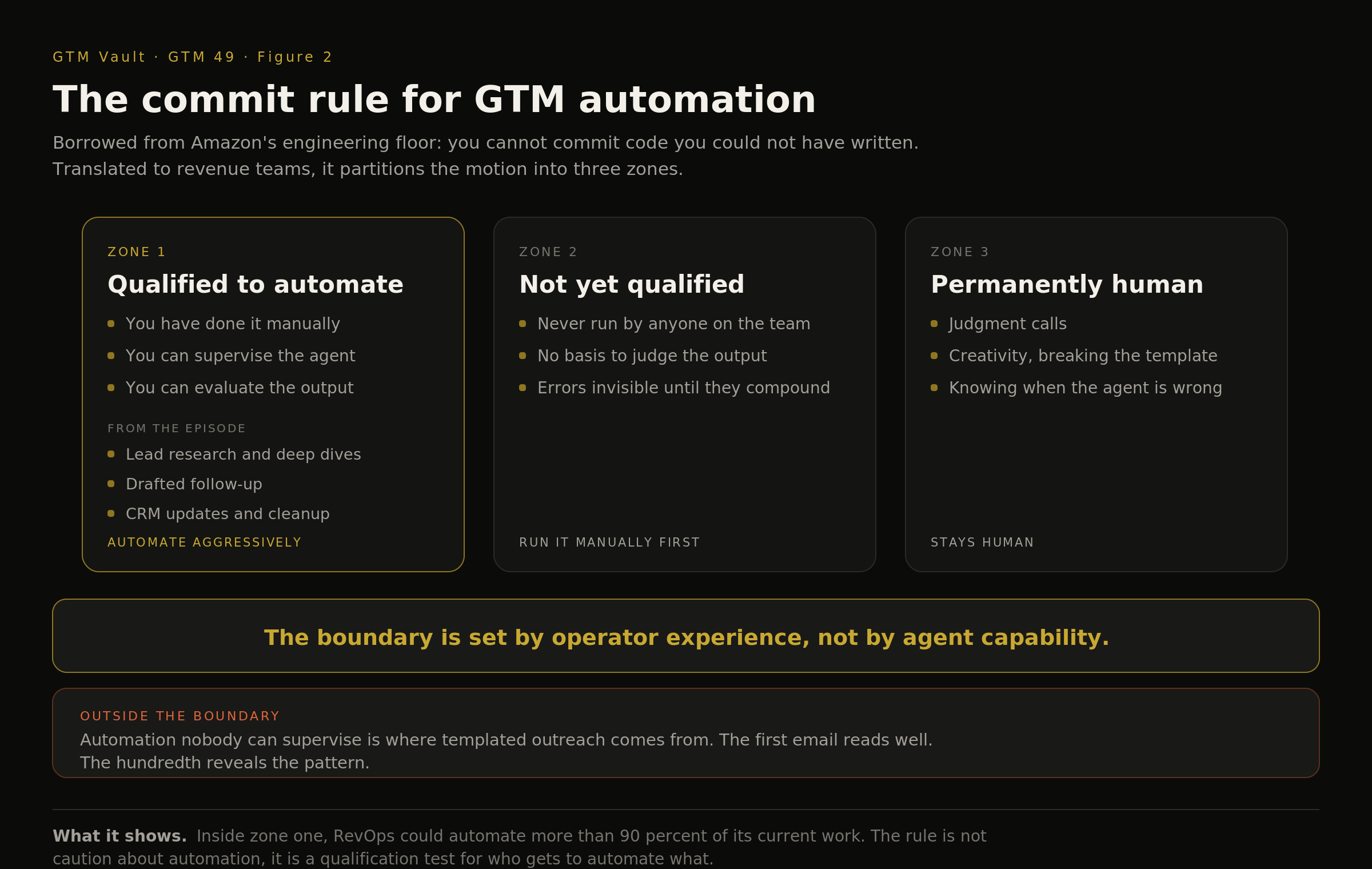
The commit rule is the automation governor GTM needed. Automate only what you have done manually and can supervise, because having done the work is what qualifies you to evaluate the agent doing it. Inside that boundary, automate aggressively, and Hao argues RevOps could automate more than 90 percent of its current work. Outside it, automation produces output nobody on the team can audit, which is where templated, Shuama King outreach comes from.
Agent output breaks at the hundredth repetition, and creativity is the remaining human job. Models distilling each other produce homogeneous responses, so the same tool writing your outreach converges on the same email. The first draft impresses, the pattern emerges at scale, and buyers see the pattern across every vendor mailing them. The teams that win with agent-written outreach are the ones with a human breaking the template on purpose, not the ones generating more volume from the same prompt.
Frameworks from the episode
Install, Don’t Train. Hao’s model for where GTM expertise lives in the agent era. Expert workflows, how to qualify, how to handle objections, how to run follow-up, are packaged as modules by people with decades of experience and installed onto agents in minutes. A human acquires expertise through years of learning. An agent acquires it through installation. The output is a GTM motion whose capability ceiling is set by the best available module, not the most experienced person on payroll.
Generative UI. The difference between fetching and generating. A normal website fetches pages that already exist and shows every visitor the same thing. A generative surface produces the UI component and the engagement line in real time, keyed to the arriving keyword and observed behavior. The output is a page assembled per visitor, which is what makes the first 15 seconds answerable at all.
The Commit Rule for GTM Automation. Borrowed from Amazon’s engineering rule that you cannot commit code you could not have written. Translated: you may automate a workflow only if you have done it manually and can supervise the agent doing it. The output is a clean partition of your GTM motion into work you hand to agents now, work you run manually first to earn the right, and judgment that stays human.
What to do this week
Split your conversion rate by source and by humanity. Pull 90 days of data, separate organic from paid, and estimate the bot share of your sessions. If organic converts at anything close to two to one, the next dollar goes to trust channels, and if bot share is material, your 1 percent was never 1 percent.
Cut your demo form to two fields. Name and business email. Everything else moves to enrichment after the click. Each field you keep is friction spent collecting what an agent can research in seconds.
Staff the first 15 seconds. Watch ten real sessions and note what a visitor sees in the window where they decide to stay. If the answer to is this for me is buried in a pricing page and a form, that window is where your pipeline leaks.
Run the commit rule audit. List everything your team automated in the last year and flag anything nobody on the team has done manually. Those automations are unsupervisable by definition, and they are where the templated output is coming from.
Why this matters
Every B2B company is about to run its funnel through two simultaneous shifts: the visitors are becoming less human, and the surface they land on is becoming capable of conversation. Most teams are responding to the first shift with more spend and ignoring the second entirely.
The uncomfortable arithmetic is that the cheapest pipeline you will add this year is already on your website, leaving. At 1 to 2 percent conversion, a surface that qualifies in the first 15 seconds does more for revenue than any realistic increase in traffic, and it compounds instead of saturating.
The automation question underneath it has a governor now. The commit rule separates the teams that automate what they understand from the teams that generate Shuama King emails at scale. The difference between those two outcomes is not the model. It is whether an operator who has done the work is supervising it.
The orgs that act on this will treat the website as a qualifying surface and automation as an earned privilege. The ones that wait will keep buying traffic into an auction their competitors are happy to lose money in. This is GTM Vault.
Send this one to whoever owns your website and your paid budget, ideally in the same thread.
Connect
Follow Hao Sheng // expertise.ai
Follow Rick Koleta // GTM Vault
Make Better Decisions With AI
AI is changing how companies operate, but the real advantage comes from making better decisions with it. The Decision Intelligence Newsletter by DecideWise breaks down enterprise AI, decision automation, and how leading organizations turn data into decisions that drive business outcomes.
Join the Decision Intelligence Newsletter →
Every tool operators name on GTM Vault is in The Stack Index, placed on the layer of revenue architecture it serves. Build your own stack at pro.gtmvault.co/stack.
Full transcript, searchable to the timestamp: pro.gtmvault.co/episodes/gtm-49.


