


Hi, it’s Rick Koleta. Welcome to GTM Vault, a breakdown of how high-growth companies design, test, and scale revenue architecture. Read inside OpenAI, Anthropic, Meta, and Google, and by 27,000+ operators across 150+ countries building GTM systems that compound.
The short version
Every page answering this question gives the same answer: revenue architecture is the design, RevOps is the execution, architecture is broader, RevOps sits inside it. That is correct and it decides nothing, because it gives an operator no way to classify the problem in front of them. The usable boundary is reversibility. Architecture decisions are the ones that are expensive to reverse and that every other decision inherits: who the customer is, how the product is priced, what the motion is, what gets built first. RevOps decisions are the ones you can change next quarter without redesigning anything above them. The practical consequence is a diagnostic: when a RevOps team is busy and revenue is not getting more predictable, the defect is almost always sitting on the architecture side of that line, where RevOps has no authority to fix it.
The Answer Everyone Gives
Search the comparison and the pages agree with each other almost word for word.
Revenue operations manages how revenue processes run. Revenue architecture designs how the revenue system is built. RevOps is operational, architecture is structural. RevOps improves execution, architecture defines the system that execution depends on. RevOps is one layer inside a larger model. You need both.
None of that is wrong. All of it is a hierarchy claim: architecture is the bigger box, RevOps is a smaller box inside it. A hierarchy claim tells you how to draw the diagram. It does not tell you which box your problem is in, which is the only reason anyone searches this comparison in the first place.
The tell is in who publishes these pages. Ca Design’s version lists five layers, of which revenue operations is one, and those five layers map one to one onto the five services the agency sells: demand generation, conversion, CRM infrastructure, RevOps, and automation. The page is accurate about the hierarchy and it is also a menu. When the boundary between two disciplines is drawn by someone who bills for both, the boundary tends to land wherever the engagement is largest.
So the comparison needs a test that does not depend on who is answering.
The Test Is Reversibility
An architecture decision is one that is expensive to reverse and that other decisions inherit. A RevOps decision is one you can change next quarter without redesigning anything above it.
Run it on real examples.
Changing your ICP is an architecture decision. Every qualification rule, every piece of messaging, every territory, every comp plan, and every dashboard downstream of it encodes the old definition. Reversing it means rebuilding all of them. Changing your lead scoring model is a RevOps decision. It is a rule set. You can rewrite it on a Tuesday and be back where you started by Friday if it is wrong.
Moving from seat-based to consumption pricing is an architecture decision. It reshapes qualification, changes what a good customer looks like, breaks the forecast model, and eventually rearranges who reports to whom. Changing the renewal reminder cadence is a RevOps decision.
Deciding that the company sells through a product-led motion with a sales assist is an architecture decision. Deciding which fields are required at opportunity creation is a RevOps decision.
The line is not about importance. RevOps decisions can be urgent, expensive, and highly visible. The line is about how many other decisions are downstream, because that determines the cost of being wrong and, more usefully, who has the authority to change it.
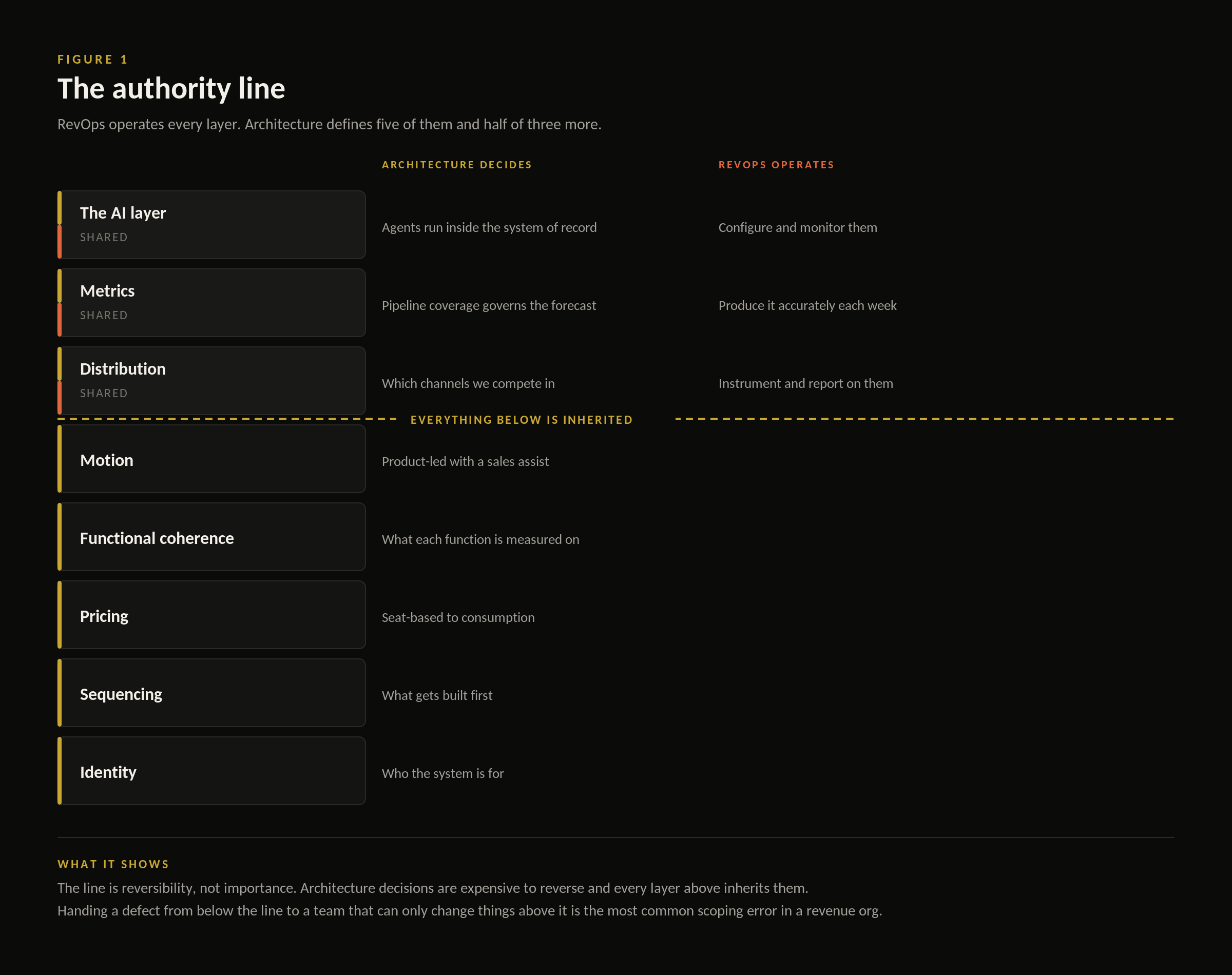
What Each One Owns
Mapped onto the eight layers of a revenue system, the split is clean and it is not a fifty-fifty split.
Identity, sequencing, pricing, functional coherence, and motion are architecture. They are decisions about what the system is. They are made once, revisited rarely, and inherited by everything above them. They are also, with the exception of sequencing, decisions no RevOps leader is typically authorized to make alone, because they belong to the founder, the CRO, or the pricing committee.
Distribution and metrics are shared, which is where most of the confusion lives. Choosing which channels the company competes in is architecture. Instrumenting those channels and reporting on them is RevOps. Deciding that pipeline coverage is the number that governs the forecast is architecture. Producing it accurately every week is RevOps.
The AI layer is shared in the same way, and it is the newest source of the confusion. Deciding that agents will run inside the system of record rather than as standalone tools is architecture. Configuring, monitoring, and maintaining them is RevOps.
RevOps owns the operation of every layer. Architecture owns the definition of five of them and half of three more.
The Failure Mode
The reason this comparison matters is not taxonomy. It is that the most common expensive mistake in a revenue org is assigning an architecture defect to the RevOps team.
The pattern is consistent. Pipeline is not converting. The CRO asks RevOps to fix conversion. RevOps does what RevOps can do: tightens the scoring model, rebuilds the stage definitions, cleans the data, adds a qualification field, ships a better dashboard. Every one of those is competent work. Conversion improves for a quarter and then returns to where it was, because the defect was in the ICP, and no scoring model can be tighter than the definition it scores against.
From the outside this looks like a RevOps performance problem. It is a scoping error. The team was handed a problem from the layer above the one it has authority over, and the only tools available to it operate below the defect.
This is what the phrase “our RevOps team is busy and revenue is not more predictable” almost always means. Busy is the symptom of working hard at the wrong layer.
The diagnostic that comes out of it is short. Before assigning a revenue problem, ask whether the fix would require changing a decision that other decisions inherit. If yes, it is architecture, and it needs whoever owns that decision in the room. If no, it is RevOps, and RevOps can own it end to end.
The Boundary Moves, and 2026 Is Moving It
The split above is not permanent, and there is now outside evidence of it shifting in a specific direction.
ICONIQ’s 2026 study of GTM org structure, drawing on more than 150 B2B software GTM leaders, found that under consumption and outcome-based pricing it becomes relatively common for RevOps to report into Finance rather than Sales, because revenue is no longer locked in at signature and forecasting gets materially harder. In the same conditions, data and reporting swells to roughly 30% of RevOps time.
Read that through the reversibility test and it is a clean demonstration. Nobody set out to reorganize RevOps. A pricing decision changed, which is architecture, and the reporting line and the time allocation of an entire function reorganized themselves downstream of it. RevOps did not choose either outcome. It inherited both.
That is what “architecture decisions are inherited” means in practice, and it is the strongest available argument that the boundary is real rather than a consultant’s diagram.
Two caveats worth stating, because the pages competing on this query do not state theirs. ICONIQ is an investor publishing on a portfolio-adjacent dataset, and the respondent set is self-selected. The org-structure findings are the durable part; treat the performance comparisons in the same report as correlational.
Where This Framing Breaks
In small companies the two roles are one person. Below roughly Series A the same operator is making the ICP call and building the dashboard. The boundary is still real, because the decisions still have different reversibility costs, but the org chart implication disappears and insisting on the distinction is overhead.
Sequencing is contested, and reasonably so. It is listed above as architecture, and a reasonable person could put it on the RevOps side, since the person who knows what can be built next quarter is usually the person operating the system. The defensible version is that sequencing is an architecture decision that requires RevOps input to make well, and treating it as either one alone produces a bad answer.
The test fails on decisions that are cheap to reverse and still inherited. Field naming conventions are a small example: easy to change, and everything downstream references them. The reversibility test handles most cases and it is not a law. Where it gives an ambiguous answer, fall back to asking how many other decisions would have to change with it.
What This Decides
The next time revenue is not compounding, the question is not whether to invest in RevOps. It is whether the defect sits above the line where RevOps has authority.
If it does, more RevOps capacity produces more competent work at the wrong layer, and the improvement decays on schedule.
Common questions
What is the difference between revenue architecture and revenue operations?
Revenue architecture designs the revenue system and its build order. RevOps operates the system that architecture defined. The usable test is reversibility: architecture decisions are expensive to reverse and are inherited by every decision below them, like ICP, pricing, and motion. RevOps decisions can be changed next quarter without redesigning anything above them, like scoring rules, stage definitions, and reporting.
Is RevOps part of revenue architecture?
Yes, and stating only that is the reason most answers to this question are unhelpful. RevOps is one layer of the architecture and it also operates all the others. The useful question is not whether one contains the other but which decisions each is authorized to change, because that determines who can fix a given problem.
Do you need a revenue architect if you already have RevOps?
Below roughly Series A, no: the same person makes both kinds of decision and the distinction is organizational overhead. Past that point the question is whether anyone is authorized to change ICP, pricing, and motion as a connected set. If those decisions are being made separately by different owners, RevOps will keep inheriting an incoherent system and being measured on the result.
Why is our RevOps team busy without making revenue more predictable?
Usually because the defect sits above the layer RevOps has authority over. If conversion is broken because the ICP is loose, every fix available to RevOps operates below the defect: tighter scoring against a vague definition, cleaner data about the wrong accounts. The work is competent, the improvement decays within a quarter, and it reads from the outside as a performance problem rather than a scoping error.
Who owns revenue architecture in a company?
Whoever can change ICP, pricing, and motion together. In practice that is the founder or CEO at early stage, and a CRO or a dedicated revenue architect past scale. It is rarely the RevOps leader, which is precisely why handing architecture defects to RevOps does not work. If nobody can name the owner, that is the finding.
Is revenue architecture just a rebrand of RevOps?
No, though the volume of agency content on this query makes the suspicion reasonable. The distinction is testable rather than positional: the two categories of decision have measurably different reversal costs and different authority requirements. A rebrand would not produce a different answer to “who has to be in the room to change this.”
Related reading
What Is Revenue Architecture?
The full definition and the eight layers this comparison maps onto.
AI-Native GTM Is a Sequencing Problem
What happens when the build order is treated as an operational choice rather than an architectural one.
GTM Vault 2: The Evolution of RevOps
How the RevOps function got to its current scope, and what it absorbed on the way.
The Revenue Architecture Map
The layers as a diagnostic surface, with the reading order for each one.
What Is a Revenue Architect?
The role the layers imply, and the test that separates holding it from advising on it.
The Stack Index Glossary
Both terms defined in one sentence each, alongside the eight layers and the tools operators run on every layer.