


Hi, it’s Rick Koleta. Welcome to GTM Vault, a breakdown of how high-growth companies design, test, and scale revenue architecture. Read inside OpenAI, Anthropic, Meta, and Google, and by 27,000+ operators across 150+ countries building GTM systems that compound.
The short version
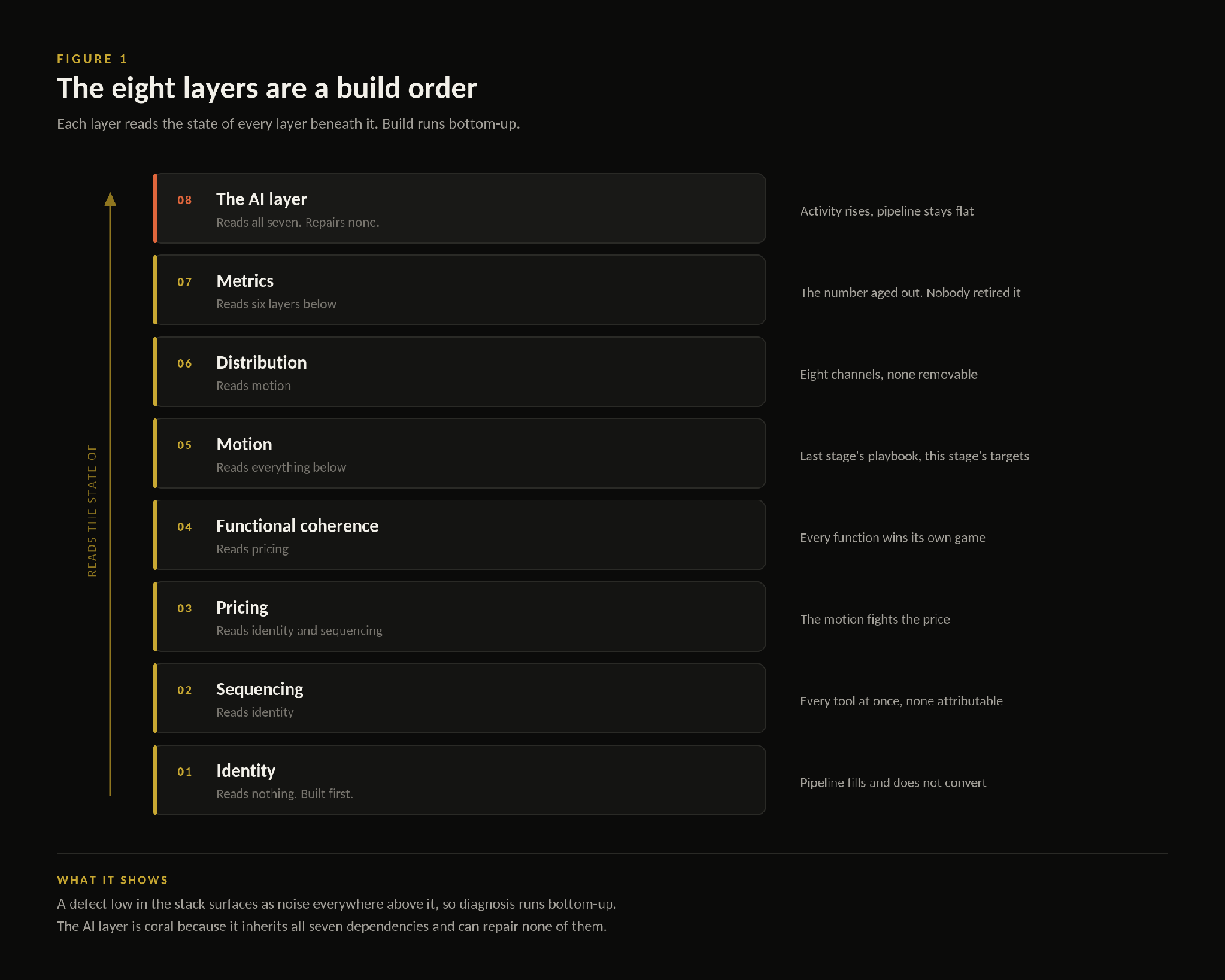
Published revenue architecture models range from three layers to six, and none of them agrees with another. They disagree because they are counting different things: maturity phases, tool categories, service lines, pipeline stages. A revenue system decomposes into eight layers (identity, sequencing, pricing, functional coherence, motion, distribution, metrics, and the AI layer), and the number is the least interesting part of the model. The property that matters is that the layers are a build order with dependencies. Each layer reads the state of every layer beneath it, which is why a defect low in the stack surfaces as noise everywhere above it, and why fixing the layer where the symptom appears never holds.
Five Models, No Agreement
Search for the layers of a revenue system and you get a number. The number is different every time.
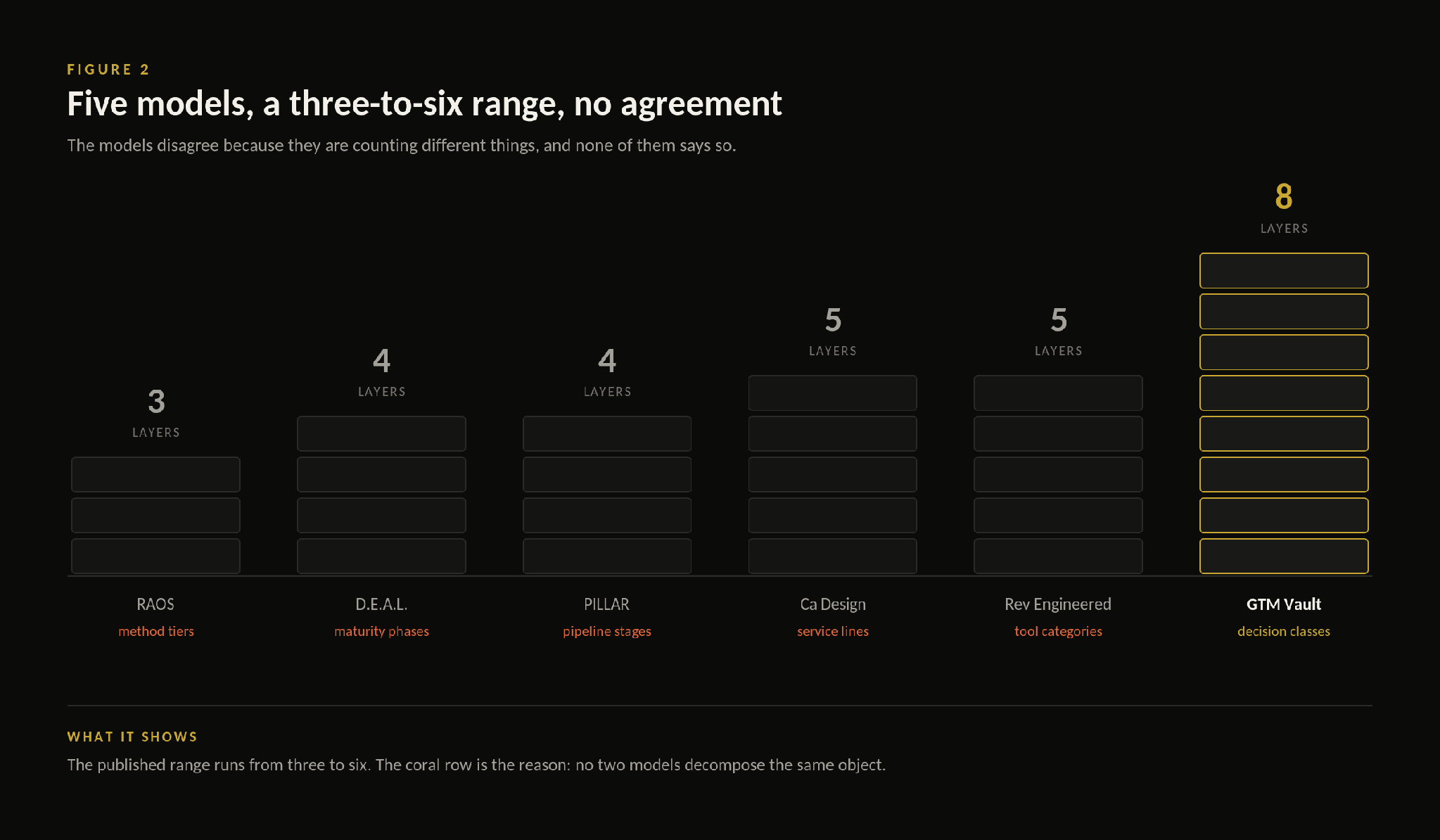
Revenue Architects publishes a three-layer method. Mike Allton’s D.E.A.L. framework has four: Data, Execution, Augmentation, Leadership. PILLAR GTM publishes a four-layer Revenue Operating System: Signal Infrastructure, Scoring Engine, Decision Engine, Operating Cadences. Ca Design has five: Demand, Conversion, CRM Infrastructure, Revenue Operations, Automation and Intelligence. Revenue Engineered has five with a sixth proposed. Step outside revenue architecture into RevOps tooling guides and the decompositions multiply again, into four-layer stacks, six-zone maps, and seven-category checklists.
Five models, a range from three to six, and no overlap in the terms. Nobody on the first page of results acknowledges that the disagreement exists.
The disagreement is not a disagreement about revenue systems. It is a disagreement about what a layer is. The AI Hat is counting organizational maturity phases. Revenue Engineered is counting tool categories in an outbound stack, which is why its layers have names like CRM. PILLAR is counting stages in a data pipeline: signal comes in, gets scored, produces a decision, gets reviewed on a cadence. Ca Design’s five layers map one to one onto the five services a HubSpot agency sells, which is the tell that recurs across the category. When the layer count matches the service catalog, the model is a price list with a diagram on it.
PILLAR is the useful case here, because it is the strongest of them and it demonstrates the problem inside a single publisher. Its canonical thesis is four layers. Its own Revenue Architecture Framework, same author, same library, is a five-pillar diagnostic: Strategy, People, Process, Systems, Metrics. Two decompositions, no reconciliation offered on either page. That is not carelessness. It is what happens when the layers are chosen to fit the argument being made rather than derived from the system being described.
So the count is the wrong argument to have. Eight is not more rigorous than four. The question worth answering is what the layers are ordered by, and whether the order is load-bearing.
What a Layer Is
A layer governs a class of decisions and reads the state of every layer beneath it.
Both halves of that do work. The first half is why the count comes out where it does: identity and pricing are different layers because they answer different questions and fail differently, not because a consultancy sells two services. The second half is the part no competing model commits to, and it is the part that makes the model falsifiable.
Reading the state of the layers beneath means a layer inherits their condition whether or not anyone intended it to. Qualification reads identity. If identity is defined loosely, qualification cannot be tight, no matter how the scoring model is built, because there is nothing precise for it to be tight against. Metrics read motion. If the motion changed and the dashboard did not, the numbers keep reporting on a system that no longer exists. None of this requires a mistake by the team operating the upper layer. The inheritance is structural.
This is where the model separates from PILLAR’s, and the distinction is worth stating plainly because both models are defensible. PILLAR’s four layers order a data pipeline running inside a business that already sells something: a signal arrives, it gets scored, a decision comes out, a cadence reviews it. Everything upstream of that pipeline is assumed. Someone already decided who the customer is, how the product is priced, and what the motion is. Those decisions are exactly the region the eight layers start in. PILLAR orders the pipeline that runs a motion. The eight layers order the decisions that create the motion.
Both can be right about dependency and be about different things. A pipeline model is not a rival to a decision model, and an essay that pretends otherwise is doing the same thing the category already does too much of.
The Eight Layers in Build Order
Each layer below carries its governing question, its failure signature, and what it reads from the layers underneath. The build order runs bottom-up.
Layer 1. Identity. Who the system is for, defined tangibly enough to disqualify in real time. It reads nothing, which is why it comes first, and everything downstream inherits it. The failure signature is a pipeline that fills and does not convert, because the filter admits accounts the product was never built for. Teams misread this as a conversion problem and hire closers.
Layer 2. Sequencing. What gets built and scaled in what order. It reads identity, because what you scale first depends on who you are scaling to. The failure signature is a company that installed every tool at once and cannot say which one is producing anything. This is the layer most teams skip entirely, which is why it is the one this model keeps returning to.
Layer 3. Pricing. Not a number. A structural decision that reshapes qualification, motion, and margin at the same time. It reads identity and sequencing. The failure signature is a motion that fights the price: enterprise pricing on a self-serve motion, or usage pricing with a sales team compensated on contract value. Pricing changes propagate upward harder than any other layer, which is the mechanism the ICONIQ data below makes visible.
Layer 4. Functional coherence. Whether the functions optimize the system or their own dashboards. It reads pricing, because compensation and targets follow the pricing model. The failure signature is the familiar one: marketing hits MQL targets, sales hits meeting targets, and pipeline is flat, because every function is winning its own game.
Layer 5. Motion. How the company sells, and whether the playbook matches the stage it is in now rather than the stage it was written for. It reads everything below. The failure signature is a playbook that worked at the last stage and is quietly failing at this one, usually blamed on execution.
Layer 6. Distribution. Whether channels compose into a system or accumulate into a pile. It reads motion. The failure signature is six to eight channels, none of which can be removed because nobody can say what any of them contributes.
Layer 7. Metrics. Whether the numbers compound understanding or conceal decay. It reads all six layers beneath it, which is why it is the most common place to misdiagnose. A metric that has aged out of structural relevance keeps reporting confidently. Nobody retires it.
Layer 8. The AI layer. Last on purpose. Agents installed on top of the seven layers below inherit whatever state those layers are in. The failure signature is the most expensive one in the category: a system that produces more activity than the company has ever generated while pipeline stays flat, because the agents are reasoning over stale data, against an ICP from two stages ago, inside functions that are each optimizing something different.
Why Diagnosis Runs Bottom-Up
The dependency claim has a practical consequence: symptoms appear at the top, causes sit at the bottom, and the two are rarely the same layer.
A team sees flat pipeline against rising activity. Activity is a layer seven and eight observation. The cause is usually layer one or two. The team responds where the symptom is visible, because that is where the dashboard is, and buys another tool or rewrites the sequences. The fix decays within a quarter, because the defect underneath it never moved.
This is why the ordering claim is worth more than the count. It generates a diagnostic procedure. Start at identity and walk up until you find the first layer whose state is wrong, then repair from there rather than from where it hurts.
The best outside evidence for the mechanic comes from a report that was not trying to make this argument. ICONIQ surveyed more than 150 B2B software GTM leaders for its 2026 study of GTM org structure, and the structural findings read as a pricing-layer change propagating upward through functional coherence and into metrics. Under consumption and outcome-based pricing, customer success managers increasingly report into Sales rather than CS, because retention and expansion stop being post-sale concerns. Under the same models it becomes common for RevOps to report into Finance rather than Sales, because revenue is no longer locked in at signature. Data and reporting swells to roughly 30% of RevOps time. Account executive compensation moves toward net new recurring revenue and net dollar retention rather than initial contract value.
Nobody redesigned the org chart because org charts were due for a redesign. A pricing decision changed, and reporting lines and compensation reorganized themselves around it two layers up. That is the dependency running in public across 150 companies.
Two caveats, because the category does not state them and should. ICONIQ is an investor publishing on a portfolio-adjacent dataset, the respondent set is self-selected, and the AI-adoption comparisons in the same report are correlational rather than causal. The org-structure findings are the durable part. The performance deltas are the part to hold loosely.
The AI Layer Reads Everything and Repairs Nothing
The eighth layer deserves its own statement because it is where the ordering claim gets tested most expensively and most often.
An agent reasons over whatever structure sits beneath it. Install one on a coherent system and it compounds. Install one on a fragmented system and it automates the fragmentation at machine speed, which looks like progress for about a quarter. The agent carries seven dependencies and can repair none of them. It cannot tighten an ICP. It cannot resolve two functions optimizing against each other. It inherits all of it and runs faster.
This is the same argument as AI-Native GTM Is a Sequencing Problem, generalized. That essay made the case for one layer. The model makes it for all eight: every layer amplifies the state of the layers beneath it. The AI layer is the most visible case because it amplifies hardest and costs most, not because it is a special exception.
Where This Framing Breaks
Three conditions, stated so the model can be argued with.
Before product-market fit, the layers collapse. A repeatable motion is what the layers decompose. Without one there is nothing to decompose, and sequencing decisions are premature abstraction. Pre-PMF companies need a product, not an architecture. Anyone applying this model at that stage is using it to feel organized.
The ordering claim is falsifiable, and here is what would falsify it. If teams that repair upper layers first, metrics before motion, or agents before identity, showed durable gains rather than gains that decay within two to three quarters, the dependency argument would be wrong. Not weakened, wrong. The model predicts that out-of-order repair produces a temporary improvement that reverts once the underlying defect reasserts itself. If that pattern does not hold, the layers are a taxonomy and not a build order, and the taxonomy is worth much less.
Eight is a decomposition choice. Merging pricing into identity gives seven. Splitting distribution by channel class gives nine. Neither breaks the argument, because the argument was never the number. Anyone treating eight as doctrine has taken the least defensible part of the model and made it the point, which is the mistake the rest of the category has already made five different ways.
What This Decides
The next time pipeline is flat against rising activity, the question is not which tool to add. It is which layer is the lowest one whose state is wrong, and whether anything above it can be trusted until that is fixed.
Most teams will find the answer further down than the dashboard suggested.
Common questions
What are the layers of a modern revenue system?
Eight, in build order: identity, sequencing, pricing, functional coherence, motion, distribution, metrics, and the AI layer. Identity comes first because every other layer inherits it. The AI layer comes last because it reads all seven beneath it and can repair none of them. The order is the argument; the count is a decomposition choice.
How many layers does a revenue architecture have?
Published models range from three to six, and they disagree because they count different things. Revenue Architects counts three method tiers, D.E.A.L. counts four maturity phases, PILLAR counts four pipeline stages, and Ca Design and Revenue Engineered count five service lines and five tool categories respectively. Counting decision classes yields eight. The useful question is not how many layers a model has but what its layers are ordered by.
Do revenue architecture layers have to be built in order?
Yes, and the mechanic is specific: each layer reads the state of the layers beneath it, so a defect below surfaces as noise above, and a fix applied above the defect decays. Repair runs in build order and diagnosis runs bottom-up. This is a testable claim, not a preference, and it predicts that out-of-order fixes revert within two to three quarters.
What is the difference between the 4-layer revenue operating system and the 8-layer revenue architecture?
Scope. PILLAR’s four layers (Signal Infrastructure, Scoring Engine, Decision Engine, Operating Cadences) order a data pipeline running inside a business that already sells something. The eight layers order the decisions that create the motion that pipeline runs on: who the customer is, what the price is, how the company sells. One assumes the upstream decisions; the other is about them. They are not rival answers to the same question.
Where does AI sit in revenue architecture?
Eighth and last, on top of the other seven. An agent reasons over whatever structure sits beneath it, so it amplifies the state of the system it inherits in either direction. It carries seven dependencies and can repair none of them, which is why installing agents before fixing data and qualification produces fragmentation at machine speed rather than intelligence.
Why do revenue architecture frameworks disagree with each other?
Because most layer counts mirror the author’s service catalog. Ca Design’s five layers map one to one onto the five services a HubSpot agency sells. PILLAR publishes two different counts in the same library without reconciling them. The models are not describing the same object and then disagreeing; they are describing maturity phases, tool categories, service lines, and pipeline stages, and calling all four “layers.”
Related reading
Revenue Architecture vs Revenue Operations
Where the architecture layers end and RevOps begins, and why the boundary is reversibility rather than scope.
The definition the eight layers sit inside, and why architecture is the layer of decisions above RevOps.
AI-Native GTM Is a Sequencing Problem
The dependency argument applied to one layer, with the seven-step build order underneath it.
Where the eighth layer belongs, and why adoption burden is the test rather than the tooling.
The layers as a diagnostic surface, with the reading order for each one.
What Is a Revenue Architect?
The role the layers imply, and the test that separates holding it from advising on it.
Every layer defined in one sentence, with the tools operators named on each one.