This is the first of eight laws in the GTM Architecture series.
Executive Summary
The system is working. Deals are closing. The team is executing. Pipeline looks healthy.
But twelve months in, the customers Marketing acquired are not the customers Sales is closing. The customers Sales is closing are not the customers Product is building for. The customers Product is building for are not expanding the way the revenue model requires.
No individual function failed. The system drifted.
It drifted because the identity it was built around was never formally defined in the first place. Not because anyone made a wrong decision. Because the architectural foundation, the precise definition of who this system exists to serve, was treated as a starting assumption rather than a maintained constraint.
This is not a messaging problem. It is not a segmentation problem. It is not a sales execution problem, though all three will absorb the blame before anyone looks upstream.
It is an identity architecture failure. And identity is architectural, not operational.
The cost does not arrive suddenly. It accumulates across functions, invisibly, until every leader can demonstrate strong local execution while the system produces declining output at every boundary.
Foundational Law 04 is about what causes that drift, how to recognize it before it becomes measurable, and the structural intervention required to stop it.
This law establishes five structural truths:
The ICP is not a targeting filter. It is the architectural definition that every GTM decision is made against.
Identity drift, the informal evolution of who you serve without a formal architectural update, is the root cause of most coherence failures.
A precise GTM identity requires four definitions: the buyer, the problem they cannot afford to leave unsolved, the trigger condition that makes them ready to act, and the expansion profile of the resulting customer.
GTM systems without a defined identity cannot compound. They can only accumulate.
Identity clarity is the prerequisite for motion selection. The right motion on the wrong identity fails structurally. The wrong motion on the right identity merely underperforms.
Organizations that define identity with architectural precision build systems where every function has a shared anchor to optimize toward. Organizations that treat identity as a marketing input watch their functions gradually drift toward different customers until the system produces dilution at every boundary.
The Structural Failure Pattern
A recognizable pattern repeats itself across companies that have achieved initial traction.
The company defines its ICP at the point of first revenue. That definition is based on the earliest customers, who they are, what they needed, and what made them buy. It is written down somewhere, usually informally, in a sales deck, a marketing brief, or a founder’s mental model.
The product evolves. The team grows. The market shifts. The ICP is never formally updated.
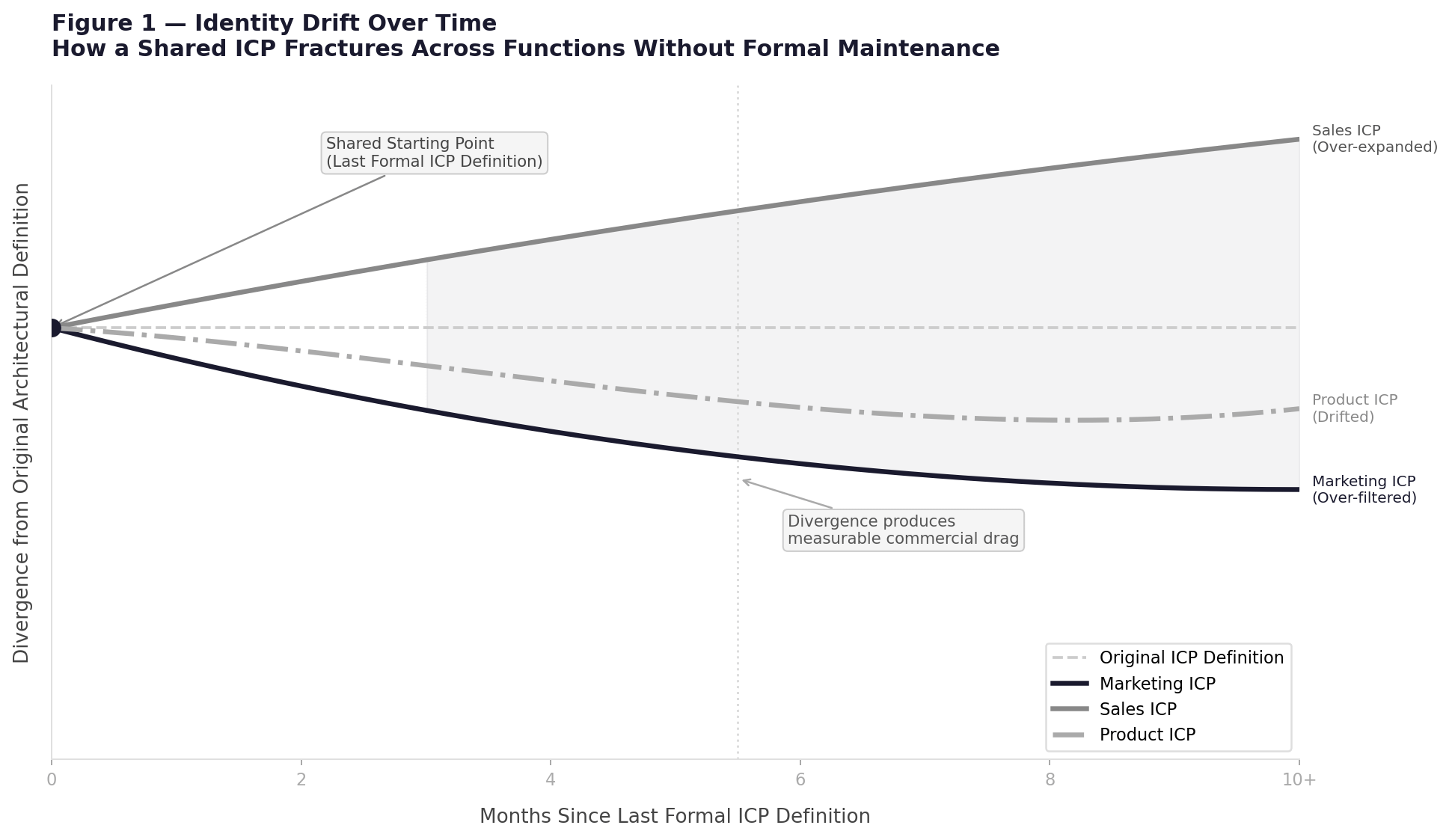
Each function inherits a slightly different version of the original definition and adapts it to their own context. Marketing narrows the definition to whoever responds to their campaigns. Sales expands it to include any company that might close. Product interprets it as the loudest voices in their support channel. Customer Success maps it to whoever is easiest to retain.
Twelve months later, every function is optimizing toward a different customer.
The system is coherent within each function. It is incoherent at the system level. Win rates decline. Net revenue retention softens. Customer acquisition cost rises. Sales cycles lengthen. Leadership commissions a diagnostic across each function. Each function produces a credible case for strong execution. The root cause remains unaddressed because it sits upstream of every function that gets examined.
The ICP was never the anchor it needed to be. It was a starting assumption that was never maintained as an architectural definition.
The Structural Principle
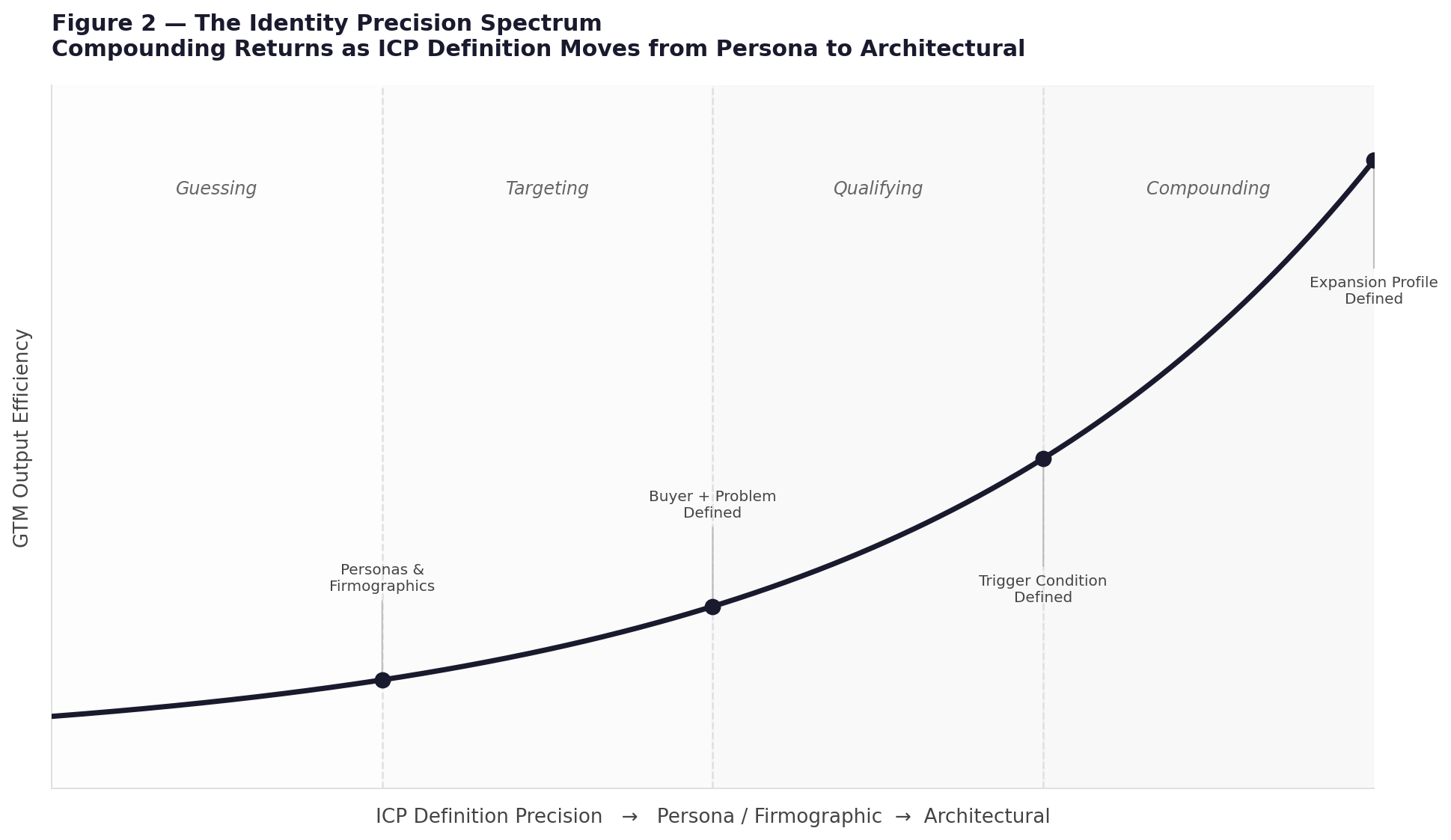
Identity precision is the condition under which GTM effort compounds rather than accumulates.
This is not a messaging principle. It is not a targeting principle. It is an architectural principle that governs the behavior of the entire GTM system.
When the ICP is defined with precision across all four dimensions, every function has a shared architectural anchor. Demand generation targets the right trigger conditions. Sales qualifies against the right problem frame. Product builds for the right expansion profile. Customer Success delivers against the right value promise. Each function’s output is precisely the input the next function needs.
When identity is imprecise, each function fills the gap with its own interpretation. The system does not collapse. It drifts. Drift is harder to diagnose than collapse because every function can report strong local metrics while the system produces declining output at every functional boundary.
A precisely defined identity does not constrain the system. It focuses it. And focused systems compound. Unfocused systems accumulate activity until the weight of misdirected effort becomes the primary drag on growth.
The ICP Is Not a Persona
The most common misunderstanding in GTM identity work is to treat the ICP as a persona.
A persona describes who a buyer is. An architectural ICP defines what makes them the right buyer for this system at this stage.
The distinction is structural. A persona tells one function who to contact. An architectural ICP tells every function what to optimize toward. A persona is a marketing input. An architectural ICP is a system constraint that every decision is made against.
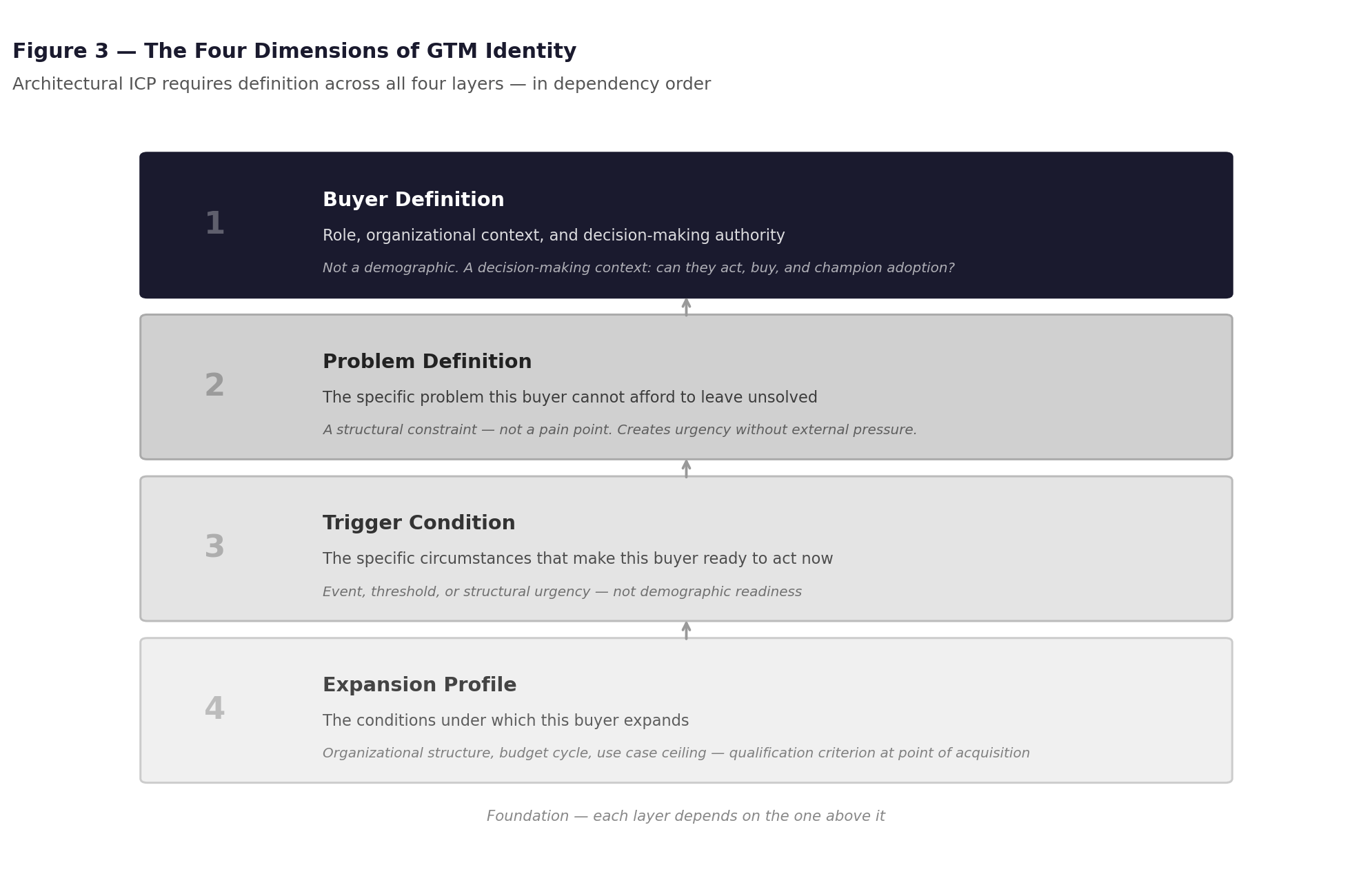
A complete architectural ICP requires definition across four dimensions:
Buyer definition
The specific role, organizational context, and decision-making authority that makes this buyer structurally right for the product. Not a demographic. Not a job title. A decision-making context that determines whether this buyer can act, can buy, and can champion adoption inside their organization.
Problem definition
The specific problem this buyer cannot afford to leave unsolved. Not a pain point. Not a challenge they would like to address. A structural constraint in their business that creates urgency without external pressure. When the problem definition is precise, qualification becomes fast. When it is imprecise, every conversation requires re-education about why the problem matters.
Trigger condition
The specific circumstances that make this buyer ready to act now. Without trigger definition, pipeline fills with buyers who match the ICP but are not yet at the moment of structural urgency. Conversion from pipeline to closed revenue is slow and unpredictable. When the trigger is defined, demand generation targets buyers at the moment of highest receptivity rather than the moment of demographic fit.
Expansion profile
The conditions under which this buyer expands. Customers who match the acquisition ICP but not the expansion ICP produce a healthy new logo number and a structurally limited NRR regardless of how well Customer Success executes. The ICP must incorporate expansion potential as a qualification criterion at the point of acquisition, not as a retroactive analysis after NRR begins declining.
Identity Drift
Identity drift is the process by which a formally defined ICP becomes informally reinterpreted across functions over time.
It is not a failure of communication. It is a structural failure of maintenance. Companies treat ICP definition as a founding exercise rather than a living architectural document that requires formal update when product, market, or competitive reality changes materially.
Drift is invisible until it becomes measurable. By the time it becomes measurable, it has been compounding for months. Each function fills the gap between the formal definition and current reality with its own interpretation. The interpretations diverge gradually. No single decision causes the drift. No single leader owns it. The system does not break. It dilutes.
When drift becomes measurable, the signals do not point directly at the ICP. Declining win rates, softening NRR, and lengthening cycles are attributed to product gaps, competitive pressure, sales execution, and marketing quality. Each function produces a credible case for strong local execution. The root cause sits upstream of every diagnostic that gets run, because identity drift does not show up in any individual function’s dashboard. It shows up at the boundaries between them.
That is where Foundational Law 04 operates. The four structural points at which identity fractures as organizations scale are predictable. They are also invisible to any single function examining its own performance in isolation.
Identity and Motion
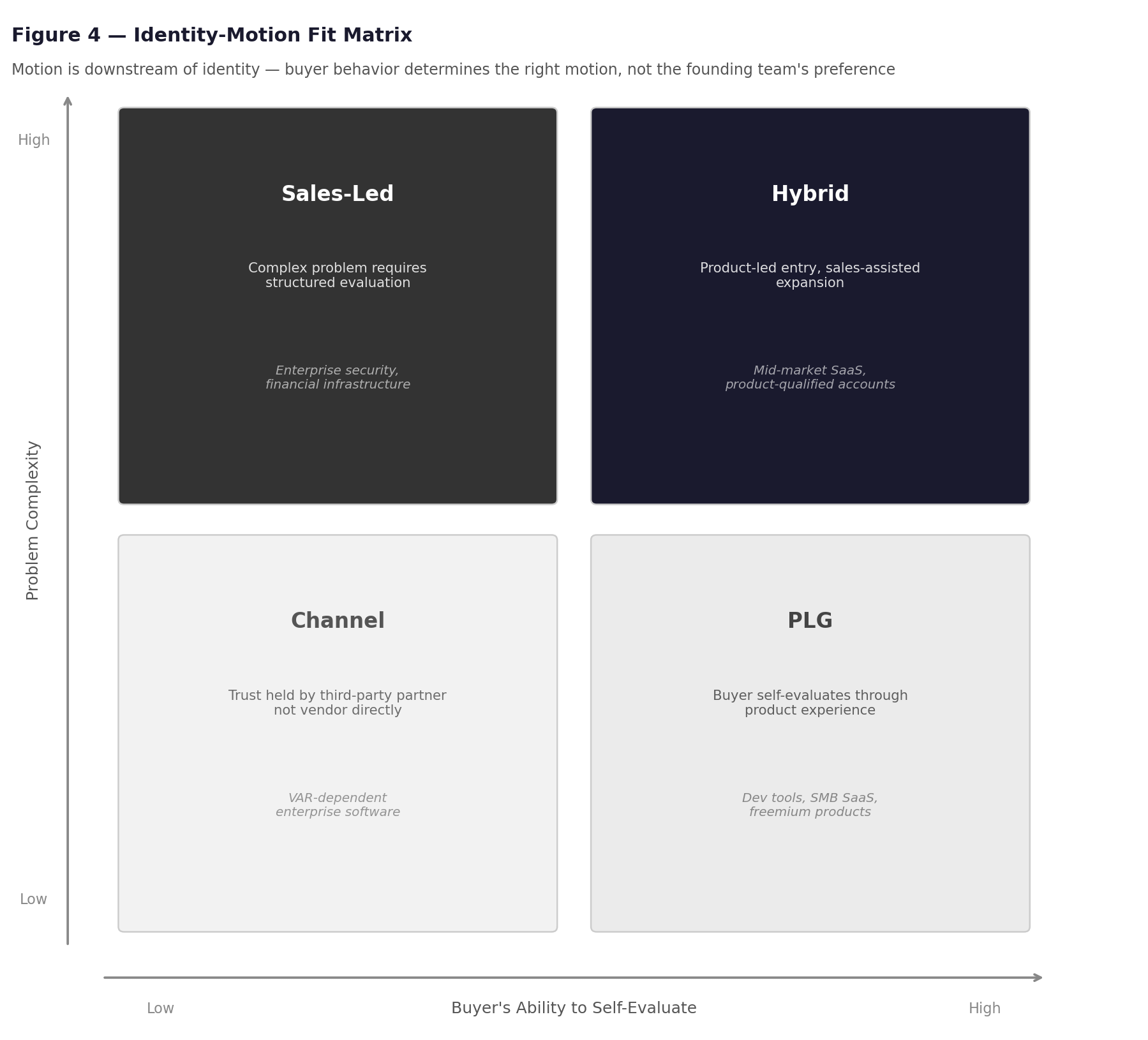
Identity determines motion. Motion does not determine identity.
This sequence matters because most companies select their GTM motion based on what the founding team knows how to execute rather than what the identity architecture requires.
A product-led motion requires a buyer who can realize value through self-directed product use without requiring a sales conversation to understand what the product does. A sales-led motion requires a buyer whose problem is complex enough that evaluation requires a structured conversation and whose organization requires a human relationship to navigate the buying process. A channel motion requires a buyer whose trust is held by a third-party partner rather than the vendor directly. A hybrid motion requires a buyer who begins with product evaluation and transitions to a sales-assisted expansion motion as the organizational footprint grows.
When the motion does not match the identity, the system underperforms regardless of execution quality. The best sales team in the world cannot save a sales-led motion imposed on a buyer who will only evaluate through product use. The most sophisticated product onboarding cannot drive adoption in an organization whose buying process requires executive sign-off before any usage begins.
Motion selection is downstream of identity definition. Selecting a motion before defining the identity produces a system optimized for the founding team’s preference rather than the buyer’s behavior. That mismatch compounds as the company scales. The cost of motion-identity misalignment grows with every sales hire, every marketing campaign, and every customer success investment made against the wrong architectural assumption.
Case Study: Intercom (2020-2023)
Intercom built its early identity around a specific buyer: the startup founder or early-stage engineering team who needed a simple way to talk to website visitors and support early customers. That identity was precise. The product reflected it. The motion reflected it. The pricing reflected it.
As Intercom scaled, the identity drifted. Enterprise accounts offered larger contract values. Mid-market companies offered more predictable expansion. The product grew in complexity to serve larger organizations. The pricing model shifted to accommodate enterprise procurement. The GTM motion added enterprise sales capacity, customer success infrastructure, and partner programs.
By 2021, Intercom was running three incompatible identity architectures simultaneously. It was too complex and expensive for the startup buyer it had been built for. It was not mature enough in security, compliance, or enterprise integrations for the large enterprise buyer it was pursuing. It was competing against purpose-built mid-market alternatives in the segment it could most credibly serve.
The motion was incoherent because the identity was undefined.
In 2023, CEO Eoghan McCabe returned to the role and made an explicit architectural decision. Intercom would define its identity precisely around a specific buyer profile: mid-market B2B companies with dedicated support teams who needed an AI-native customer service platform. The consequences of that decision were structural, not cosmetic. Pricing was restructured from seat-based to resolution-based, anchoring the revenue model to the value the defined buyer actually cared about. The product roadmap was realigned away from engagement and marketing tooling and back toward customer service outcomes. Fin, their AI agent, became the architectural center of the product rather than one feature among many. Sales investment was reallocated toward the segments where the refined identity had the highest structural fit.
The intervention was architectural. Intercom did not hire better salespeople. It did not redesign its marketing campaigns. It redefined the identity the entire system was built around, then restructured every function to optimize toward that identity.
The clarity came first. The compounding followed.
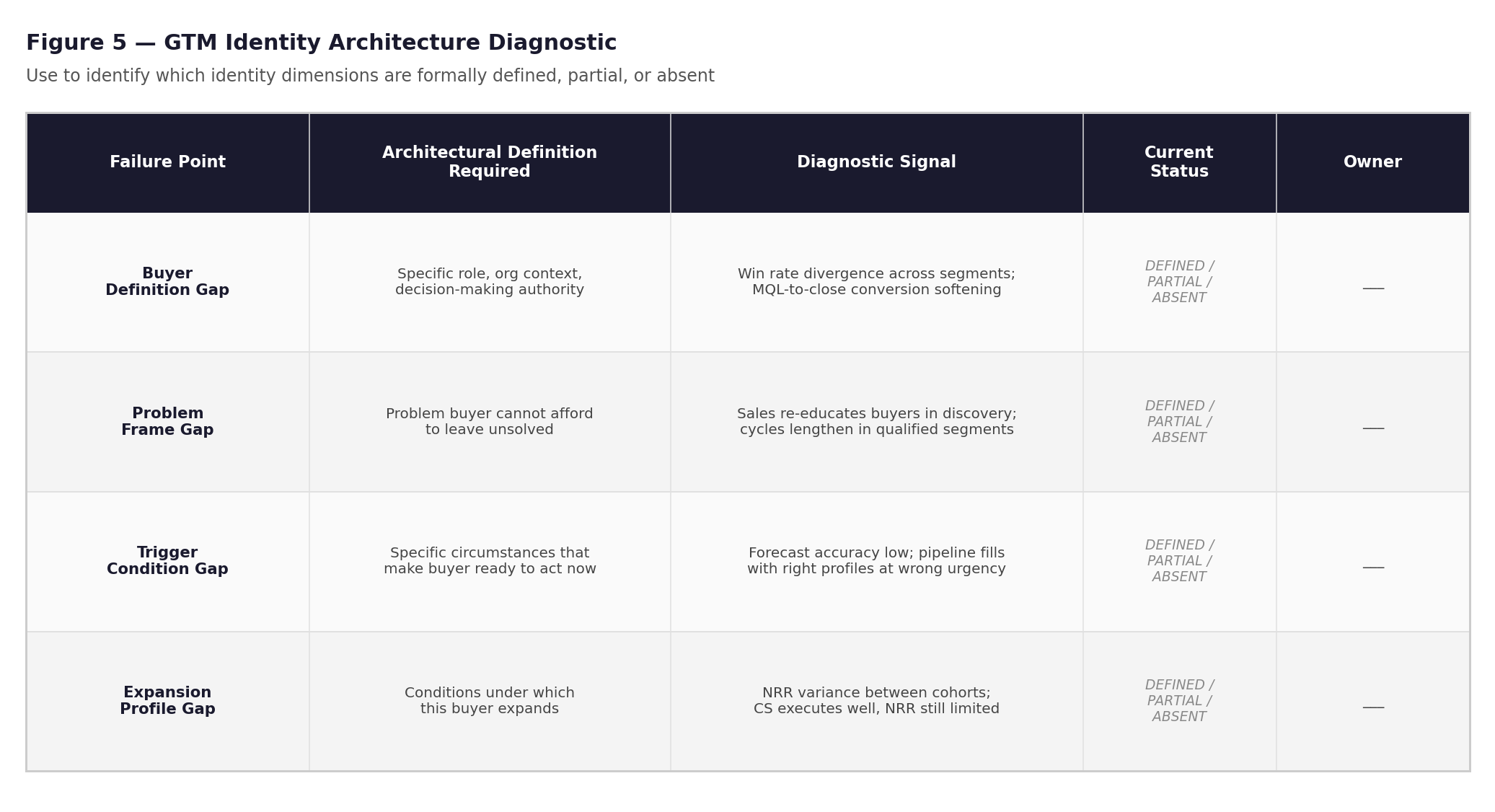
The Four Identity Failure Points
GTM identity does not break uniformly. It fractures at four predictable structural points as organizations scale.
The buyer definition gap
Marketing is targeting a buyer profile that no longer matches the buyer Sales is successfully closing. Qualification logic has not been updated to reflect the current architectural ICP. Pipeline volume looks healthy. Pipeline quality is declining. Conversion from opportunity to close is slowing. The gap is attributed to sales execution. The root is buyer definition drift.
The problem frame gap
The problem framing in demand generation does not match the problem buyers present in sales discovery conversations. Marketing generates demand against a problem frame established at an earlier stage of the company. The product has evolved to solve a different or more precise problem. Sales spends the first part of every discovery call re-educating buyers about why the problem matters. Cycles lengthen. This is not a messaging problem. It is a problem definition drift in the identity architecture.
The trigger condition gap
The system has no formal definition of when a buyer is structurally ready to act. Pipeline fills with correctly profiled buyers at the wrong stage of urgency. Sales effort goes into converting buyers who are not yet at the moment of structural need. Forecast accuracy is low. Conversion is unpredictable. This is not a forecasting problem. It is an absence of trigger condition definition in the identity architecture.
The expansion profile gap
The acquisition motion optimizes for initial close without evaluating whether the resulting customer is architecturally positioned to expand. Customers are acquired who match the buyer definition and problem definition but whose organizational structure, budget cycle, or use case limits expansion. NRR is structurally constrained before the first renewal conversation. This is not a Customer Success execution problem. It is an expansion profile gap in the identity architecture.
Institutional Anchor
GTM systems are built for a specific buyer solving a specific problem under specific conditions.
When that definition is precise and maintained, every function has a shared architectural anchor. Demand generation targets the right trigger conditions. Sales qualifies against the right problem frame. Product builds for the right expansion profile. Customer Success delivers the right value promise. The system compounds because every function is amplifying the same architectural definition.
When that definition drifts, every function fills the gap with its own interpretation. The system does not fail visibly. It produces dilution at every functional boundary while every leader demonstrates strong local execution. The root cause sits upstream of every diagnostic that gets run.
Foundational Law 04 is definitive:
GTM without a defined identity compounds in the wrong direction.
It produces the appearance of a scaling system while misdirecting every dollar of GTM investment against a buyer the architecture was never formally designed to serve.
It cannot be resolved through better segmentation, sharper messaging, or stronger qualification frameworks. These are functional responses to an architectural problem.
It requires an architectural intervention: formal definition of the buyer, the problem, the trigger condition, and the expansion profile, maintained as a living architectural document, and used as the anchor against which every GTM decision is made.
Identity is not a marketing input. It is the foundational constraint of the entire GTM system.
Without it, coherence has nothing to compound toward. Pricing has no value anchor to express. Scaling has no structural foundation to build on.
Doctrine Implications for Founders
Define the ICP across all four dimensions: buyer, problem, trigger condition, and expansion profile. Treat any dimension that is not formally defined as structural debt.
Review the identity architecture formally every six months and whenever product, pricing, or market reality changes materially. An ICP that is not maintained is an ICP that is drifting.
When win rates decline, check buyer definition drift before adjusting sales execution or compensation structure.
When NRR declines, check expansion profile fit before investing in Customer Success capacity or tooling.
Select GTM motion after identity is defined, not before. Motion is a downstream architectural choice, not a founding preference or a hiring decision.
When Marketing ICP and Sales ICP have diverged, the root cause is always an identity architecture failure. Do not resolve it with a qualification scorecard. Resolve it with a formal ICP update across all four dimensions.
Revenue compounds when the system is aimed at the right buyer, solving the right problem, at the right moment, with the right expansion profile in view.
Define the identity. Maintain it with discipline.
Compound in the right direction.
This is the first law in the GTM Architecture series.