


GTM Vault is a breakdown of how high-growth companies design, test, and scale revenue architecture.
Guy Rubin on why pipeline rose 68% while revenue per seller fell, and what the teams that got more efficient did differently
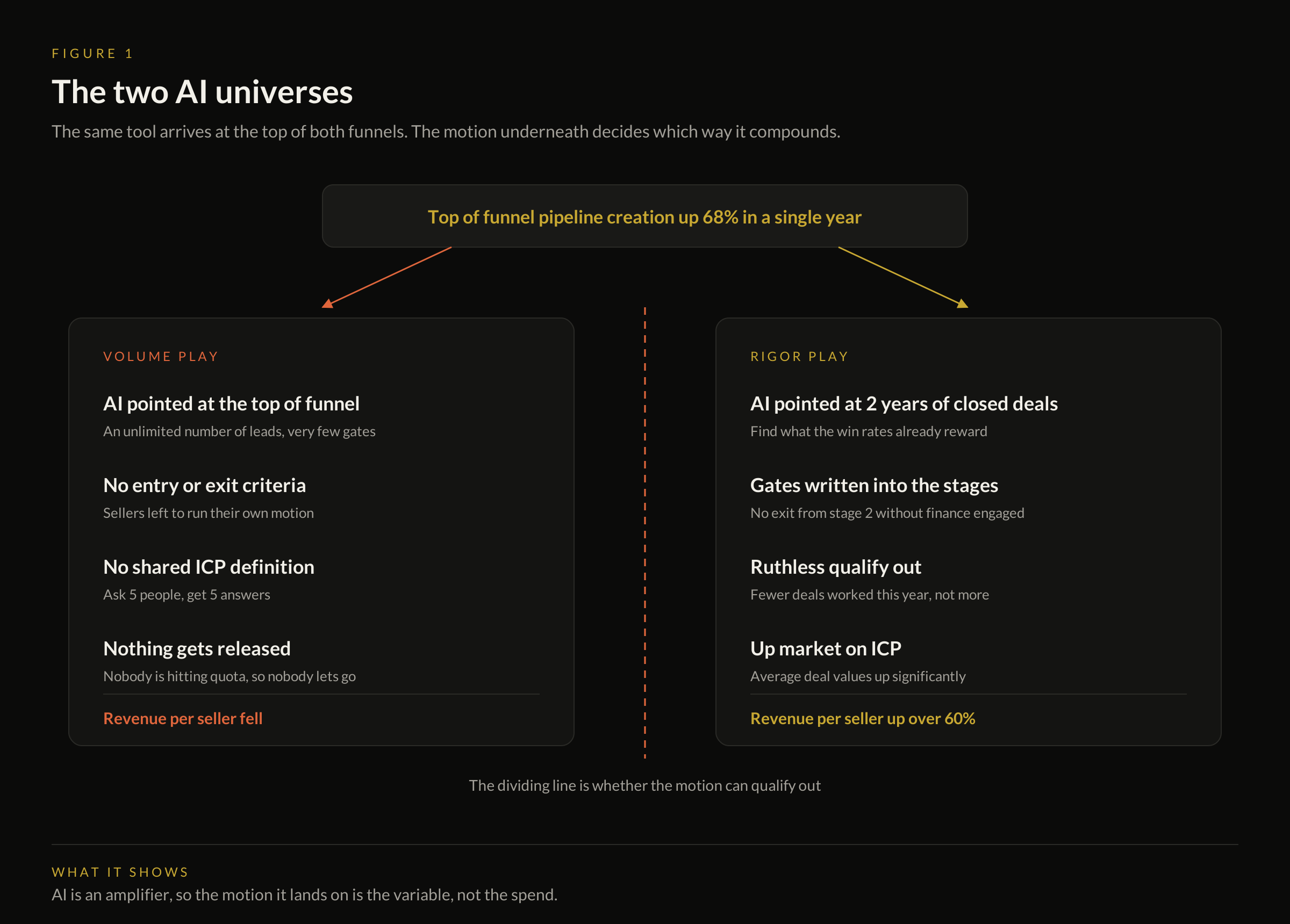
Every revenue team has a dashboard that says the pipeline is fine. Then the quarter closes and it was not. In the 2026 benchmark data, top of funnel pipeline creation rose 68% in a single year, more than 3 in 4 sellers missed quota, and average revenue per seller went down.
“AI puts fuel on the fire. And if the sales motion is inefficient, it’s going to get a whole lot more inefficient when you throw AI on top of it.”
Meet Guy Rubin, managing director of revenue intelligence at Fullcast. He founded Ebsta, grew it to about 1,000 customers, sold it to Fullcast, and now runs the quarterly go-to-market audits behind the GTM benchmarks he has published with Pavilion for 4 years. He joins GTM Vault for episode 56 to explain why teams that bolted AI onto an unqualified motion got measurably worse, and why the ones that got better worked fewer deals.
About Fullcast
Fullcast is a revenue operations platform for B2B revenue teams, covering territory and capacity planning, quota and commissions, forecasting and revenue intelligence. It was founded by Dharmesh Singh and Bala Balabaskaran and is headquartered in Salt Lake City, where Simplus co-founder Ryan Westwood became CEO in January 2024 alongside a $34 million round led by Epic Ventures, with Companyon Ventures, Firsthand Alliance, True Blue Partners and Sepio Capital participating. It has since bought its way across the stack, acquiring Atrium and Ebsta in August 2025 and Copy.ai in October 2025, alongside Commissionly. Its 2026 Benchmarks Report is built on $78 billion in pipeline, 361,000 opportunities and 2,500 sellers across 316 companies.
Watch or listen now across YouTube, Apple Podcasts, and Spotify
Episode highlights
(0:00) Trailer
(2:51) What the 2026 benchmarks measured across 316 companies
(4:25) 3 in 4 sellers missed quota as pipeline rose 68%
(6:11) The 2 AI universes
(8:13) The stage 2 finance gate and 7x win rates
(11:10) Balanced territories and routing: 11% and 15%
(12:30) Engagement, the data point no CRM holds
(17:35) AI puts fuel on the fire
(20:20) What to do with 31% of open pipeline at risk
(25:10) Relationships are driving revenue
What you’ll learn:
Why top of funnel pipeline rose 68% in a single year while average revenue per seller fell across 316 B2B companies
How sales velocity, average deal value times win rate divided by sales cycle, reduces a revenue org to dollars per day
Why more than 3 in 4 sellers missed quota and nearly 60% did not reach 80% of their number
How the disciplined minority worked fewer deals, moved up market and lifted revenue per seller by over 60% in 1 year
The stage 2 finance gate that carries win rates 7x higher than engaging finance at stage 4
Why balancing territories adds about 11% growth and routing by vertical expertise lifts win rates by about 15%
The 30 opportunity ceiling past which sellers stop multi-threading and engagement thins across the whole book
Why deals stalled past 60 days sit at single digit win rates and belong closed out, not nursed
How partners, referrals and in-person dinners are gaining efficiency while cold volume motions lose it
Why the territory that qualifies out the most early is the one that builds the most at quarter end
Key takeaways
Pipeline rose 68% in a year, and that volume is what pulled revenue per seller down. The 2026 benchmarks cover 316 B2B software and services businesses, and top of funnel opportunity creation rose 68% in a single year, mostly from AI. More than 3 in 4 sellers missed quota over the same 12 months, and nearly 60% did not reach 80% of their number. Average revenue per seller fell, because the extra opportunities landed in motions that did not know how to qualify out.
There are 2 AI universes now, and the dividing line is whether the motion can qualify out. The majority pointed AI at the top of the funnel as a volume play, with few gates, no agreed entry and exit criteria, and sellers left to run their own motion. A minority pointed it at the last 2 years of closed deals to find what wins, then wrote that back into the stages as gates. That minority worked fewer deals, moved up market and lifted revenue per seller by over 60% in a single year.
Engagement is the forecast input the CRM never held. Rubin’s engagement score turns email traffic, calendar events, calls and transcripts into 1 number out of 100, and the goal is a threshold, not 100. Read back against closed deals, a score above 60 with the finance persona engaged at stage 2 carries win rates 7x higher than reaching finance at stage 4. Stage is a label a rep applies, while engagement polices itself: a finance lead does not spend 3 hours on a contract they will not sign.
Capacity and routing move win rates before any hiring decision does. In a complex B2B motion, sellers carrying more than about 30 open opportunities stop multi-threading, and their engagement thins across every account they hold. Balancing territories against that load adds about 11% growth in a single year, and routing leads to sellers with matching vertical expertise lifts win rates by about 15%. Most teams still settle both with round robin, which is a distribution rule, not a capacity plan.
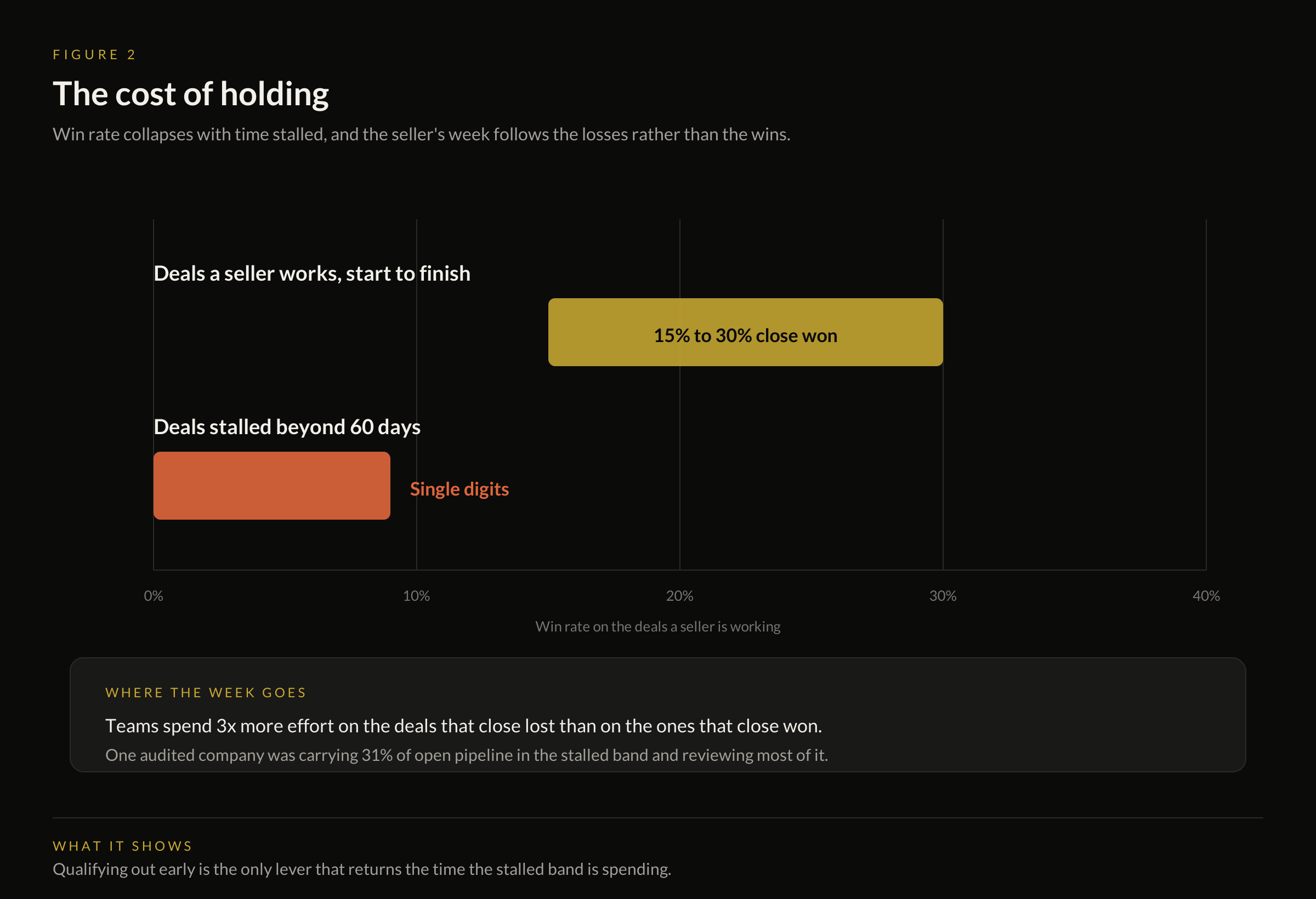
The cheapest growth in the 2026 data came from closing deals out, not opening more. Sellers close between 15% and 30% of what they work, yet teams spend 3x more effort on deals that close lost than on deals that close won. Once a deal stalls past 60 days its win rate drops to single digits, which is how one audited company ended up with 31% of open pipeline in that state. The territory that qualifies out hardest in the early stages is the one that builds the most at quarter end.
Guy Rubin
LinkedIn: https://www.linkedin.com/in/rubinguy/
Fullcast: https://www.fullcast.ai/
2026 Benchmarks Report: https://www.fullcast.ai/ebooks/2026-benchmarks-report-the-state-of-gtm-in-2026
Rick Koleta (Host)
LinkedIn: https://www.linkedin.com/in/rickkoleta
GTM Vault
LinkedIn: https://www.linkedin.com/company/gtmvault
YouTube: https://www.youtube.com/@gtmvault
Website: https://gtmvault.co/
The GTM Vault Podcast - subscribe on your platform of choice
Subscribing on YouTube, Apple, or Spotify is what tells each platform to put the next episode in front of more operators, which is how the show keeps booking the guests worth an hour of your week.
Previous episodes include


See all previous episodes here
Guy’s stack is on the record. See yours against it: 7 taps at pro.gtmvault.co/survey, and the State of the GTM Stack 2027 report ships in March, free.
The GTM Vault Podcast is a breakdown of how high-growth companies design, test, and scale revenue architecture. Visit gtmvault.co for more episodes, the GTM Vault newsletter, and Show Me Your Stack.


