


GTM Vault is a breakdown of how high-growth companies design, test, and scale revenue architecture.
Bogdan Liutic on building LinkedIn ad audiences from hiring signals, uploading companies instead of contacts, and why 1,000 accounts is the floor
Most teams run LinkedIn ads the same way. They open Campaign Manager, set company size, industry, region and job title, push a "book a demo" ad, spend $1,000 to $5,000, and conclude that LinkedIn is too expensive for their niche. The channel is not the problem. The filters are. The signals that say a company is ready to buy live outside LinkedIn, and the native targeting cannot see them.
“I don’t really trust LinkedIn only filters.”
Meet Bogdan Liutic, founder of CR8, a LinkedIn ads and ABM practice in Berlin. He has spent 14 years in go-to-market and built two businesses to seven figures. He joins Show Me Your Stack for episode 11 to walk through the one flow his agency runs: build the account list from hiring signals, upload companies rather than contacts, copy the ad angles competitors have kept running for 90 days, catch the accounts that engage without converting, and push them to SDRs while they are warm.

The stack is Apify, Claude Code, n8n, LinkedIn Campaign Manager and the LinkedIn Ad Library, ZenABM, RB2B and a Slack or Telegram alert. The tool list is not the story. The story is that every step exists to stop paying LinkedIn prices for impressions on accounts that were never going to buy.
Watch on YouTube
The full episode is on YouTube. Subscribe to the channel for the clips and cuts that never make the write-up.
The List: Build It From Signals LinkedIn Cannot See
LinkedIn has no filter for "hiring a head of demand generation right now." For CR8, that is the strongest buying signal there is: a company that has posted the role has already decided to spend on demand generation, and has decided to do it now.
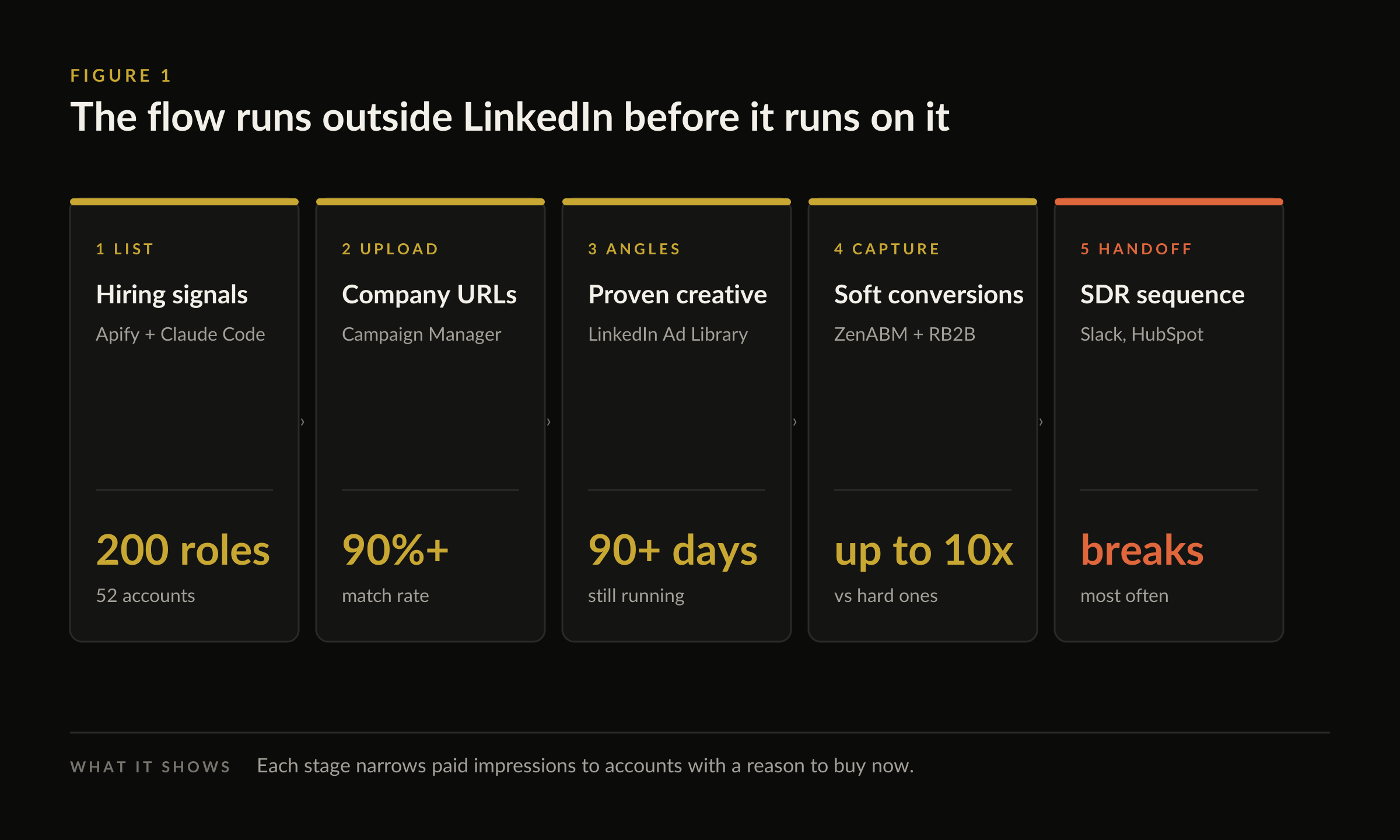
Bogdan runs an Apify career-site scraper with a plain-language brief: find 200 open roles for demand generation, paid social and growth marketing managers, exclude agencies, exclude interns and coordinators. Apify returns the listings from Workable and company careers pages as a CSV. That list is still raw. He drops the CSV into Claude Code with an ICP prompt, and 200 records become 127 companies, then 52. Out went 33 companies selling to consumers, 22 agencies, 7 roles that do not own a budget, and a handful of postings with no live role behind them.
Neither of those filters, B2B versus B2C or whether the hire owns budget, exists inside LinkedIn. That is the point of building the list outside it.
A list built once serves one campaign. CR8 runs it as a weekly n8n loop: every Tuesday the workflow pulls signals from several sources into one database, scores and ranks the accounts, and pushes the hot ones, an open role plus an ICP fit plus an existing relationship, to Telegram. It could as easily be Slack or an SDR's queue. With an MCP connection, Claude Code can build the n8n workflow itself.
The Upload: Match Companies, Then Filter Titles
LinkedIn is the only major ad platform that lets you upload a list of company URLs and target the people inside them. You can upload companies or contacts, and contacts look better on paper.
They do not work in practice. Contacts match on the email a person registered with LinkedIn, and very few people register with their current work email. Tools like Clay try to brute-force it by trying every work and personal address on record, and the match rate stays low. Company lists match on the LinkedIn company URL, which is easy to find, and CR8 sees match rates above 90%.
So CR8 uploads companies and narrows with titles inside Campaign Manager: for a finance product, the CEO, the CFO, the head of finance and the finance manager. Four or five people per account. When both the company and the title fit, the audience is small and hot.
The Floor: Why 300 Accounts Is Not Enough
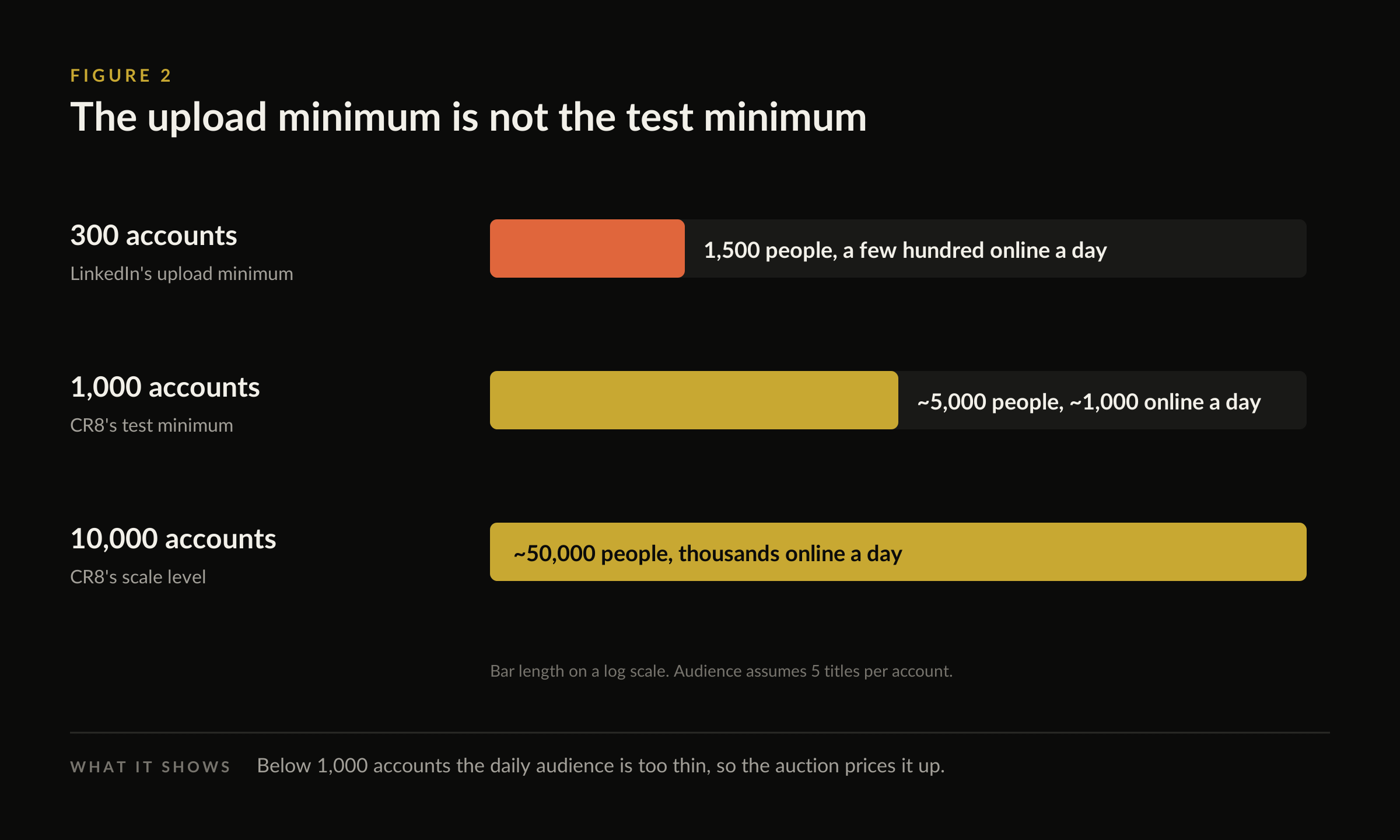
LinkedIn accepts a company list as small as 300 accounts. CR8 will not test below 1,000.
The arithmetic is simple. Three hundred accounts with five titles each is an addressable audience of 1,500 people, and only a few hundred of them are on LinkedIn on any given day. LinkedIn ads are sold by auction, so a tiny daily audience drives the cost per thousand impressions up sharply. A thousand accounts gives roughly 5,000 people and around 1,000 active each day, enough to test. Ten thousand accounts, roughly 50,000 people, is the level CR8 scales at.
The test has one number attached. "I don't care what's your impression about LinkedIn," Bogdan says. The target is a lifetime value to acquisition cost ratio of at least 3 to 1, and at small list sizes the CPM alone can make that impossible.
The Angles: Copy the Ad That Has Run for 90 Days
CR8 does not invent ad angles. "You don't have to be a genius to figure out which angles for ads works," Bogdan says. "You just have to know what your competitors are running long enough."
The LinkedIn Ad Library shows every ad a company has run, filterable by country and date. Search a competitor for the last 30 days, then for the last 90, and compare. An ad still live after 90 days is very likely producing pipeline, because nobody keeps paying LinkedIn rates for an ad that does not. For ads served in European countries, the library also shows impressions and targeting.
Doing this by hand works. CR8 runs it through an Apify ad-library scraper instead, by keyword, region or company, which returns the creative and the copy at scale. The rule is to take the angle that has survived, improve it, and test 10 variations of that angle rather than gambling on a new one.
The Capture: Soft Conversions Outnumber Hard Ones Up to 10x
A senior buyer on a $50,000 to $100,000 contract rarely fills in a form. They see the ad, click through to the site, and leave. Across CR8's clients, these soft conversions run up to 10 times the hard ones. "If you don't catch people who are on your website, who are engaging with your ads... you're losing 90% of the potential lead grab," Bogdan says.
CR8 catches them three ways. LinkedIn shows which companies engaged with each campaign, with impressions, clicks and CTR per account. ZenABM pulls the same LinkedIn engagement data, and because it runs over MCP, Claude Code and n8n can move it into other systems. RB2B de-anonymises website traffic. An account inside the ICP with 20 engagements from its decision-makers goes to an SDR now, rather than waiting for it to convert on its own.
The scoring is where it breaks. A prompt that asks a model whether an account "fits the ICP" drifts. CR8 boiled the judgment down to numbers, and that is what made the scoring hold.
Where This Goes: The Work Ends at Revenue
The biggest failure in this flow is not technical. Across clients, the leads get caught and pushed into Slack and HubSpot, and then nobody reaches out to them. His message to GTM engineers is blunt: "Your work doesn't end when the lead is in, your work ends when the revenue is in."
A soft conversion needs a cold sequence, not a single inbound reply: calls, LinkedIn messages and emails in a defined cadence, owned by the SDR lead. Bogdan prefers Apify plus n8n over Clay for the flexibility, though he uses Clay as well, and his bet is that the agencies that win on LinkedIn will be the ones that own the handoff as tightly as the targeting.
The Pattern
LinkedIn ads are expensive because the audience is valuable. The mistake is paying that price for impressions on accounts that show no sign of buying.
Build the list from signals outside LinkedIn, match companies rather than contacts, copy the angles that have survived 90 days, and treat engagement as a lead.
The rule: target hard enough that every impression lands on an account with a reason to buy now.

Use open roles as the buying signal. A company hiring the person who would buy from you has already approved the budget. Scrape the postings with Apify and filter them to your ICP with Claude Code.
Upload companies, not contacts. Company URLs match above 90%. Contact uploads depend on the email someone registered with LinkedIn, which is rarely their work address.
Test at 1,000 accounts, scale at 10,000. LinkedIn accepts 300, but 1,500 people is too thin a daily audience to price. Below 1,000 accounts the CPM alone can break a 3 to 1 LTV to CAC target.
Copy the ad that has run for 90 days. Compare a competitor's last 30 days against the last 90 in the Ad Library. What survived is working, so improve that angle instead of inventing a new one.
Treat engagement as a lead. Soft conversions run up to 10x the hard ones. Pull account engagement from LinkedIn or ZenABM, de-anonymise visits with RB2B, and route the ICP fits to SDRs.
Score with numbers, not prompts. A model asked whether an account "fits" drifts. Turn the judgment into numeric criteria before you automate it.

(0:00) Trailer and intro
(1:34) The flow: LinkedIn ads for $10K+ ACV and director-level buyers
(4:07) Why LinkedIn filters miss the buyers, and the hiring signal
(6:53) Filtering 200 job posts to 52 companies with Claude Code
(8:39) The weekly n8n signal loop
(9:58) Company list versus contact list uploads
(14:54) Finding proven angles in the LinkedIn Ad Library
(20:37) Soft conversions, ZenABM and RB2B
(24:33) Where it breaks: the SDR handoff
(26:43) Why 1,000 accounts is the minimum
On the record from this episode: Apify, Claude Code, n8n, LinkedIn Ads, RB2B and HubSpot. Each links to the operators who run it on The Stack Index.

Follow Rick on LinkedIn - https://www.linkedin.com/in/rickkoleta/
Follow Bogdan on LinkedIn - https://www.linkedin.com/in/bgdn/
Visit CR8 - https://cr8.eco/
GTM Vault on LinkedIn - https://www.linkedin.com/company/gtmvault

SMYS 10 | The Expensive Campaign Is the One You Never Ran
SMYS 9 | The First Thing a Signal Agent Does Is Throw Signal Away
SMYS 8 | The Browser Is the Interface Everyone Abandoned
If this was useful, hit like and restack.
This newsletter was written and edited by Rick Koleta.
Show Me Your Stack is a GTM Vault series. Each episode features one operator walking through the system behind their outbound, their prioritization, or their pipeline motion. No slides. Just the stack.


