


GTM Vault is a breakdown of how high-growth companies design, test, and scale revenue architecture.
Every vendor in your inbox is selling a signal, and most teams respond by picking the best one and wiring it to a sequence. The data says that is the wrong question. Accounts carrying more than eight signals generate nineteen times the opportunities of accounts carrying one or two, while the best single signal in B2B, champions on the move, tops out at about twelve percent of opportunities on its own. Christian Kletzl built UserGems on that one signal, in a one-week build in a cabin in the Austrian Alps that sold its first contract for $50,000. The co-founder and CEO joins GTM Vault for episode 53 to explain why he has spent the years since moving past it: how stacked signals get scored into one daily ranking, why if-this-then-that routing burns your best contacts, and why he gave up the dashboard to get there.
About UserGems
UserGems tracks when a company's past champions, users and buyers change jobs, then scores that against more than twenty other signal types to rank which accounts and people a revenue team should work on a given day. It was founded by the Austrian twin brothers Christian Kletzl, the CEO, and Stephan Kletzl, the CTO, and runs out of San Francisco, having started as SmartHires, their Y Combinator W15 company. Its customers are mid-market and enterprise B2B revenue teams, including Procore, Medallia, UserTesting and Sisense. UserGems has raised $22.4M, including a $20M Series A led by Craft Ventures with Battery Ventures, Tiger Global and Uncork Capital.
Watch or listen now across YouTube, Apple Podcasts, and Spotify
Episode highlights
(0:00) Cold Open: Eight Signals, Nineteen Times the Opportunities
(4:01) A Cabin in the Austrian Alps and a One-Week Build
(5:38) Why Champions on the Move Tops Out at Twelve Percent
(10:53) The If-This-Then-That Mistake and What It Costs You
(13:25) Stacking Signals Into One Daily Ranking of Fifteen
(16:34) Twenty Million Accounts, Six Hundred Attributes, One ICP Score
(21:52) Where Gem-E Stops and the Rep Starts
(26:34) Going Headless Over MCP and Who Owns the Outcome
(34:41) Data Accuracy and the Ten Percent Trust Line
(37:14) Publishing Pricing and the Case for Self-Selecting Out
What you’ll learn:
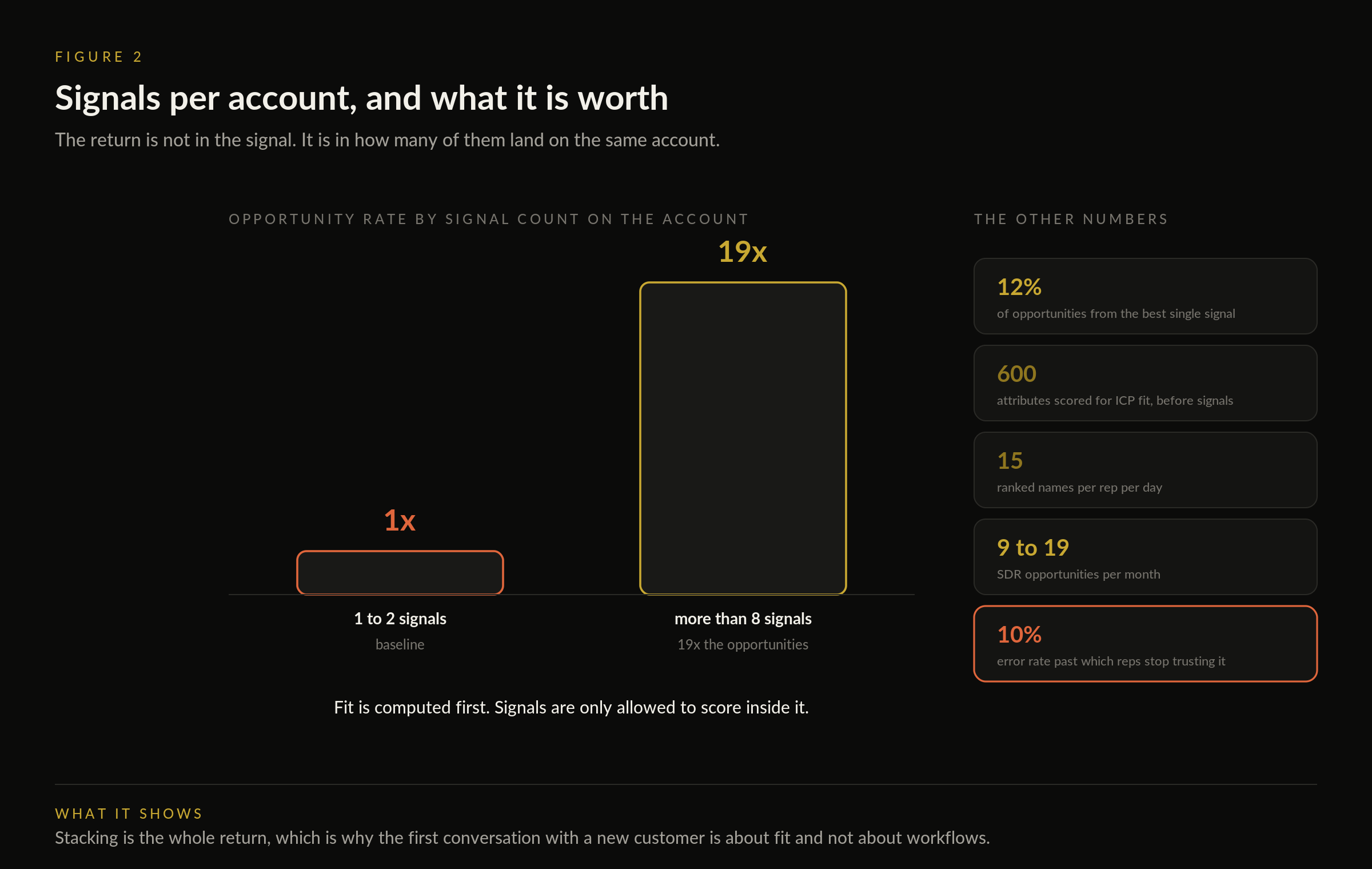
The finding that accounts carrying more than eight signals produce nineteen times the opportunities of accounts carrying one or two
Why champions on the move generates about twelve percent of opportunities, why that share holds across organizations, and why it compounds on its own
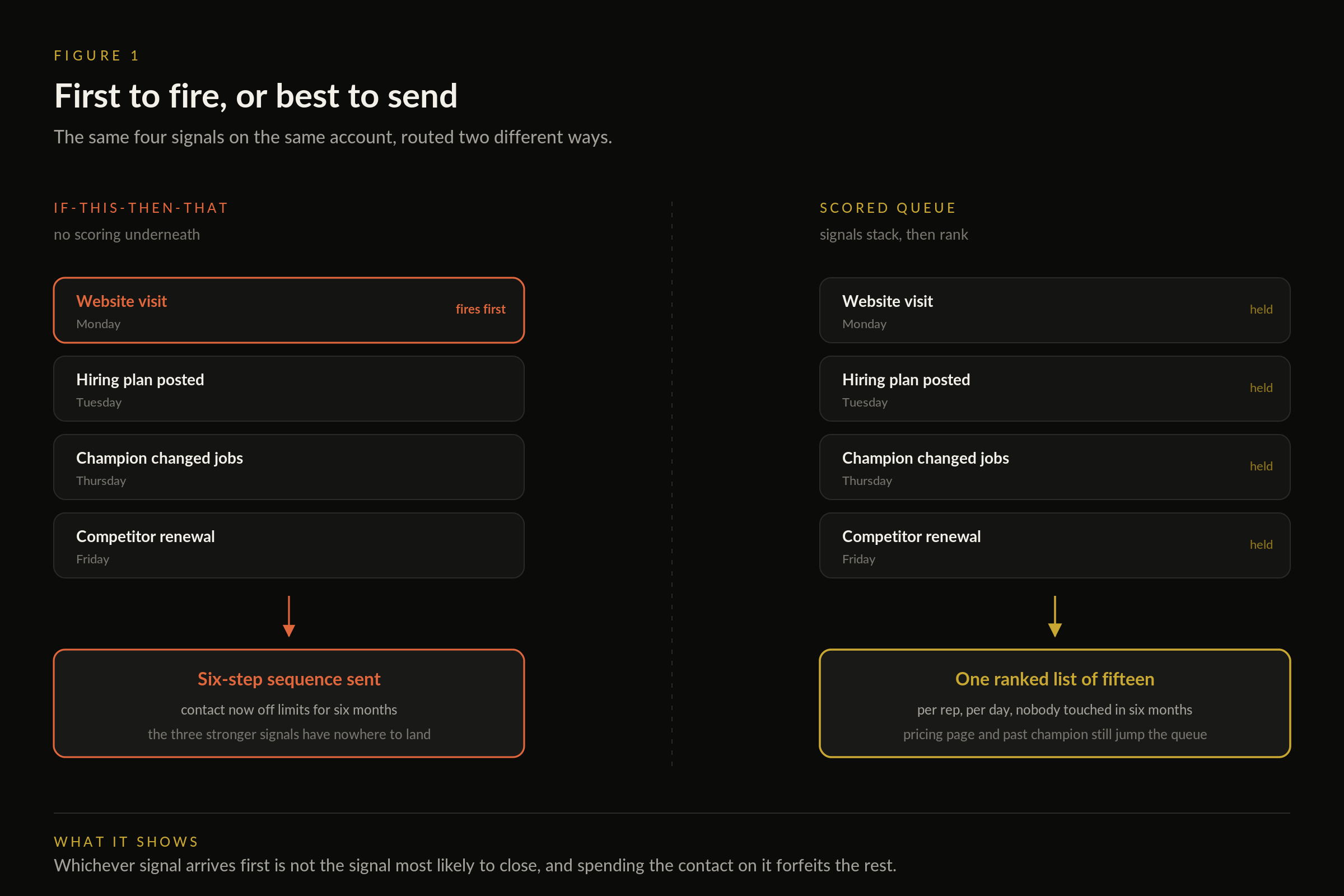
Why if-this-then-that routing spends your best information on whichever signal fires first, and burns the account for six months doing it
How twenty million accounts and six hundred attributes become one ICP ranking, built by comparing your customers against everyone who never bought
The two exceptions that should still fire instantly, and why everything else belongs in a daily ranked list of fifteen
Why a ten percent error rate is where reps stop trusting a signal motion whatever its coverage, and the case against waterfall enrichment
How UserGems doubled SDR-generated opportunities from nine to nineteen a month, hired more SDRs on the back of it, and kept calls human
Which signals a competitor can buy, which ones only you can create, and why that line decides durability
What changed in AI-written outbound around September 2025, and how the customer complaints flipped
Why publishing a $40K entry price is a qualification mechanism rather than a pricing decision, and the math Kletzl expects a buyer to run
Key takeaways
1. The best signal in B2B has a ceiling, and the ceiling is the whole argument.
Champions on the move generates about twelve percent of opportunities, and Kletzl says that share holds across organizations. It compounds on its own, because a larger customer base produces more job changes. The mechanism underneath is durable: roughly eighty percent of people stay in the same industry and eighty percent stay at the same company size, so a champion carries the same problems into the next role. But twelve percent is not what a CMO wakes up thinking about, which left UserGems valuable and peripheral at once. Every product decision since has been an attempt to reach fifty.
2. If-this-then-that routing spends your best information on your first signal.
Kletzl names this as the most common mistake he sees, and says the easier the tooling makes it, the more it happens. A signal fires, a sequence launches, and that person is now off limits for six months. Better information arriving next week has nowhere to go. Two exceptions still fire instantly, a past champion and a pricing or comparison page visit. Everything else waits for the ranking.
3. Stacking signals beats picking signals, by a factor of nineteen.
Accounts carrying more than eight individual signals generate nineteen times the opportunities of accounts carrying one or two. That reframes the question most teams bring him. They want to know which signals to switch on, when the compounding sits in how many land on the same account and how they are scored together. It is also why he refuses to start a new customer on workflows, and starts on ICP definition instead. Kletzl will not name the signals behind his best customers’ motions, because at the top end it is no longer about any individual one.
4. Data accuracy is the foundation, and the tolerance is ten percent.
Above a ten percent error rate, Kletzl says people stop trusting the motion, and no amount of coverage recovers it. That applies to every signal and not just job changes, because a website visitor with a stale title is a dead signal the same way a nine-month-old job change is. It is also his case against waterfall enrichment, which buys quantity at the cost of knowing whether any of it is right. UserGems would rather return nothing than return something wrong.
5. Going headless gives up the interface and keeps the outcome.
UserGems exposed the whole platform over MCP, including campaign setup, audience building, list uploads and persona creation, not just data export. Kletzl puts that in the middle of three phases: humans clicking through a browser, then humans directing AI, then AI tuning campaigns against its own results. He is comfortable losing the dashboard because the end user was never in it. The buyer was always buying opportunities generated, and ownership of the outcome does not move when ownership of the interface does.
Christian Kletzl
LinkedIn: https://www.linkedin.com/in/christiankletzl/
UserGems: https://www.usergems.com/
Rick Koleta (Host)
LinkedIn: https://www.linkedin.com/in/rickkoleta/
Newsletter: https://gtmvault.co/
GTM Vault
LinkedIn: https://www.linkedin.com/company/gtmvault
YouTube: https://www.youtube.com/@gtmvault?sub_confirmation=1
Website: https://gtmvault.co/
The GTM Vault Podcast - subscribe on your platform of choice
Subscribing on YouTube, Apple, or Spotify is what tells each platform to put the next episode in front of more operators, which is how the show keeps booking the guests worth an hour of your week.
Previous episodes include


See all previous episodes here: https://www.gtmvault.co/podcast
The GTM Vault Podcast is a breakdown of how high-growth companies design, test, and scale revenue architecture. Visit gtmvault.co for more episodes, the GTM Vault newsletter, Show Me Your Stack, and Coffee Walk, the on-location founder series that opens with Barbaros Ozbugutu in Istanbul.


