


GTM Vault is a breakdown of how high-growth companies design, test, and scale revenue architecture.
A conference booth costs $90K to $100K and returns a badge-scan list nobody wants to work. A $500 Amazon voucher buys a 30-minute demo from a buyer who cannot name the company 2 weeks later. Sachin Gupta built HackerEarth, then started Breakout in 2024 with $3.25M against competitors that raised many multiples of that. He joins GTM Vault for episode 55 to explain why his team buried cold outbound in a hearse at Inbound for under $6K, how each stunt is measured before it runs, and why an inbound agent company spends its brand budget on things software cannot do.
About Breakout
Breakout builds an AI inbound SDR that engages website visitors in real time, answers product questions, qualifies intent and books meetings, so mid-market B2B companies convert more of the traffic they already have. It was founded in 2024 in San Francisco by Sachin Gupta, previously founder and CEO of the technical hiring platform HackerEarth, and Hitesh Aggarwal, who spent more than a decade building AI products at Google and Citi. In October 2025 it launched Blocks, which turns static website elements into personalized, AI-driven interfaces, with CaptivateIQ, Barti and HackerEarth among its named customers. Breakout raised a $3.25M seed round led by Village Global, with Recall Capital and Z21 Ventures participating.
Watch or listen now across YouTube, Apple Podcasts, and Spotify
Episode highlights
(0:00) Attention Is the Scarcest Commodity
(2:40) What HackerEarth Taught Him About Focus
(3:40) Building Into a Loud AI SDR Market
(6:14) Why Breakout Killed the Complex Demo
(7:48) A Funeral for Cold Email at Inbound
(12:26) The Lego Stunt and the Attention Problem
(15:39) Brand Activation, Not a Pipeline Target
(18:51) How to Put ROI on a Stunt
(34:33) Outbound at Scale vs the Inbound Shortlist
(46:46) The Website Becomes the Closer
What you’ll learn:
Why a $500 Amazon voucher for a demo buys a meeting and none of the attention, and what Breakout sends instead
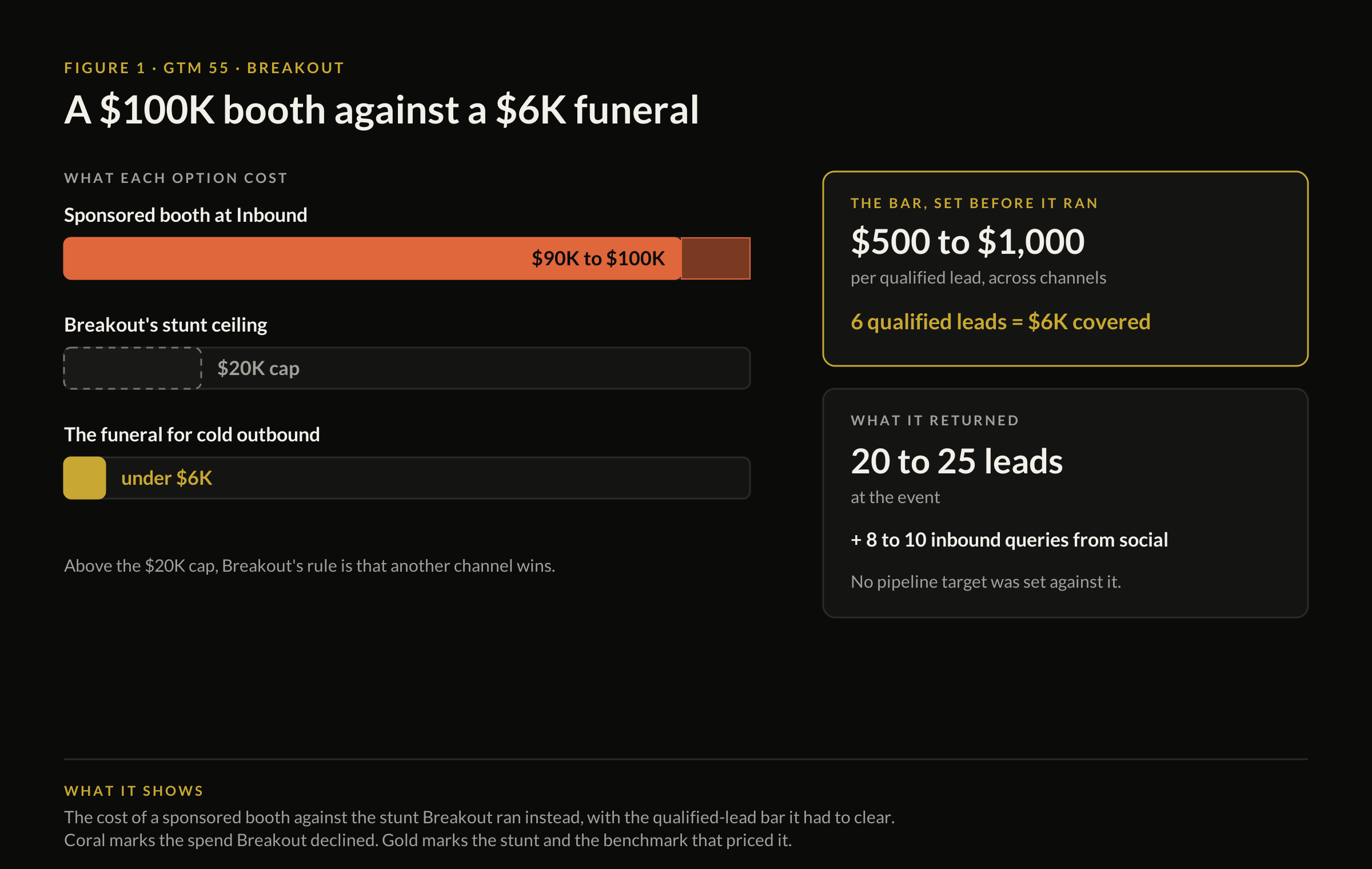
How a staged funeral for cold outbound went from idea to team commitment in 3 hours and cost under $6K, against a $90K to $100K booth
The pre-launch math: a $500 to $1,000 cost per qualified lead means 6 qualified leads covers a $6K stunt
How $5 to $10 coffee vouchers turned a fuzzy brand stunt into a countable metric, people posting on the day
Why the funeral produced 20 to 25 leads at the event and another 8 to 10 inbound queries from social, with no pipeline target set
Why limited-edition Lego plus a LinkedIn and email follow-up hit a 30% activation rate where generic gift cards burn budget
The cardboard-sign stunt that flopped in San Francisco, and why shared office towers killed the foot traffic it needed
Why Breakout would cut paid ads before it cut stunts, and the one condition under which it would not
How 60% of Breakout’s closed-won comes from inbound, and why its own site has no form, only the agent
Why a 5-year-old press release on a customer’s site can lose a buyer at peak intent, and what onboarding now excludes
Key takeaways
1. Attention is the constraint, and a gift that is one of many buys none of it.
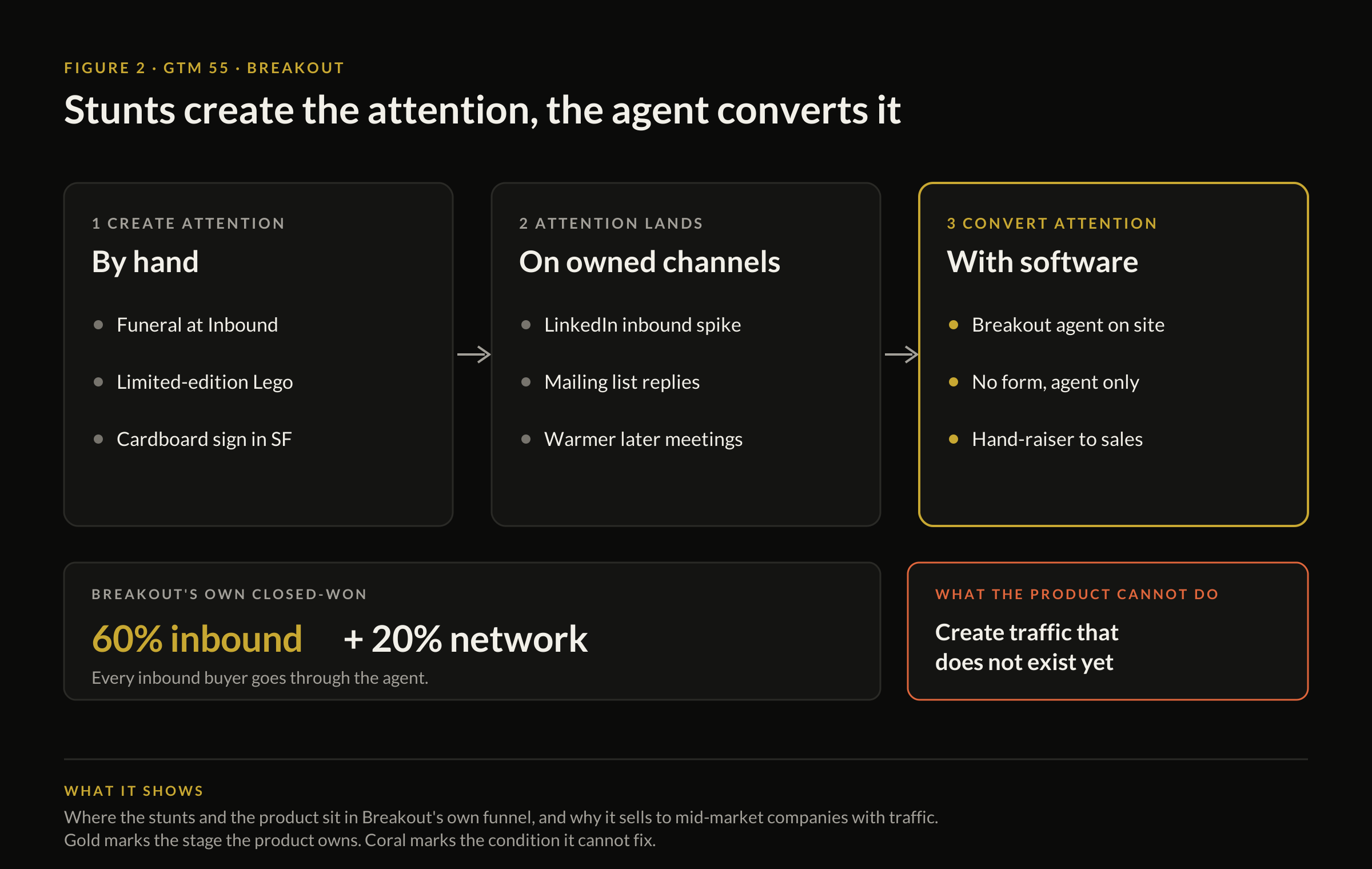
Gupta calls attention the scarcest commodity in B2B, and the voucher story is his proof: $500 for a 30-minute demo, and 2 weeks later the buyer could not name the company. Breakout sent limited-edition Lego to target accounts instead, picked because Lego fans are passionate rather than because everyone likes it. The gift was paired with a LinkedIn and email follow-up asking whether it arrived, and 30% of recipients replied positively.
2. A stunt is measurable when the input and the output are set before it runs.
Breakout caps any stunt at $20K, above which another channel wins. The funeral, a hired hearse and a eulogy for cold outbound at Inbound, cost under $6K against a $90K to $100K booth. With a qualified lead costing $500 to $1,000 across channels, 6 qualified leads met the benchmark. Coffee vouchers of $5 to $10 for anyone who posted on the day made the result countable, and it returned 20 to 25 leads plus 8 to 10 inbound queries.
3. Brand activations carry no pipeline target, by design.
Gupta separates the decision to run a stunt from its direct pipeline contribution, and plans none against it. The targets are social: impressions, reach and activation, because stunts feed LinkedIn, the mailing list and later sales conversations. He needs a stunt to be a smashing success about 20% of the time to earn the money back. The cardboard-sign stunt, which drew an 80 to 90% open rate on its Polaroid follow-ups and no conversions, sits inside that tolerance.
4. Creating attention and converting it are different businesses.
Rick named the tension: Breakout sells software that automates the buyer’s first conversation while winning with things software cannot do. Gupta’s answer is that Breakout does not create attention, it converts it. 60% of its closed-won comes from inbound and another 20% from network, and every one of those buyers goes through the agent, because the site has no form. That is also why Breakout sells to mid-market companies with traffic, and not to early-stage companies without it.
5. At peak intent, the cost of a wrong answer is the pipeline itself.
Outbound agents can get 5 emails wrong out of thousands and lose little, because those recipients were never going to convert. An inbound agent talks to a buyer who already has intent. Breakout learned this when large customers pointed the agent at thousands of pages, including a 5-year-old acquisition announcement for a product since shut down. Onboarding now starts with curating what the agent reads, and everything stale stays out.
Sachin Gupta
LinkedIn: https://www.linkedin.com/in/sachingupta006/
Breakout: https://www.getbreakout.ai/
Rick Koleta (Host)
LinkedIn: https://www.linkedin.com/in/rickkoleta/
Instagram: https://www.instagram.com/rickkoleta
GTM Vault
LinkedIn: https://www.linkedin.com/company/gtmvault
YouTube: https://www.youtube.com/@gtmvault
Website: https://gtmvault.co/
The GTM Vault Podcast - subscribe on your platform of choice
Subscribing on YouTube, Apple, or Spotify is what tells each platform to put the next episode in front of more operators, which is how the show keeps booking the guests worth an hour of your week.
Previous episodes include


See all previous episodes here
Sachin’s stack is on the record. See yours against it: 7 taps at pro.gtmvault.co/survey, and the State of the GTM Stack 2027 report ships in March, free.
The GTM Vault Podcast is a breakdown of how high-growth companies design, test, and scale revenue architecture. Visit gtmvault.co for more episodes, the GTM Vault newsletter, and Show Me Your Stack.


