


The Short Version
The GTM Vault MCP is live, and every GTM Vault subscriber can add it to Claude with one URL. Claude can then run the eight-layer revenue system audit on your company and build your stack from The Stack Index, and Pro members can also search every podcast and Show Me Your Stack episode to the timestamp from inside Claude. Every answer names the operator who ran the thing, the episode where they said it, and a link to check it. It is read-only, it stores nothing you ask, and it is free for every subscriber, with Pro unlocking all of it. Thirty-four playbooks ship with it at launch, from the audit to a tool comparison to a forecast reset.
One click opens Claude with the MCP ready to add. Sign in with the email you subscribe with. The full setup guide covers adding it by hand and Claude Code.
The audit, the operator lookups and the full Build Your Stack output are free with a subscription. Pro, $99 a month or $999 a year, adds Library search inside Claude, every playbook, and a live office hours session with me on the first Wednesday of every month.

Open the Library · Browse The Stack Index · Add the GTM Vault MCP
Advice With No Operator Behind It
Ask Claude which enrichment tool to run and it gives you a category. Four vendor names, a sentence about your needs and budget, a suggestion to run a trial. Every name is plausible. None of it has been run by anyone you can check.
This is not a model problem. It is a sourcing problem. A model answers from the average of what has been written about a tool, and most of what is written about GTM tools is written by the people selling them. The operator who ran a tool for a year, hit its ceiling and replaced it said so once, in a conversation. That conversation is not in the average.
GTM Vault is where those conversations are. More than twenty operators have put their stacks on the record across the podcast and Show Me Your Stack, and every tool they named sits in The Stack Index on the layer it serves: more than 100 tools, about two thirds of them verified by an operator who ran them in a working system. The evidence was never the gap. The gap was that the evidence lived on a website, and the decisions get made in a chat window.

Reasoning in Claude, Evidence From the Vault
The MCP draws one line and keeps everything on the correct side of it. Claude does what it is good at: reading your situation, holding your context, reasoning across it and writing the answer. GTM Vault does the one thing Claude cannot do on its own, which is supply evidence with a name, an episode code and a link attached.
Three sources sit behind the MCP. The Library holds every podcast and Show Me Your Stack episode as a write-up and a transcript, searchable to the moment a phrase was said, and it is free to read on the web with no sign-in. The Stack Index holds every tool operators named, placed on the eight layers of revenue architecture, with the operator evidence behind each placement. The revenue system audit holds the eight questions, one per layer, in build order.
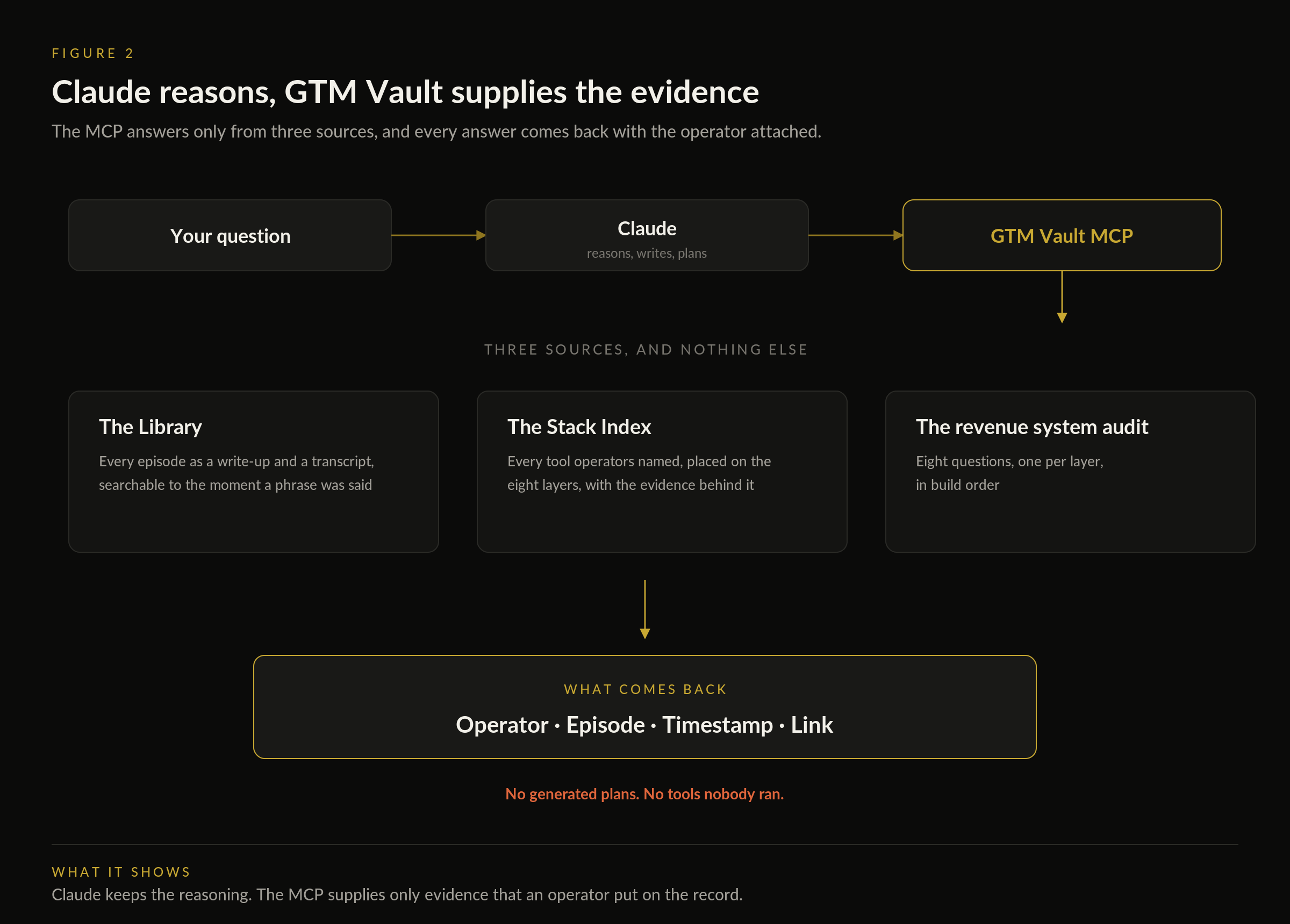
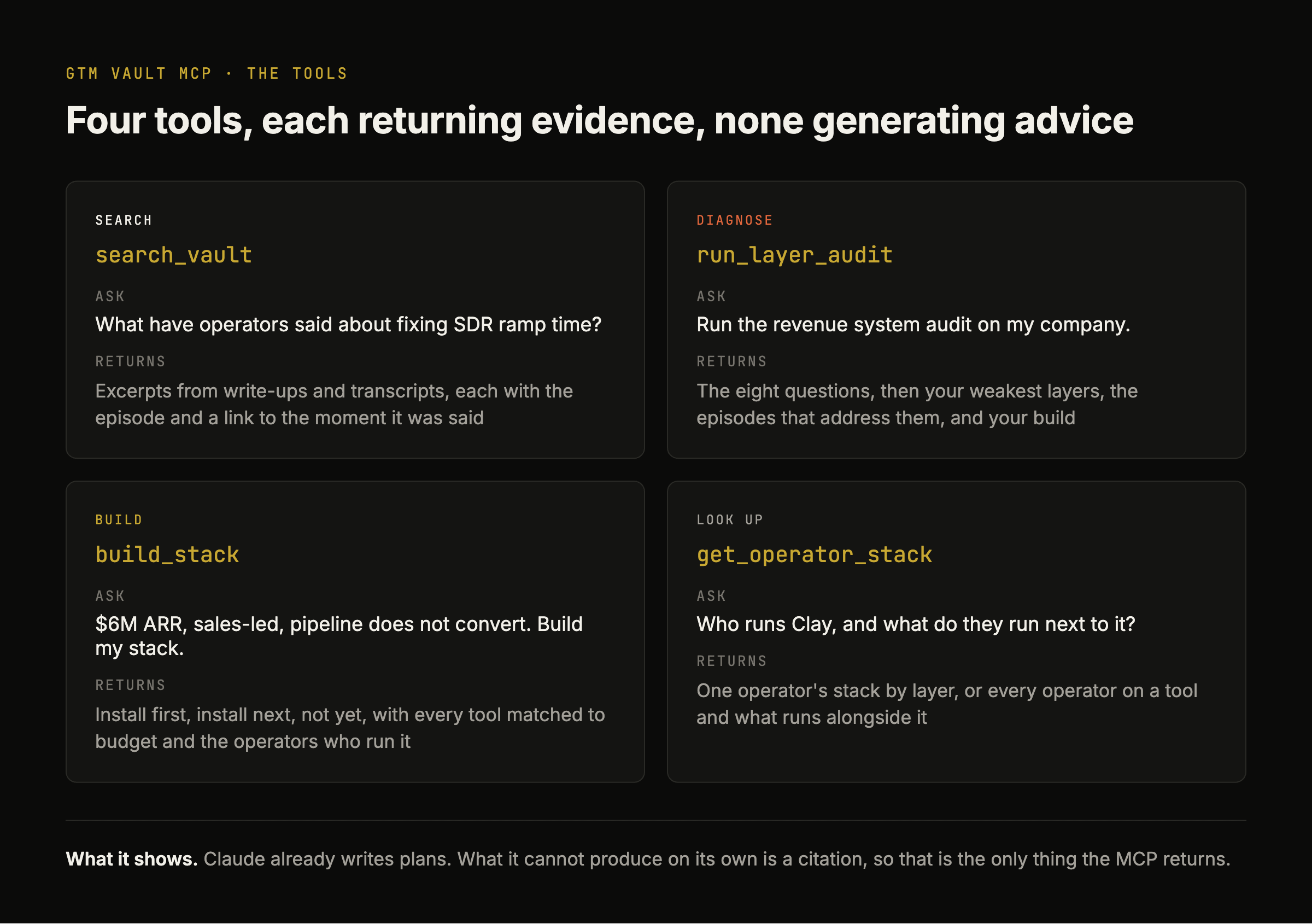
Claude reaches those sources through four tools. Each one returns evidence. None of them generates advice.
Three Sessions, Start to Finish
The Audit
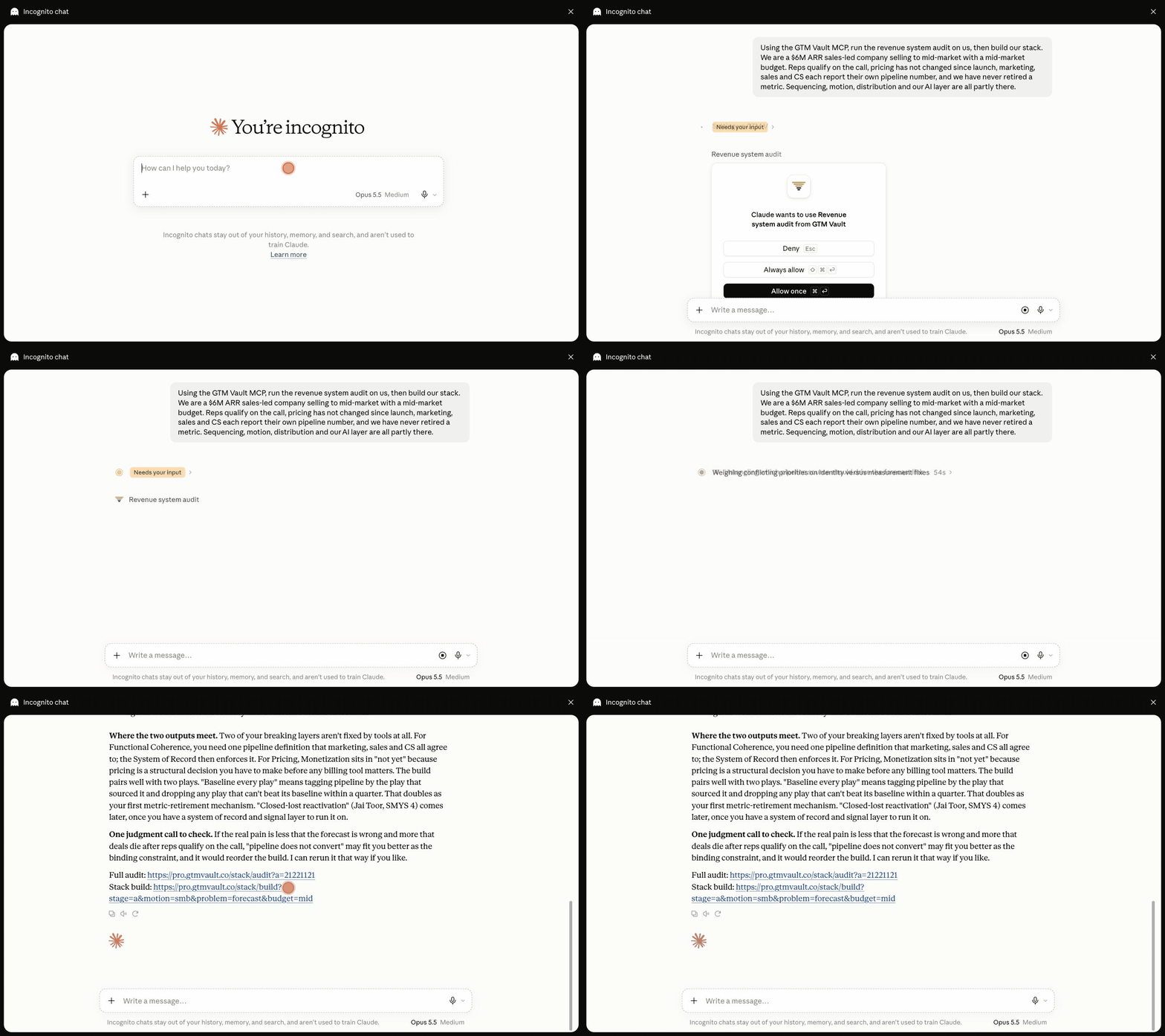
The audit is where most sessions should start, because it answers the question every stack decision depends on: which layer is breaking first. You describe your company in plain language. Claude answers the eight questions from what you told it, asks you for anything it cannot infer, and runs the scoring The Stack Index uses on the site.
The output is a layer, not a tool. When four layers are breaking, the lowest one goes first, because every layer reads everything beneath it. A pipeline number rebuilt on a loose ICP inherits the looseness. Fixing Functional Coherence before Identity produces a reconciled dashboard of the wrong accounts.

In Claude, the answer arrives with the operators who have rebuilt that layer on the record, and the build order for your company already filled in.
The Build
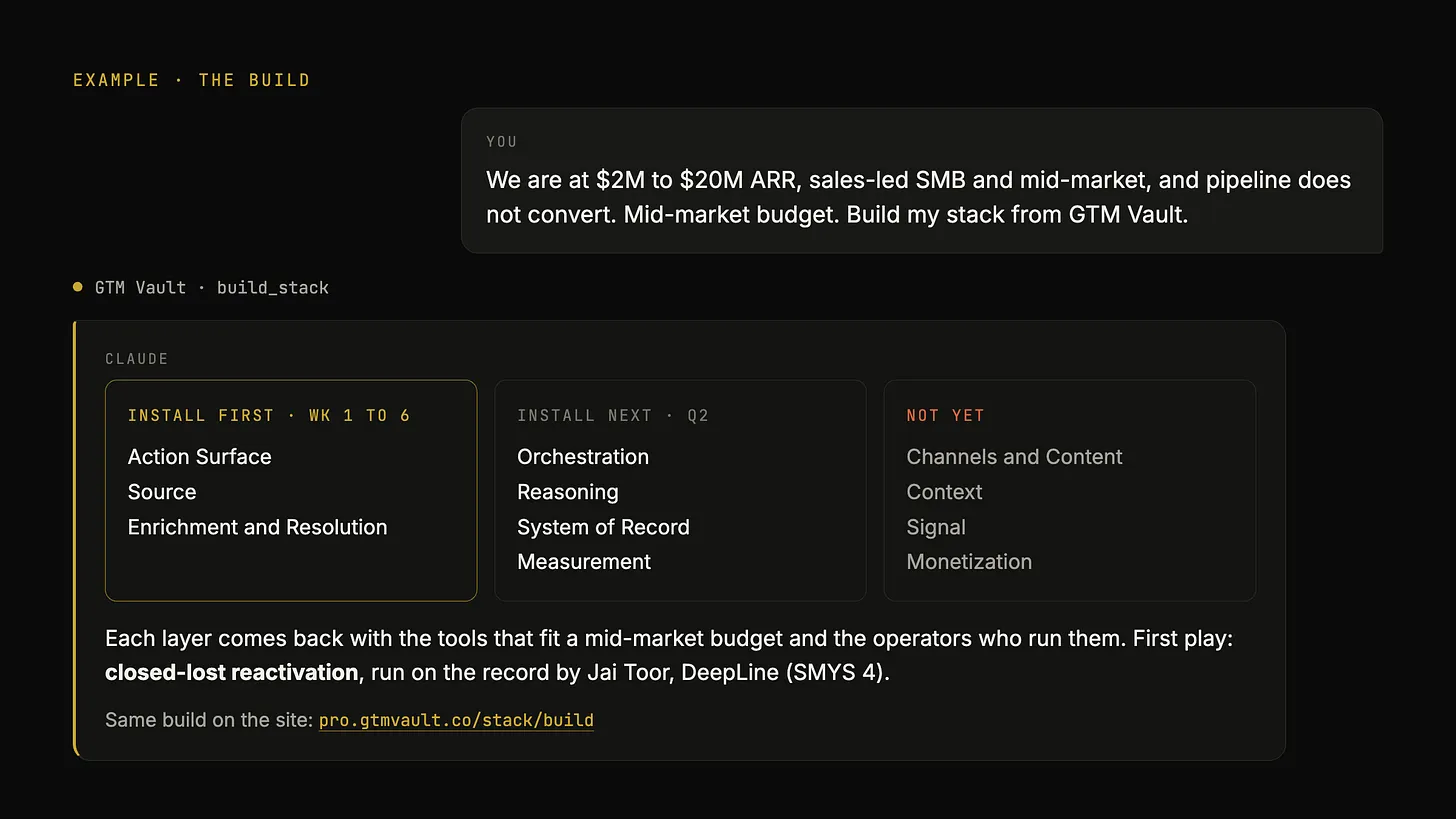
Build Your Stack takes four answers: revenue band, motion, binding constraint and budget posture. Revenue band and motion set the base order, the constraint reorders it, and budget decides which tools are admissible inside each layer. The output is a sequence: what to install in the first six weeks, what waits for the second quarter, and what to deliberately not buy yet.
The "not yet" column is the most valuable part of the answer and the part generic advice never gives. Buying signal data, context layers and content channels before the source, enrichment and action surface hold is the most common way a stack stops compounding. Claude returns the same build the site does, down to the link, because both run the same engine. If the two ever disagreed, one of them would be wrong.
The Operator Lookup
The lookup answers the question buyers ask each other in private: who else runs this, and what do they run next to it. Ask about a tool and Claude returns every operator on the record who named it, what it did in their system, the tools that show up in the same stacks, and any displacement an operator stated.
Clay is the clearest example. Seven operators run it. Elliot O'Connor moved enrichment to it at Frontier and displaced ZoomInfo. Tim Scheuer ran his campaign build on it at Oxygen and later replaced it with CLI orchestration. Both facts are on the record, both come back in the answer, and neither is a vendor claim.

The Playbooks
The three sessions above are the four tools used one at a time. Playbooks chain them. Each one is a sequence of calls to the evidence tools for a job you already have, and every step either retrieves operator evidence or reasons over what came back. Thirty-four ship today, in six groups:
Diagnose. The revenue system audit, the fix-first layer, why pipeline stalled, whether your motion still fits your stage, whether your lower layers can carry AI agents, whether you are ready for signal data, a forecast reset, and the gap between the accounts you win and the ones you lose.
Build. Your stack, what not to buy yet, the same stack at another budget, the stack for your next revenue band, the first play to run, your enrichment waterfall, your CRM choice, every play on the record your build can run, whether to move a workflow from Clay into Claude Code, and the context layer your team and agents read from.
Distribute. How to get cited by AI answer engines, which channel your stage can carry, and the outbound sending stack operators run at your stage and budget.
Before you buy. Due diligence on one tool, two tools head to head, whether anyone has replaced a tool, a shortlist for one layer, a vendor claim checked against the record, and a teardown of the stack you pay for now.
Research. One operator's stack, two operators compared, the exact moment something was said, and a cited brief on any topic.
Decide. Whether to fill a GTM role with an agent, a person or both, a one-page decision memo with every claim cited, and whether your system is ready for its first GTM or RevOps hire.
Ask for one by name, for example Using the GTM Vault MCP, run the compare-tools playbook on Clay and Apollo, or type / in Claude Code. The gtm-audit, build-my-stack and tool-check playbooks are free; every playbook comes with Pro, including new ones as they ship. The full list with descriptions is on the MCP page.
Why I Did Not Build a GTM Plan Generator
The obvious version of this product exposes tools called build_icp, create_90_day_plan and generate_playbook. I scoped that version and threw it out. Claude already writes ICPs and ninety-day plans. Wrapping that capability in a GTM Vault label adds a server call and nothing a founder could not get for free. An MCP that generates GTM plans is a prompt with a logo.
What Claude cannot produce is a citation. So the MCP returns evidence and nothing else, and three decisions follow from that. It is read-only: Claude can look things up in GTM Vault and cannot change anything. It runs the same code as the site: the audit, the build and the operator pages compute one answer, so Claude and pro.gtmvault.co can never disagree. And it stores nothing you ask: what you tell Claude about your company is used to answer the request and discarded. The only thing logged is which tool ran and when, to enforce the daily limit, 50 requests on the free tier and 300 on Pro.
The same rule governs the playbooks that ship with it. A playbook such as tool-check or decision-memo is a sequence of calls to the evidence tools, not a template Claude fills in. Every step either retrieves evidence or reasons over what came back, and when nothing is on the record it says so. The full list is on the GTM Vault MCP page.
Setting It Up
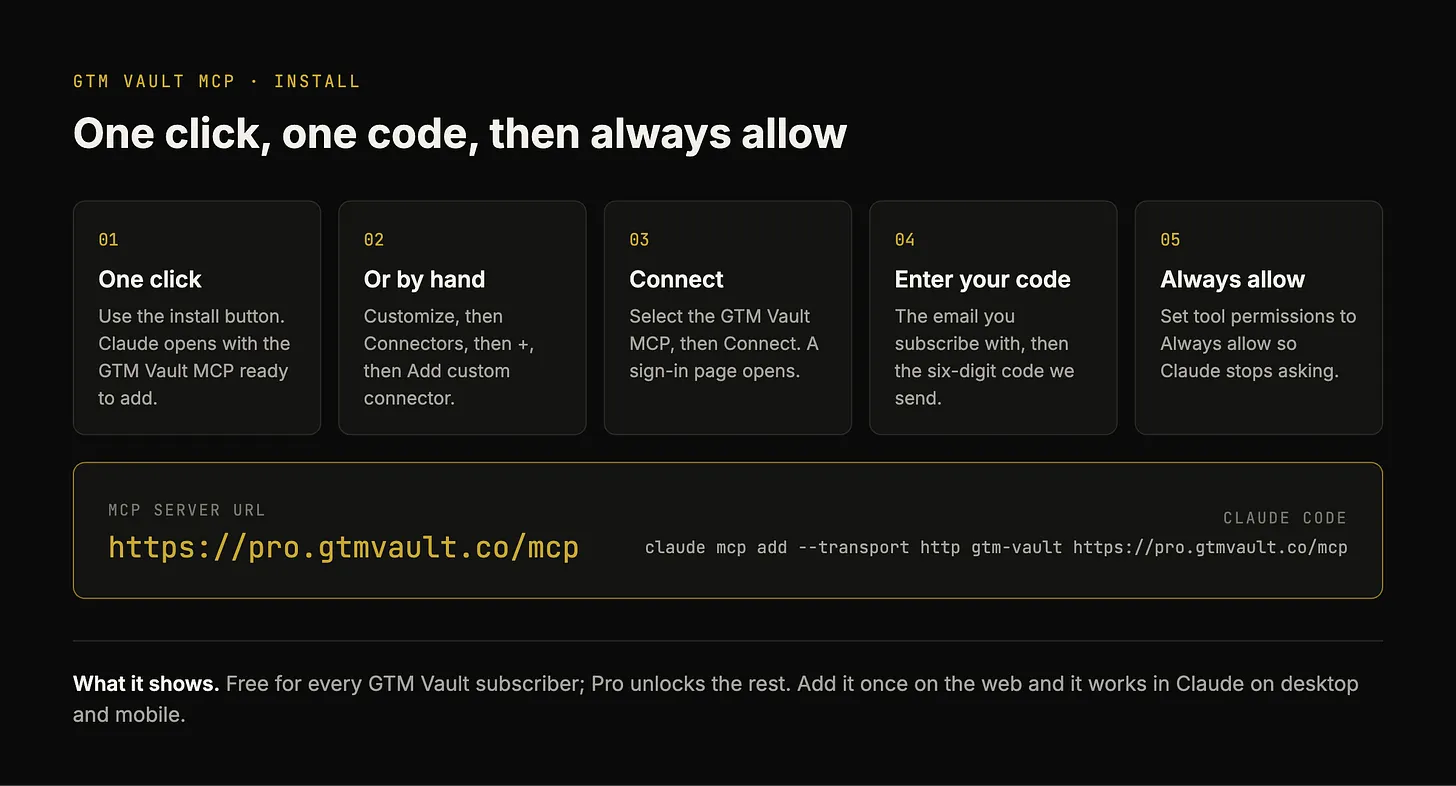
Setup takes one click. The button below opens Claude with the GTM Vault MCP ready to add. Select Connect, enter the email you subscribe with and the six-digit code I send, and the tools and playbooks appear in Claude.
To add it by hand, open Claude and go to Customize, then Connectors. Select +, then Add custom connector, name it GTM Vault MCP and paste https://pro.gtmvault.co/mcp. That address is for Claude, not a web page, so paste it rather than opening it. Once connected, set the tool permissions to Always allow so Claude uses the tools without asking each time. Add it once on the web and it works in Claude on desktop and mobile. In Claude Code, run claude mcp add --transport http gtm-vault https://pro.gtmvault.co/mcp.
The full guide, with prompts to start from, is at gtmvault.co/p/mcp.
Free, With Pro for the Rest
Every GTM Vault subscriber can add the MCP for free: the revenue system audit, operator and tool lookups, the full Build Your Stack output with every tool matched to budget, and three playbooks. GTM Vault Pro, $99 a month or $999 a year, adds Library search from inside Claude across every episode, every playbook including new ones as they ship, the Doctrine, the GTM Strategy Course, and a 30-minute live office hours session with me on the first Wednesday of every month. Annual members also get a 45-minute Blueprint Session with me that starts from their sequence.
If you subscribe to GTM Vault, add it to Claude today and start with one prompt: "Using the GTM Vault MCP, run the revenue system audit on my company."
One more thing. The Library is now free for everyone: every podcast, Show Me Your Stack and Coffee Walk episode as a searchable playbook, with the stack and the full transcript, and no sign-in. Open the Library.
Common Questions
What is the GTM Vault MCP?
It is an MCP server that gives Claude read access to GTM Vault's operator evidence: the Library of podcast and Show Me Your Stack episodes, The Stack Index of tools placed on the eight layers of revenue architecture, and the revenue system audit. Claude reasons about your company and uses the MCP to cite named operators, episodes and timestamps. It is free for every subscriber, and Pro unlocks all of it.
Is the GTM Vault MCP free?
Yes, for every GTM Vault subscriber: the revenue system audit, operator and tool lookups, the full Build Your Stack output, and three playbooks, up to 50 requests a day. GTM Vault Pro, $99 a month or $999 a year, adds Library search from inside Claude across every episode and transcript, every playbook, monthly office hours and 300 requests a day.
What are GTM Vault playbooks?
Playbooks are multi-step workflows over the GTM Vault MCP's evidence tools, such as gtm-audit, compare-tools, agent-readiness and decision-memo. Ask Claude to run one by name, or type / in Claude Code. Every step retrieves operator evidence or reasons over it, so every answer stays cited, and when nothing is on the record the playbook says so.
How do I add the GTM Vault MCP to Claude?
Use the one-click install, or in Claude go to Customize, then Connectors, select +, then Add custom connector, and paste https://pro.gtmvault.co/mcp. Sign in with the email you subscribe with and the six-digit code sent to it. In Claude Code, run claude mcp add --transport http gtm-vault https://pro.gtmvault.co/mcp. The step-by-step guide is at gtmvault.co/p/mcp.
Does GTM Vault see or store my company's data?
No. What you tell Claude about your company is sent to the MCP only to answer the request, and it is not stored. GTM Vault logs which tool ran and when, to enforce the daily limit: 50 requests on the free tier and 300 on Pro. The MCP is read-only and cannot change anything in GTM Vault or in your accounts.
Will Claude recommend tools that no operator has run?
Through the MCP, no. Claude is instructed to recommend only tools The Stack Index returns, each with the operators who run it and the episode where they said so. If you ask about a tool no operator has named on GTM Vault, the MCP finds no operator on the record for it, and that absence is part of the answer: nobody on the record has run it in a working system.
What is a GTM MCP?
An MCP (Model Context Protocol) server connects an AI assistant like Claude to outside tools, data or expertise. A GTM MCP connects Claude to go-to-market systems or knowledge. Most GTM MCPs connect a single tool, such as a CRM or an enrichment platform. The GTM Vault MCP connects Claude to operator evidence: which tools operators run on each layer of revenue architecture, what those tools did in their systems, and the episodes where they said it.
How is the GTM Vault MCP different from the Clay MCP or the Salesforce MCP?
Tool MCPs like the Clay MCP and the Salesforce MCP let Claude read and act on your data inside one product. The GTM Vault MCP tells Claude which tools to run, in what order, and what happened when operators ran them. The two work together: tool MCPs for your data, the GTM Vault MCP to decide what to build and why. Both the Clay MCP and the Salesforce MCP are on the record in The Stack Index, named by operators who run them.
Does the GTM Vault MCP work with ChatGPT or other AI assistants?
Not today. MCP is an open standard, but this version signs in Claude clients only: claude.ai on the web, the desktop and mobile apps, and Claude Code.
Related Reading
A Tool List Cannot Tell You What to Build First: the launch of The Stack Index, the evidence base the MCP reads from, and why sequence comes before tools.
The 8 Layers of a Modern Revenue System: the architecture the audit scores and the build orders against.
GTM 50 | The Next Buyer of Your Data Is Not a Person: why evidence now has to be readable by agents, not only by people.
GTM 48 | The Transcript Is the Commodity, the Context Is the Asset: why transcripts searchable to the timestamp are worth more than the episodes they came from.