


GTM Vault is a revenue architecture publication for founders and senior revenue leaders at B2B and AI companies. It covers how GTM works inside real companies: tooling decisions, system design, execution trade-offs, organizational leverage. This page is for the two ways to work with it directly.
Two Ways To Work With GTM Vault
Sponsorship. Reach the audience. Three quarterly partner packages across the newsletter, Show Me Your Stack and the podcast, plus two premium placements, with capped inventory. Request the media pack for packages, pricing, and current availability.
Revenue Architecture Advisory. Install the system the publication writes about. Structural diagnosis and installation for teams whose revenue has stopped compounding predictably. The intake form is the front door.
Who Reads GTM Vault
This is a decision-making audience, not an awareness audience. 75% of subscribers sign up with a work email, 20,716 of 27,542 as of 31 October 2026. That is 11,497 companies, and 2,223 of them have 3 or more people on the list. Most subscribers are running GTM systems inside their companies rather than reading for education.
27,000+ subscribers and 47,450 followers. 1M+ views across GTM Vault properties over the last 12 months. 6,901 readers, roughly 25% of the list, open at least half of every send.

55% of the audience is in the United States, across all 50 states. California leads at 19%, Texas at 8.4%, New York at 8.2%. The rest spans India, the UK, Canada, Australia, and 150+ countries in total. That distribution aligns with where B2B SaaS, AI, and venture-backed teams are headquartered.
The core segments: founders and CEOs at Seed through Series C+ B2B and AI companies, CROs and VPs of Sales and RevOps leaders, senior operators responsible for tooling and systems and execution, and the buyers and internal champions evaluating GTM, data, and infrastructure tools.
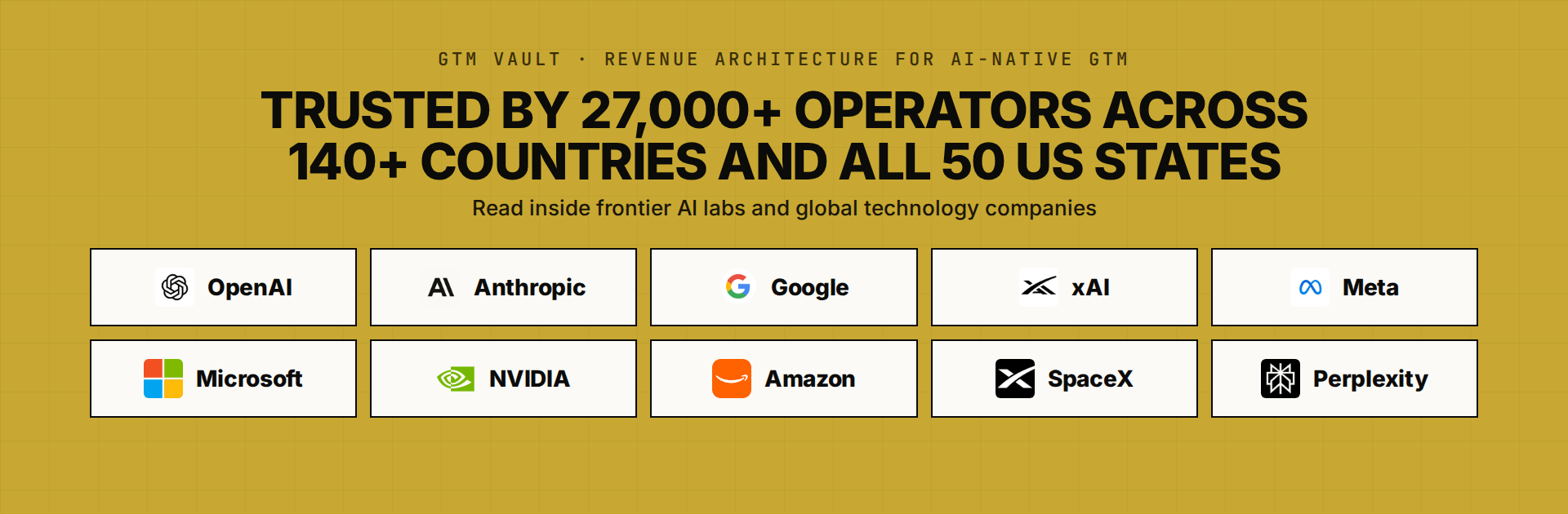
Companies with the most subscribers by work email include Deel, Deloitte, Insight Partners, Gusto, Gong, Airbnb, Benchling, Vidyard, Front, Anthropic, Clari, Gartner, Perplexity, Apollo, Clay, Databricks, Microsoft, SpaceX, Salesforce, ZoomInfo, McKinsey, Bain and Coinbase. GTM Vault is read inside OpenAI, Anthropic, Meta and Google. Employees subscribe as individuals; none of these companies endorses GTM Vault.
Ranked #35 on Substack Rising for Business, Substack’s leaderboard of its fastest-growing paid publications in the category.

GTM Vault readers also read the publications below. A decision-making audience, not a general startup media audience.

Sponsorship
I sell quarterly partnerships, not single ads. A fixed number of placements, reporting on every send, and I write every newsletter placement myself, in my voice, so it reads like the rest of the issue. Every video placement runs the same way: your logo on screen for the full episode, a presented-by banner at the top and end of the episode newsletter, and a credit with link in the YouTube description. No scripted ad breaks.

Partner. 3 Sponsored Newsletter placements across the quarter, 1 per month, at the top of the send. Or 1 placement plus 1 Sponsored Show Me Your Stack episode, if your buyer is the operator building the stack.
Stack Partner. Everything in Partner, plus 2 Sponsored Show Me Your Stack episodes with your logo on screen throughout, plus 1 paid boost of the episode post to your target accounts on LinkedIn.
Presenting Partner. Everything in Stack Partner, plus presenting credit on 2 GTM Vault Podcast episodes across YouTube, Spotify and Apple, category exclusivity for the quarter, first right of renewal, and first right on the presenting tier of the annual State of the GTM Stack report.
Every Show Me Your Stack guest names the tools they run, and every tool lands in The Stack Index at pro.gtmvault.co/stack with the operator who named it. If your tool is on the record, the sponsored write-up carries the line "named by N operators on Show Me Your Stack." Placement in the index is not for sale and no sponsorship moves a tool into a layer or up a list. That is what makes the line worth having.
Two premium placements book separately, on top of a package or alone.
Sponsored Coffee Walk. Founder interview filmed on location in Istanbul, with your credit carried across the write-up, the trailer and every clip. Books furthest ahead. One a month.
Presented Episode. Your executive is the guest for a full 60-minute episode, presented by your company on every surface. I set the questions and the episode is labeled sponsored throughout. Category exclusivity for that episode. One a month.
Quarterly inventory. Two Partner packages, one Stack Partner, and one Presenting Partner. One Presented Episode and one Coffee Walk a month. One partner per category per quarter at the Presenting level. No programmatic placements.
Fit categories. GTM software, sales and revenue operations tooling, developer and AI infrastructure, data platforms, and B2B services selling into revenue teams. If you are unsure whether you fit, send a note and you will get an honest answer rather than a stretched one.
Where partners start. Most start at Stack Partner. It reaches both halves of the audience in one buy: the newsletter reaches revenue leaders, Show Me Your Stack reaches the operators building the stack, and the LinkedIn boost reaches the accounts you name. Partner is the right first quarter when you want to test one door before committing to both. Presenting Partner is for a category that wants to own the quarter. Dates lock once you pick a package. Single placements are available by inquiry.
Disclosure. Every sponsored send carries a Brought to you by placement and sponsorship labeling, and sponsored posts are labeled at the top of the article and inside the newsletter. Content is reviewed with the partner before publishing. Editorial substance is never altered by sponsors. Every package reports at 48 hours and 2 weeks after each send or episode, with views, opens and clicks on your link.
The media pack covers every package, current pricing, and what is still open on the calendar.
Revenue Architecture Advisory
Revenue is not proof of a revenue system. Many companies reach product-market fit and assume scale will follow. Early traction creates confidence. Confidence creates expansion. Expansion happens before the underlying go-to-market architecture is engineered.
The result is not immediate collapse. It is gradual structural strain. Acquisition costs rise without a clear cause. Win rates soften. Messaging fragments across teams. Marketing optimizes channels. Sales pushes harder. Product ships features. Customer success fights churn. The organization works harder to produce the same output.
Tactical optimization cannot repair sequencing violations. Structural problems require structural intervention.
This Is For Teams That
You have product-market fit but revenue does not compound predictably. There is friction between marketing, sales, product, and customer success that no hire or campaign has resolved. CAC is rising. Win rates are softening. Headcount is scaling faster than system coherence. Your product works. Your pipeline does not. The constraint is structural.
What Gets Installed
Revenue architecture installation is one coherent system across marketing, sales, product, and customer success, engineered in sequence. That includes structural revenue diagnosis, ICP and narrative re-architecture, motion sequencing across product-led, inbound-led, outbound-led, partner-led, and community-led growth, a 90-day execution architecture, a revenue operating cadence across teams, and AI-native GTM workflow systems.

Engagement Model
Installed inside venture-backed and growth-stage teams including YC and SoftBank-backed companies across B2B and AI.
Revenue Architecture Audit, $4,999. Two sessions, a 90-minute diagnostic and a 60-minute readout, and a written layer audit across the eight layers: the breaking layer named, the install order, and what a quarter would build. Includes Annual Pro for the year. The full $4,999 credits against the first advisory month if the engagement starts within 60 days of the readout. 2 a month, by intake form.
1-to-1 Revenue Architecture Advisory, from $10,000 a month. Bespoke engagement where I install the revenue architecture directly: a weekly working session with async review between, scoped per engagement and typically a three-month minimum. Opens by intake form or a direct conversation.

Selected Installations
Series A vertical SaaS. Constraint: rising CAC and narrative inconsistency across channels. Structural change: re-sequenced motion and clarified ICP. 60-day shift: reduced acquisition volatility and improved win rate predictability.
Post Series B B2B platform. Constraint: expansion leaking across segments. Structural change: installed segmented motion and cadence alignment. 60-day shift: increased expansion revenue concentration and reduced churn pressure.
Early growth AI SaaS. Constraint: strong demand but low close rates. Structural change: re-engineered positioning and sales sequencing. 60-day shift: improved pipeline conversion and shortened sales cycle.
Which One You Need
If you sell to revenue teams and want the audience, that is sponsorship. Request the media pack and say what you are launching, and you will get a recommendation for the package that fits.
If your own revenue system is the constraint, that is advisory. The intake form is the front door. The Revenue Architecture Audit is the diagnosis: 2 sessions, a written layer audit, and the full $4,999 credited against advisory if we go on. The 1-to-1 Revenue Architecture Advisory is where I install the system directly, from $10,000 a month.
GTM Vault is where the research lives: the applied knowledge base, operator interviews, and structural frameworks that define modern revenue architecture. Advisory is where that architecture gets installed inside your business, under real constraints, with real accountability.
Last updated: 31 October 2026. Audience data reflects Substack and YouTube analytics.