

Eight Foundational Laws. More than a dozen architecture breakdowns. All the structural theory behind why GTM systems break and how to rebuild them.
This series shows the build.
Show Me Your Stack is the teardown. One operator per episode, sharing their screen. No theory. No frameworks deck. The actual stack, in production.
Every episode follows the same structure
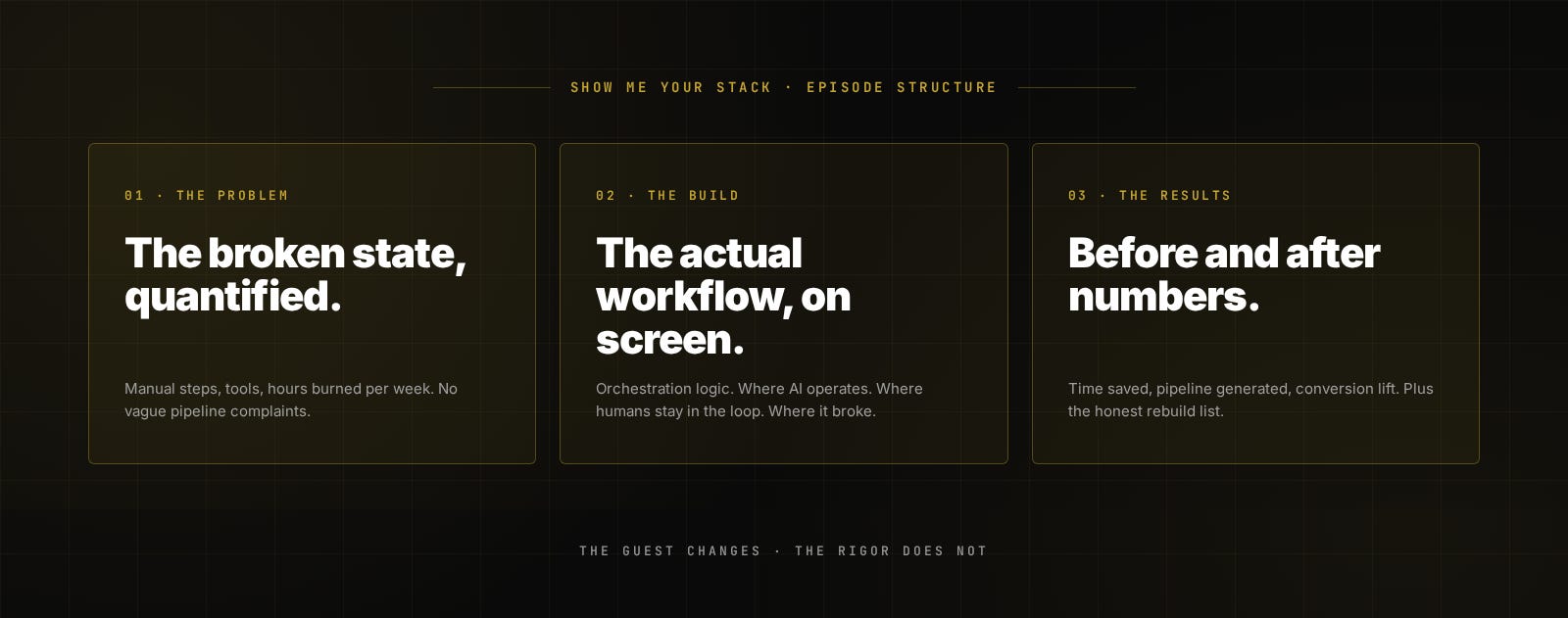
The problem. Not “we needed more pipeline.” The broken state quantified: manual steps, tools, hours burned per week on a process that should take minutes.
The build. Orchestration logic. Where AI operates. Where humans stay in the loop. Where it broke during the build, because it always breaks somewhere.
The results. Time saved, conversion lift, pipeline generated, cost reduced. Plus the honest version, not the case study version: what they would rebuild differently knowing what they know now.
The tools you will see on screen
The stack changes with the guest: Claude Code, Clay, Apollo, Salesforce, n8n and more. Every tool named on the show goes into The Stack Index, placed on the layer of revenue architecture it serves, with the operator who runs it.
The Foundational Laws describe the architecture. This series shows what it looks like when someone actually builds against it.
Where every team actually is
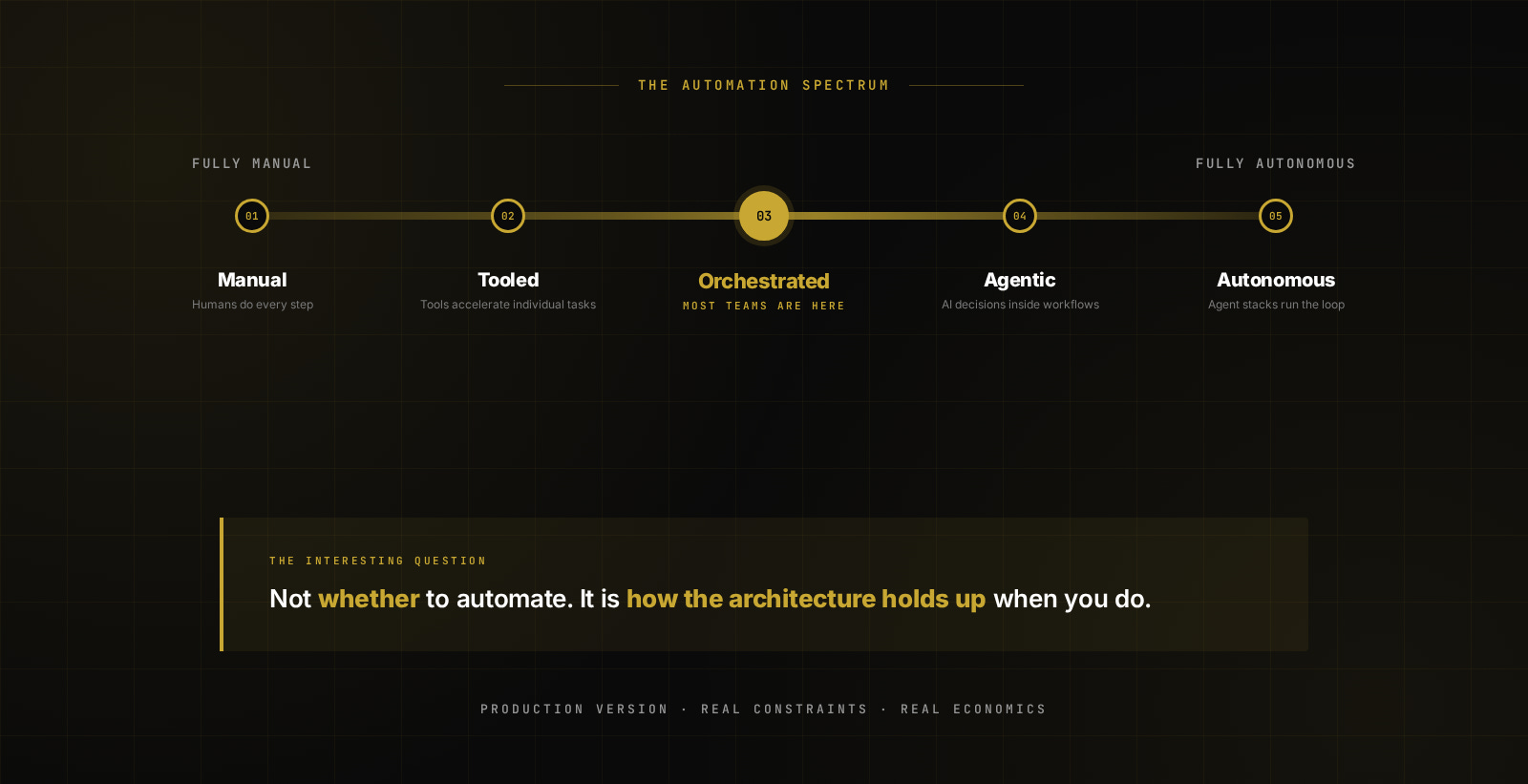
Every GTM team is somewhere on the spectrum between fully manual execution and autonomous agents. Most are in the middle, running orchestrated workflows that partially automate what used to take a team of SDRs or ops people a full week. The interesting question is not whether to automate. It is how the architecture holds up when you do.
That is what this series gets into. Not the pitch deck version of AI in GTM. The production version. Real constraints. Real failure modes. Real economics.
How it works
Video episodes go live on YouTube, free. The written breakdown of each build, mapped back to the Revenue Architecture layers and Foundational Laws it touches, publishes here. Pro members also get every episode in the Pro Library as a written playbook with the full transcript. Same structure every time. The guest changes. The rigor does not.
Every episode
SMYS 9 | The First Thing a Signal Agent Does Is Throw Signal Away Michael Bartimer of Clarify runs a website visitor agent that removes employees, competitors and customers before it classifies anyone.
SMYS 8 | The Browser Is the Interface Everyone Abandoned Elliot O'Connor of Frontier puts Clay and Salesforce one click from the rep, inside the browser.
SMYS 7 | Your Reps Should Never Meet Your Agents Angelo Quiambao of Intellistack hides seven layers of agents behind one checkbox the rep clicks.
SMYS 6 | From Five Hours in Clay to Forty Minutes in a Terminal Tim Scheuer of Oxygen runs outbound by prompting Claude Code instead of building tables.
SMYS 5 | From Account List to Monitoring Universe Umar Farooq Adam of Hitachi Vantara finds the right 300 accounts a month in a TAM of 150,000.
SMYS 4 | From Win List to Win-Loss Gap Jai Toor of DeepLine runs signal work on the win-loss gap: a month and $2,000 down to 30 minutes and $10.
SMYS 3 | From Clay Tables to Intent HQ Garrett Wolfe builds a Claude Code action layer on top of the CRM, from the operator behind $15M in pipeline at Unify.
SMYS 2 | MCPs vs APIs in a Production Enrichment Pipeline Alexander Shartsis on Skyp's twelve MCPs in Claude Code, and why production drops to direct APIs.
SMYS 1 | Review Intelligence as a GTM Signal Layer Vinayak Mishra of Slang AI pulls buying signals from restaurant reviews with a five-tool pipeline.
Browse all Show Me Your Stack episodes → View all episodes
Subscribe and every new episode lands in your inbox.
Run a production stack worth a teardown? → Come on the show
Want to reach GTM engineers? → Sponsor an episode