


Hi. I am Rick Koleta. Welcome to GTM Vault - a breakdown of how high-growth companies design, test, and scale revenue architecture. Join 27,000+ operators building GTM systems that compound.
“A must-read for anyone driving growth, this newsletter offers sharp insights on GTM strategy, covering inbound/outbound tactics, ideal customer profiles, and key growth metrics.”
— Sean Ellis, Founder of GrowthHackers
GTM Vault is read inside OpenAI, Anthropic, Meta, and Google by 27,000+ founders and revenue leaders across 140+ countries.
What is revenue architecture? Revenue architecture is the structural design of a company’s revenue system: how positioning, pricing, motion design, RevOps, and AI-native workflows fit together, and in what order they get built. It is not a tool choice and not a growth tactic. The core claim is that revenue problems at working companies are usually structural, not effort problems: when the product works and the pipeline does not, the constraint is the architecture, not the activity. Revenue architecture treats sequencing as the first decision, because the same tools installed in the wrong order produce fragmentation instead of compounding.
What is GTM engineering? GTM engineering is the practice of building go-to-market as a system instead of a headcount plan: workflows, data pipelines, enrichment layers, and AI agents that execute the motion, designed and maintained the way software is. A GTM engineer replaces repetitive execution with orchestrated systems and spends their judgment on what the system should do, not on doing it manually. The discipline emerged when AI collapsed the cost of execution and moved the constraint to design: the scarce skill is no longer doing the work, it is architecting the system that does.
GTM Vault is a structural breakdown of how revenue architecture works, why it breaks, and how to rebuild it. Eight Foundational Laws. Dozens of architecture posts. A podcast. A video series showing production GTM stacks on screen. A full GTM strategy course.
There is a lot of material. This page tells you where to start.
The Stack Index
Every GTM tool operators named on GTM Vault, 102 of them across 25 operators, placed on the layer of revenue architecture it serves. Every operator has a page showing their full stack. Not sure which layer is yours? The audit asks eight questions, one per layer, and names the layer where your revenue system is breaking. Then Build Your Stack returns the order to install the layers in for your revenue band, motion, binding constraint and budget.
Open The Stack Index · Every operator’s stack
The GTM Vault MCP

If you work in Claude, bring GTM Vault with you. The GTM Vault MCP lets Claude search every episode to the timestamp, run the revenue system audit on your company, and build your stack from The Stack Index, with the operator and the episode behind every answer. Free for every subscriber. Pro adds search of every episode and the full Build Your Stack.
What the MCP does and how to install it
If Your GTM System Is Broken and You Do Not Know Why
Start with the Foundational Laws. These are the structural rules that govern how go-to-market systems compound or collapse. They are written in sequence, each one building on the previous.
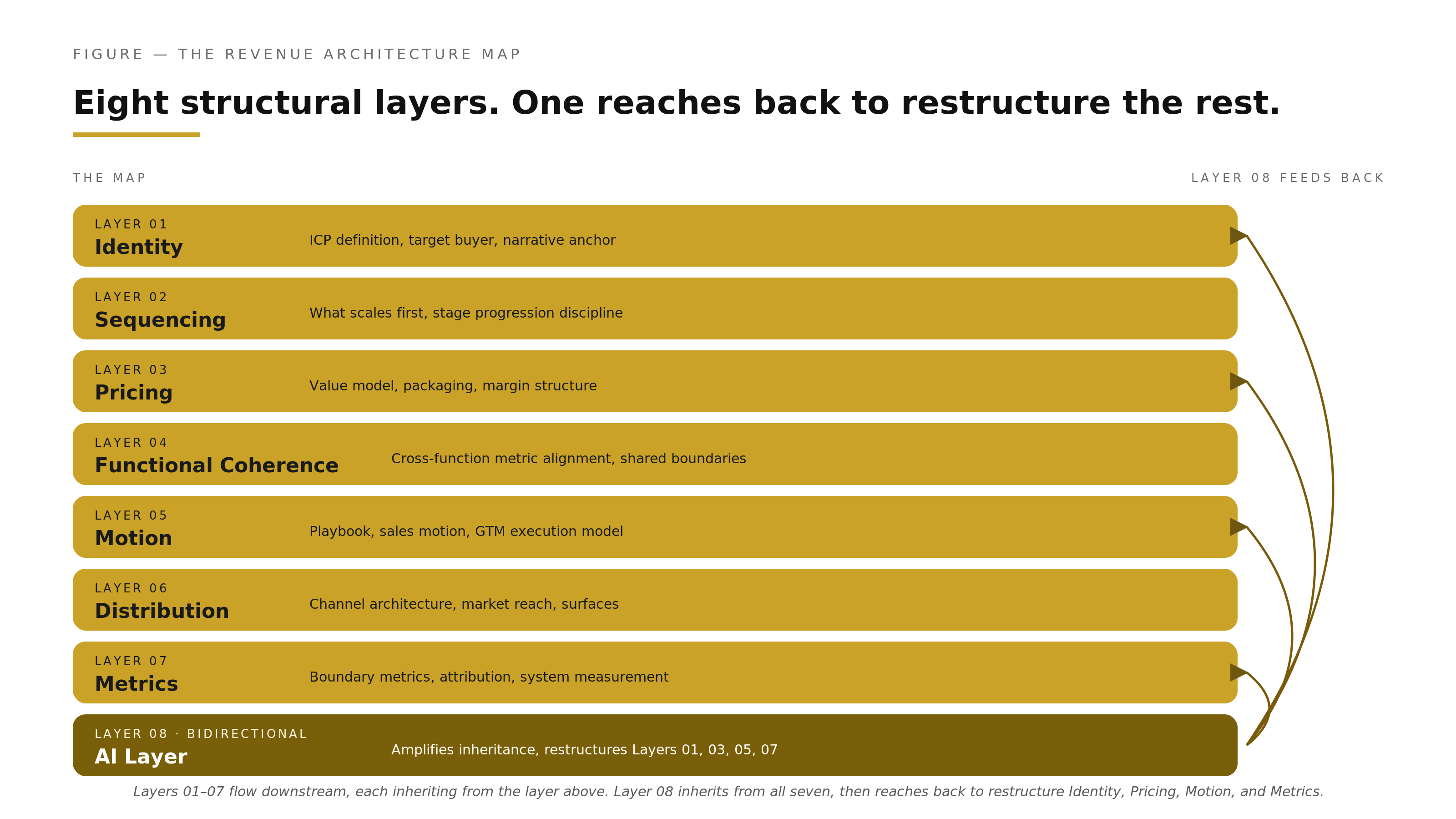
The Revenue Architecture Map. Read this first. It defines the eight structural layers that determine whether GTM compounds or collapses. Every other piece of content on this publication references these layers.
If You Are Building or Rebuilding GTM Infrastructure
Start with the Architecture section. These posts go deep on specific structural problems: org design, pricing, tool spend, information architecture, agentic systems.
The New GTM Org. Why five people and an agent stack now outperform fifteen-person teams.
The AI-Native Revenue Engine. Why information architecture, not execution speed, defines modern GTM.
GTM Tool Spend by Growth Stage. Why premature tooling turns leverage into coordination cost.
The Org Chart Is Dead. How AI-native execution is replacing roles, teams, and handoffs.
Agentic GTM Requires Systems, Not Smarter Agents. Why AI-first go-to-market only works when context, orchestration, and execution are designed together.
These can be read in any order. Each one is a standalone architecture breakdown of a specific GTM subsystem.
If You Want to See What Production GTM Looks Like
Start with Show Me Your Stack. This is a video series, every two weeks, where one GTM engineer per episode walks through their workflows on screen. No theory. No slides. The stack in production.
GTM Engineer Series: Show Me Your Stack. The series announcement. Read this for the format and what to expect.
Review Intelligence as a GTM Signal Layer (paid). Episode 1. Vinayak Mishra builds a five-tool pipeline (Clay, Serper, Apify, n8n, Claude) to extract buying signals from restaurant reviews for Slang AI. The written breakdown maps the build to the Revenue Architecture layers.
Video episodes go live on YouTube. Written architectural breakdowns publish here for paid subscribers.
If You Want the Full System in One Place
Start with the GTM Strategy Course: Build a Modern Revenue Engine. A ten-chapter course that walks through the complete GTM system from ICP definition through execution architecture. This is the most structured path through the material.
If You Want Thought Leadership on GTM Architecture
Start with the GTM Vault Podcast. Long-form episodes on pricing, metrics, agentic marketing, revenue activation, and the structural shifts rewriting how GTM operates. Episodes are standalone. Start with whatever title matches the problem you are working on.
If You Want Applied Frameworks
Start with the Applied Architecture section. These are specific, implementable frameworks built on the structural theory from the Laws and Architecture sections.
The Three Stages of AI-Native GTM. The gap between generating subject lines and running pipeline on autopilot is not a better model. It is three distinct architectural stages.
The 90-Day GTM Blueprint. Stop diagnosing symptoms, install revenue architecture.
The New B2B GTM Playbook. How modern revenue teams design demand, read intent, and move beyond funnels.
You Scaled Before You Knew Where You Win. Why most B2B GTM systems break after Series A.
The Reading Order That Covers Everything
For readers who want the complete path:
The Foundational Laws, starting with The Revenue Architecture Map (the structural foundation and theory)
The GTM Strategy Course (the system)
The Architecture section (deep dives on subsystems)
Applied Architecture (frameworks you can implement)
Show Me Your Stack (watch real operators build against the architecture)
The Podcast (ongoing thought leadership)
You do not need to read everything. Start with the section that matches the problem in front of you. The architecture will connect the rest.
What Paid Subscribers Get
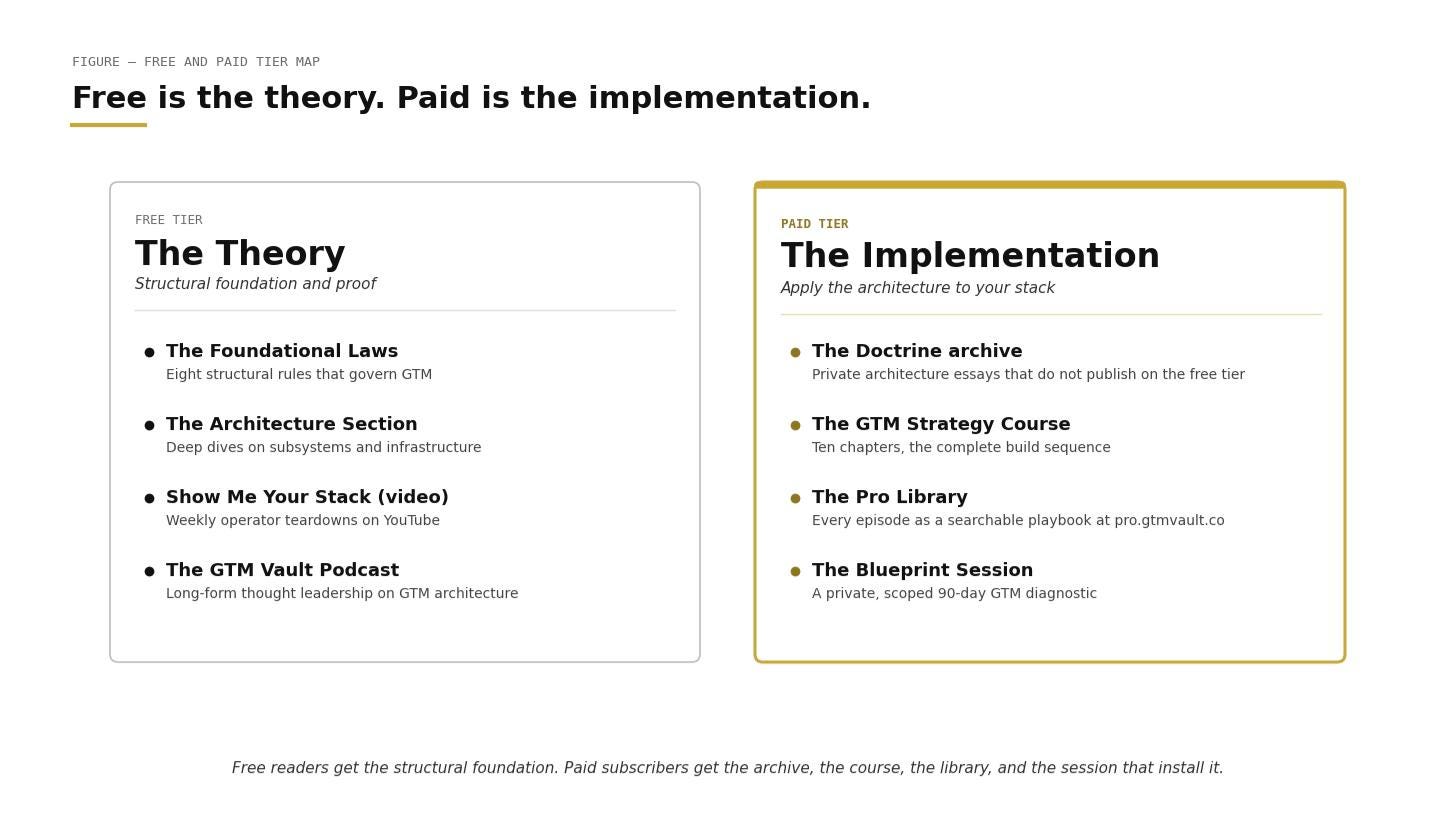
Free posts cover the Foundational Laws, the Architecture section, Show Me Your Stack video episodes on YouTube, and the GTM Vault Podcast. That is the structural theory.
Paid subscribers get the implementation layer: written architectural breakdowns for every Show Me Your Stack episode mapping each build back to the Revenue Architecture, the full Applied Architecture library, the GTM Strategy Course, and access to the private revenue architecture content that does not publish on the free tier. Paid subscribers also get the GTM Vault Pro Library at pro.gtmvault.co: every GTM Vault Podcast and Show Me Your Stack episode as a searchable written playbook, with the frameworks, guest stacks, and full transcripts in one place. Search any phrase across all 57 transcripts and jump to the timestamp where it was said. And they get the full GTM Vault MCP, which brings the library, The Stack Index and the audit into Claude.
That is what is inside GTM Vault. Some founders want it built with them, not just read.
Want to work together? See how I help founders build revenue architecture → About
Last Updated: September 28th, 2026
Common Questions
What is GTM Vault?
GTM Vault is a publication covering revenue architecture for AI-native go-to-market. It installs the frameworks that replace fragmented GTM execution with coherent, compounding systems across positioning, pricing, motion design, RevOps, and AI-native workflows.
What is revenue architecture?
Revenue architecture is the structural design of a company’s revenue system: how positioning, pricing, motion design, RevOps, and AI-native workflows fit together, and in what order they get built.
What is GTM engineering?
GTM engineering is the practice of building go-to-market as a system instead of a headcount plan: workflows, data pipelines, enrichment layers, and AI agents that execute the motion, designed and maintained the way software is.
Where should I start if my pipeline is stalling?
Start with the Foundational Laws. They diagnose the structural cause before recommending a fix. The most common pattern: companies optimize channel-level metrics while the architecture underneath is misaligned. The Laws walk through each layer in sequence.
Where should I start if I want to build a full GTM system?
Start with the GTM Strategy Course. Its ten chapters walk through the complete GTM system, from ICP definition to execution architecture, in the order the pieces compound.
Is GTM Vault free?
The newsletter, podcast, Show Me Your Stack, Coffee Walk and The Stack Index are free, and every subscriber can connect the GTM Vault MCP free. GTM Vault Pro, $49 a month or $499 a year, includes the Doctrine archive, the 10-chapter GTM Strategy Course, the Pro Library at pro.gtmvault.co (every podcast and Show Me Your Stack episode as a searchable playbook, with every transcript searchable by phrase), the full GTM Vault MCP for Claude, and a private Blueprint Session (for annual subscribers only).
Can I use GTM Vault inside Claude?
Yes. The GTM Vault MCP is a Claude connector, free for every subscriber. Add it once and Claude can run the revenue system audit and build your stack from operator evidence, in Claude Chat, Cowork and Claude Code. Pro adds search of every episode to the timestamp. Install it here.
Perks
Tools and discounts for GTM Vault readers. See the perks