


The short version
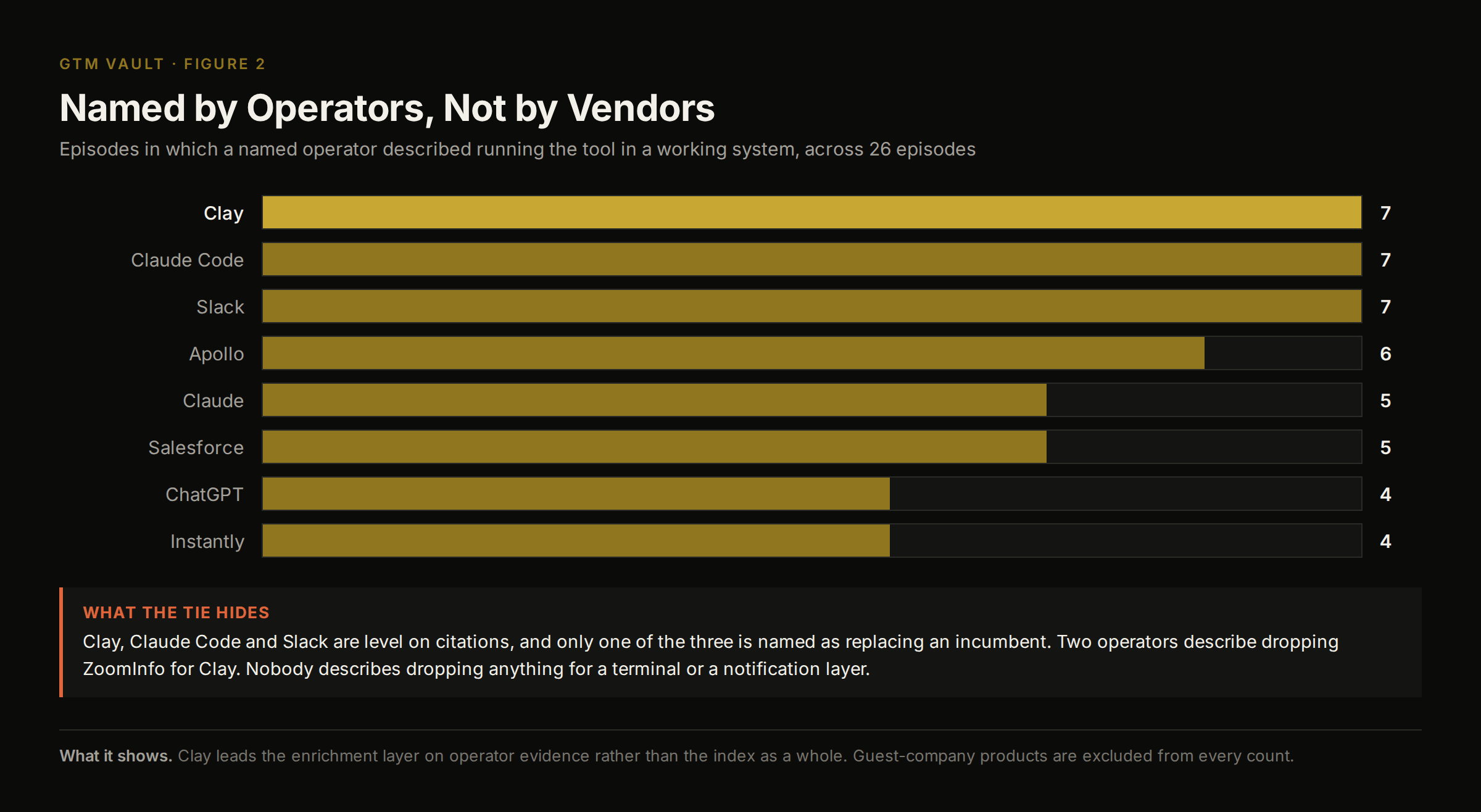
Across twenty-six GTM Vault episodes carrying operator evidence, Clay was named in seven, level with Claude Code and Slack and ahead of every other tool in its own layer. In one of those stacks it displaced ZoomInfo outright. In two others the operator no longer opens Clay at all, reaching it through MCP or a command line with Claude Code holding the orchestration. Clay won the enrichment layer. The interface it won with is already being replaced, and that is the more useful finding.
Seven Stacks, One Table
The count comes from write-ups, not from a survey. Vinayak Mishra at Slang AI built three Clay tables as the master data layer for a review-scraping pipeline. Garrett Wolfe at 1GTM ran an enrichment waterfall inside it, with Lead Magic as the first call and Apollo and Sales Navigator behind. Umar Farooq Adam ran account research through it at Hitachi Vantara, wired to HubSpot, Salesforce and Outreach through the Microsoft Power Platform. Charles Cormier at TopLeads put it in a cold email stack that cost under two hundred dollars a month in total. Michael Saruggia described it as the core of the GTM engineer’s stack. Tim Scheuer at Oxygen built campaigns in it. Elliot O’Connor at Frontier used it to replace ZoomInfo.
Seven operators, seven companies, at seven different stages, from a two-hundred-dollar stack to an enterprise deployment. The same table in the middle of all of them. The full operator record, with every citation, sits on the Clay page of the GTM Vault Stack Index.
What the Waterfall Cost Before
The reason this happened is unglamorous. Enrichment was never one purchase. It was four or five, and the work was not the enrichment. The work was reconciliation.
A team bought a contact database, a second source for the records the first one missed, a scraping tool for the fields neither carried, and a spreadsheet to join them. Every step produced an export. Every export produced a different schema, a different match rate and a different set of duplicates. The operator’s time went into deciding which of three conflicting job titles was correct, not into deciding which account to work.
Clay did not invent better data. It absorbed the join. The fallback logic that used to live in a person’s head and a spreadsheet became a column rule, and the vendors that had priced themselves as the whole step became individual calls inside it. Once the waterfall was a configuration rather than a workflow, the seat-based contract for one participant in that waterfall stopped making sense.
This is not a story about data quality. It is a story about where the reconciliation work sits.
Where Nothing Was Displaced
The displacement is not universal, and the exceptions are the interesting part.
Umar Farooq Adam at Hitachi Vantara runs Clay and still keeps ZoomInfo as the first source in his firmographic waterfall. Mark van Oppen at SecureAuth confirmed ZoomInfo in heavy use for account and contact data. Michele Shepard at Emburse runs Demandbase for account intelligence, alongside Gong, Nooks, Goldcast and HeyGen. In none of these stacks did a table displace the incumbent. At that size the contract is not paying for the waterfall, it is paying for procurement-approved coverage, security review, and a support relationship someone can escalate through. Those are real purchases and no amount of column logic replaces them.
So the honest version of the claim is narrower than the enthusiasm around it. Clay displaced the incumbent where the buyer was the operator. Where the buyer was procurement, the incumbent held. Both of those appear in the same twenty-six episodes, which is why the count on its own is a poor guide to what any given company should do.
The Front Door Moved
Two of the seven stacks no longer touch the Clay interface.
Elliot O’Connor reaches it through Clay MCP, with Salesforce arriving the same way, and the rep works in a Chrome extension rather than in either system. Tim Scheuer went further and built a command line layer so that Claude Code executes the scrape, the enrichment, the personalisation and the launch from a prompt, replacing the campaign setup he used to do by hand in Clay.
Claude Code appears in seven stacks across the index, and in two of the seven that run Clay. Outside the Clay stacks the same move shows up. Angelo Quiambao at Intellistack runs his entire agent layer from it, over Databricks, Salesforce, Gong and Apollo. Jai Toor at DeepLine runs a signal discovery skill end to end in it. In none of these cases did the underlying layer change. The work still happens. The person stopped being the one clicking.
That is the pattern worth naming. The interface was Clay’s distribution advantage, the thing that made a GTM engineer productive in an afternoon. It was never the moat. When the orchestration moves to an agent, an interface optimised for a human operator becomes a cost, and the product that survives the transition is the one whose API and MCP server are as good as its tables.
The Layer Is the Durable Unit
The Eight Layers argument holds that tool categories are not architecture, and this is the cleanest evidence for it I have collected. Over eighteen months the enrichment layer stayed exactly where it was in the system. What changed was which vendor occupied it, and then how the occupant was reached. The layer persisted through both changes without moving.
Which means the question to ask about any tool in your stack is not whether it is the best in its category. It is whether the layer it occupies would survive its removal. If the layer would collapse, the tool is load-bearing and the switching cost is real. If another vendor would slot into the same position in a fortnight, the contract length is the only thing making the decision feel permanent.
For most teams reading this, the enrichment layer is load-bearing and the vendor inside it is not. Price the contract accordingly, and build the layer so the front door can move again, because on the evidence of the last eighteen months it will.
Common questions
Is Clay replacing ZoomInfo?
In some operator-led stacks, yes. One of the seven Clay users documented on GTM Vault, Elliot O’Connor at Frontier, described replacing ZoomInfo with it, and the mechanism is that Clay absorbs the enrichment waterfall that ZoomInfo used to be one expensive step inside. In enterprise stacks where procurement, security review and support coverage are part of what is being bought, ZoomInfo remains in place. The displacement follows the buyer, not the feature list.
What does Clay do that a contact database does not?
It runs the fallback logic. A contact database returns what it has. Clay calls several sources in sequence, takes the first acceptable answer per field, and keeps the join rules as configuration rather than as a spreadsheet someone maintains. The value is in the reconciliation, not in the records.
Do I still need Clay if I am running agents?
The enrichment layer is still required, so something has to occupy it. What changes is how you reach it. Two operators documented here access Clay through MCP or a command line with Claude Code driving, and never open the interface. If you are heading that way, weigh a vendor’s API and MCP server more heavily than its user interface.
What is the cheapest working version of this stack?
Charles Cormier at TopLeads ran a functioning cold email system for under two hundred dollars a month, with Clay for enrichment, Instantly for sending, Namecheap and SendGrid for infrastructure and Persana for lead intelligence. The constraint at that budget is not tooling, it is the quality of the account list going in.
How was this counted?
One citation per episode where a named operator described running the tool in a working system. Mentions in passing, sponsor reads and guest biographies were excluded, and products belonging to the guest’s own company were excluded from the counts entirely. The base is twenty-six GTM Vault and Show Me Your Stack episodes carrying operator evidence.
Related reading
The 8 Layers of a Modern Revenue Architecture sets out why tool categories are not architecture layers, which is the frame this essay tests against real stacks.
SMYS 8: The Browser Is the Interface Everyone Abandoned is the episode where Clay displaces ZoomInfo and the rep stops opening either system.
SMYS 6: From Clay to Claude Code is the clearest documented case of the orchestration moving out of the interface and into an agent.
You Are Building the Wrong Moat makes the distribution argument that explains how Clay took the layer in the first place.