



GTM Vault is a breakdown of how high-growth companies design, test, and scale revenue architecture. 27,000+ operators read it. Join them.
Your CRM knows the deal, the stage, and the contact's title. It does not know which person on your team can walk you into the account, or that the champion who changed jobs last quarter is now a warm door somewhere else. Olivier Roth built a company on that gap. The co-founder and Chief Growth Officer of The Swarm joins GTM Vault for episode 51 to explain why the relationship layer sits alongside the CRM rather than inside it, why it travels to wherever the work happens, and who ends up owning the relationship when it does.
About The Swarm
The Swarm turns a company’s extended network into a data layer its sales team can query. Founded in San Francisco in 2021 by David Connors, Michal Bil, and Olivier Roth, it grew out of Connors’ previous company, Automately.io, which Sequoia acquired, and the tools he then built so Sequoia’s portfolio could tap the firm’s network. The graph now covers 580M+ people and 100M+ company profiles, pipes into HubSpot, Attio, Clay, and any agent via MCP, and in 2026 the company acquired Commsor, the competitor that coined the go-to-network category. The Swarm has raised $8M in total, including a $4M seed led by 500 Global and a round backed by HubSpot Ventures, Motivate Ventures, and TRAC VC.
Watch or listen now across YouTube, Apple Podcasts, and Spotify
Download the transcript

Episode highlights
(0:00) LinkedIn Is Your Audience, Not Your Network
(2:44) What A CRM Cannot Capture, And The Anti-CRM
(4:07) The Six Edges Of A Relationship Graph
(7:32) Where The Graph Lives: Inside, Beside, Or Under The CRM
(12:40) One Motion: LinkedIn Profile To Claude Prompt To Clay Workflow
(15:06) 500 Million Profiles, Freshness, And The Consent Architecture
(19:05) Potential, Likely, Confirmed: How The Graph Scores A Path
(23:39) The Commsor Acquisition And The Size Of The Category
(26:32) Swarm Send, 40 Percent Of Pipeline, And Three Intros Every Monday
(32:36) Rapid Fire

What you’ll learn:
Why the CRM is a system of the past, and why the deals that could exist never appear in it
LinkedIn is your audience, not your network: why a binary connection tells you nothing and most people know five to ten percent of theirs
The six edges in a relationship graph: work overlaps, education overlaps, investor overlaps, LinkedIn connections, LinkedIn engagement, and email and calendar contact
Potential, likely, confirmed: the scoring that says how sure the graph is that two people know each other
Why the relationship layer is a building block that travels, and why the CRM stays the central nervous system anyway
How a rep uses the graph from a LinkedIn profile, from a Claude prompt, and from a stalled-deals query inside HubSpot
Freshness is what breaks at scale, and why The Swarm built its own 500-million-profile data layer instead of buying one
The consent architecture: what is passive, what is user-permissioned, and why every company’s swarm is siloed
Why orchestration, not data, is the next thing to build, and what three intros every Monday morning looks like in practice
The test that would prove the bet: thirty percent of pipeline from warm intros, visible in the CRM’s own reports
Key takeaways
The CRM records the past. The deals that could exist live somewhere it cannot see.
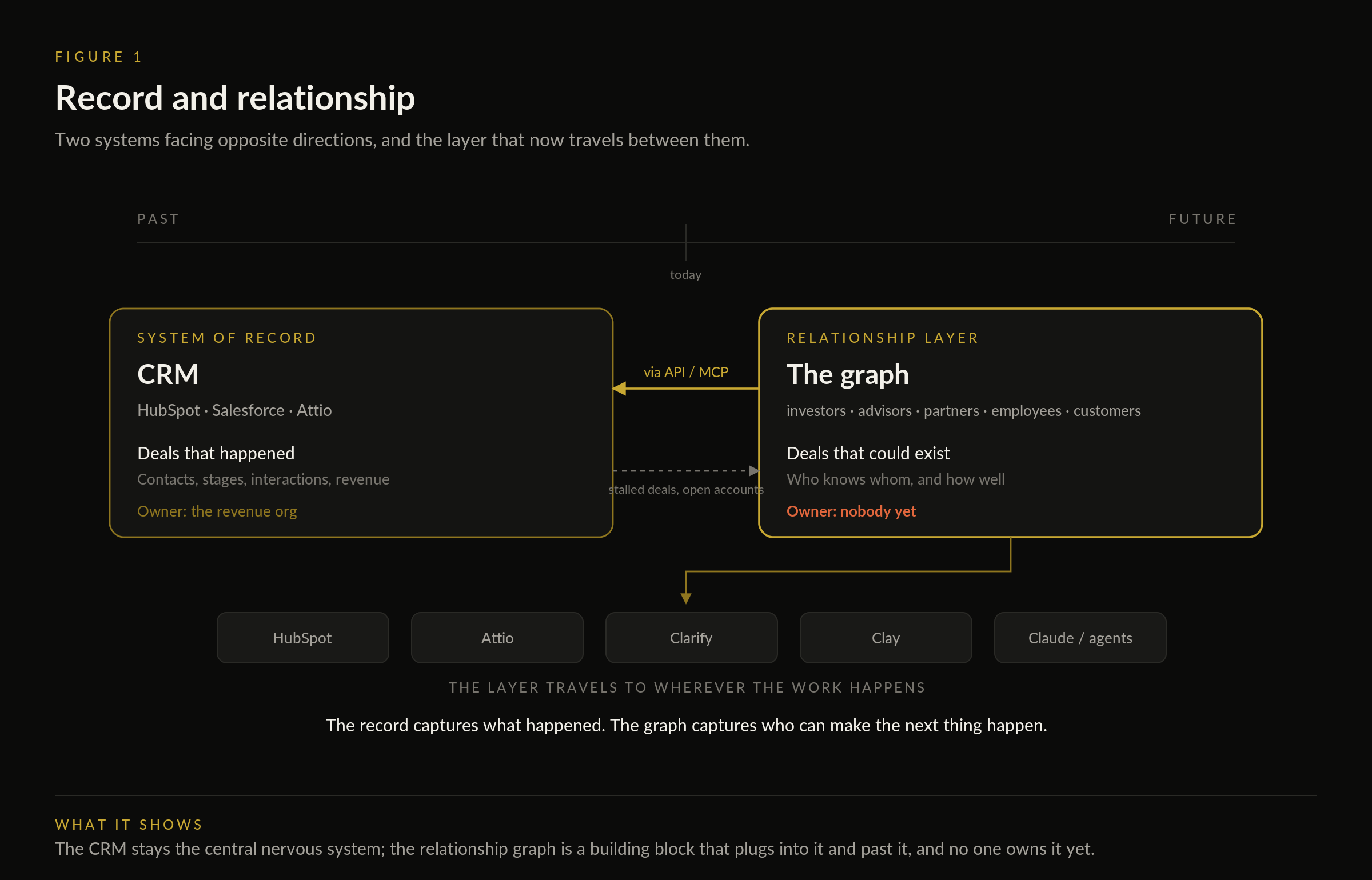
A CRM records interactions that already happened, tied to deals that already exist, and that is its job. It holds nothing on the other side: every potential deal reachable through someone attached to the company. The Swarm pools the networks of a company's investors, advisors, partners, employees and best customers, which Olivier calls an anti-CRM, peering forward at what the relationships make possible rather than backward at what closed.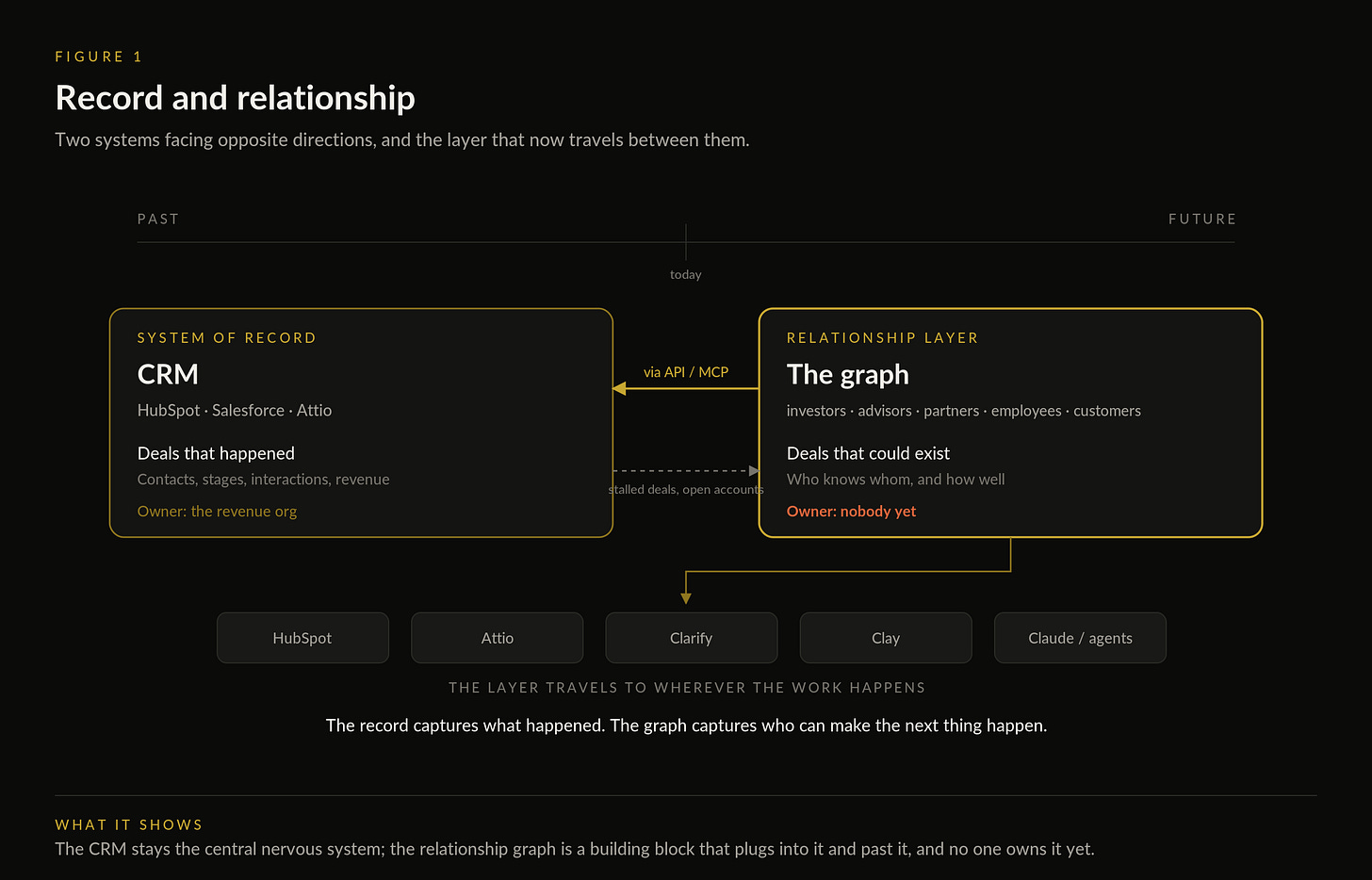
Figure 1. Two systems, two directions. The record faces backward and belongs to the CRM; the graph faces forward and belongs to nobody yet, which is the whole question of the episode. LinkedIn is your audience, not your network, and a connection alone scores as "potential."
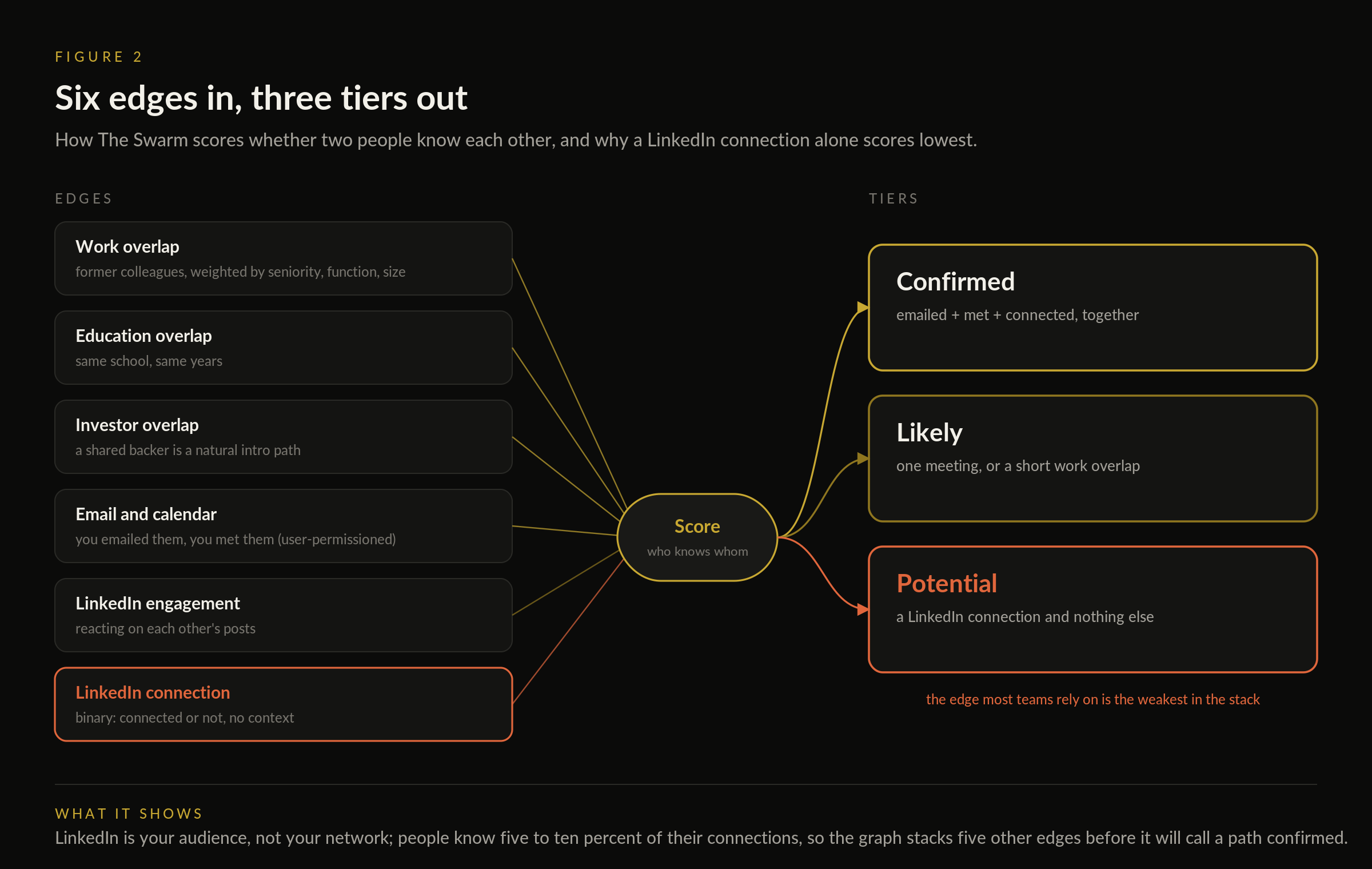
A LinkedIn connection is binary, no context, and Olivier puts the share of connections people know at five to ten percent. So The Swarm stacks six edges instead: work overlaps, education overlaps, investor overlaps, LinkedIn connections, LinkedIn engagement, and email and calendar contact. Each relationship scores potential, likely, or confirmed: emailed, met and connected is confirmed; a single meeting or a short work overlap is likely; a LinkedIn connection and nothing else is potential.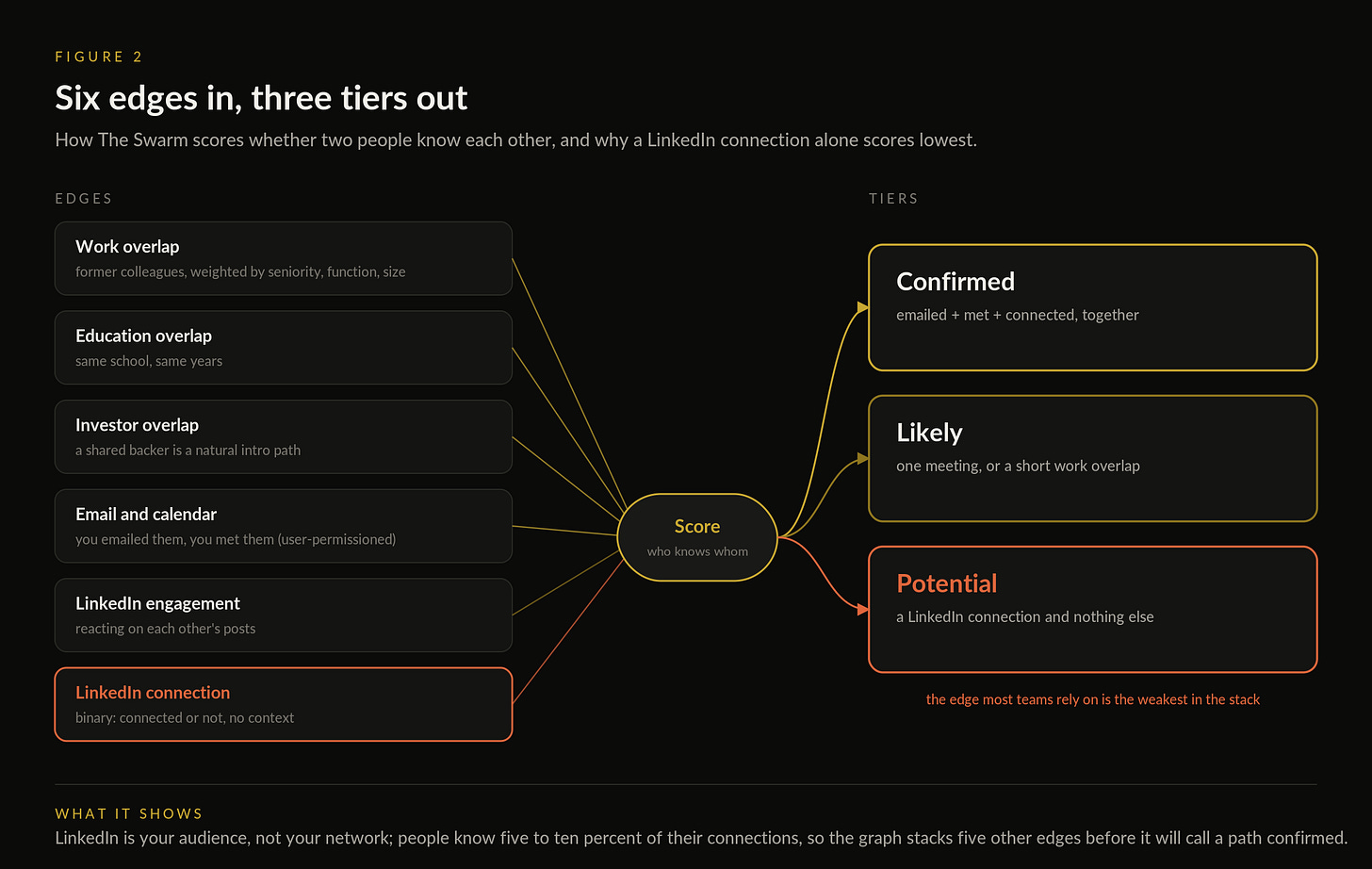
Figure 2. Six edges in, three tiers out. The single edge most teams rely on is the weakest one in the stack. The layer is a building block, and the CRM stays the central nervous system.
Go-to-market engineers build agents on The Swarm's API; sellers use it inside HubSpot, Attio and Clarify, with Salesforce in progress, and in Clay workflows. With the HubSpot MCP a rep can take every deal stalled for ninety days and ask for a champion or investor in the swarm who can unstick it. Olivier still calls the CRM the central nervous system, because that is where revenue is recorded and reported, and the bet is that when every CRM ships a warm intro tab, the tab is built on The Swarm.Freshness is what breaks at scale, so they built the data layer themselves, with the consent lines drawn in advance.
No existing provider was fresh enough, so The Swarm built its own: roughly 500 million profiles, 100 million companies, job-change tracking, and a live enrichment endpoint that refreshes a profile on demand. Work, education and investor overlaps are computed passively from public history; LinkedIn connections, email and calendar are user-permissioned and visible only to the admins of that company's swarm. Every company's data sits in its own silo.The data took five years. Orchestration is what comes next, and the proof is forty percent of their own pipeline.
Olivier vibe-coded Swarm Send, which ranks the best-scored intro paths to target accounts and drafts the requests; roughly forty percent of The Swarm's pipeline now comes through intros. The pattern he wants to productize is one a customer's go-to-market engineer already built: three intros dripped to each seller every Monday morning. The test that proves the bet is a report, not a case study: thirty percent of pipeline from warm intros, visible as fields inside the CRM, next to paid ads on the same chart.
The Pro Library
Every episode of this show, and every Show Me Your Stack, now lives as a written playbook in one searchable place. Fifty podcast episodes, eight stack breakdowns, and the tools behind each one indexed across all of them, so you can pull every episode where Clay or Claude Code shows up before you wire it yourself. It is part of Pro. If you are a member, sign in at pro.gtmvault.co with your subscriber email. If you are not, this is the reason to upgrade.
Olivier Roth
The Swarm: https://www.theswarm.com
Rick Koleta (Host)
LinkedIn: https://www.linkedin.com/in/rickkoleta/
Newsletter: https://gtmvault.co/
GTM Vault
YouTube: https://www.youtube.com/@gtmvault
Website: https://gtmvault.co/
Previous episodes include


See all previous episodes here
The GTM Vault Podcast is a breakdown of how high-growth companies design, test, and scale revenue architecture. Visit gtmvault.co for more episodes, the GTM Vault newsletter, and Show Me Your Stack.


